







Question: Haskell Parallel form on comparator networks. ADDITIONAL INFO: the sort1.txt is just a text file that contains this: [(1,2),(3,4),(1,3),(2,4),(2,3)] Don't worry about the public test,
Haskell Parallel form on comparator networks.
ADDITIONAL INFO: the sort1.txt is just a text file that contains this:
[(1,2),(3,4),(1,3),(2,4),(2,3)]
Don't worry about the public test, it's not related.
Here's what a comparator network looks like:
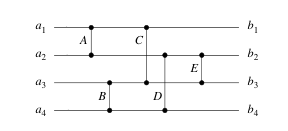
Notice: A(1,2), B(3,4), C(1,3), D(2,4), E(2,3)
![a text file that contains this: [(1,2),(3,4),(1,3),(2,4),(2,3)] Don't worry about the public](https://dsd5zvtm8ll6.cloudfront.net/si.experts.images/questions/2024/09/66f50a4fb24de_99166f50a4f534d5.jpg)
Thanks for the help so far guys, I appreciate it.
Could someone implement the toParallelForm (the one that's undefined) function?
import Data.List (groupBy, sort) import Data.Function (on) import System.Environment (getArgs)
type Wire = Int type Comparator = (Wire, Wire)
-- Parse the input file to get the list of comparators parseInput :: FilePath -> IO [Comparator] parseInput filename = do contents
parseComparator :: String -> Comparator parseComparator line = let [x, y] = map read $ words line in (x, y)
-- Write the parallel form to a file writeOutput :: FilePath -> [[Comparator]] -> IO () writeOutput filename comps = writeFile filename output where output = unlines $ map showComp comps showComp = unwords . map showPair showPair (x, y) = show x ++ "-" ++ show y
-- TODO: Implement the function to convert a list of comparators to parallel form toParallelForm :: [Comparator] -> [[Comparator]] toParallelForm = undefined
-- TODO: Implement the function to calculate the parallel form and write it to file calc :: FilePath -> IO () calc filename = do comps
main :: IO () main = do args calc filename _ -> putStrLn "Usage: Parallel filename"
For this part, you have to implement running a comparator network on an input sequence. The command-line for this is Run filename sequence where filename is the name for a file containing a comparator network (like sort1.txt), and sequence is a list like [5,1,3,0]. You may assume that the list is in the correct format, that all numbers in the list are distinct, and that its length is equal to the biggest wire number in the comparator network that will be used. You should print out the result of applying the network to the sequence. Just print it to the standard-output channel of the program using a function like putStrLn, and print it out in the Haskell format for lists of integers (you can just call show on a list you compute in your code). There is a public test to check that the running sort1.txt on [5,1,3,0] produces [0,1,3,5]
Step by Step Solution
There are 3 Steps involved in it

Get step-by-step solutions from verified subject matter experts
 Study Help