







Question: i need the solve step by step Equipment Encyelopedia 8.69. A double-effect evaporator (two evaporators in series) is used to produce fresh water from seawater
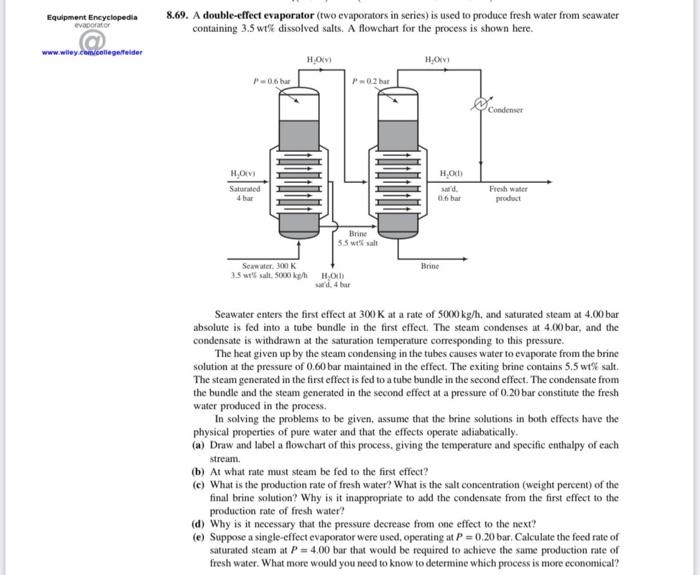
Equipment Encyelopedia 8.69. A double-effect evaporator (two evaporators in series) is used to produce fresh water from seawater containing 3.5 wt? dissolved salts. A flowchart for the process is shown here. www.wiley cemicoliegelfelder Seawater enters the firs effect at 300K at a rate of 5000kg/h, and saturated steam at 4.00 bar absolute is fed into a tube bundle in the first effect. The steam condenses at 4.00 bar, and the condensate is withdrawn at the saturation temperuture corresponding to this pressure. The heat given up by the steam condensing in the tubes causes water to evaporate from the brine solution at the pressure of 0.60 bar maintained in the effect. The exiting brine contains 5.5 wt salt. The steam generated in the first effect is fed to a tube bundle in the second effect. The condensate from the bundle and the steam generated in the second effect at a pressure of 0.20 bar constitute the fresh water produced in the process. In solving the problems to be given, assume that the brine solutions in both effects have the physical properties of pure water and that the effects operate adiabatically. (a) Draw and label a flowchart of this process, giving the temperature and specific enthalpy of each stream. (b) At what rate must steam be fed to the first effect? (c) What is the production rate of fresh water? What is the salt concentration (weight percent) of the final brine solution? Why is it inappropriate to add the condensate from the first effect to the production rate of fresh water? (d) Why is it necessary that the pressure decrease from one effect to the next? (e) Suppose a single-effect evaporator were used, operating at P=0.20 bar. Calculate the feed rate of saturated steam at P=4.00 bar that would be required to achieve the sume production rate of fresh water. What more would you need to know to determine which process is more economical? Equipment Encyelopedia 8.69. A double-effect evaporator (two evaporators in series) is used to produce fresh water from seawater containing 3.5 wt? dissolved salts. A flowchart for the process is shown here. www.wiley cemicoliegelfelder Seawater enters the firs effect at 300K at a rate of 5000kg/h, and saturated steam at 4.00 bar absolute is fed into a tube bundle in the first effect. The steam condenses at 4.00 bar, and the condensate is withdrawn at the saturation temperuture corresponding to this pressure. The heat given up by the steam condensing in the tubes causes water to evaporate from the brine solution at the pressure of 0.60 bar maintained in the effect. The exiting brine contains 5.5 wt salt. The steam generated in the first effect is fed to a tube bundle in the second effect. The condensate from the bundle and the steam generated in the second effect at a pressure of 0.20 bar constitute the fresh water produced in the process. In solving the problems to be given, assume that the brine solutions in both effects have the physical properties of pure water and that the effects operate adiabatically. (a) Draw and label a flowchart of this process, giving the temperature and specific enthalpy of each stream. (b) At what rate must steam be fed to the first effect? (c) What is the production rate of fresh water? What is the salt concentration (weight percent) of the final brine solution? Why is it inappropriate to add the condensate from the first effect to the production rate of fresh water? (d) Why is it necessary that the pressure decrease from one effect to the next? (e) Suppose a single-effect evaporator were used, operating at P=0.20 bar. Calculate the feed rate of saturated steam at P=4.00 bar that would be required to achieve the sume production rate of fresh water. What more would you need to know to determine which process is more economical
Step by Step Solution
There are 3 Steps involved in it

Get step-by-step solutions from verified subject matter experts
 Study Help