



Question: Using Stellarium Web, change your location to the town of Auvers-sur-Oise by pasting 49.070720, 2.169886 into the location search box. Next, change your observing
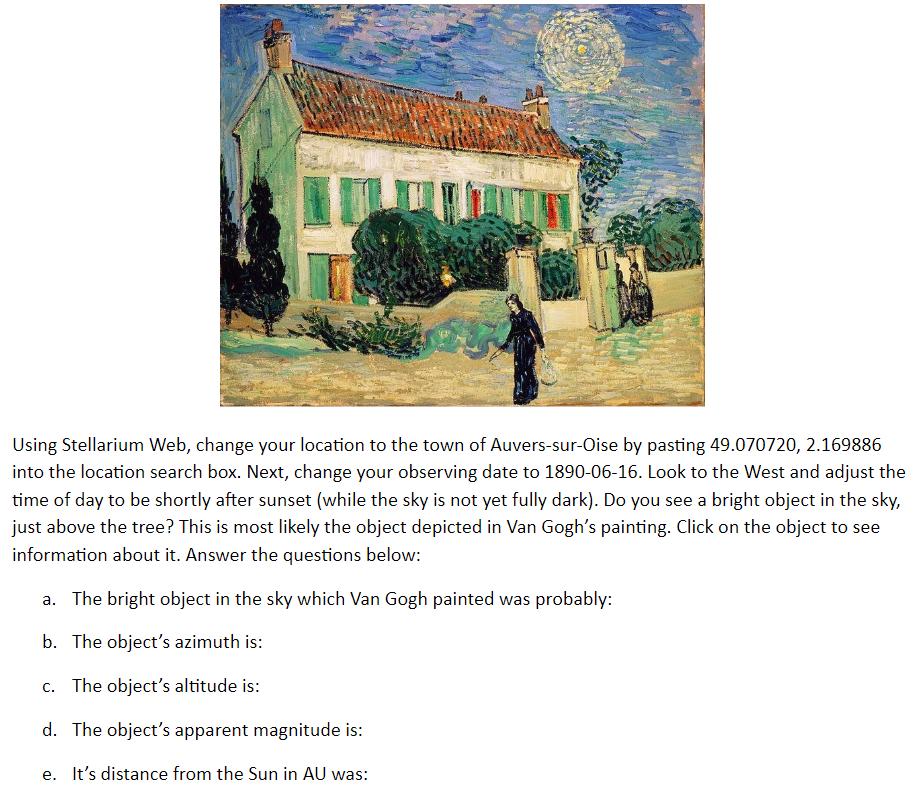

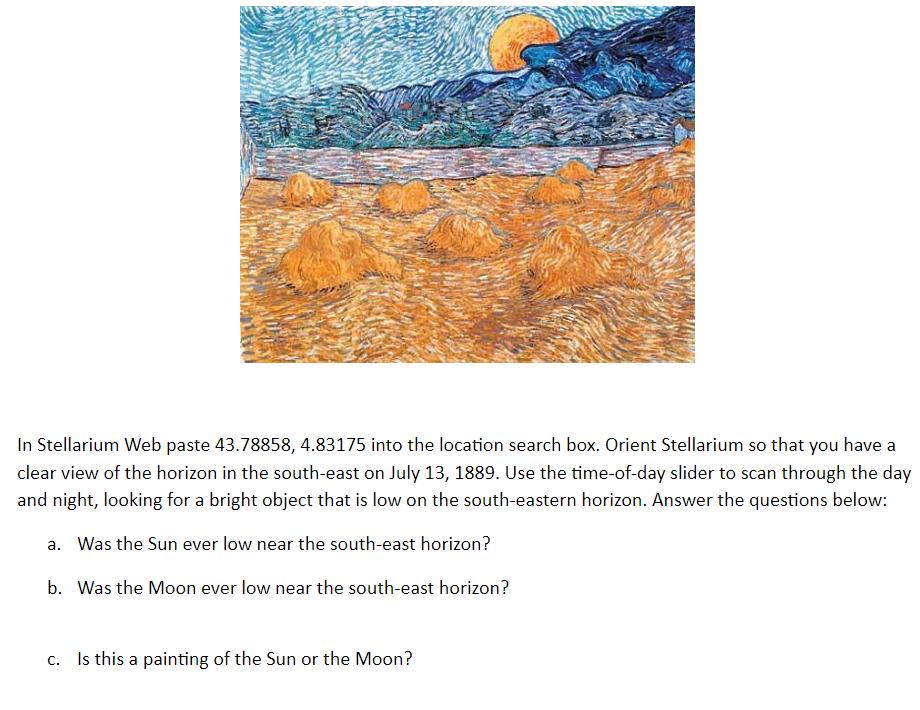

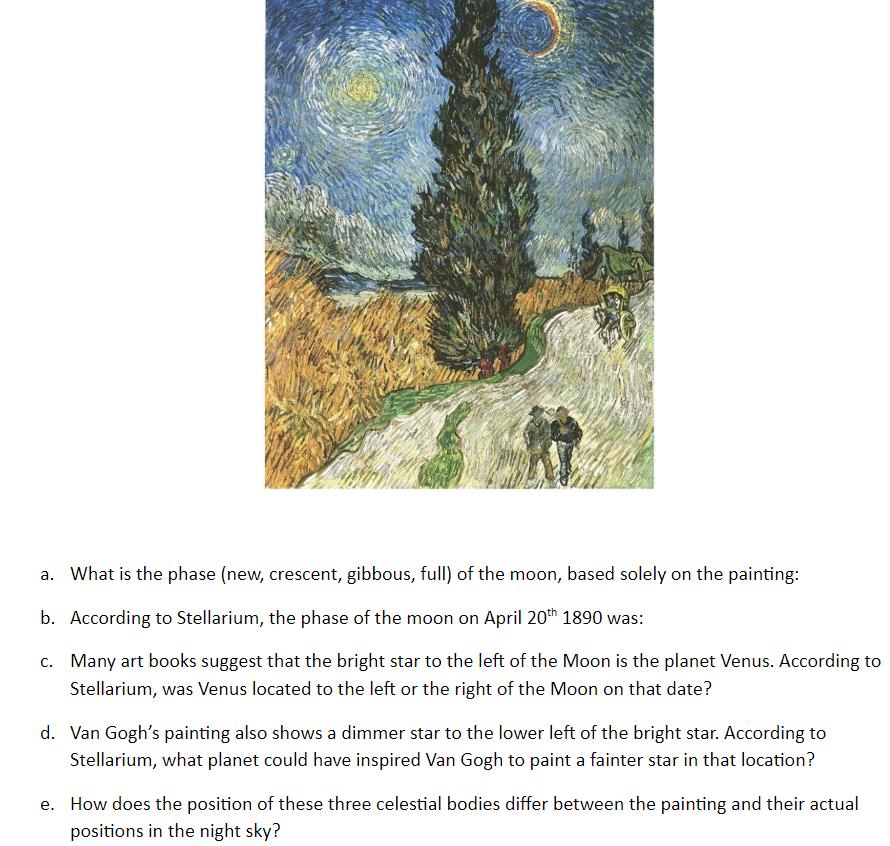
Using Stellarium Web, change your location to the town of Auvers-sur-Oise by pasting 49.070720, 2.169886 into the location search box. Next, change your observing date to 1890-06-16. Look to the West and adjust the time of day to be shortly after sunset (while the sky is not yet fully dark). Do you see a bright object in the sky, just above the tree? This is most likely the object depicted in Van Gogh's painting. Click on the object to see information about it. Answer the questions below: a. The bright object in the sky which Van Gogh painted was probably: b. The object's azimuth is: c. The object's altitude is: d. The object's apparent magnitude is: e. It's distance from the Sun in AU was: Haycocks The painting below was likely created by Van Gogh from his room in a monastery hospital on 13 July 1889 in the town of Saint-Remy-de-Provence in southern France (latitude 43.78858 N, longitude 4.83175 E). The overhanging cliff in the painting can still be seen from the monastery today and is at an azimuth of 128* (south-east) and an altitude of 6 (just above the horizon). Notice the bright yellow object in the sky centered on the cliff? What was it? The Sun or the Moon? In Stellarium Web paste 43.78858, 4.83175 into the location search box. Orient Stellarium so that you have a clear view of the horizon in the south-east on July 13, 1889. Use the time-of-day slider to scan through the day and night, looking for a bright object that is low on the south-eastern horizon. Answer the questions below: a. Was the Sun ever low near the south-east horizon? b. Was the Moon ever low near the south-east horizon? Is this a painting of the Sun or the Moon? C. Road with Cypress and Star Van Gogh most likely painted the artwork below sometime between May 12h and May 15th 1890, again in the town of Saint-Remy-de-Provence in southern France (latitude 43.78858 N, longitude 4.83175 E). It is believed to be inspired by the conjunction (close approach) of the Moon and two planets in the evening sky on April 20th of the same year. Based on this information, answer the following questions: a. What is the phase (new, crescent, gibbous, full) of the moon, based solely on the painting: b. According to Stellarium, the phase of the moon on April 20th 1890 was: c. Many art books suggest that the bright star to the left of the Moon is the planet Venus. According to Stellarium, was Venus located to the left or the right of the Moon on that date? d. Van Gogh's painting also shows a dimmer star to the lower left of the bright star. According to Stellarium, what planet could have inspired Van Gogh to paint a fainter star in that location? e. How does the position of these three celestial bodies differ between the painting and their actual positions in the night sky?
Step by Step Solution
3.41 Rating (148 Votes )
There are 3 Steps involved in it
ns The bright bjet in the sky whih Vn Ggh inted ws rbbly the Brighest Str Venus ns b The bjets zimut... View full answer

Get step-by-step solutions from verified subject matter experts