







Question: instructions and references are already here. o Operations research Many optimization problems in operations research (OR) involve combinatorics. The job scheduling problem is essentially a
instructions and references are already here.

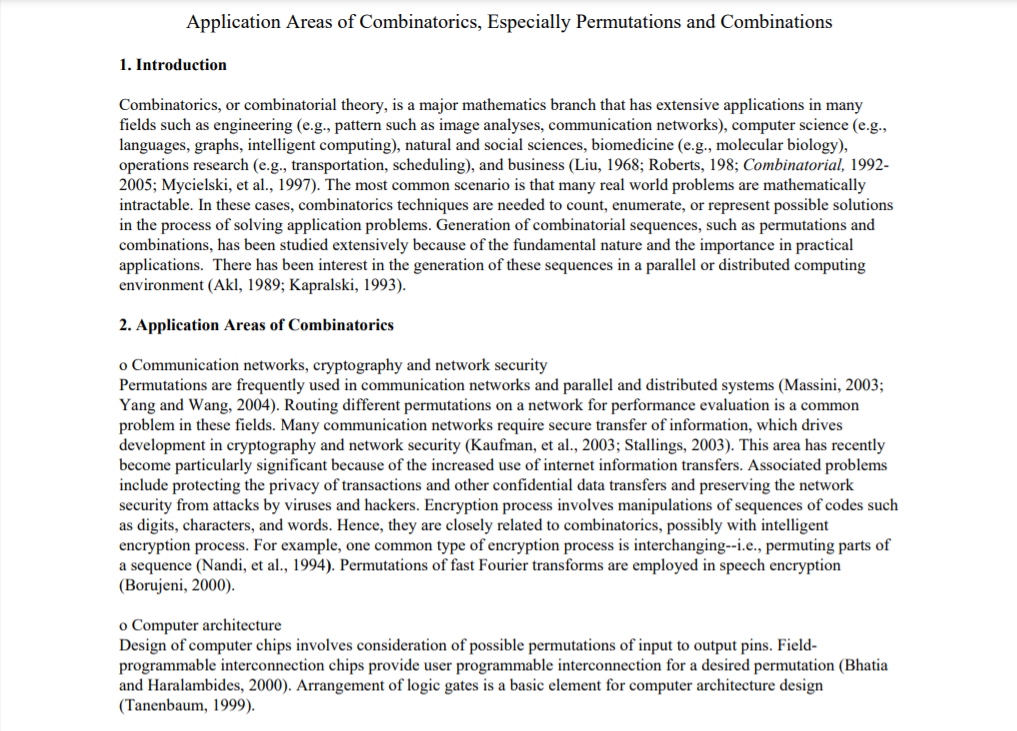
o Operations research Many optimization problems in operations research (OR) involve combinatorics. The job scheduling problem is essentially a sequencing problem to determine the order of jobs to be processed in an effort to minimize the total time, cost, etc. Here, jobs can be in a computer system, network, or processing plant. Many problems involving graphs or networks also deal with the order of vertices and edges. The traveling salesperson problem is to determine the order of cities to be visited to minimize the total distance (Matsumoto and Yashiki, 1999). The shortest path problem of a graph is to determine a sequence of edges, the total length of which is minimum. oftentimes, these problems are computationally diiculteg, NPcomplete or NP-hardand, therefore, require extensive research. o Simulation Permutations and combinations can be employed for simulations in many areas. Permutations representing various genotype-phenotype associations are employed in genetics simulations {Doerge and Churchill1 1996}. Other areas that employ permutations and combinations for simulations include networks, cryptography, databases and OR. o Homeland security This is a very specialized problem domain that has become a major national challenge aer 9!] 1. To con'ont this challenge, many intelligent computing techniques have been applied, including intelligent pattern analyses of human faces. X-my images, chemical components. data from a distributed network of wireless sensors. etc. Natural language processing and data mining techniques have been applied to sift through and monitor the tremendous 2 0 Pattern analysis In a broad sense, all the above-mentioned areas can be viewed as special cases of pattern analysis. Molecular biology, for example, studies patterns of atoms, molecules, and DNAs whereas languages treat patterns of sentences, words, and strings. Patterns can have many other forms; for example, visual images, acoustic signals, and other physical quantities such as electrical, pressure, temperature, etc., that appear in engineering problems. Patterns can also be abstract without any associated physical meaning. These patterns may be represented in various ways such as digital, analog, and other units. Some of these types of patterns can be associated with combinatorics. There has been extensive research on combinatorial pattern matching (Combinatorial. 1992-2005). Computer music can be a specialized application domain of combinatorics of acoustic signals. 0 Scientic discovery For certain types of knowledge discovery problems, generation of combinatorial sequences may become necessary in the process of yielding candidate solutions. For example, in scientic discovery, we may want to have a sequence of plausible chemicalfbiological reactions and their formations Wattles-Perez, 1999). In each step of the sequence, we may generate combinatorial sequences of chemicaniological radicals, bases, and molecular compounds as candidate solutions and may select the most likely ones under certain rules and constraints. In another era-rie, certain areas of mathematics, such as graph theory and number theory. may generate combinatorial sequences as candidate solutions. o Databases and data mining Queries in databases are multiple join operations that are permutations of the constituent join operations. Determining an optimal permutation that gives minimum cost is a common and important problem (Kumar Verna. and Trimbak Tanntankar. 199?). Data mining or knowledge discovery in databases is a relatively new eld that aims at distilling useful information, often from large databases. In this area, techniques employing symbolic Al can manipulate combinatorial sequences of atoms or information elements. Non-symbolic knowledge discovery techniques, such as genetic algorithms and genetic programming, most commonly deal with solutions in the form of sequences ofbits, digits, characters, and sometimes Lisp program elements. Neural networks, another domain of non-symbolic AI, sometimes deal with combinatorial patterns. Knowledge discovery techniques under uncertainty, such as Bayesian networks, Dempster-Shafer theory. fuzzy logic, and rough set theory. may have combinatorial solutions (Munaltata, 1998). Performance Task: Listed below are application areas of Fundamental Principles of Counting, Permutation, and Combination. Choose one of these topics and explain how is this area uses the aforementioned Math concepts. Make an infographic of your explanation. Provide specific examples, supporting images to justify your answer. 1. Communication networks 2. Cryptography 3. Network security 4. Languages 5. Homeland security (You may use other applications if you can think of another.) Expected content of the infographic. How is the math topic being used in the chosen field? Images to support your answer. Interesting factsaccumulation of electronic communication data. Since combinatorics are extensively applied to these intelligent computing techniques, there is a wide spectrum of potentials for the national security issue. Some specic examples may include string searching algorithms and their performance analysis in conununication data. pre' and posh analysis of combinatorial sequences of information elements, and combinatorial pattern matching. o Computational molecular biology This field involves many types of combinatorial and sequencing problems such as atoms, molecules, DNAs, genes, and proteins (Combinatorial, 1992-2005; Doerge and Churchill, 1996; Chiang and Eisen, 2001; Siepel, 2003). One- dimensional sequencing problems are essentially permutation problems under certain constraints. o Languages Both natural and computer languages are closely related to combinatorics (Combinatorial, 1992-2005; Kotz, 1995). This is because the components of these languages, such as sentences, paragraphs, programs, and blocks, are arrangements of smaller elements, such as words, characters, and atoms. For example, a string searching algorithm may rely on combinatorics of words and characters. Direct applications of this can include word processing and databases. Another important application area is performance analysis of these string searching algorithms. The study of computability--what we can compute and how it is accomplished--draws heavily on combinatorics.Application Areas of Combinatorics, Especially Permutations and Combinations 1. Introduction Combinatoric s, or combinatorial theory, is a major mathematics branch that has extensive applications in marry elds such as engineering (e.g., pattern such as image analyses, communication networks), computer science (e.g., languages, graphs, intelligent computing), natural and social sci-ces, biomedicine (e. g., molecular biology), operations research {e.g., transportation, scheduling), and business (Liu. 1968; Roberts, 198; Combinatorial, 1992- 2005; Mycielski, et al., 199?). The most common scenario is that many real world problems are mathematically intractable. In these cases, combinatorics techniques are needed to count1 enumerate, or represent possible solutions in the process of solving application problems. Generation of combinatorial sequences, such as permutations and combinations, has been studied extensively because of the fundamental nature and the importance in practical applications. There has been interest in the generation of these sequences in a parallel or distributed computing environment (Aid, 1989; Kapralski, 1993). 2. Application Areas of Combinatorics 0 Communication networks. cryptography and network security Permutations are frequently used in communication networks and parallel and distributed systems (Massini, 2003; Yang and Wang, 2004). Routing different permutations on a network for performance evaluation is a common problem in these elds. Many conununication networks require secure transfer of information, which drives development in cryptography and network security (Kaufman, et 9.1., 2003; Shillings, 2003). This area has recently become particularly signicant because of the increased use of internet information transfers. Associated problems include protecting the privacy of transactions and other condential data transfers and preserving the network security from attacks by viruses and hackers. Encryption process involves manipulations of sequences of codes such as digits, characters, and words. Hence1 they are closely related to combinatorics, possibly with intelligent encryption process. For example. one common type of encryption process is interchangingLe. permuting parts of a sequence (Nandi, et al., i994). Permutations of fast Fourier transforms are employed in speech encryption (Borujeni. 2000). 0 Computer architecture Design of computer chips involves consideration of possible pennutations of input to output pins. Field- programmable interconnection chips provide user programmable interconnection for a desired permutation (Bhatia and Haralambides, 2000). Arrangement of logic gates is a basic element for computer architecture design (Tanenbaum, [999)
Step by Step Solution
There are 3 Steps involved in it

Get step-by-step solutions from verified subject matter experts
 Study Help