







Question: Just this image below, thanks, what is (A), (B), and (C)? The Matlab source code Homework 5, due October 5 This project studies the numerical
Just this image below, thanks, what is (A), (B), and (C)? The Matlab source code
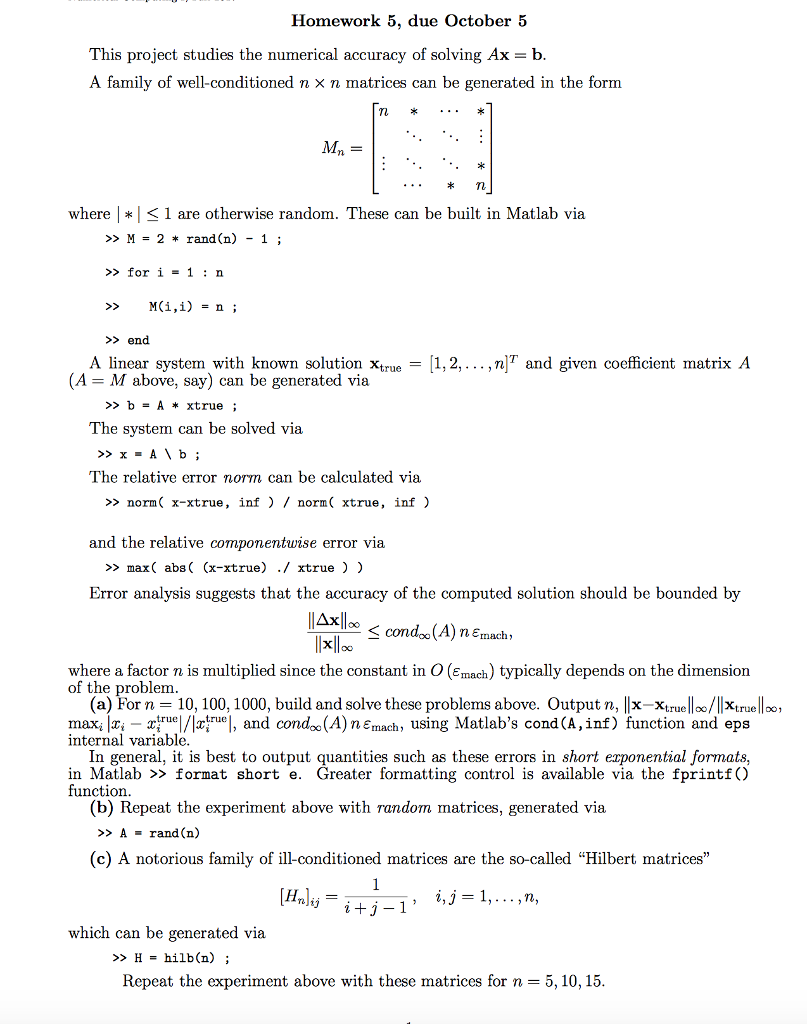
Homework 5, due October 5 This project studies the numerical accuracy of solving Ax -b A family of well-conditioned n n matrices can be generated in the form where |> M = 2 * rand(n) -1 ; for i = 1 : n >> end A linear system with known solution Xtrue -[1,2,... ,nlT and given coefficient matrix A (A- M above, say) can be generated via The system can be solved via The relative error norm can be calculated via. >> norm( x-xtrue, inf ) / norm( xtrue, inf ) and the relative componentwise error via >>max abs (x-xtrue) ./ xtrue)) Error analysis suggests that the accuracy of the computed solution should be bounded by where a factor n is multiplied since the constant in O (Emach) typically depends on the dimension of the problem (a) Forn= 10, 100, 1000, build and solve these problems above. Output n' llx-Xtruelloo/lXtruelloo, maxi|Xi-Xtruol/1Xtruel, and condo (A) n mach , using Matlab's cond (A, inf) function and eps internal variabl
Step by Step Solution
There are 3 Steps involved in it

Get step-by-step solutions from verified subject matter experts
 Study Help