



Question: Question 1: In a region of space, a particle with mass 'm' is moving in a non-zero potential field (V) #0). Axe 12 The
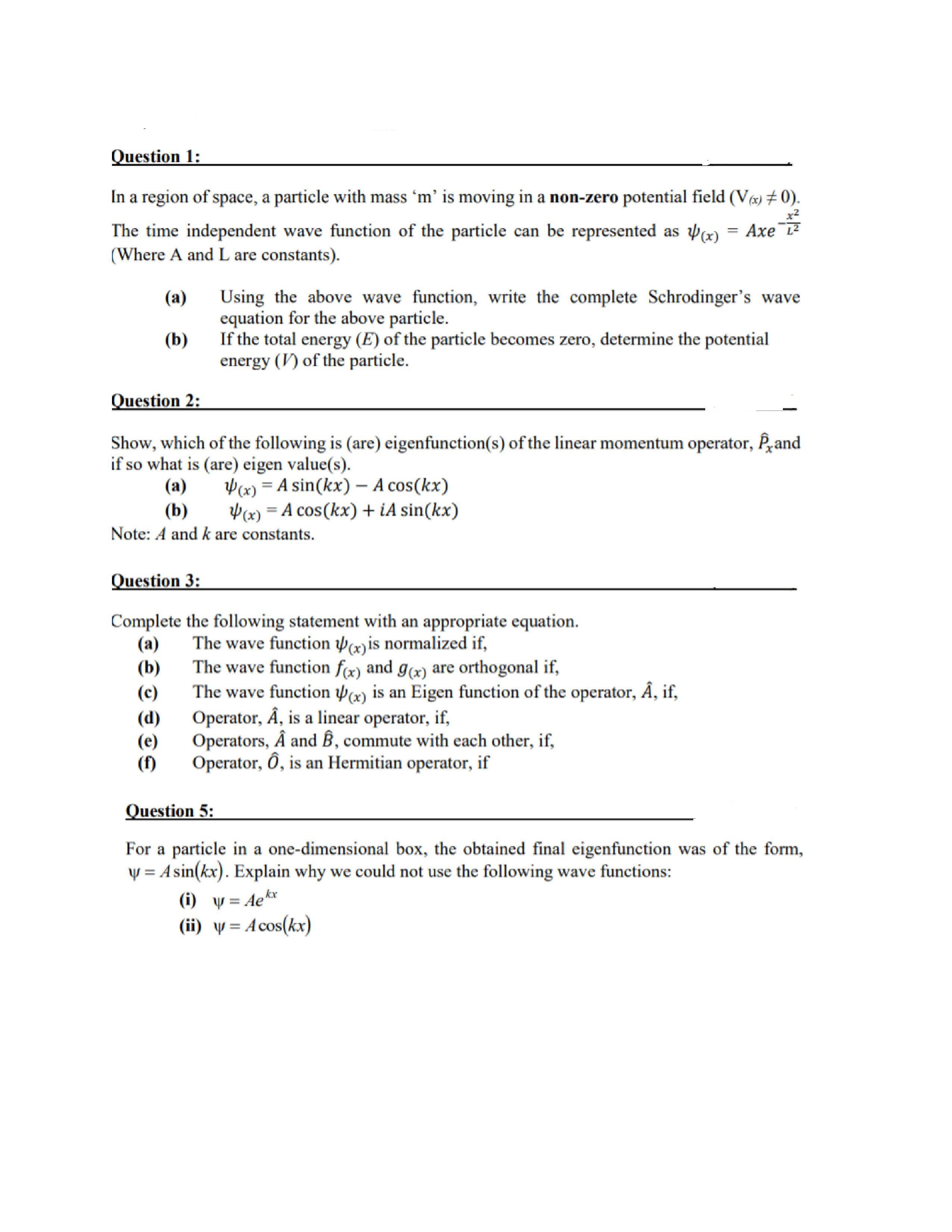
Question 1: In a region of space, a particle with mass 'm' is moving in a non-zero potential field (V) #0). Axe 12 The time independent wave function of the particle can be represented as Px) (Where A and L are constants). Using the above wave function, write the complete Schrodinger's wave equation for the above particle. If the total energy (E) of the particle becomes zero, determine the potential energy (V) of the particle. () (b) Question 2: Show, which of the following is (are) eigenfunction(s) of the linear momentum operator, Pand if so what is (are) eigen value(s). P(x) = A sin(kx) A cos(kx) P(x) = A cos(kx) + iA sin(kx) (a) (b) Note: A andk are constants. Question 3: Complete the following statement with an appropriate equation. (a) (b) The wave function is normalized if, The wave function fx) and g(x) are orthogonal if, The wave function P) Operator, , is a linear operator, if, Operators, A and B, commute with each other, if, Operator, 0, is an Hermitian operator, if (c) is an Eigen function of the operator, , if, (d) (e) (f) Question 5: For a particle in a one-dimensional box, the obtained final eigenfunction was of the form, y = A sin(kx). Explain why we could not use the following wave functions: (i) y = Ae' (ii) y = Acos(kx)
Step by Step Solution
3.41 Rating (148 Votes )
There are 3 Steps involved in it

Get step-by-step solutions from verified subject matter experts