







Question: Please EXPLAIN and solve EACH / ALL part(s) in Question #3 ! DOUBLE CHECK YOUR WORK AND ANSWER(S) . PLEASE NEATLY SHOW ALL WORK, EXPLANATIONS
Please EXPLAIN and solve EACH/ALL part(s) in Question #3!
DOUBLE CHECK YOUR WORK AND ANSWER(S).
PLEASE NEATLY SHOW ALL WORK, EXPLANATIONS, & CALCULATIONS STEP-BY-STEP USING PEN AND PAPER! I AM NEWTO CHEMISTRY! I AM A COMPLETE NEWBIE!
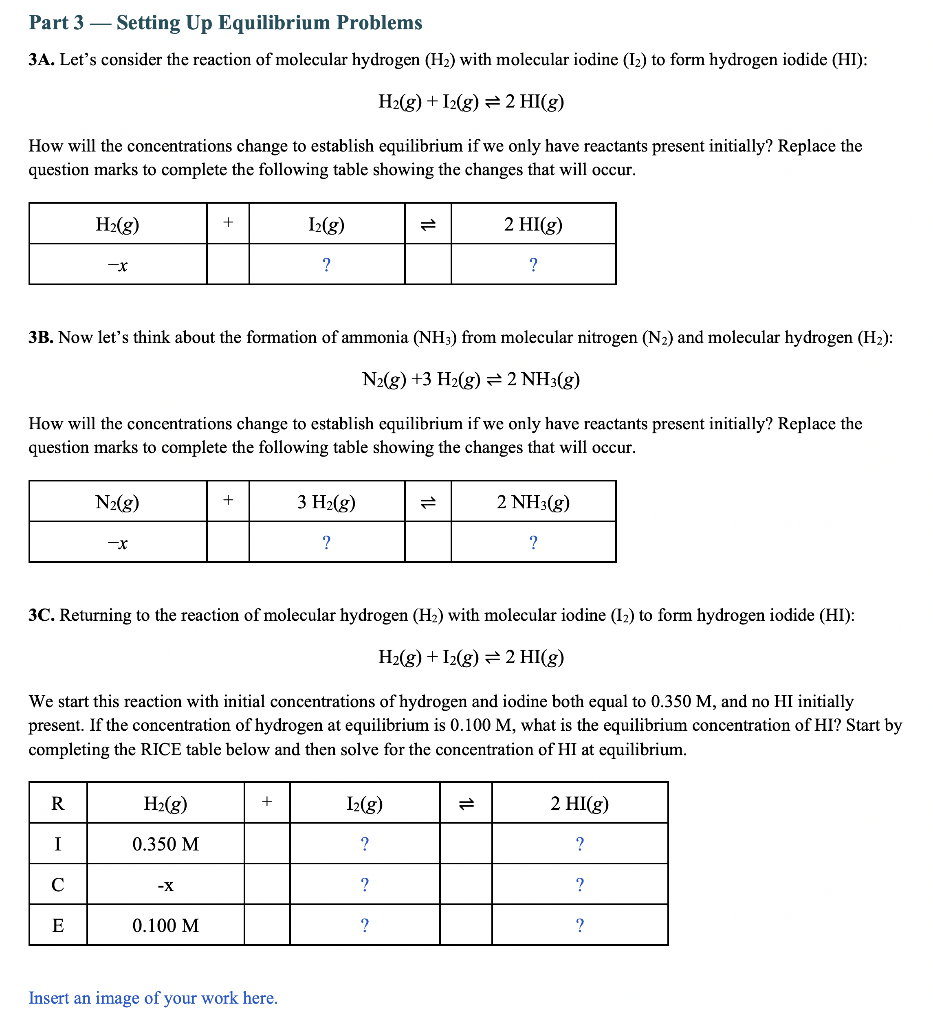

Part 3 - Setting Up Equilibrium Problems 3A. Let's consider the reaction of molecular hydrogen (H2) with molecular iodine (I2) to form hydrogen iodide (HI): H2(g)+I2(g)2HI(g) How will the concentrations change to establish equilibrium if we only have reactants present initially? Replace the question marks to complete the following table showing the changes that will occur. 3B. Now let's think about the formation of ammonia (NH3) from molecular nitrogen (N2) and molecular hydrogen (H2) : N2(g)+3H2(g)2NH3(g) How will the concentrations change to establish equilibrium if we only have reactants present initially? Replace the question marks to complete the following table showing the changes that will occur. 3C. Returning to the reaction of molecular hydrogen (H2) with molecular iodine (I2) to form hydrogen iodide (HI): H2(g)+I2(g)2HI(g) We start this reaction with initial concentrations of hydrogen and iodine both equal to 0.350M, and no HI initially present. If the concentration of hydrogen at equilibrium is 0.100M, what is the equilibrium concentration of HI ? Start by completing the RICE table below and then solve for the concentration of HI at equilibrium. Insert an image of your work here. 3D. Based on the equilibrium concentration from your RICE table, what is the value of the equilibrium constant, Kc, for the reaction? Insert an image of your work here
Step by Step Solution
There are 3 Steps involved in it

Get step-by-step solutions from verified subject matter experts
 Study Help