







Question: please read this case and answer questions 25 Deutsche Post World Net: Leveraging Procurement Savings with Performance Measures 1 It was an early evening August
please read this case and answer questions 
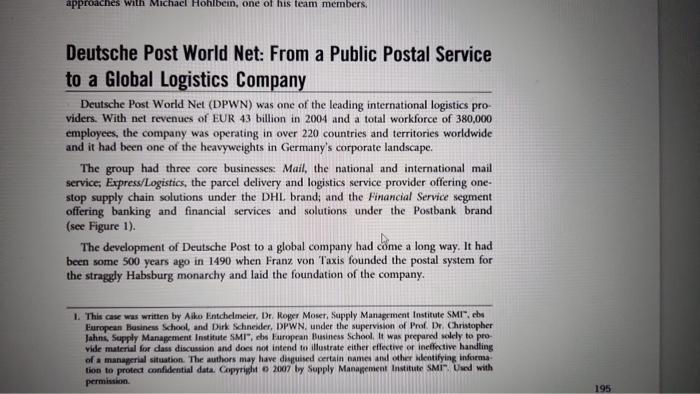
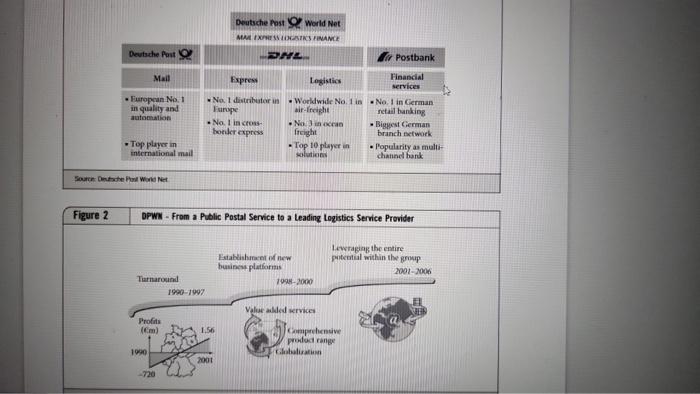
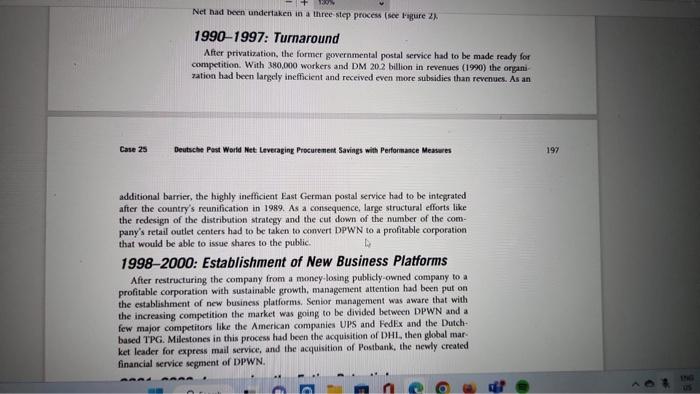
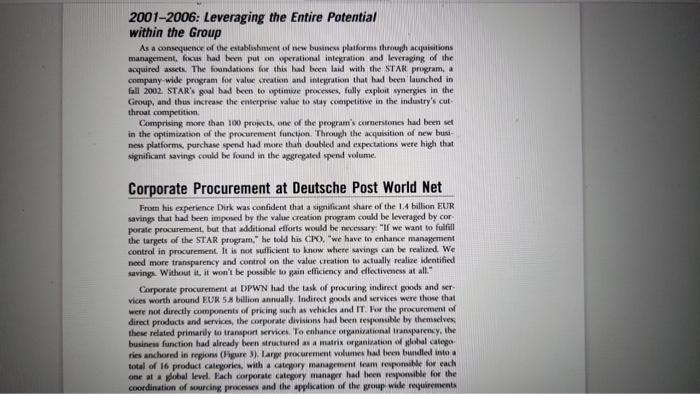
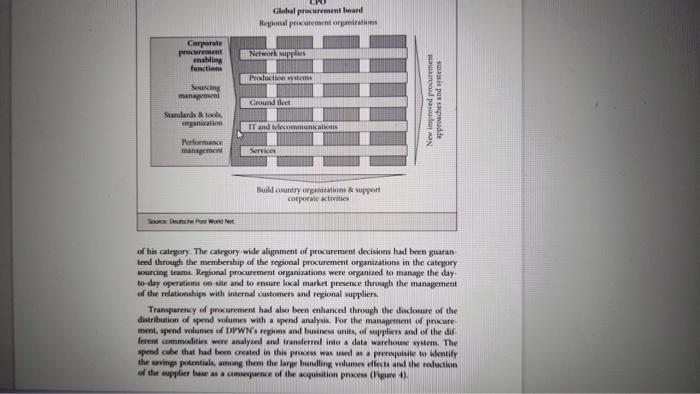
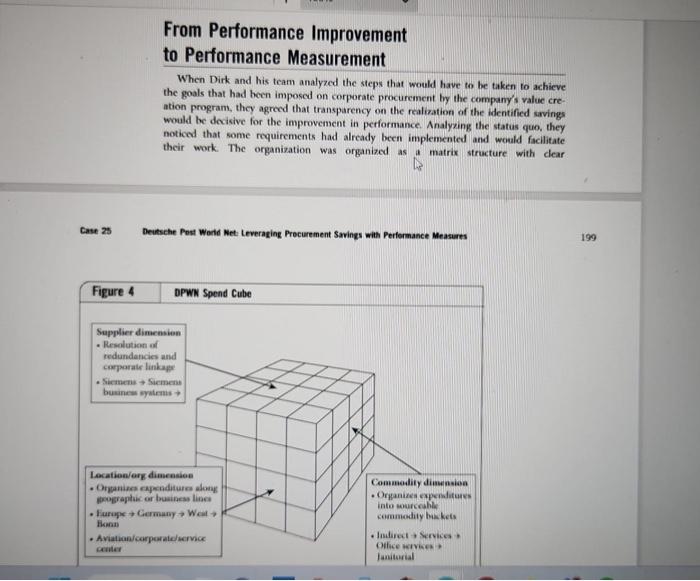
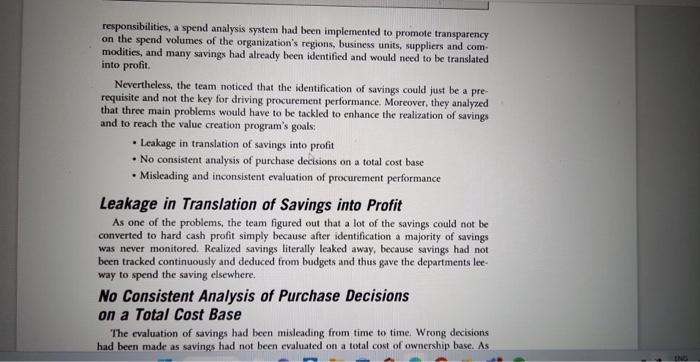
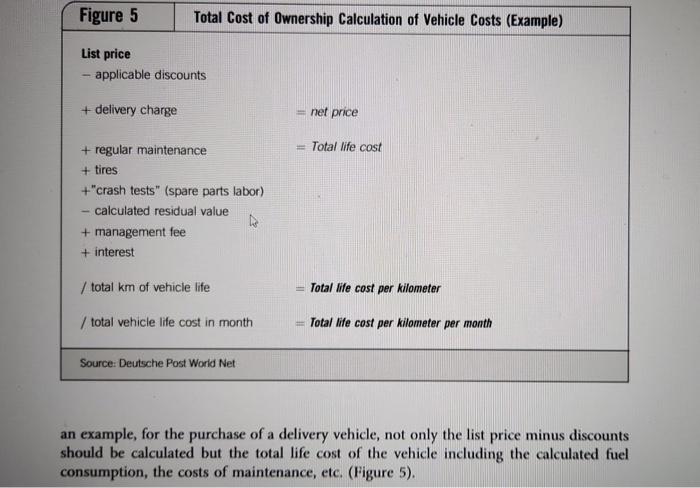
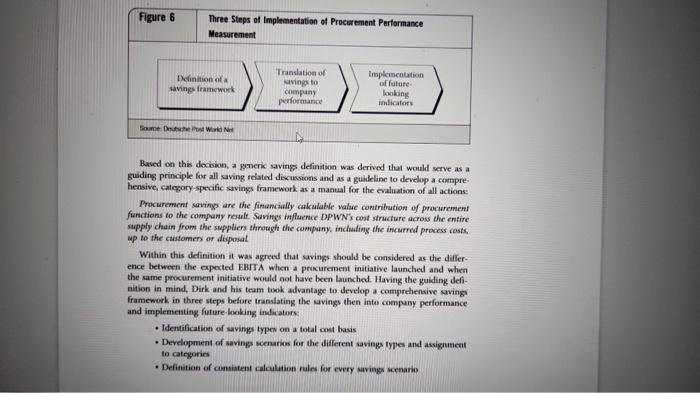
25 Deutsche Post World Net: Leveraging Procurement Savings with Performance Measures 1 It was an early evening August 6, 2002 when Dirk Schneider left a meeting with the CPO and the recently established Global Procurement Board of Deutsche Post World Net. As a senior vice president responsible for Procurement Performance Management of Deutsche Post World Net, Dirk had been assigned together with his colleagues from the procurement board to lever the enormous savings potentials that had been hidden in the company's procurement organization after the acquisition of several major companies. Dirk already knew that the identification of the savings itself was not sufficient to translate the huge synergy effects from recently acquired businesses into hard cash savings. Procurement savings would need to be controlled constantly to be translated into profit. Thinking about a solution, Dirk picked up the phone to start to discuss possible approaches with Michael Hohlbein, one of his team members. Deutsche Post World Net: From a Public Postal Service to a Global Logistics Company Deutsche Post World Net (DPWN) was one of the leading international logistics providers. With net revenues of EUR 43 billion in 2004 and a total workforce of 380,000 employees, the company was operating in over 220 countries and territories worldwide and it had been one of the heavyweights in Germany's corporate landsape. The group had three core businesses: Mail, the national and international mail service, Express/Logistics, the parcel delivery and logistics service provider offering onestop supply chain solutions under the DHL. brand; and the Financial Service segment offering banking and financial services and solutions under the Postbank brand (see Figure 1). The development of Deutsche Post to a global company had come a long way. It had been some 500 years ago in 1490 when Franz von Taxis founded the postal system for the straggly Habsburg monarchy and laid the foundation of the company. 1. This case was written by Ake Entchdmeier, De. Roger Moser, Sapply Managrment Institute SMI", ebs Furopean Blasiness School, and Dirk Schneiler, DPWN, under the supervision of Prof. Dr. Christopher Jahns, Supply Management Institute SMI , do Europran Business School. It was preparded sollely to provile materal for dass discusaion and does not intend to illustrate either effective or ineffective handting of a managrrial situation. The authors may have disguised certain nanee and other identifyiag infoema-: tion to protad confidential data. Copyright 62007 by Supply Management Institute SMr-" Uwal with permission. Dvetsche Past gat World Net 1990-1997: Turnaround After privatization. the former governmental postal service had to be made ready for competition. With 380.000 workers and DM 20.3 billion in revenues (1990) the arganizatioa had been largely inefficient and received even more subsidies than revenues. As an Case 25 Deutsche Pest Warfd Ket Leveraging Procurenent Savings with Performance Measeres additional barrier, the highly inefficient East German postal service had to be integrated after the country's reunification in 1989. As a consequence, large structural efforts like the redesign of the distribution strategy and the cut down of the number of the company's retail outlet centers had to be taken to convert DPWN to a profitable corporation that would be able to issue shares to the public. 1998-2000: Establishment of New Business Platforms After restructuring the company from a money-losing publicly-owned company to a profitable corporation with sustainable growth, management attention had been put on the establishment of new business platforms. Senior management was aware that with the increasing competition the market was going to be divided between DPWN and a few major competitors like the American compunies UPS and FedEx and the Dutchbased TPG. Milestones in this process had been the acquisition of DHI, then global market leader for express mail service, and the acquisition of Postbank, the newly created financial service segment of DPWN. 2001-2006: Leveraging the Entire Potential within the Group As a conseyacnor of the etablshment of ncw busiscs platiorms thirough acyuisitions management, Gocus had bex put on operational integration and leveraging of the acquired assete. The foondations for this had been laid with the STAR program, a company-wide program for value creation and incegration that had been launched in fall 2002. STAR's goal hal been to optimize processes, fully exploit synergies in the Group, and thus increase the enterprise value to stay competitive in the induatry's catthroat competitinn. Comprising more than 100 projects, ane of the program's curnentones had been sel in the optimization of the procurement function. Through the acquisition of new business platforms, perchase spend had more than doubled and expectations were hight that significant savings conald be found in the aggregated pend volume. Corporate Procurement at Deutsche Post World Net From his experience Dirk was confident that a significant shufe of the 1.4 billion EUR savings that had been imposed by the value creation program could be locraged by corporate procurement, but that additional efforts would be nccesary: "If we want to fulfil the targets of the STAR program," he told his CPO, "we have to enhance management control in procurement. It is not sufficient to know where saving can be realined. We need more transparency and control on the value creation to actually realize identified savings. Without it it won't be posshble io gaie efficiency and dfectiveness at all." Corporate procurement at DPWN had the lask of procaring indirect goods and services worth around EUK 5B billion anieally. Indirect goods and services were those that were not directly components of pricing aach as vehicles and IT. For the procureneen of direct products and services, the corporate divisions hal heen respensible by themselves; these relaied primarily to transpart service. To enhance organivational iransyorency, the busines function had already been structured as a matrix arganizatious of glohal catego: ries anchored in regions (Figure 3). Large procurenient wolumers had twern thunded into a total of 16 product calpories, with a categary managrman leam tepponsibe for each ane at a Eobal levi. Fach corpirate catepory manager had leen reoponible for the coordination of suarcing processes and the application of the gesup-wile requirements of his category. The catcgory wide alignment of procurement decisions had been guaran: teed through the membership of the regiocal procurement organizations in the category sourcing teams. Peginaal procurement ofganizations were organized to manage the day. to-day operations on site and to ensure local market presence through the management of the relationahipe with internal customers and regional suppliers. Transparney of procurement had also been enhanced thruwgh the theclosure of the distritution of spend voluenes with a spend analysis. For the management of procurement, agend wolumes of DE'WN's replons and business units, of suppliers and of the dif. ferent commodities were analyoed and tranaferred inte a data watrhenewe system. The ppend cule that had hern creaied in this process was usct as a proreyuisite to identify the aaving potentiale, among them the larje bunalbing vulumes aflects atal the roluctian of the aupplier tase as a conceryurace of the acubition praces (fygure 4). From Performance Improvement to Performance Measurement When Dirk and his team analyzed the steps that would have to be taken to achieve the goals that had been imposed on corporate procurement ly the company's value creation program, they agreed that transparency on the ralization of the identified savings would be decisive for the improvement in performance. Analyzing the status quo, they noticed that some requirements had already been implemented and would facilitate their work. The organization was organized as a matrix structure with clear Deitsche Post World ket. Leverating Precurement Savings with Perfermance Measures responsibilities, a spend analysis system had been implemented to promote transparency on the spend volumes of the organization's regions, business units, suppliers and commodities, and many savings had already been identified and would need to be translated into profit. Nevertheless, the team noticed that the identification of savings could jus be a prerequisite and not the key for driving procurement performance. Moreover, they analyzed that three main problems would have to be tackled to enhance the realization of savings and to reach the value creation program's goals: - Leakage in translation of savings into profit - No consistent analysis of purchase decisions on a total cost base - Misleading and inconsistent evaluation of procurement performance Leakage in Translation of Savings into Profit As one of the problems, the team figured out that a lot of the savings could not be converted to hard cash profit simply because after identification a majority of savings was never monitored. Realized savings literally leaked away, because savings had not been tracked continuously and deduced from budgets and thus gave the departments leeway to spend the saving elsewhere. No Consistent Analysis of Purchase Decisions on a Total Cost Base The evaluation of savings had been misleading from time to time. Wrong decisions had been made as savings had not been evaluated on a total cost of ownership base. As List price - applicable discounts + delivery charge + regular maintenance = net price + tires +"crash tests" (spare parts labor) - calculated residual value + management fee + interest / total km of vehicle life life cost / total vehicle life cost in month = Total life cost per kilometer Source: Deutsche Post Worla Net an example, for the purchase of a delivery vehicle, not only the list price minus discounts should be calculated but the total life cost of the vehicle including the calculated fuel consumption, the costs of maintenance, etc. (Figure 5). Misleading and Inconsistent Evaluation of Procurement Performance The team further observed that procurement savings had been evaluated inconsistently between different departments, preventing the possibility to compare the performance of the purchasers. Some saving evaluations even led to wrong evaluations of procurement performance; for example, when market developments had been influencing the price of a product and the baseline used for the performance calculation had not been adapted to the market environment. After the problem analysis, Dirk and his team concluded that performance could only be enhanced significantly when it would be controlled consistently. Following the old saying "you can't manage what you can't measure," they decided to start to develop a procurement performance measurement system according to a three-step process (Figure 6). Definition of a Savings Framework As a first step before starting to analyze the savings potential and to control and realize it, Dirk joined his team of experts and thought about how to define procurement savings. Discussing several concepts for the evaluation of savings measurement from company practice, the team agreed that a single specific savings formula that fits for all purchase situations didn't exist. Savings rather needed to be identified and evaluated through a savings framework according to category and scenario specifics as well as stages of excellence and maturity. Based on this docision, a grneric saving defination was derived that would serve as a guiding principle for all saving related discussions and as a guadeline to develop a cornprehensive, calegory-specific savings framework as a manual for the evaluation of all actions: Procurement saving' are the finuandally cakculable value contribution of procuremient furictions to the company resilt. Savings influence. DPWN' cost structure across the entire supply chain from the suppliers through the compuny, inchuding the incurred pracess costs, up to the customers of ditposal Within this definition it was agreed that savings should be considered as the difference between the capected EBITA when a procurement initiative launched and when the same procurement initiative would not have been launched. Having the guiding definition in mind, Dirk and his team took advantage to. develop a comprehensive savinge framework in three steps before translating the avings then into compuny performance and implementing future-looking indicators: - Identification of avings typen on a total cost basis - Development of savings scenarios for the different savings Iypes and assignment to cateqorirs - Definition of coneiatent calculation rules for every suvings scenario - Development of savings scenarios for the different savings types and assignment to categories - Definition of consistent calculation rules for every savings scenario Discussion Questions 1. What is the purpose and content of the STAR program? 2. What kind of savings types and appropriate saving scenarios might be applied by Dirk and his team? 3. What kind of calculation rules for saving scenarios might Dirk apply? 4. How can Dirk ensure that the defined savings translate into company performance? 5. How can Dirk further support the integration of the savings measurement into DPWN's financial planning and calculate the impact of realized savings? 6. What kind of key performance indicators can further support DPWN's performance measurement approach? 7. What are the benefits from the DPWN performance measurement project? 8. What are lessons learned from this project
Step by Step Solution
There are 3 Steps involved in it
1 Expert Approved Answer
Step: 1 Unlock

Question Has Been Solved by an Expert!
Get step-by-step solutions from verified subject matter experts
Step: 2 Unlock
Step: 3 Unlock
 Study Help