







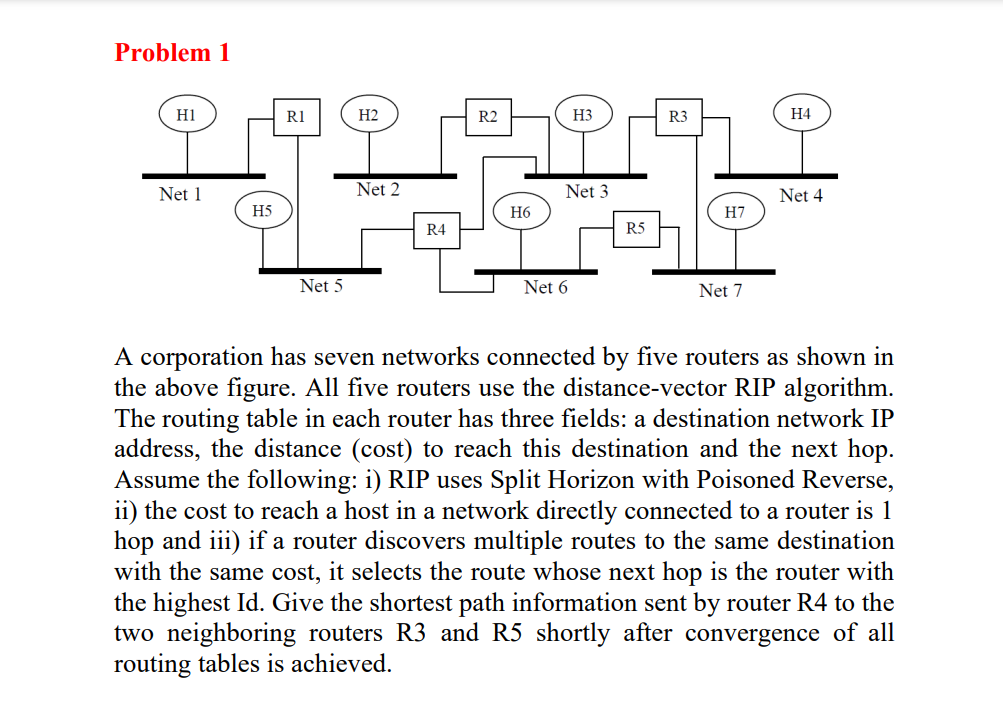
Question: Problem 1 A corporation has seven networks connected by five routers as shown in the above figure. All five routers use the distance - vector
Problem
A corporation has seven networks connected by five routers as shown in the above figure. All five routers use the distancevector RIP algorithm. The routing table in each router has three fields: a destination network IP address, the distance cost to reach this destination and the next hop. Assume the following: i RIP uses Split Horizon with Poisoned Reverse, ii the cost to reach a host in a network directly connected to a router is hop and iii if a router discovers multiple routes to the same destination with the same cost, it selects the route whose next hop is the router with the highest Id Give the shortest path information sent by router R to the two neighboring routers R and R shortly after convergence of all routing tables is achieved.
Problem Consider a network topology obtained by adding a direct connection between router R and network Net in the network topology of problem All routers use the OSPF algorithm with cost of for each hop similar to RIP The OSPF algorithm executes in these networks with the ECMP option enabled. Each host has a default gateway router to which it sends all the nonlocal outbound packets. If a network has multiple routers connected to it the default router for hosts in this network is the one that has the highest Id note: inbound packets are delivered to their destination hosts directly by anyone of these multiple routers Seven longliving UDP streams operate between the following senderdestination pairs: HHHHHHHHHHHH and HH Each stream sends packets at a rate of packets per second where each packet has a size of bytes. If each of the seven networks has a bandwidth of Mbps rank these networks in ascending order of their steady state utilization. Utilization of a network is the ratio between the actual traffic transported by this network in one second and the announced bandwidth of this network.
Step by Step Solution
There are 3 Steps involved in it
1 Expert Approved Answer
Step: 1 Unlock

Question Has Been Solved by an Expert!
Get step-by-step solutions from verified subject matter experts
Step: 2 Unlock
Step: 3 Unlock
 Study Help