Question: Read: Chapter Nineof Introduction to Documentary , Third Edition by Bill Nichols. 9 HOW CAN WE WRITE EFFECTIVEL ABOUT DOCUMENTARY? This chapter assumes some general
Read:
Chapter NineofIntroduction to Documentary, Third Edition by Bill Nichols.
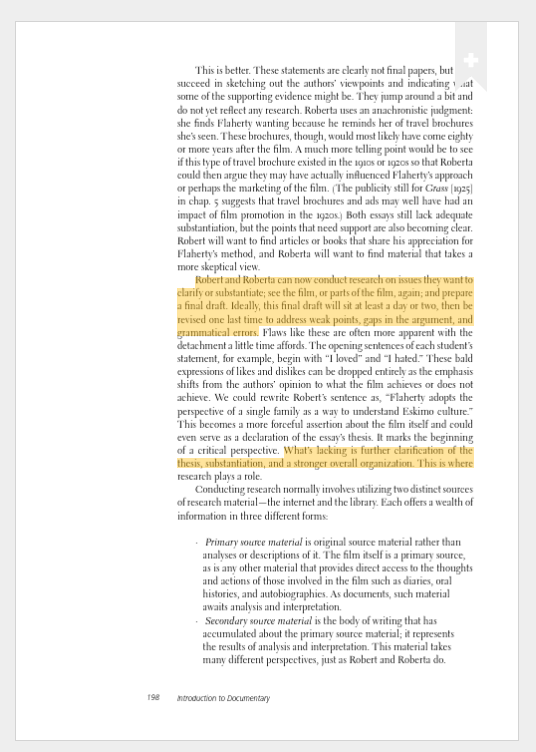
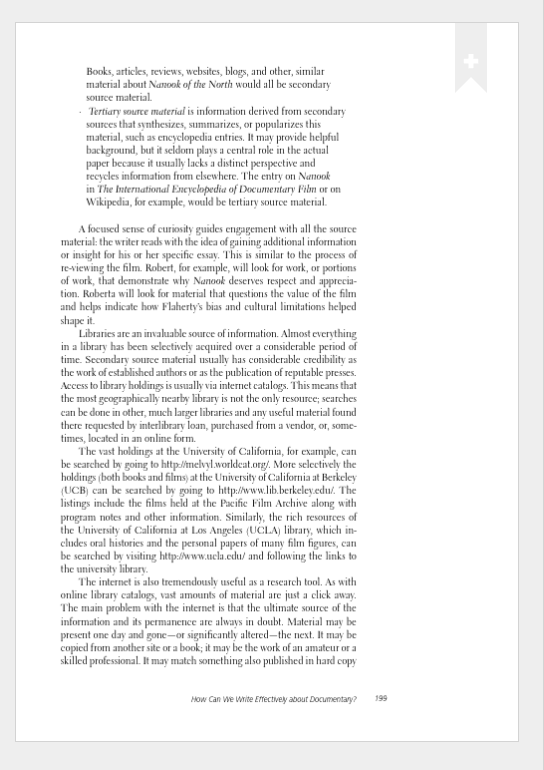
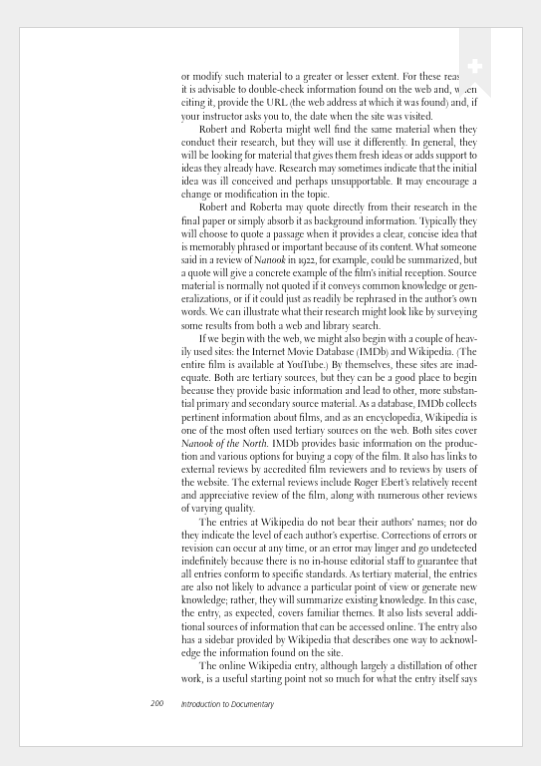
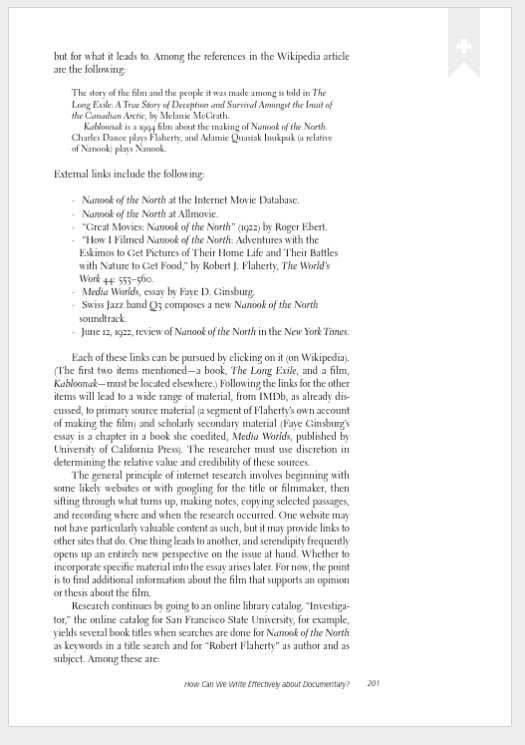
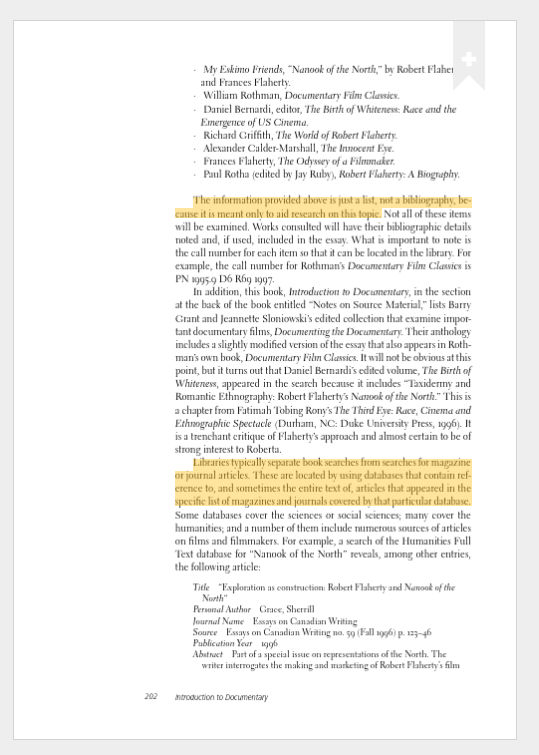
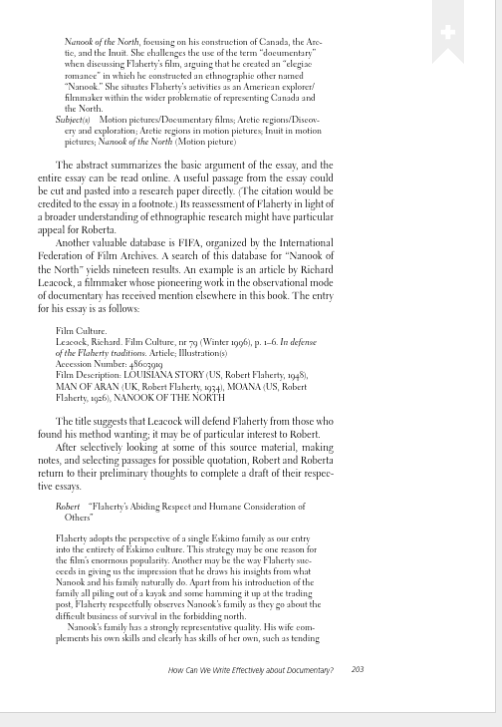
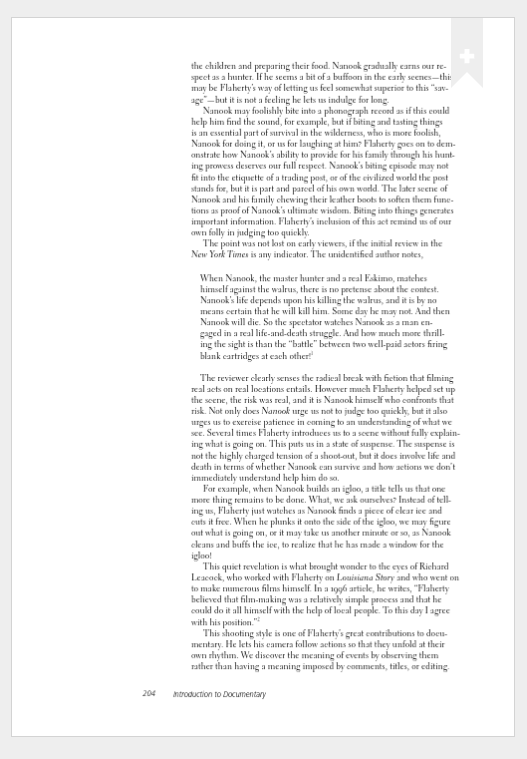
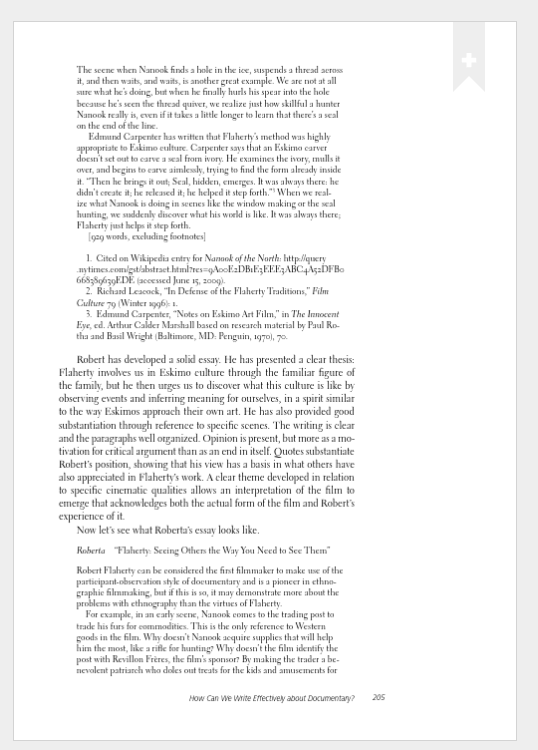
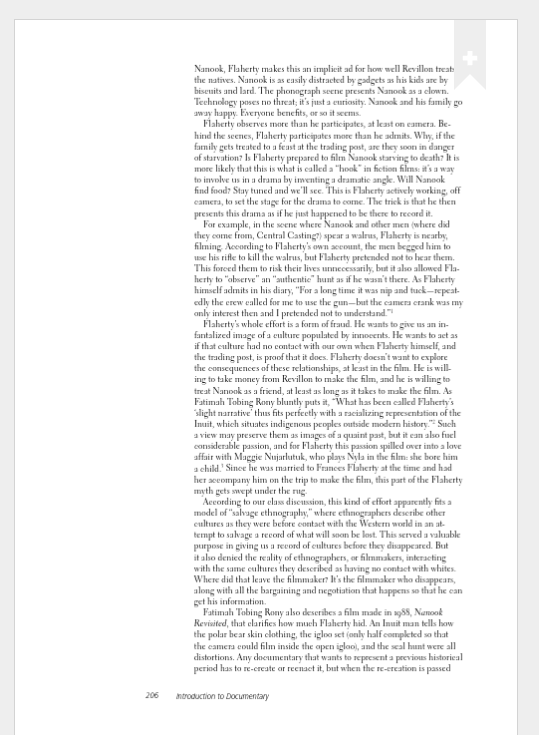
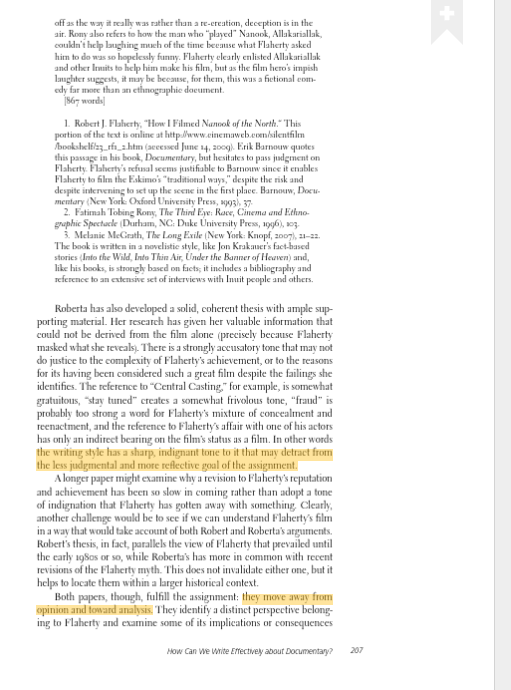
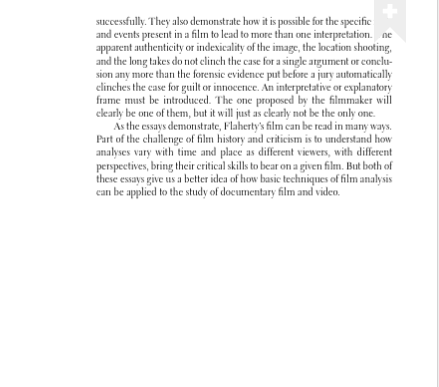
9 HOW CAN WE WRITE EFFECTIVEL ABOUT DOCUMENTARY? This chapter assumes some general familiarity with cway writing for film. All introductory film texts cover the topic, and other helpful guides to essay writing also exist. This chapter gives sharper focus to writing about documentary film, but the basic principles pertain to almost any research topic in the humanities. Some suggestions for further reading, include ing more introductory guides to writing about film, can be found in the "Notes on Source Material" section of this book. Crucial to a purpose. On one level, it may be to get a grade or pass a course, but on a more concrete level, writ- ing on a specific topic calls for an investment of curiosity, enthusiasm, and effort. A concrete purpose, such as defending a position, advancing a point of view, or exploring an issue, endows an essay with interest. Simply summarizing a film, repeating what others have said about it, or describing parts of it without evaluating them-in essence, withholding a personal perspective-detract from an essay's interest. Finding a theme or idea that holds genuine personal interest typically yields a better essay than simply going through the motions of completing an assignment. We will explore effective writing by using a concrete example: an essay assignment on Nanook of the North (1gaz). The hypothetical essay question below invites the student to assess the film and respond to it. Documentary addresses the historical world by shaping its represents- tion of this world from a distinct perspective or point of view. Identify the point of view adopted by Robert Flaherty in Nanook of the North and consider some of its implications, based on what you have karned about documentary film. Demonstrate research on this topic by including at least three research citations in your cray Length: 8p-1,poo worth. The first s ion Seeing Nanook is the most obvious preparation, but seeing it more than once is also impor- tant. On first viewing, we become immersed in the viewing experience. We may ask ourselves some questions about what we are seeing, but on a second viewing, this process of asking and thinking about what we see becomes more central. We might ask, for example, why Flaherty begins the way he does. What does this set up for the rest of the film? Why does he end as he does? How does this relate to the beginning" What kind of relationship is there among Flaherty, the camera, and Nanook? How are 194Nanook bites a record. Is this an act of playful hamming for the camera, or is this Flaherty's way of demonstrating the back- wardness of his subject? The two sample essays that follow take different paths in interpreting this classic documentary film. Nanook of the North (Robert Flaherty, 1922) scenes edited? What scenes stood out, and why? How is one scene joined to another? What does the narrative structure of the film revolve around? How does Flaherty represent people from another culture? How does he characterize them or convey a sense of their individuality? Questions like these might be guided by a specific idea we already have for a paper, or they may guide note taking before developing a spe- cific idea. In either case, they increase our awareness of Flaherty's distinct approach and can rarely be answered by a single viewing. Some viewers like to make notes on the first viewing of a film; others find it distracting, But on repeat viewing, notes provide the raw material that will later support critical writing about the film. In general, notes can track such things as the following: Chronology of scenes (what comes first, second). Types of camera shots (wide angle, telephoto, tracking shots, zooms, composition within the frame). Editing techniques (continuity editing, point-of-view shots, unusual juxtapositions or jumps in time and space). Role of speech (dialogue, commentary), written words (titles, subtitles, intertitles), music, or sound effects in a scene. Character development (how the film makes choices to enhance our sense of individual characters or personalities by camera angle, editing, organization of scenes, selection of what is said, and, possibly, hints as to what is left unsaid or omitted). Rhetorical technique (how the film makes itself seem credible, convincing, and compelling, or noty Modes and models (what modes and models the film relies on to organize itself and how it inflects them in a distinct way). How Can We Write Effectively about Documentary? 195Other unusual qualities (degree of acknowledged presence o the filmmaker in scenes; the political perspective, if any, that are film conveys). . Aesthetic or emotional responses to specific qualities of the film and what seems to prompt them in terms of technique or subject matter. Taking notes is a selective business. We can attend to only so many aspects of a film. We may choose to focus on the camera style or editing, on the filmmaker's own presence or the development of social actors as complex characters, but we cannot concentrate on everything at once. Notes provide a record of some of our preoccupations and interests. When done in relation to an essay, they provide source material for the points we plan to make in our commentary. Let's assume that two hypothetical students, Robert and Roberta, have seen Nanook once and have formed an initial opinion. Let's talk through the process of moving forward toward a finished essay. Robert What did you think of Nanoalt Roberta I hated it. Robert Oh, I loved it As a comprehensive response to the film, this type of comment barely registers as a half-hearted attempt. It does provide a valuable starting place for thinking about the film, however. Each viewer has a strong response, and that response can motivate writing an essay. It furnishes a purpose: to defend a basic feeling about the film. To do so, however, this initial judgment has to be shaped into a critical analysis that relies on substantive support to make its points. At this point, our path branches in two directions. One leads to film reviews and the other to film criticism. A useful distinction is that a re- viewer writes for those who have not seen the film, as a kind of consumer guide. A critic writes for those who have seen the film, as part of a critical dialogue. Although some professional reviewers also pose issues that con- tribute to a critical dialogue, classroom essays seldom serve as reviews: the professor has already seen the film. The assigned essay topic on Nanook clearly expects the essay to be part of a critical dialogue among those who have seen the film. One important consequence: there is no need to summarize the plot. In film criticism, unlike film reviewing, once an essay begins to sum- marize a film or describe a scene, the essay's analytic momentum may come to a halt. Summaries are largely redundant because the reader has already seen the film, and once begun, they often compel the writer to go on, summarizing more and more until the entire plot is clearly stated. This reverses priorities. For criticism, it is more vital to make a point and then provide supporting evidence through references to the film than to give a summary and then connect it to an overall opinion. Developing arguments that convey your own considered thoughts about the film 196 Introduction to Documentaryhas the highest priority. Describe scenes of techniques that support your argument but avoid summaries that do not advance your own point of view. Robert and Roberta's initial statements of love and hate are unsub- stantiated opinions-they have not yet offered any supporting evidence yet. Their opinions do not yet qualify as criticism. Let's take them a bit further. Robert I loved the way Flaherty showed me things about Eskimo cul- ture I hadn't seen before. Roberta I hated the way Flaherty made Nanook act like a typical primi- live who knew all shout nature but couldn't figure out a phonograph record. This gets the ball rolling, Each student has given us some sense of why he or she loves or hates the film. Robert has begun to put his finger on the quality he admires about Flaherty. From here he could begin to think about what Flaherty shows him and how Flaherty shows him these things: what about the representation seems to deserve admiration? Roberta has begun to link Flaherty with a set of misrepresentations in which tradi- tional cultures appear like earlier, or more infantile, versions of our own. From here she could begin to think about what Flaherty does to give her this feeling and how Flaherty's style contributes to it. Film viewing notes will help this process. Robert and Roberta may now make a preliminary thesis statement or an outline for their papers. They will also view the film again, looking for scenes and moments that will support their theses. They may conduct additional research as well, but let's first see how they can elaborate their initial argument a bit more with a thesis statement and then see how research can help support their evolving argument in written form. The goal of the statement or outline is to indicate concisely what the point of the final paper will be. Robert I loved the way Flaherty adopts the perspective of a single fam- ily as a way to understand Eskimo culture. This gives us a convenient handle because we are already familiar with family roles but not fa- millar with the specific problems and tasks facing this family. Flaherty iroles in mainly with Nanook, but he also shows how the kids begin to learn Eskimo ways and how Nyla, Nanoak's wife, contributes to the micers of the group. Flaherty has a way of letting seenes linger, they don't rush to a conclusion. This is a really harsh environment, and men must be very determined and skilled to survive. Roberta I hated Flaherty's hackneyed attempt to make us love Eskimos by making us love Nanook. This is a trite way of saying that we should admire other cultures because the people are cute and colorful-the sort of thing I see in travel brochures for exotic locales. Nanook acts like a ham when Flaherty gives him a chance to respond to the cam- cra, especially at the trading post. He's more in his clement when hunting scab, but that's where we expect him to be most at case. Is this Flaherty's way of keeping him in his place? Nanook seems like Eskimo brawn to the white man's brain. How Can We Write Effectively about Documentary? 197This is better. These statements are clearly not final papers, but succeed in sketching out the authors' viewpoints and indicating 1 .at some of the supporting evidence might be. They jump around a bit and do not yet reflect any research. Roberta uses an anachronistic judgment: she finds Flaherty wanting because he reminds her of travel brochures she's seen. These brochures, though, would most likely have come eighty or more years after the film. A much more telling point would be to see if this type of travel brochure existed in the agios or 19zos so that Roberta could then argue they may have actually influenced Flaherty's approach or perhaps the marketing of the film. (The publicity still for Grows [1925] in chap. 5 suggests that travel brochures and ads may well have had an impact of film promotion in the 1geos) Both essays still lack adequate substantiation, but the points that need support are also becoming clear. Robert will want to find articles or books that share his appreciation for Flaherty's method, and Roberta will want to find material that takes a more skeptical view. Robert and Roberta can now conduct research on issues they want to clarify or substantiate; see the film, or parts of the film, again; and prepare a final draft. Ideally, this final draft will sit at least a day or two, then be revised one last time to address weak points, gaps in the argument, and grammatical errors. Flaws like these are often more apparent with the detachment a little time affords. The opening sentences of each student's statement, for example, begin with "I loved" and "I hated." These bald expressions of likes and dislikes can be dropped entirely as the emphasis shifts from the authors' opinion to what the film achieves or does not achieve. We could rewrite Robert's sentence as, "Flaherty adopts the perspective of a single family as a way to understand Eskimo culture." This becomes a more forceful assertion about the film itself and could even serve as a declaration of the essay's thesis. It marks the beginning of a critical perspective. What's lacking is further clarification of the thesis, substantiation, and a stronger overall organization. This is where research plays a role. Conducting research normally involves utilizing two distinct sources of research material-the internet and the library. Each offers a wealth of information in three different forms Primary source material is original source material rather than analyses or descriptions of it. The film itself is a primary source, as is any other material that provides direct access to the thoughts and actions of those involved in the film such as diaries, oral histories, and autobiographies. As documents, such material awaits analysis and interpretation. Secondary source material is the body of writing that has accumulated about the primary source material; it represents the results of analysis and interpretation. This material takes many different perspectives, just as Robert and Roberta do. 198 Introduction to DocumentaryBooks, articles, reviews, websites, blogs, and other, similar material about Nanook of the North would all be secondary source material Tertiary source material is information derived from secondary sources that synthesizes, summarizes, or popularizes this material, such as encyclopedia entries. It may provide helpful background, but it seldom plays a central role in the actual paper because it usually lacks a distinct perspective and recycles information from elsewhere. The entry on Nanook in The International Encyclopedia of Documentary Film or on Wikipedia, for example, would be tertiary source material. A focused sense of curiosity guides engagement with all the source material: the writer reads with the idea of gaining additional information or insight for his or her specific essay. This is similar to the process of re-viewing the film. Robert, for example, will look for work, or portions of work, that demonstrate why Nanook deserves respect and apprecia- tion. Roberta will look for material that questions the value of the film and helps indicate how Flaherty's bias and cultural limitations helped shape it. Libraries are an invaluable source of information. Almost everything in a library has been selectively acquired over a considerable period of time. Secondary source material usually has considerable credibility as the work of established authors or as the publication of reputable presses. Access to library holdings is usually via internet catalogs. This means that the most geographically nearby library is not the only resource; searches can be done in other, much larger libraries and any useful material found there requested by interlibrary loan, purchased from a vendor, or, some- times, located in an online form. The vast holdings at the University of California, for example, can be searched by going to http://melvyl.worldeat.org/. More selectively the holdings (both books and films) at the University of California at Berkeley (UCB) can be searched by going to http:/www.lib.berkeley.edu/. The listings include the films held at the Pacific Film Archive along with program notes and other information. Similarly, the rich resources of the University of California at Los Angeles (UCLA) library, which in- cludes oral histories and the personal papers of many film figures, can be searched by visiting http:/www.uela.edu/ and following the links to the university library. The internet is also tremendously useful as a research tool. As with online library catalogs, vast amounts of material are just a click away. The main problem with the internet is that the ultimate source of the information and its permanence are always in doubt. Material may be present one day and gone-or significantly altered-the next. It may be copied from another site or a book; it may be the work of an amateur or a skilled professional. It may match something also published in hard copy How Can We White Effectively about Documentary? 199or modify such material to a greater or lesser extent. For these reas it is advisable to double-check information found on the web and, u en citing it, provide the URL (the web address at which it was found) and, if your instructor asks you to, the date when the site was visited. Robert and Roberta might well find the same material when they conduct their research, but they will use it differently. In general, they will be looking for material that gives them fresh ideas or adds support to ideas they already have. Research may sometimes indicate that the initial idea was ill conceived and perhaps unsupportable. It may encourage a change or modification in the topic. Robert and Roberta may quote directly from their research in the final paper or simply absorb it as background information. Typically they will choose to quote a passage when it provides a clear, concise idea that is memorably phrased or important because of its content. What someone said in a review of Nanook in 1922, for example, could be summarized, but a quote will give a concrete example of the film's initial reception. Source material is normally not quoted if it conveys common knowledge or gen- eralizations, or if it could just as readily be rephrased in the author's own words. We can illustrate what their research might look like by surveying some results from both a web and library search. If we begin with the web, we might also begin with a couple of heav- ily used sites: the Internet Movie Database (IMDb) and Wikipedia. (The entire film is available at YouTube.) By themselves, these sites are inad- equate. Both are tertiary sources, but they can be a good place to begin because they provide basic information and lead to other, more substan- tial primary and secondary source material. As a database, IMDb collects pertinent information about films, and as an encyclopedia, Wikipedia is one of the most often used tertiary sources on the web. Both sites cover Nanook of the North. IMDb provides basic information on the produc- tion and various options for buying a copy of the film. It also has links to external reviews by accredited film reviewers and to reviews by users of the website. The external reviews include Roger Ebert's relatively recent and appreciative review of the film, along with numerous other reviews of varying quality. The entries at Wikipedia do not bear their authors' names; nor do they indicate the level of each author's expertise. Corrections of errors or revision can occur at any time, or an error may linger and go undetected indefinitely because there is no in-house editorial staff to guarantee that all entries conform to specific standards. As tertiary material, the entries are also not likely to advance a particular point of view or generate new knowledge; rather, they will summarize existing knowledge. In this case, the entry, as expected, covers familiar themes. It also lists several addi- tional sources of information that can be accessed online. The entry also has a sidebar provided by Wikipedia that describes one way to acknowl edge the information found on the site. The online Wikipedia entry, although largely a distillation of other work, is a useful starting point not so much for what the entry itself says 200 Introduction to Documentarybut for what it leads to. Among the references in the Wikipedia article are the following: The story of the film and the people it was made among is told in The Long Exile: A True Story of Deception and Survival Amongst the Inuit of the Canadian Arctic, by Melanie MeGrath. Kabloanal is a togg film about the making of Nanook of the North. Charles Dance plays Flaherty, and Adamis Quasiak Inukpuk (a relative of Nanook) play Nanook. External links include the following: Nanook of the North at the Internet Movie Database. Nanook of the North at Allmovic. "Great Movies: Nanook of the North" (1gaz) by Roger Ebert. "How I Filmed Nanook of the North: Adventures with the Eskimos to Get Pictures of Their Home Life and Their Battles with Nature to Get Food," by Robert J. Flaherty, The World's Work 44: 553-560. Media Worlds, essay by Faye D. Ginsburg. Swiss Jazz band Of composes a new Nanook of the North soundtrack. June 12, 1932, review of Nanook of the North in the New York Times. Each of these links can be pursued by clicking on it (on Wikipedia). (The first two items mentioned-a book, The Long Exile, and a film, Kobloonat-must be located elsewhere.) Following the links for the other items will lead to a wide range of material, from IMDb, as already dis- cussed, to primary source material (a segment of Flaherty's own account of making the film and scholarly secondary material (Faye Ginsburg's essay is a chapter in a book she coedited, Media Worlds, published by University of California Press). The researcher must use discretion in determining the relative value and credibility of these sources. The general principle of internet research involves beginning with some likely websites or with googling for the title or filmmaker, then sifting through what turns up, making notes, copying selected passages, and recording where and when the research occurred. One website may not have particularly valuable content as such, but it may provide links to other sites that do. One thing leads to another, and serendipity frequently opens up an entirely new perspective on the issue at hand. Whether to incorporate specific material into the essay arises later. For now, the point is to find additional information about the film that supports an opinion or thesis about the film. Research continues by going to an online library catalog, "Investiga- tor," the online catalog for San Francisco State University, for example, yields several book titles when searches are done for Nanook of the North as keywords in a title search and for "Robert Flaherty" as author and as subject. Among these are: How Can We Write Effectively about Documentary? 201My Eskimo Friends, "Nanook of the North," by Robert Flaher and Frances Flaherty. William Rothman, Documentary Film Classics. Daniel Bernardi, editor, The Birth of Whiteness: Race and the Emergence of US Cinema. Richard Griffith, The World of Robert Flaherty. Alexander Calder-Marshall, The Innocent Eve. Frances Flaherty, The Odyssey of a Filmmaker. Paul Rotha (edited by Jay Ruby), Robert Flaherty: A Biography. The information provided above is just a list, not a bibliography, be- cause it is meant only to aid research on this topic. Not all of these items will be examined. Works consulted will have their bibliographic details noted and, if used, included in the essay. What is important to note is the call number for each item so that it can be located in the library. For example, the call number for Rothman's Documentary Film Classics is PN 1995 9 D6 Rog 1997. In addition, this book, Introduction to Documentary, in the section at the back of the book entitled "Notes on Source Material," lists Barry Grant and Jeannette Sloniowski's edited collection that examine impor- tant documentary films, Documenting the Documentary. Their anthology includes a slightly modified version of the essay that also appears in Roth- man's own book, Documentary Film Classics. It will not be obvious at this point, but it turns out that Daniel Bernardi's edited volume, The Birth of Whiteness, appeared in the search because it includes "Taxidermy and Romantic Ethnography: Robert Flaherty's Nanook of the North." This is a chapter from Fatimah Tobing Rony's The Third Eye: Race, Cinema and Ethnographic Spectacle (Durham, NC: Duke University Press, 1996). It is a trenchant critique of Flaherty's approach and almost certain to be of strong interest to Roberta. Libraries typically separate book searches from searches for magazine or journal articles. These are located by using databases that contain ref- crence to, and sometimes the entire text of, articles that appeared in the specific list of magazines and journals covered by that particular database. Some databases cover the sciences or social sciences; many cover the humanities; and a number of them include numerous sources of articles on films and filmmakers. For example, a search of the Humanities Full Text database for "Nanook of the North" reveals, among other entries, the following article: Title "Exploration as construction: Robert Flaherty and Nanout of the North" Personal Author Grace, Sherrill Journal Name Essays on Canadian Writing Source Essays on Canadian Writing no. 59 (Fall 2096) p. 123-46 Publication Year iqgh Abstract Part of a special issue an representations of the North. The writer interrogates the making and marketing of Robert Flaherty's film 202 Introduction to DocumentaryNanook of the North, focusing on his construction of Canada, the Arc- + tic, and the Inuit. She challenges the use of the term "documentary" when discussing Flaherty's film, arguing that he created an "elegiac romance" in which he constructed an ethnographic other named "Nanook " She situates Flaherty's activities as an American explorer/ filmmaker within the wider problematic of representing Canada and the North. Subjectfol Motion pictures/ Documentary films; Aretie regionsDisco- ery and exploration; Aretie regions in motion pictures Inuit in motion pictures; Nanook of the North (Motion picture) The abstract summarizes the basic argument of the essay, and the entire essay can be read online. A useful passage from the essay could be cut and pasted into a research paper directly. (The citation would be credited to the essay in a footnote.) Its reassessment of Flaherty in light of a broader understanding of ethnographic research might have particular appeal for Roberta. Another valuable database is FIFA, organized by the International Federation of Film Archives. A search of this database for "Nanook of the North" yields nineteen results. An example is an article by Richard Leacock, a filmmaker whose pioneering work in the observational mode of documentary has received mention elsewhere in this book. The entry for his essay is as follows: Film Culture. Leacock, Richard. Film Culture, or 79 (Winter 1996), p. 1-6. In defense of the Flaherty traditions. Article; Illustration(s Accession Number: 4560990g Film Description: LOUISIANA STORY (US, Robert Flaherty, 1948), MAN OF ARAN (UK, Robert Flaherty, 1934), MOANA (US, Robert Flaherty, 19:6), NANOOK OF THE NORTH The title suggests that Leacock will defend Flaherty from those who found his method wanting; it may be of particular interest to Robert. After selectively looking at some of this source material, making notes, and selecting passages for possible quotation, Robert and Roberta return to their preliminary thoughts to complete a draft of their respec- tive essay's. Robert "Flaherty's Abiding Respect and Humane Consideration of Other" Flaherty adopt the perspective of a single Eskimo family as our entry into the entirely of Hakima culture. This strategy may be one reason for the film's common popularity. Another may be the way Flaherty me- seeds in giving on the impression that he draws his insights from what Nanook and his family naturally do. Apart from his introduction of the family all piling out of a kayak and sons hamming it up at the trading post, Flaherty respectfully observes Nanock's family as they go about the difficult business of survival in the forbidding north. Nanook's family has a strongly representative quality. His wife com- plements his own skills and clearly has skills of her own, such as tending How Can We Write Effectively about Documentary?the children and preparing their food. Nanook gradually carns our re- spect as a hunter. If he seems a bit of a buffoon in the carly seenes-thi may be Flaherty's way of letting us feel somewhat superior to this "say- age" - but it is not a feeling he lets us indulge for long. Nanook may foolishly bite into a phonograph record as if this could help him find the sound, for example, but if biting and tasting things is an essential part of survival in the wilderness, who is more foolish, Nanook for doing it, or us for laughing at him? Flaherty goes on to dem- anstrate how Nanook's ability to provide for his family through his hunt- ing prowess deserves our full respect. Nanook's biting episode may not fit into the etiquette of a trading post, or of the civilized world the pest stands for, but it is part and parcel of his own world. The later secre of Nanook and his family chewing their leather boots to soften them fune. tions as proof of Nanook's ultimate wisdom. Biting into things generates important information. Flaherty's inclusion of this act remind us of our own folly in judging too quickly The point was not list on early viewers, if the initial review in the New York Times is any indicator. The unidentified author notes, When Nanook, the master hunter and a real Eskimo, matches himself against the walrus, there is no pretense about the contest. Nanook's life depends upon his killing the walrus, and it is by no means certain that he will kill him. Some day he may not. And then Nanook will dic. So the spectator watches Nanook as a man en- caged in a real life-and-death struggle. And how much more thrill- ing the sight is than the "battle" between two well-paid actors firing blank cartridges at each other!" The reviewer clearly senses the radical break with fiction that filming real acts on real locations entails. However much Flaherty helped set up the scene, the risk was real, and it is Nanook himself who confronts that risk. Not only does Nanook urge us not to judge too quickly, but it also urges us to exercise patience in coming to an understanding of what we see. Several times Flaherty introduces us to a scene without fully explain- ing what is going on. This puts us in a state of suspense. The suspense is not the highly charged tension of a shoot-out, but it does involve life and death in terms of whether Nanook can survive and how actions we don't immediately understand help him do sa. For example, when Nanook builds an igloo, a title tell us that one more thing remains to be done. What, we ask ourches? Instead of bell ing us, Flaherty just watches as Nanook finds a piece of clear ies and cuts it free. When he plunks it onto the side of the igloo, we may figure out what is going on, or it may take us another minute or so, as Nanook cleans and buffs the ice, to realize that he has made a window for the igloo! This quiet revelation is what brought wander to the eyes of Richard Leacock, who worked with Flaherty on Louisiana Story and who went on to make numerous films himself. In a agg6 article, he writes, "Flaherty believed that film-making was a relatively simple procen and that he could do it all himself with the help of local people. To this day I agree with his position." This shooting style is one of Flaherty's great contributions to docu- mentary. He lets his camera follow actions so that they unfold at their own rhythm. We discover the meaning of events by observing them rather than having a meaning imposed by comments, titles, or editing 204 Introduction to DocumentaryThe scene when Nanook finds a hole in the ice, suspends a thread across it, and then waits, and waits, is another great example. We are not at all sure what he's doing, but when be finally hurls his spear into the hole because he's seen the thread quiver, we realize just how skillful a hunter Nanook really is, even if it takes a little longer to learn that there's a scal on the end of the line. Edmund Carpenter has written that Flaherty's method was highly appropriate to Falimo culture. Carpenter says that an Eskimo carver doesn't act out to carve a seal from ivory. He examines the ivory, mulls it over, and begin to carve aimlessly, trying to find the form already inside it. "Then he brings it out Scal, hidden, emerges. It was always there, he didn't create it; he sek ned it; he helped it step forth."" When we real- ire what Nanook is doing in scenes like the window making or the meal hunting, we suddenly discover what his world is like, It was always there, Flaherty just helps it step forth. [qeq words, eachading footnotes] 1. Cited on Wikipedia entry for Nanook of the North: http //query 665:806goEDE jaccened June 15, zoogi. 2. Richard Leacock, "In Defense of the Flaherty Traditions," Film Culture 70 (Winter ingby 1. 3. Edmund Carpenter, "Notes on Eskimo Art Film," in The Innocent Eve, ed. Arthur Calder Marshall based on research material by Paul Ro- the and Basil Wright ( Baltimore, MD: Penguin, 1970), 70- Robert has developed a solid essay. He has presented a clear thesis: Flaherty involves us in Eskimo culture through the familiar figure of the family, but he then urges us to discover what this culture is like by observing events and inferring meaning for ourselves, in a spirit similar to the way Eskimos approach their own art. He has also provided good substantiation through reference to specific scenes. The writing is clear and the paragraphs well organized. Opinion is present, but more as a mo- tivation for critical argument than as an end in itself. Quotes substantiate Robert's position, showing that his view has a basis in what others have also appreciated in Flaherty's work. A clear theme developed in relation to specific cinematic qualities allows an interpretation of the film to emerge that acknowledges both the actual form of the film and Robert's experience of it. Now let's see what Roberta's essay looks like. Roberta "Flaherty Sexing Others the Way You Need to See Them" Robert Flaherty can be coridered the first filmmaker to make use of the participant-observation slyk of documentary and is a pioneer in ethno- graphic filmmaking, but if this is so, it may demonstrate mare about the problems with ethnography than the virtues of Flaherty, For example, in an early scene, Nanock comes to the trading post ta trade his furs for commodities. This is the only reference to Western goods in the film. Why doesn't Nanook acquire supplies that will help him the most, like a rifle for hunting? Why doesn't the film identify the post with Revillon Freres, the film's sponsor? By making the trader a be- nevolent patriarch who doles out treats for the kids and amusements for How Can We White Effectively about Documentary? 205Nanook, Flaherty makes this an implicit ad for how well Revillon treats the natives. Nanook is as easily distracted by gadgets as his kids are by biscuits and lard. The phonograph scene presents Nanook as a clown. Technology poses no threat; it's just a curiosity. Nanook and his family go way happy. Everyone benefits, or so it seems. Flaherty observes more than he participates, at least on camera. He- hind the scenes, Flaherty participates more than he admits. Why, if the family gets treated to a feast at the trading post, are they soon in danger of starvation? Is Flaherty prepared to film Nanook starving to death? It is more likely that this is what is called a "hook" in fiction files it's a way to involve us in a drama by imenting a dramatic anck. Will Nanook find food? Stay tuned and we'll see. This is Flaherty actively working, off camera, to set the stage for the drama to come. The trick is that he then presents this drama as if he just happened to be there to record it. For example, in the scene where Nanook and other men (where did they came from, Central Casting?) spear a walrus, Flaherty is nearby, filming According to Flaherty's own socount, the men begged him to use his rifle to kill the walrus, but Flaherty pretended not to hear them. This forced them to risk their lives unnecessarily, but it abo allowed Fla- herty to "observe" an "authentic" hunt as if he wasn't there. As Flaherty himself admits in his diary, "For a long time it was mip and tuck-repeat- edly the crew called for me to use the gun-but the camera crank was my only interest then and I pretended not to understand. " Flaherty's whole effort is a form of fraud. He wants to give us an in- fantalized image of a culture populated by innocents. He wants to act as if that culture had no contact with our own when Flaherty himself, and the trading post, is proof that it does. Flaherty doesn't want to explore the consequences of these relationships, at least in the film. He is will ing to take money from Revillon to make the film, and he is willing to treat Nanook as a friend, at least as long as it takes to make the film. As Fatimah Tobing Rony bluntly puts it, "What has been called Flaherty's "slight narrative' thus fits perfectly with a racializing representation of the Inuit, which situates indigenous peoples outside modern history." Such a view may preserve them as images of a quaint past, but it can abo fuel considerable passion, and for Flaherty this passion spilled over into a love affair with Maggie Nujarlutuk, who plays Nyla in the filme she bore him a child.' Since he was married to Frances Flaherty at the time and had her accompany him on the trip to make the film, this part of the Flaherty myth gets swept under the rug. According to our class discussion, this kind of effort apparently fits a model of "salvage ethnography," where ethnographer describe other cultures as they were before contact with the Weder world in an at. tempt to salvage a record of what will soon be lost. This served a valuable purpose in giving us a record of cultures before they disappeared. But it abo denied the reality of ethnographers, or filmmakers, interacting with the same cultures they described as having no contact with whites. Where did that leave the filmmaker? It's the Glammaker who disappears, along with all the bargaining and negotiation that happens so that he can get his information. Fatimah Tobing Rony also describes a film made in 165, Nanook Revisited, that clarifies how much Flaherty hid. An Inuit man tells how the polar bear skin clothing, the igloo set (only half completed so that the camera could film inside the open igloo), and the seal hunt were all distortions. Any documentary that wants to represent a previous historical period has to re-create or reenact it, but when the re-ercation is passed 206 Introduction to Documentaryoff as the way it really was rather than a re-creation, deception is in the air. Rony also refers to how the man who "played" Nanook, Allakariallak, couldn't help laughing much of the time because what Flaherty asked him to do was so hopelessly funny. Flaherty clearly enlisted Allakariallak and other limits to help him make his film, but as the film hero's impish laughter suggests, it may be because, for them, this was a fictional com- edy far more than an ethnographic document. 1867 worthy 1. Robert J. Flaherty, "How I Filmed Nanook of the North." This portion of the text is onling at http /www.cinemaweb.com/silentfilm Abookshelflag_rf_a him (areeased June 14, zooq). Erik Barnouw quotes this passage in his book, Documentary, but hesitates to pass judgment on Flaherty, Flaherty's refinal mems justifiable to Barnouw since it enables Flaherty to film the Eskimo's "traditional ways," despite the risk and despite intervening to set up the seene in the first place. Barnouw, Docu- mentary (New York Oxford University Press, 893h 37 2. Fatimah Tobing Rony, The Third Eye: Race, Cinema and Ethno- graphic Spectacle (Durham, NC: Duke University Press, 1096), 109. 3. Melanic McGrath, The Long Exile (New York: Knopf, 2007), 21-23. The book is written in a novelistic style, like Jon Krakauer's fact-based stories (Into the Wild, Into Thin Air, Under the Banner of Heaven) and, like his books, is strongly based on facts; it includes a bibliography and reference to an extensive set of interviews with Inuit people and others. Roberta has also developed a solid, coherent thesis with ample sup- porting material. Her research has given her valuable information that could not be derived from the film alone (precisely because Flaherty masked what she reveals). There is a strongly accusatory tone that may not do justice to the complexity of Flaherty's achievement, or to the reasons for its having been considered such a great film despite the failings she identifies. The reference to "Central Casting " for example, is somewhat gratuitous, "stay tuned" creates a somewhat frivolous tone, "fraud" is probably too strong a word for Flaherty's mixture of concealment and reenactment, and the reference to Flaherty's affair with one of his actors has only an indirect bearing on the film's status as a film. In other words the writing style has a sharp, indignant tone to it that may detract from the less judgmental and more reflective goal of the assignment. A longer paper might examine why a revision to Flaherty's reputation and achievement has been so slow in coming rather than adopt a tone of indignation that Flaherty has gotten away with something, Clearly, another challenge would be to see if we can understand Flaherty's film in a way that would take account of both Robert and Roberta's arguments. Robert's thesis, in fact, parallels the view of Flaherty that prevailed until the early 19Bos or so, while Roberta's has more in common with recent revisions of the Flaherty myth. This does not invalidate either one, but it helps to locate them within a larger historical context. Both papers, though, fulfill the assignment: they move away from opinion and toward analysis. They identify a distinct perspective belong- ing to Flaherty and examine some of its implications or consequences How Can We White Effectively about Documentary? 207successfully. They also demonstrate how it is possible for the specific and events present in a film to lead to more than one interpretation. ne apparent authenticity or indexicality of the image, the location shooting, and the long takes do not clinch the case for a single argument or conclu sion any more than the forensic evidence put before a jury automatically clinches the case for guilt or innocence. An interpretative or explanatory frame must be introduced. The one proposed by the filmmaker will clearly be one of them, but it will just as clearly not be the only one. As the essays demonstrate, Flaherty's film can be read in many ways. Part of the challenge of film history and criticism is to understand how analyses vary with time and place as different viewers, with different perspectives, bring their critical skills to bear on a given film. But both of these essays give us a better idea of how basic techniques of film analysis can be applied to the study of documentary film and video
Step by Step Solution
There are 3 Steps involved in it
1 Expert Approved Answer
Step: 1 Unlock
Question Has Been Solved by an Expert!
Get step-by-step solutions from verified subject matter experts
Step: 2 Unlock
Step: 3 Unlock
Students Have Also Explored These Related Business Writing Questions!









 Study Help