



Question: Read the text in the images above and answer the following question: What is the importance of good leadership practices in a production system? Discuss
Read the text in the images above and answer the following question: What is the importance of good leadership practices in a production system? Discuss the examples of good leadership found in the case and then seek extra academic material to support your findings. Clarifications In order an answer to be considered as a complete one, it should point out the importance of good leadership practices in a production system, as found in many sections of the case, and discuss (discuss, not just bullets) those examples and the impact of good leadership on production systems. Please write about 650
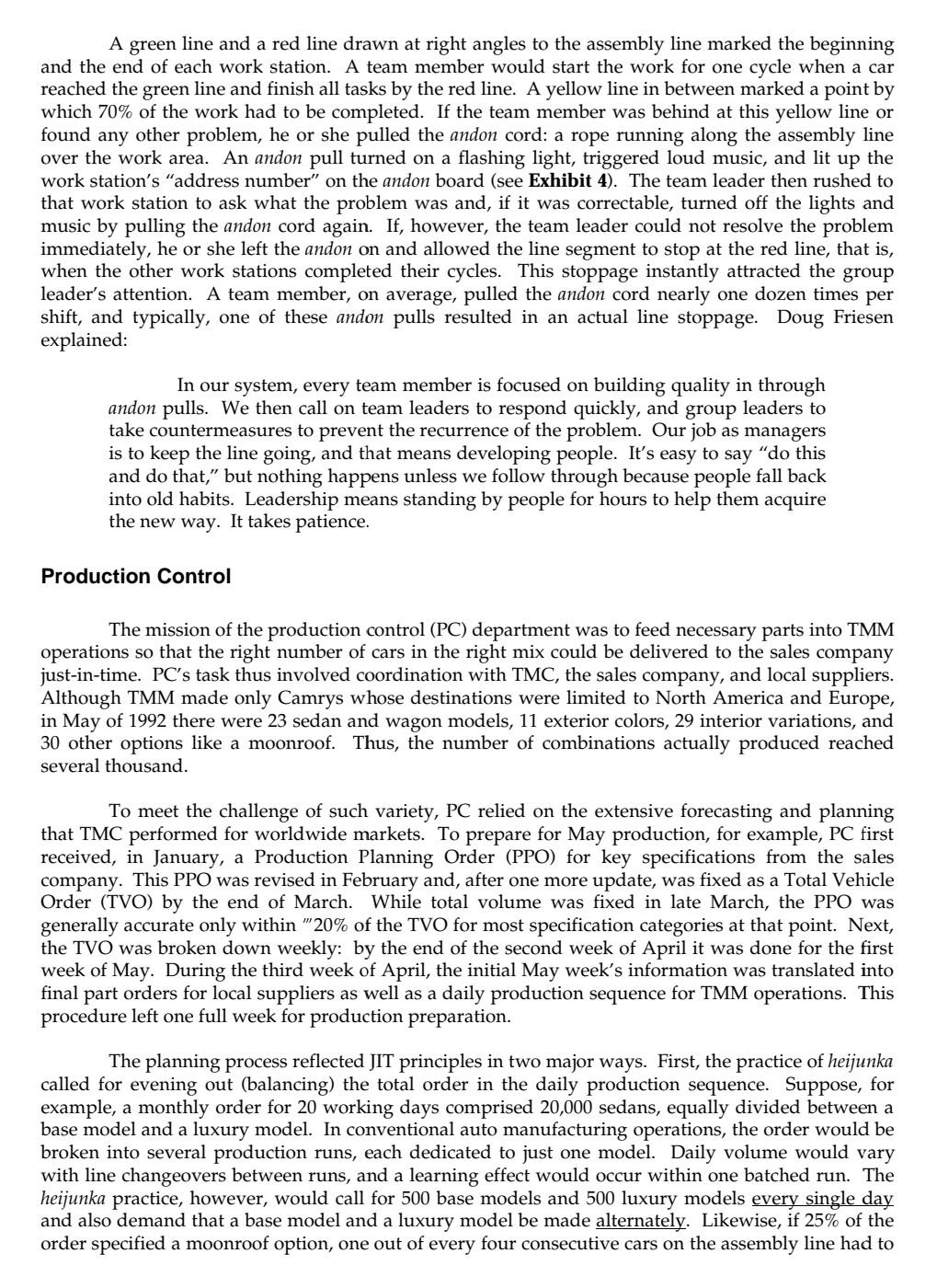
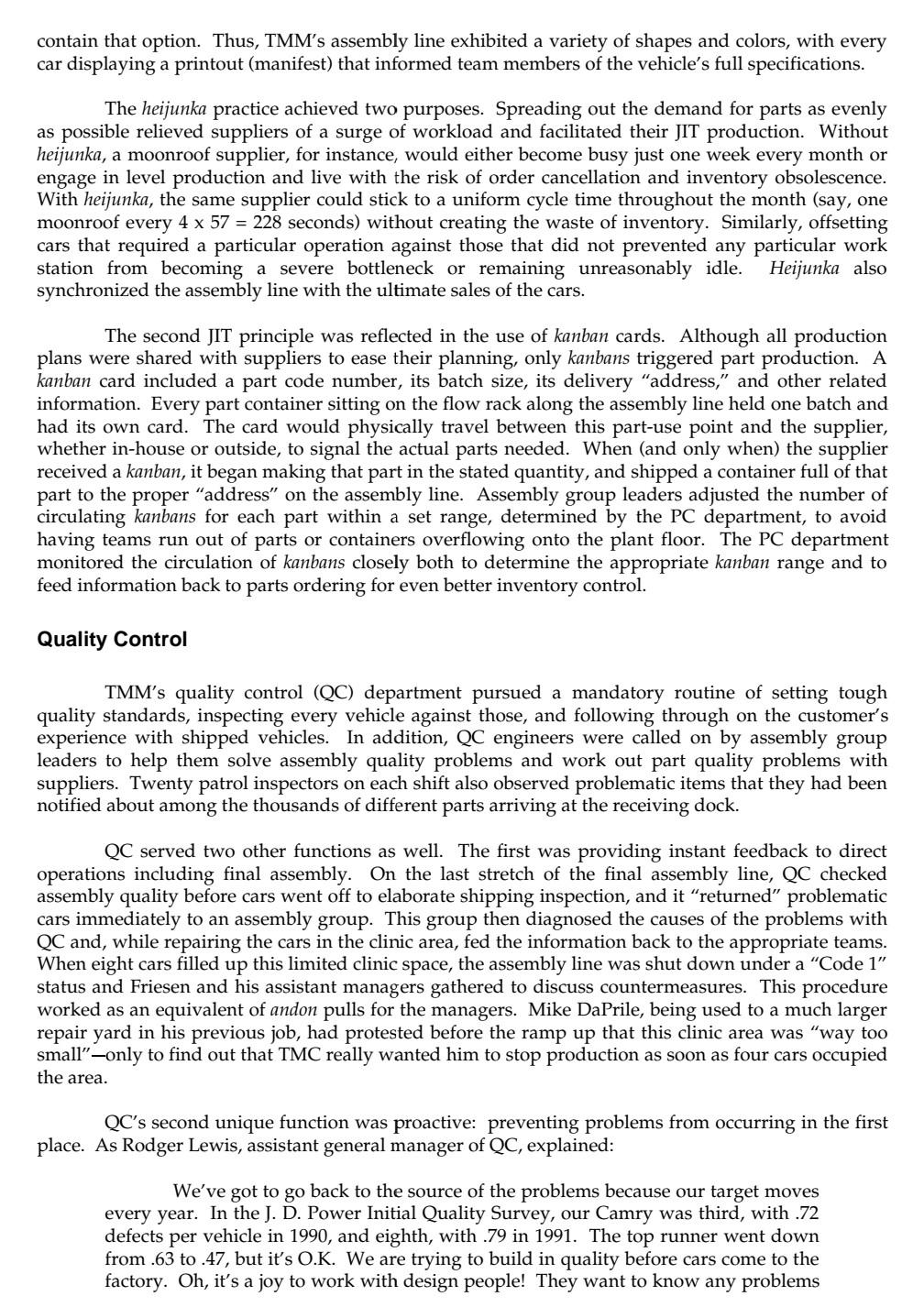
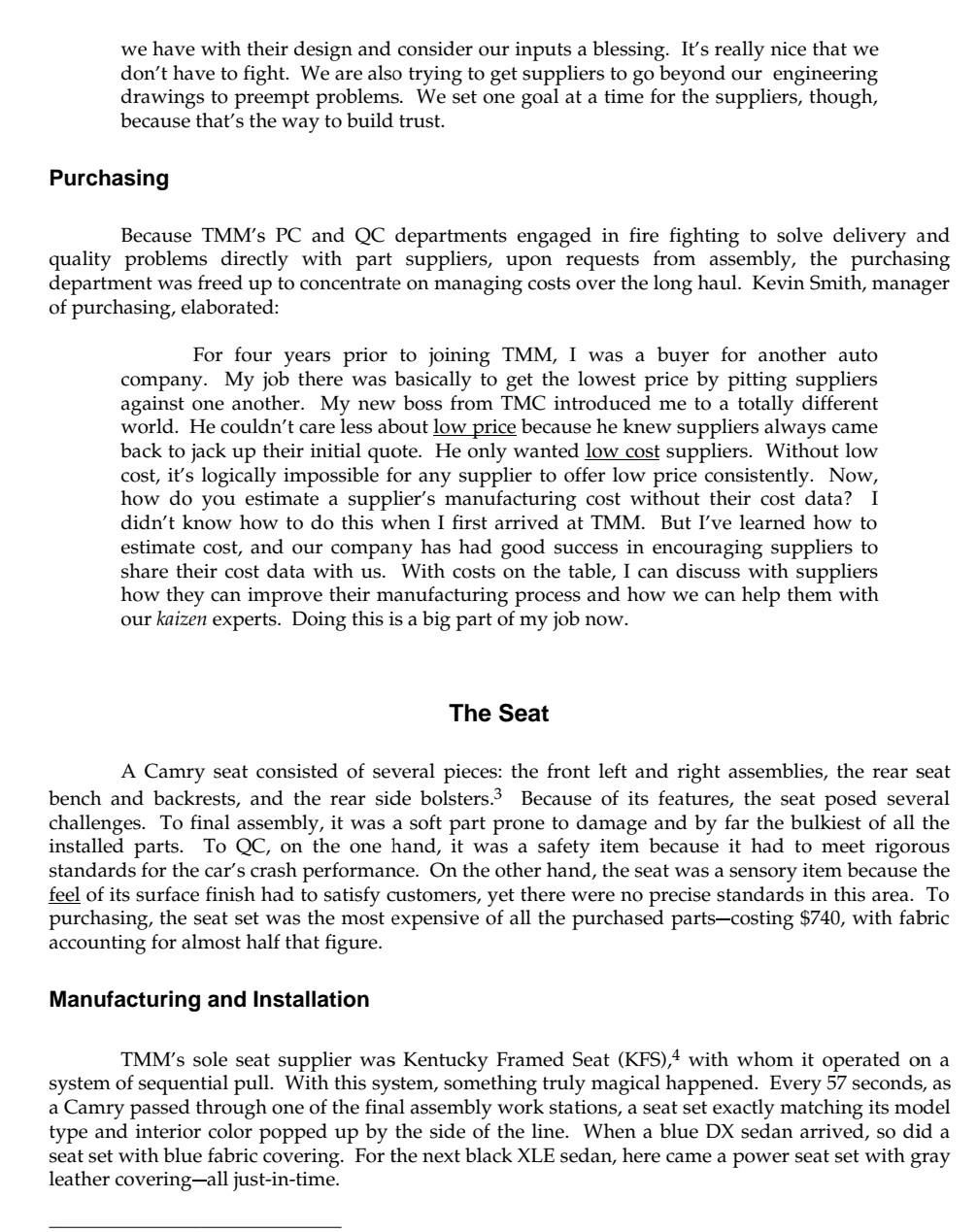
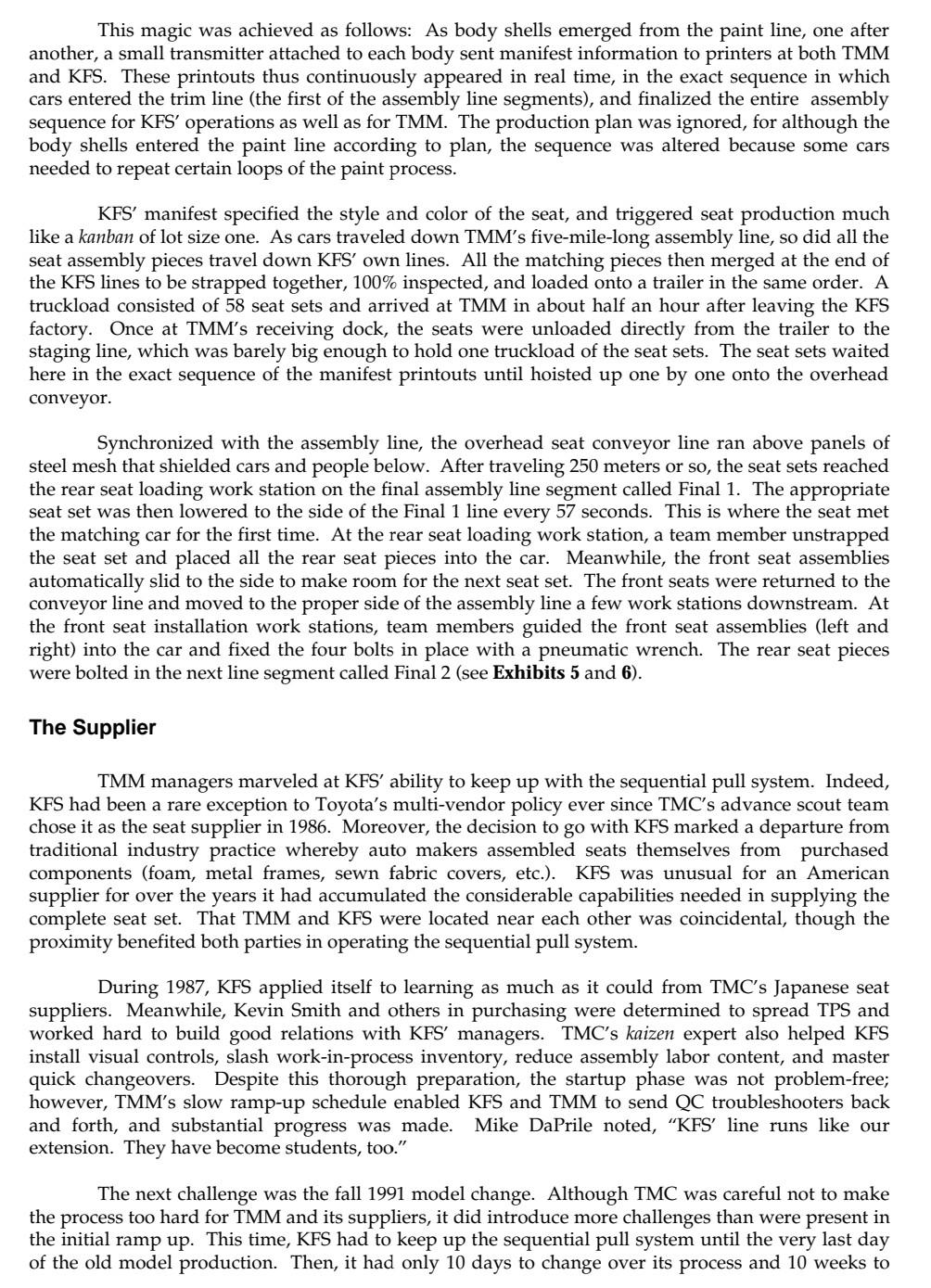
Toyota Motor Manufacturing, U.S.A., Inc. On the Friday before the running of the 118th Kentucky Derby, Doug Friesen, manager of assembly for Toyota's Georgetown, Kentucky, Plant, was approaching the final assembly lines, where shiny Camrys took shape. He heard a cheer go up. Team members on the lines were waving their hand tools towards a signboard that read "no overtime for the shift. Smiling broadly, Friesen agreed: everyone in the plant surely deserved a relaxed Derby weekend. The plant had been hectic lately, as it was both supplying brisk sales of the all-new Camry sedan and ramping up station wagon versions for the European as well as North American markets. Overtime also had been necessary early in the week to make up lost production because the line utilization rate was below the projected target. In addition to these immediate problems, a growing number of cars were sitting off the line with defective seats or with no seats at all. The seat problem had been the subject of an urgent meeting called by Mike DaPrile, general manager of the assembly plant, that morning, May 1, 1992. At the meeting, Friesen learned of the situation firsthand from key people in both the plant and the seat supplier. He then spent the afternoon on the shop floor to learn more about the problem while the issues discussed were fresh in his mind. By the end of the day, it became clear to Friesen that the seat problem needed solving once and for all; the trouble was that trying to do so could hurt line utilization. This was not the first tough question Toyota's famous production system had encountered, nor would it be the last. But this seat problem was especially delicate and undoubtedly would demand Friesen's attention in the following week. Background In the early 1980s, Japanese auto makers contemplated building cars in North America. Japan's huge trade imbalance had caused political pressure to mount, while the economic feasibility of such investment had improved with a rapidly rising yen. At that time, however, it was unclear whether cars produced outside Japan could live up to their hard-earned reputation of high quality at low cost. This issue was far from settled in 1985 when Toyota Motor Corporation (TMC) unveiled its plan to open an $800 million greenfield plant in Kentucky. (See Exhibit 1.) Thus, the company's endeavor to transplant its unique production system to Bluegrass Country effectively became a live experiment for the world to watch. In July 1988, Toyota Motor Manufacturing, U.S.A. (TMM) began volume production on a 1,300 acre site in Georgetown, near Lexington. The plant had an annual capacity of 200,000 Toyota Camry sedans, which would replace the bulk of Japanese imports of the same model. In 1992, TMM was expected to supply 240,000 of the all-new Camrys, whose sales were up by more than 20% since the model change in fall 1991. The new Camry joined the ranks of midsize family sedans, which constituted one-third of the total American car market and returned an average 17% pretax profit margin' on a sticker price averaging $18,500. For the first time, in March 1992, TMM started producing wagon versions of the new Camry exclusively within Toyota's worldwide plant network. Toyota Production System2 Since its inception, Toyota had always striven for "better cars for more people. This meant producing cars meeting diverse customer preferences with flawless quality. It further meant delivering cars at an affordable price with perfect timing. This ambitious goal had seemed nearly elusive after the Second World War, since most people in Japan could not afford a car even at cost. In addition, the country's labor productivity was only one-eighth of that of the United States. In essence, Toyota was challenged to cut cost dramatically, but without the scale economies that American firms enjoyed. It needed an entirely new source of economies to satisfy customers with variety, quality, and timeliness, all at a reasonable price. The Toyota Production System (TPS) evolved as Toyota's answer to this challenge, and served as a common frame of reference among all its employees. TPS aimed at cost reduction by thoroughly eliminating waste, which, in production environments tended to snowball unnoticeably. Waste of overproduction, for example, not only tied up working capital in inventory, but it necessitated warehouse storage space, forklift trucks to move goods about, material handlers to operate trucks, computers to keep track of inventory locations, a staff to maintain the computerized system, and so on. Furthermore, overproduction often concealed the location of the true bottleneck and thereby invited investment in the wrong equipment, resulting in excess capacity. Identifying what was waste in reality, however, was no simple matter. Thus, TPS provided two guiding principles to facilitate this critical process. The first was the principle of Just-In-Time (JIT) production: produce only what was needed, only how much was needed, and only when it was needed. Any deviation from true production needs was condemned as waste. The second was the principle of jidoka: make any production problems instantly self-evident and stop producing whenever problems were detected. In other words, jidoka insisted on building in quality in the production process and condemned any deviation from value-addition as waste. TPS defined "needs" and "value" from the viewpoint of the next station down the line, that is, the immediate customer. These TPS principles reflected two assumptions about production environments. First, true needs would deviate from a production plan unpredictably, no matter how meticulously that plan was prepared: hence the virtue of JIT production. Second, problems would crop up constantly on the shop floor, making deviations from planned operating conditions inevitable: hence the virtue of jidoka. TPS, of course, encouraged continually improving the planning process, but it also strongly emphasized alerting plant people to deviations from any plans about how production was to proceed. To implement the TPS principles, Toyota employed a variety of tools, many described later in this case. For JIT production, these tools were used to keep information flow as close to the physical flow of parts as possible. Parts were thus pulled from downstream based on actual usage, rather than pushed from upstream based on a planned schedule remote from the shop floor. This arrangement required upstream stations to be capable of changing over among parts with minimal setup time. Hence, creating a flowing production process was a prerequisite for TPS. The purposes of jidoka tools were to aid immediate problem detection and facilitate visual control. For them to work properly, the normal state of operations had to be well characterized and understood. Therefore, another prerequisite of TPS was standardizing the process and documenting the standard plainly. Finally, TPS depended on human infrastructure, symbolized by Toyota's corporate slogan: "Good Thinking, Good Products." Plants practicing JIT and jidoka principles were extremely prone to shutdowns, and would be paralyzed without people capable of solving exposed problems promptly, completely, and systematically. Toyota thus instilled good thinking in all its employees through senior management coaching and internal training programs. These efforts cultivated two strong attitudes that permeated the organization: stick to the facts, and get down to the root cause of the problem. A typical discussion of a problem would start with "let's go see it" and then converge on the "Five Whys exercise. This exercise consisted of asking a chain of "why" questions until the root cause was identified and countermeasures determined (see Exhibit 2). Methodical thinking extended beyond solving problems after the fact. It enabled people to seek kaizen: change for the better. At Toyota, as soon as anyone established a standard way of doing a Kaizen was job, that person set out to demolish it proactively, to install an even better way. indispensable in pursuing TPS goals continuously and indefinitely. The Georgetown Ramp Up Developing human infrastructure was TMC's foremost priority in transplanting TPS to Georgetown, as evidenced by several decisions made early on. First, TMC assigned to TMM the 1987 Camry that was already being mass-produced in its Tsutsumi plant in Japan. Second, it replicated the Tsutsumi line as closely as possible at TMM. And third, it set a deliberately slow ramp up schedule. As a result, TMC could find people in Tsutsumi who, based on their own experience, were able to demonstrate to TMM how to solve the problems encountered in that plant. While construction was underway at Georgetown in early 1986, TMM initiated a hiring and training program (run out of a trailer office). It began with top managers and proceeded to core operations personnel; these people primarily came from within the industry and formed the nucleus of TMM operations. Their first encounter with TPS occurred during a month-long trip to Tsutsumi, to which Doug Friesen's reaction was quite typical: I built cars at Tsutsumi, and couldn't believe 60% of what I saw there. The line was unbelievably fast-paced, the plant was kind of run down, and the American company I left had more automation. The good things I saw were just common sense and no big deal at all. My eyes weren't open back then. Next, TMC sent Tsutsumi people to Georgetown, hundreds of them in all. These trainers-on- loan coached TMM supervisory personnel one-on-one and reinforced TPS basics. Every TMM manager was also paired with a coordinator from TMC, who remained in Kentucky for a few years. These coordinators were charged to develop their counterparts only by persuasionnot to do things themselves. This intensely personal approach brought an eye-opening" moment to most TMM people. As TMC's plan unfolded in front of them, they could witness actions in the context around them, appreciate unexpectedly positive results, and have their coaches make sense of what lay behind these results. Although everyone had a unique episode that marked a turning point, they converged on one point: "TPS isolates problems from people and thereby enables people to focus on solving problems." Fujio Cho, president of TMM and TPS evangelist, described his vision: We fortunately have not seen any surprises so far. I believe in the universality of TPS and its ability to deliver high quality. To develop TMM, we put safety above all else and began with quality. We then added productivity to our target. Right now, our cars are as good as Tsutsumi's in quality and we are only slightly behind in productivity. We are currently moving to the next step-worrying about cost and spreading TPS to local suppliers. I am hopeful that we can make TMM a truly American company that contributes to the community. In early 1992, Georgetown's huge complex employed over 4,000 people, representing $150 million in annual payroll. In the plant's backyard, construction was underway to double TMM's capacity. Operations In Georgetown, the power train plant supplied engines and axles to the assembly plant, which performed sheet metal stamping, plastic molding, body welding, painting, and assembly operations. In these direct operations as well as in their support functions (see Exhibit 3), TPS was deployed as a set of management tools to be practiced daily. Mike DaPrile commented: TPS highlights problems so that people can see them easily. The hard part is teaching it so that people practice it because they want to, rather than because they have to. To teach it well, you have to get to know people very deeply and over time. In the process, we all become students here. In fact, I have learned more in the last five years than I did in the 25 years I spent with another auto company. Assembly Assembly operations were performed along 353 stations on a conveyor line, over five miles in length and consisting of several connected line segments: the trim lines, chassis lines, and final assembly lines. Adjacent line segments were decoupled by a few cars, and the entire assembly line was buffered from the power train plant and the paint line with about half an hour's production. The line currently operated on a line cycle time of 57 seconds, down from 60 at the startup. Assembly and part handling required 769 team members, who were paid an average of $17 an hour (not including benefits), plus a 50% premium for overtime. A team usually had four members and one team leader, who received a premium of 5% to 8%. To supervise these team leaders and team members in two shifts, Doug Friesen worked closely with 10 assistant managers and 46 group leaders (see Exhibit 3). A regular shift lasted 525 minutes, including 45 minutes of unpaid lunch time and two paid 15-minute breaks. When a team member had to leave the moving line, the team leader filled in that position as a line rover. Every station on the assembly line embodied jidoka and kaizen tools. A standardized work chart was posted adjacent to each work station on the line, showing the cycle time of that station, the sequence of work tasks, and the timing to perform them within one cycle. Colored tape marked out areas of the floor to specify where just about everything in sight belonged, and promoted the "4Ss (sift, sort, sweep, spic-and-span). In the resulting work environment, any deviations from normal conditions stood out visually. A green line and a red line drawn at right angles to the assembly line marked the beginning and the end of each work station. A team member would start the work for one cycle when a car reached the green line and finish all tasks by the red line. A yellow line in between marked a point by which 70% of the work had to be completed. If the team member was behind at this yellow line or found any other problem, he or she pulled the andon cord: a rope running along the assembly line over the work area. An andon pull turned on a flashing light, triggered loud music, and lit up the work station's "address number" on the andon board (see Exhibit 4). The team leader then rushed to that work station to ask what the problem was and, if it was correctable, turned off the lights and music by pulling the andon cord again. If, however, the team leader could not resolve the problem immediately, he or she left the andon on and allowed the line segment to stop at the red line, that is, when the other work stations completed their cycles. This stoppage instantly attracted the group leader's attention. A team member, on average, pulled the andon cord nearly one dozen times per shift, and typically, one of these andon pulls resulted in an actual line stoppage. Doug Friesen explained: In our system, every team member is focused on building quality in through andon pulls. We then call on team leaders to respond quickly, and group leaders to take countermeasures to prevent the recurrence of the problem. Our job as managers is to keep the line going, and that means developing people. It's easy to say do this and do that," but nothing happens unless we follow through because people fall back into old habits. Leadership means standing by people for hours to help them acquire the new way. It takes patience. Production Control The mission of the production control (PC) department was to feed necessary parts into TMM operations so that the right number of cars in the right mix could be delivered to the sales company just-in-time. PC's task thus involved coordination with TMC, the sales company, and local suppliers. Although TMM made only Camrys whose destinations were limited to North America and Europe, in May of 1992 there were 23 sedan and wagon models, 11 exterior colors, 29 interior variations, and 30 other options like a moonroof. Thus, the number of combinations actually produced reached several thousand. To meet the challenge of such variety, PC relied on the extensive forecasting and planning that TMC performed for worldwide markets. To prepare for May production, for example, PC first received, in January, a Production Planning Order (PPO) for key specifications from the sales company. This PPO was revised in February and, after one more update, was fixed as a Total Vehicle Order (TVO) by the end of March. While total volume was fixed in late March, the PPO was generally accurate only within "20% of the TVO for most specification categories at that point. Next, the TVO was broken down weekly: by the end of the second week of April it was done for the first week of May. During the third week of April, the initial May week's information was translated into final part orders for local suppliers as well as a daily production sequence for TMM operations. This procedure left one full week for production preparation. The planning process reflected JIT principles in two major ways. First, the practice of heijunka called for evening out (balancing) the total order in the daily production sequence. Suppose, for example, a monthly order for 20 working days comprised 20,000 sedans, equally divided between a base model and a luxury model. In conventional auto manufacturing operations, the order would be broken into several production runs, each dedicated to just one model. Daily volume would vary with line changeovers between runs, and a learning effect would occur within one batched run. The heijunka practice, however, would call for 500 base models and 500 luxury models every single day and also demand that a base model and a luxury model be made alternately. Likewise, if 25% of the order specified a moonroof option, one out of every four consecutive cars on the assembly line had to contain that option. Thus, TMM's assembly line exhibited a variety of shapes and colors, with every car displaying a printout (manifest) that informed team members of the vehicle's full specifications. The heijunka practice achieved two purposes. Spreading out the demand for parts as evenly as possible relieved suppliers of a surge of workload and facilitated their JIT production. Without heijunka, a moonroof supplier, for instance, would either become busy just one week every month or engage in level production and live with the risk of order cancellation and inventory obsolescence. With heijunka, the same supplier could stick to a uniform cycle time throughout the month (say, one moonroof every 4 x 57 = 228 seconds) without creating the waste of inventory. Similarly, offsetting cars that required a particular operation against those that did not prevented any particular work station from becoming a severe bottleneck or remaining unreasonably idle. Heijunka also synchronized the assembly line with the ultimate sales of the cars. The second JIT principle was reflected in the use of kanban cards. Although all production plans were shared with suppliers to ease their planning, only kanbans triggered part production. A kanban card included a part code number, its batch size, its delivery "address," and other related information. Every part container sitting on the flow rack along the assembly line held one batch and had its own card. The card would physically travel between this part-use point and the supplier, whether in-house or outside, to signal the actual parts needed. When (and only when) the supplier received a kanban, it began making that part in the stated quantity, and shipped a container full of that part to the proper "address" on the assembly line. Assembly group leaders adjusted the number of circulating kanbans for each part within a set range, determined by the PC department, to avoid having teams run out of parts or containers overflowing onto the plant floor. The PC department monitored the circulation of kanbans closely both to determine the appropriate kanban range and to feed information back to parts ordering for even better inventory control. Quality Control TMM's quality control (QC) department pursued a mandatory routine of setting tough quality standards, inspecting every vehicle against those, and following through on the customer's experience with shipped vehicles. In addition, QC engineers were called on by assembly group leaders to help them solve assembly quality problems and work out part quality problems with suppliers. Twenty patrol inspectors on each shift also observed problematic items that they had been notified about among the thousands of different parts arriving at the receiving dock. QC served two other functions as well. The first was providing instant feedback to direct operations including final assembly. On the last stretch of the final assembly line, QC checked assembly quality before cars went off to elaborate shipping inspection, and it returned" problematic cars immediately to an assembly group. This group then diagnosed the causes of the problems with QC and, while repairing the cars in the clinic area, fed the information back to the appropriate teams. When eight cars filled up this limited clinic space, the assembly line was shut down under a "Code 1" status and Friesen and his assistant managers gathered to discuss countermeasures. This procedure worked as an equivalent of andon pulls for the managers. Mike DaPrile, being used to a much larger repair yard in his previous job, had protested before the ramp up that this clinic area was "way too small"-only to find out that TMC really wanted him to stop production as soon as four cars occupied the area. QC's second unique function was proactive: preventing problems from occurring in the first place. As Rodger Lewis, assistant general manager of QC, explained: We've got to go back to the source of the problems because our target moves every year. In the J. D. Power Initial Quality Survey, our Camry was third, with .72 defects per vehicle in 1990, and eighth, with .79 in 1991. The top runner went down from .63 to.47, but it's O.K. We are trying to build in quality before cars come to the factory. Oh, it's a joy to work with design people! They want to know any problems we have with their design and consider our inputs a blessing. It's really nice that we don't have to fight. We are also trying to get suppliers to go beyond our engineering drawings to preempt problems. We set one goal at a time for the suppliers, though, because that's the way to build trust. Purchasing Because TMM's PC and QC departments engaged in fire fighting to solve delivery and quality problems directly with part suppliers, upon requests from assembly, the purchasing department was freed up to concentrate on managing costs over the long haul. Kevin Smith, manager of purchasing, elaborated: For four years prior to joining TMM, I was a buyer for another auto company. My job there was basically to get the lowest price by pitting suppliers against one another. My new boss from TMC introduced me to a totally different world. He couldn't care less about low price because he knew suppliers always came back to jack up their initial quote. He only wanted low cost suppliers. Without low cost, it's logically impossible for any supplier to offer low price consistently. Now, how do you estimate a supplier's manufacturing cost without their cost data? I didn't know how to do this when I first arrived at TMM. But I've learned how to estimate cost, and our company has had good success in encouraging suppliers to share their cost data with us. With costs on the table, I can discuss with suppliers how they can improve their manufacturing process and how we can help them with our kaizen experts. Doing this is a big part of my job now. The Seat A Camry seat consisted of several pieces: the front left and right assemblies, the rear seat bench and backrests, and the rear side bolsters. Because of its features, the seat posed several challenges. To final assembly, it was a soft part prone to damage and by far the bulkiest of all the installed parts. To QC, on the one hand, it was a safety item because it had to meet rigorous standards for the car's crash performance. On the other hand, the seat was a sensory item because the feel of its surface finish had to satisfy customers, yet there were no precise standards in this area. To purchasing, the seat set was the most expensive of all the purchased parts-costing $740, with fabric accounting for almost half that figure. Manufacturing and Installation TMM's sole seat supplier was Kentucky Framed Seat (KFS),4 with whom it operated on a system of sequential pull. With this system, something truly magical happened. Every 57 seconds, as a Camry passed through one of the final assembly work stations, a seat set exactly matching its model type and interior color popped up by the side of the line. When a blue DX sedan arrived, so did a seat set with blue fabric covering. For the next black XLE sedan, here came a power seat set with gray leather covering-all just-in-time. This magic was achieved as follows: As body shells emerged from the paint line, one after another, a small transmitter attached to each body sent manifest information to printers at both TMM and KFS. These printouts thus continuously appeared in real time, in the exact sequence in which cars entered the trim line (the first of the assembly line segments), and finalized the entire assembly sequence for KFS' operations as well as for TMM. The production plan was ignored, for although the body shells entered the paint line according to plan, the sequence was altered because some cars needed to repeat certain loops of the paint process. KFS' manifest specified the style and color of the seat, and triggered seat production much like a kanban of lot size one. As cars traveled down TMM's five-mile-long assembly line, so did all the seat assembly pieces travel down KFS' own lines. All the matching pieces then merged at the end of the KFS lines to be strapped together, 100% inspected, and loaded onto a trailer in the same order. A truckload consisted of 58 seat sets and arrived at TMM in about half an hour after leaving the KFS factory. Once at TMM's receiving dock, the seats were unloaded directly from the trailer to the staging line, which was barely big enough to hold one truckload of the seat sets. The seat sets waited here in the exact sequence of the manifest printouts until hoisted up one by one onto the overhead conveyor. Synchronized with the assembly line, the overhead seat conveyor line ran above panels of steel mesh that shielded cars and people below. After traveling 250 meters or so, the seat sets reached the rear seat loading work station on the final assembly line segment called Final 1. The appropriate seat set was then lowered to the side of the Final 1 line every 57 seconds. This is where the seat met the matching car for the first time. At the rear seat loading work station, a team member unstrapped the seat set and placed all the rear seat pieces into the car. Meanwhile, the front seat assemblies automatically slid to the side to make room for the next seat set. The front seats were returned to the conveyor line and moved to the proper side of the assembly line a few work stations downstream. At the front seat installation work stations, team members guided the front seat assemblies (left and right) into the car and fixed the four bolts in place with a pneumatic wrench. The rear seat pieces were bolted in the next line segment called Final 2 (see Exhibits 5 and 6). The Supplier TMM managers marveled at KFS' ability to keep up with the sequential pull system. Indeed, KFS had been a rare exception to Toyota's multi-vendor policy ever since TMC's advance scout team chose it as the seat supplier in 1986. Moreover, the decision to go with KFS marked a departure from traditional industry practice whereby auto makers assembled seats themselves from purchased components (foam, metal frames, sewn fabric covers, etc.). KFS was unusual for an American supplier for over the years it had accumulated the considerable capabilities needed in supplying the complete seat set. That TMM and KFS were located near each other was coincidental, though the proximity benefited both parties in operating the sequential pull system. During 1987, KFS applied itself to learning as much as it could from TMC's Japanese seat suppliers. Meanwhile, Kevin Smith and others in purchasing were determined to spread TPS and worked hard to build good relations with KFS' managers. TMC's kaizen expert also helped KFS install visual controls, slash work-in-process inventory, reduce assembly labor content, and master quick changeovers. Despite this thorough preparation, the startup phase was not problem-free; however, TMM's slow ramp-up schedule enabled KFS and TMM to send QC troubleshooters back and forth, and substantial progress was made. Mike Da Prile noted, "KFS' line runs like our extension. They have become students, too." The next challenge was the fall 1991 model change. Although TMC was reful not to ma the process too hard for TMM and its suppliers, it did introduce more challenges than were present in the initial ramp up. This time, KFS had to keep up the sequential pull system until the very last day of the old model production. Then, it had only 10 days to change over its process and 10 weeks to build up to full capacity for the new model. Nonetheless, according to TMM managers, the model changeover process was uneventful, and that description included KFS' performance as well. Signs of Problems Despite KFS' success with the sequential pull system, by early 1992 there was cause for concern: product proliferation. The old model Camry seat had three styles and four colors; the 1992 Camry offered only three seat colors but had five styles. The problem intensified in March when TMM launched the Camry wagons and became the sole source of these cars for the first time for Toyota worldwide. The wagon models destined for North America added eight seat variations immediately, but producing for the world market added considerably to that number. Indeed, in April, wagons destined for Europe added another 10 variations, and on the horizon was export to Japan and the Middle East, and this would add still another 18 seat variations. The impact of the wagons for Europe was apparent to Doug Friesen. When he returned from a trip to Japan on April 27th, the run ratio was down to a meager 85%. This figure, which Friesen watched closely, measured the number of cars actually assembled in proportion to the number of cars that could have been assembled with no line stoppages. It had been around 95% when he had last seen it early in the month. This 10-point drop meant a shortfall of 45 cars per shift, which had to be made up with overtime. In addition, on April 30th, Mike DaPrile became concerned by an alarmingly high level of off-line vehicle inventory. Presumably, too many cars needed off-line operations of one type or another before they could go on to shipping. To DaPrile, this situation meant that the sales company was not getting cars on time as promised, and one of the main culprits was the seat. After mulling over the problem, he had asked Rodger Lewis to schedule an urgent meeting the following morning The cars with seat problems accumulating off-line reflected TMM's choice for handling occasional glitches. What if a seat set and car did not match at the magic moment? What if a matching seat set arrived with defects? TMM standardized its response as follows. First, a team member pulled the andon cord to report the problem to the team leader before installing the defective seat. The team leader then pulled the andon cord to signal okay, and tagged the car to alert QC inspectors to the seat problem. The car then went through the rest of the assembly line as usual with the defective seat in it. Upon line-off, the car was driven to the Code 1 clinic area to see if the problem was correctable there. If the problem called for a replacement seat, the car was moved to the overflow parking area where the replacement seat was ordered and the car waited for KFS' special delivery. Defective seats were returned to KFS. This routine was made an exception to the standard practice of investigating problems on the line, even at the expense of shutting down the line, for three reasons: first, the final assembly people already knew of the problem; second, it was possible to finish building the car without seat assemblies; third, it was felt that stopping the line was too expensive given how long it took to obtain the replacement seat. May 1, 1992 The meeting Lewis scheduled took place from 10:00 to 11:30 in the overflow parking area. In addition to DaPrile and Lewis, those attending were Doug Friesen; group leader of the clinic and overflow parking area, Jim Cremeens; and PC and QC managers from TMM and KFS. DaPrile began by explaining the situation. Lewis then summed up seat quality trends, recalling the monthly QC meetings between TMM and KFS (Exhibit 7). Cremeens also handed out his data on recent seat problems (Exhibit 8). After some discussion, DaPrile proposed they walk through the overflow parking area to see for themselves the problems just discussed. Examining sheets of paper under each car's wiper, the group found 18 vehicles with various seat problems. They also discovered that some cars dated as far back as April 27, a major surprise because cars were supposed to leave this area with retrofit seat assemblies within the same or the following shift. According to Cremeens, his team members faxed a seat reorder form (Exhibit 9) as soon as a car came in, and KFS responded with a special delivery of replacements twice a day. He suggested that KFS sometimes sent the wrong seat assembliesones that did not match any of the cars waiting for rework. The group brainstormed about this information, trying to figure out what went wrong. All the ideas remained under consideration, however, when the meeting adjourned. After the group dispersed, Friesen walked down the aisle between Final 1 and Final 2, determined to learn more about the problem. While studying some data posted at work stations along the lines (Exhibit 10), he found a few people near the front seat installation area and asked them about seats. The only problem they could think of was occasional incidents of cross-threading, that is, when a team member shot a bolt at an angle. Team leaders, however, could fix this familiar problem on-line in 30 seconds with a re-tapping tool. The team members also reminded Friesen of rare incidents when someone would accidentally damage the seat covering with hand tools, but they could not recall any recent occurrences. Being used to seat defects, they looked increasingly puzzled when Friesen kept asking about seat problems. Friesen then found the group leader of Final 2, Shirley Sargent. She mentioned that she and her team leaders had been busy with the new team members she had received through a rotation program at the beginning of April. Regarding the seat, she drew Friesen's attention to an ongoing problem since the past fall: during rear side bolster installation, a hook protruding from the back of that part was to be snapped into the "eye of the body (see Exhibit 11), but the hook sometimes broke off. She suspected that its sharp edge made it brittle, and was curious about the status of an engineering change request she had filed several months ago. Friesen remembered that Cremeens had blamed the design of the 1992 Camry for the hook problem, noting that the hook had been changed from metal to plastic. Later that afternoon, however, Friesen learned three facts from QC: modifying the relevant tooling for the hook would cost KFS about $50,000; Tsutsumi, which used the identical engineering drawings for the part, had not reported the problem; and hook breakage frequency had gone down from about seven occurrences per shift at the new model introduction to one per shift by April. Leaving Final 2, Friesen tried to sort out all the information he had gathered during the day. He then pondered what he should do next Monday to follow up on the meeting and resolve the seat problem: I take responsibility for allowing the seat problem to go on this long. It's clear that we lacked a "system for recovering from the problem. But, what does it mean to implement JIT and jidoka principles in this situation? More broadly, are we handling seat defects correctly on the line? Is our current routine for handling seat- defect cars really a legitimate exception to TPS, or could it be a dangerous deviation from TPS? After all, we swear by building in quality on the line. Yet we know all too well how painful it is to lose production. Maybe there's a way to kaizen our off-line routine. These are all hard questions, but we must begin somewhere
Step by Step Solution
There are 3 Steps involved in it

Get step-by-step solutions from verified subject matter experts