



Question: Shreve Exercise (Solving the Vasicek equation) The Vasicek interest rate stochastic equation is dR(t)=(R(t))dt+dW(t) where ,, and are positive constants. The solution to this equation
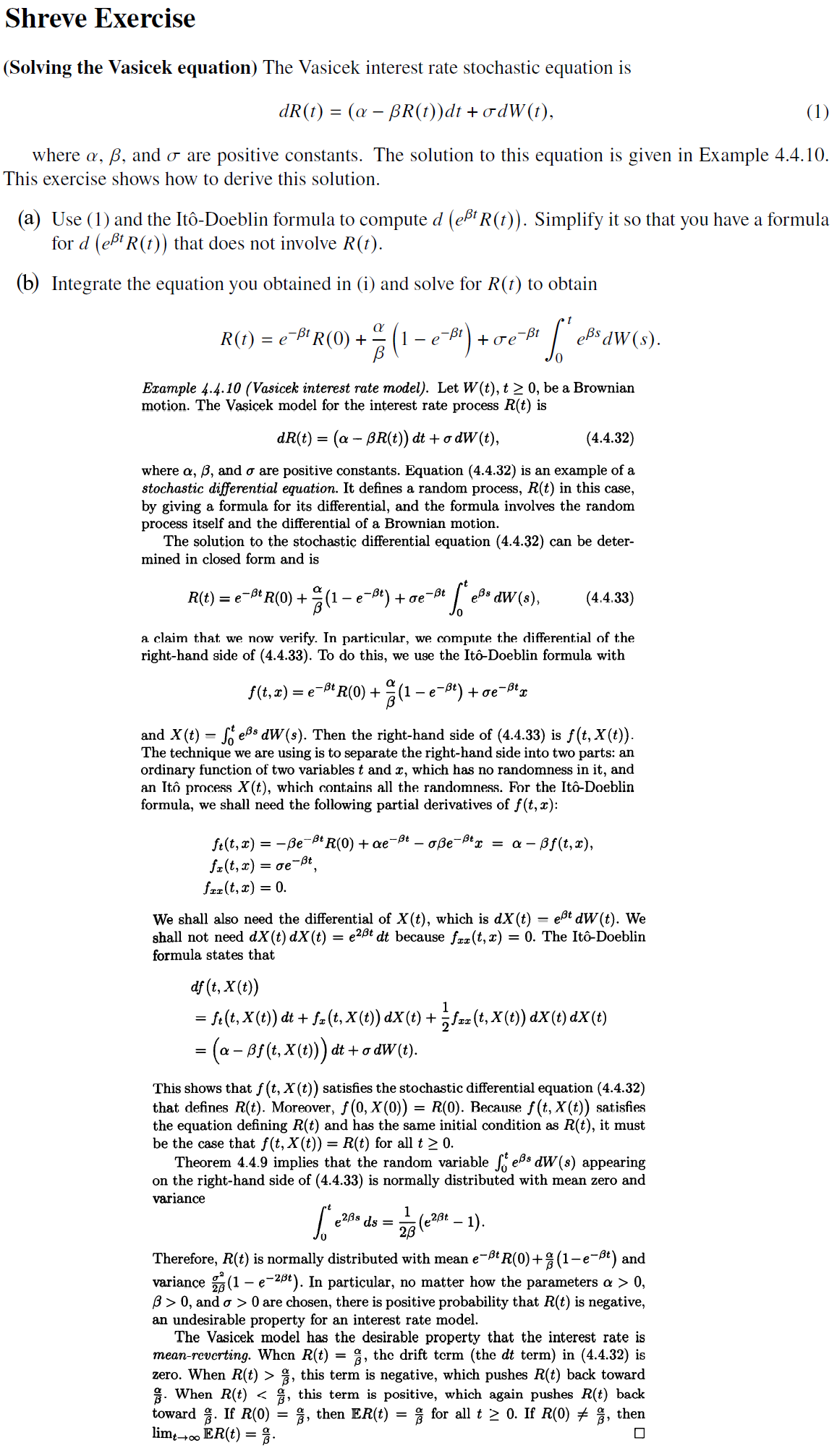
Shreve Exercise (Solving the Vasicek equation) The Vasicek interest rate stochastic equation is dR(t)=(R(t))dt+dW(t) where ,, and are positive constants. The solution to this equation is given in Example 4.4.10. This exercise shows how to derive this solution. (a) Use (1) and the It-Doeblin formula to compute d(etR(t)). Simplify it so that you have a formula for d(etR(t)) that does not involve R(t). (b) Integrate the equation you obtained in (i) and solve for R(t) to obtain R(t)=etR(0)+(1et)+et0tesdW(s). Example 4.4.10 (Vasicek interest rate model). Let W(t),t0, be a Brownian motion. The Vasicek model for the interest rate process R(t) is dR(t)=(R(t))dt+dW(t), where ,, and are positive constants. Equation (4.4.32) is an example of a stochastic differential equation. It defines a random process, R(t) in this case, by giving a formula for its differential, and the formula involves the random process itself and the differential of a Brownian motion. The solution to the stochastic differential equation (4.4.32) can be determined in closed form and is R(t)=etR(0)+(1et)+et0tesdW(s), a claim that we now verify. In particular, we compute the differential of the right-hand side of (4.4.33). To do this, we use the It-Doeblin formula with f(t,x)=etR(0)+(1et)+etx and X(t)=0tesdW(s). Then the right-hand side of (4.4.33) is f(t,X(t)). The technique we are using is to separate the right-hand side into two parts: an ordinary function of two variables t and x, which has no randomness in it, and an It process X(t), which rontains all the randomness. For the It-Doeblin formula, we shall need the following partial derivatives of f(t,x) : ft(t,x)fx(t,x)fxx(t,x)=etR(0)+etetx=f(t,x),=et,=0. We shall also need the differential of X(t), which is dX(t)=etdW(t). We shall not need dX(t)dX(t)=e2tdt because fxx(t,x)=0. The It-Doeblin formula states that df(t,X(t))=ft(t,X(t))dt+fx(t,X(t))dX(t)+21fxx(t,X(t))dX(t)dX(t)=(f(t,X(t)))dt+dW(t). This shows that f(t,X(t)) satisfies the stochastic differential equation (4.4.32) that defines R(t). Moreover, f(0,X(0))=R(0). Because f(t,X(t)) satisfies the equation defining R(t) and has the same initial condition as R(t), it must be the case that f(t,X(t))=R(t) for all t0. Theorem 4.4.9 implies that the random variable 0tesdW(s) appearing on the right-hand side of (4.4.33) is normally distributed with mean zero and variance 0te2sds=21(e2t1). Therefore, R(t) is normally distributed with mean etR(0)+(1et) and variance 22(1e2t). In particular, no matter how the parameters >0, >0, and >0 are chosen, there is positive probability that R(t) is negative, an undesirable property for an interest rate model. The Vasicek model has the desirable property that the interest rate is mean-reverting. When R(t)=, the drift term (the dt term) in (4.4.32) is zero. When R(t)>, this term is negative, which pushes R(t) back toward . When R(t)
Step by Step Solution
There are 3 Steps involved in it

Get step-by-step solutions from verified subject matter experts