







Question: Slander is spoken, in print it's libel This is one of the most famous Supreme Court cases around free speech dealing with the question of
"Slander is spoken, in print it's libel"
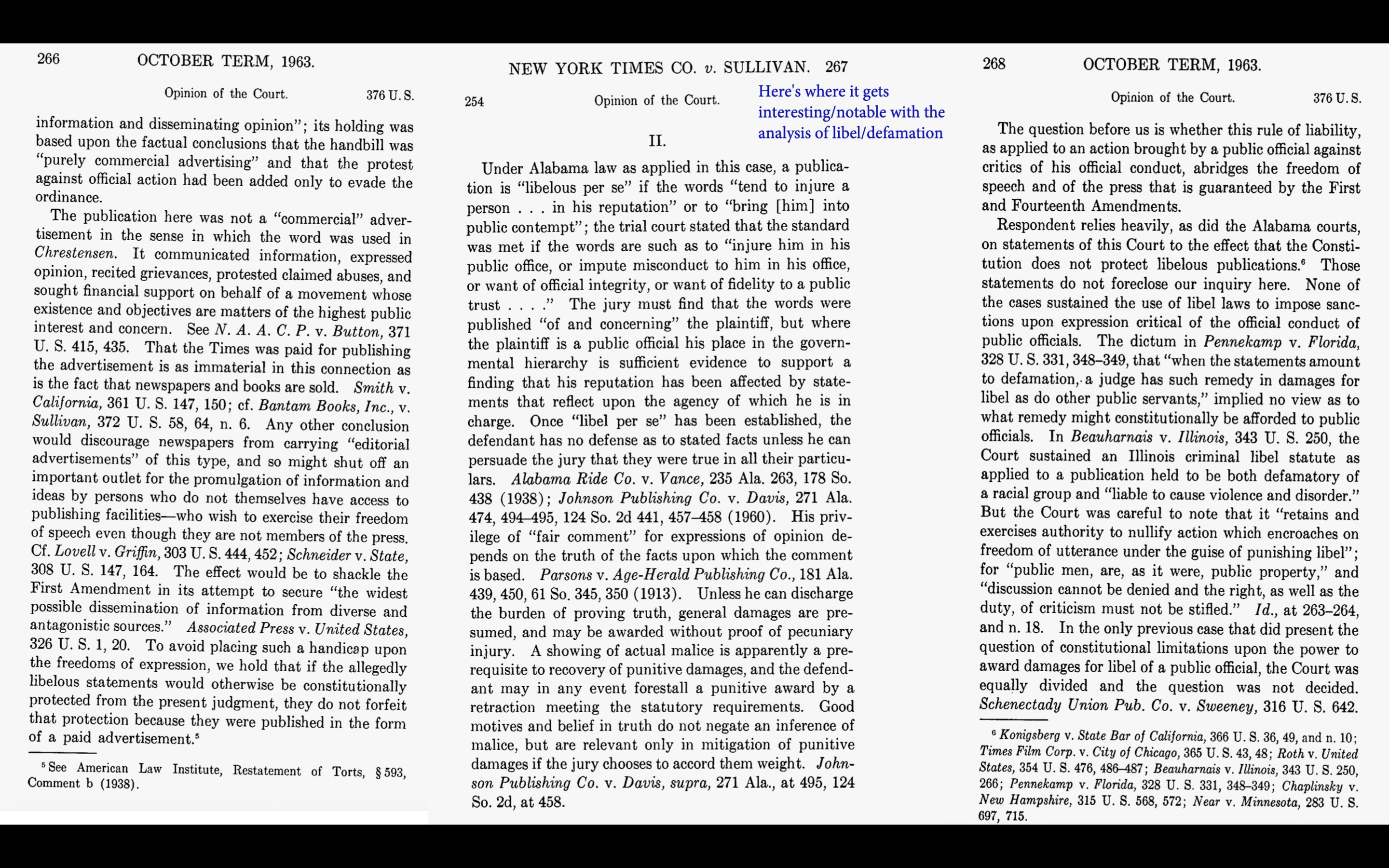
This is one of the most famous Supreme Court cases around free speech dealing with the question of when speech (especially about public figures) crosses the line into defamation (slander or libel): New York Times co. v. Sullivan. NYT v. Sullivan is a famous case that sets up the standard used in most subsequent defamation free speech cases, even when they don't deal with the same fact pattern (the defendant was a newspaper and the person they were accused of "defaming" was a public figure).
This is a medium-size opinion, but it has a few complicated issues in it. There are essentially 5 points that the majority addresses?the most important ones for us are b and c. Since this begins as a civil lawsuit (suing someone), there's a lot in the opinion about "damages." In a civil suit, you can ask for damages as reimbursement for harm you may have suffered, e.g. if someone defames you by leaving a whole bunch of spammy false reviews and that leads to you losing a contract, you could sue them asking for "general damages" in the amount of the contract you lost. Or, if you were in a car crash due to another driver's negligence, you might get general damages for hospital bills, possibly for pain and suffering, and potentially even the amount of lost wages from time you missed work. The goal is to make you "whole" again. Punitive damages are assessed by a court to punish someone for their negligence. They serve as a warning/deterrent to the person who was in the wrong. If the person who hit you was a repeated reckless driver acting with casual disregard of safety rules, the jury might also award additional money as punitive damages. In the Sullivan case, a public figure has sued the New York Times asking for both general and punitive damages. You can skim lightly over the factual/procedural history and jump into the analysis at page 265 of the opinion)
Answer the following questions:
1) As Justice Brennan opens his majority opinion, he addresses Alabama's claims that libel is low-value speech and should be unprotected by the First Amendment. Does Justice Brennan agree with this position? What does he say in response?
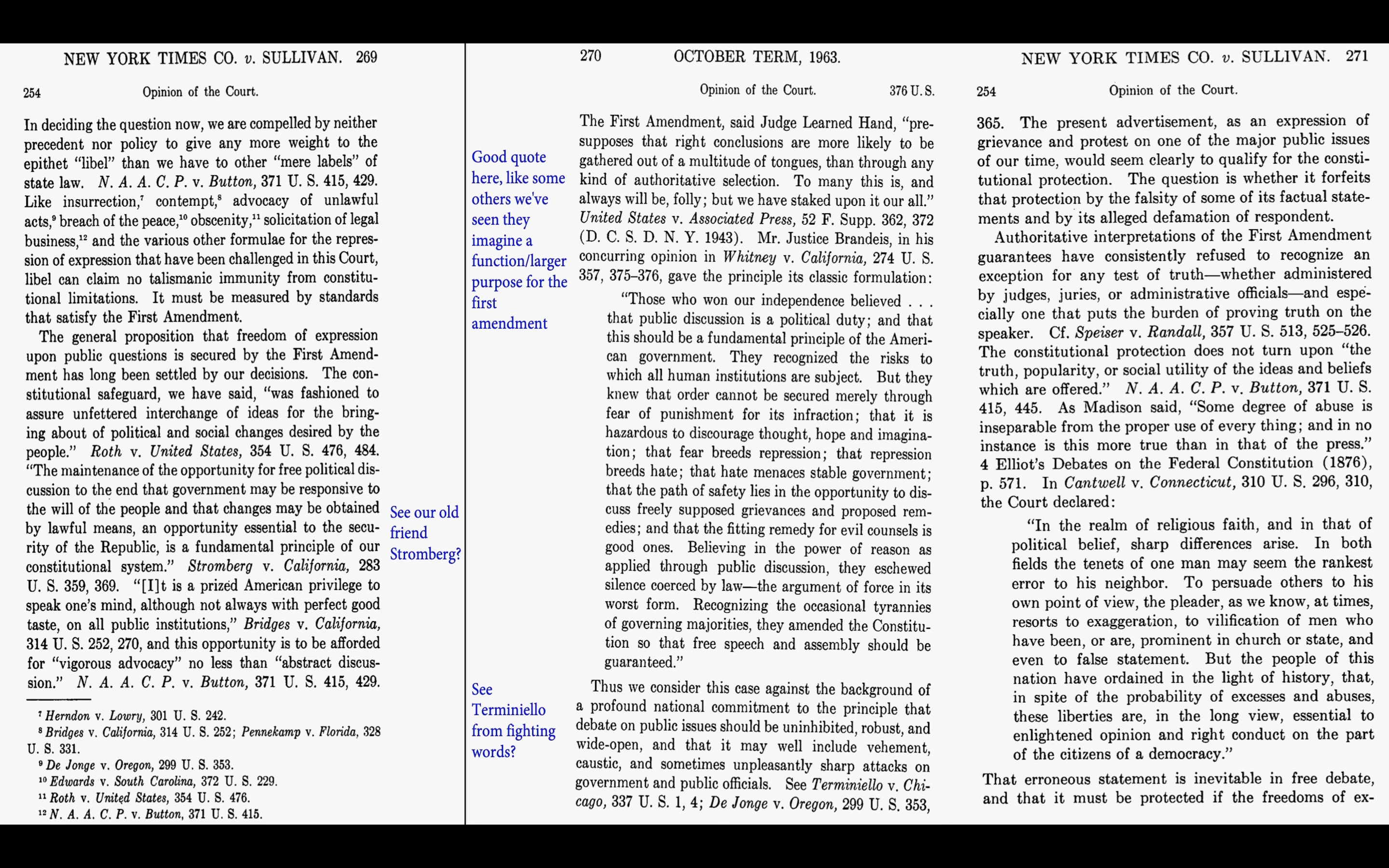
2) Shortly after this opening few pagers about libel, Brennan moves to a discussion of core principles of free expression in the US system. With some old friends popping up, why does Brennan suggest is our profound national commitment? Why?
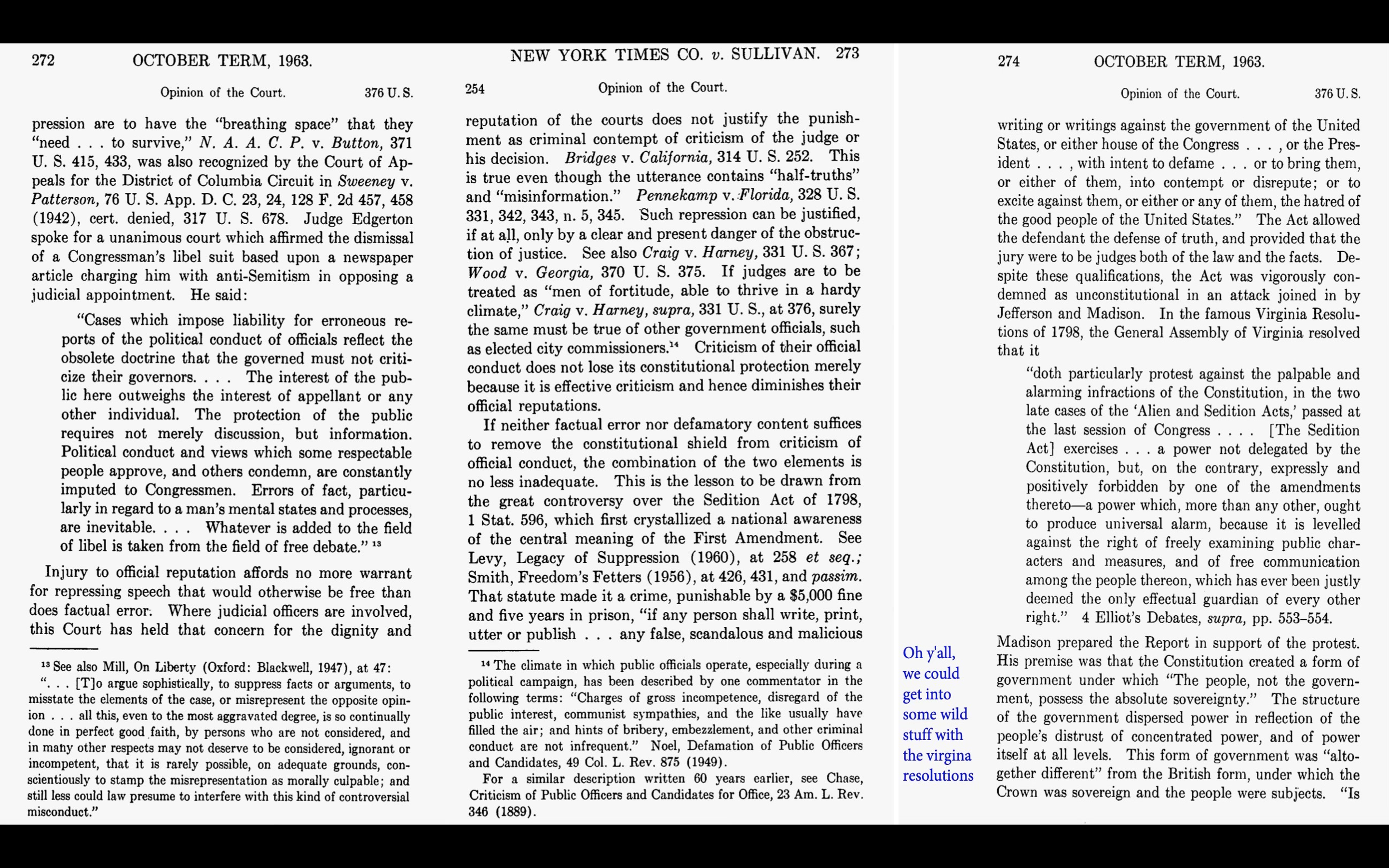
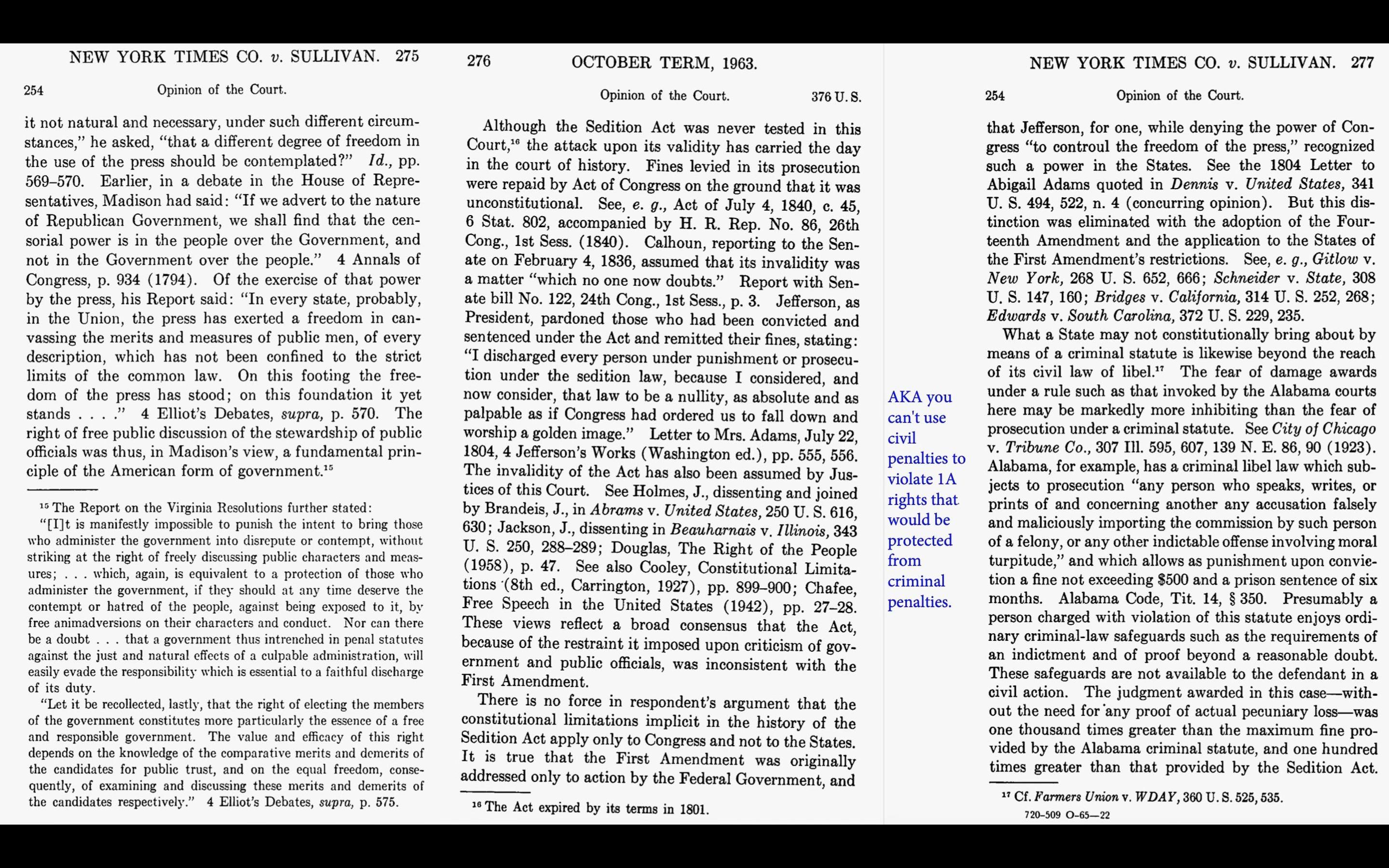
3) Taking a little bit of time to work through the history around the Alien and Sedition Acts (under John Adams), follow through the narrative/fiction that Brennan is weaving here. What are we supposed to learn from the example of the sedition acts? From Madison's Virginia Resolutions? What's the takeaway from this fiction--the lesson we are to learn about libel, truth, and criticism of public officials?
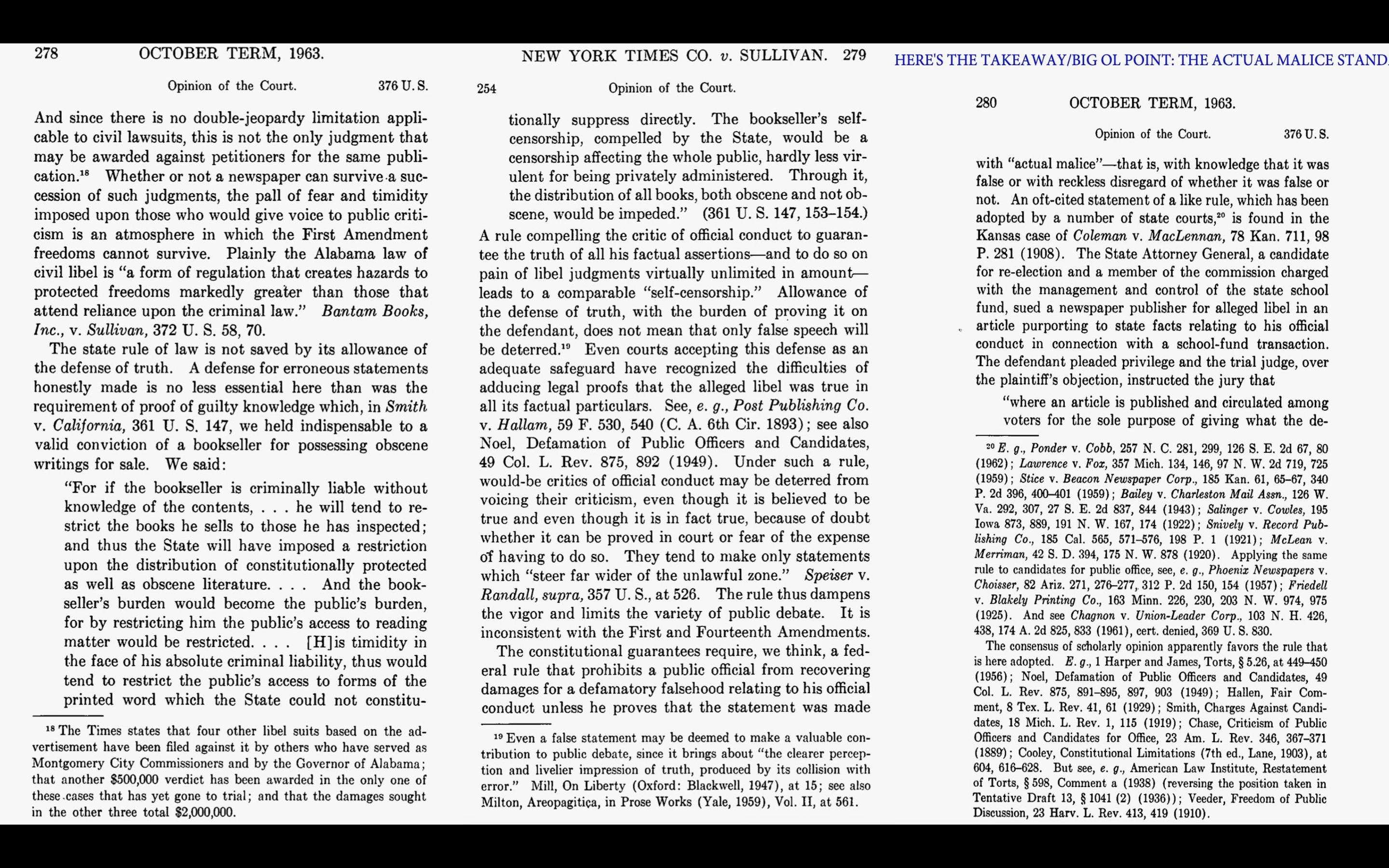
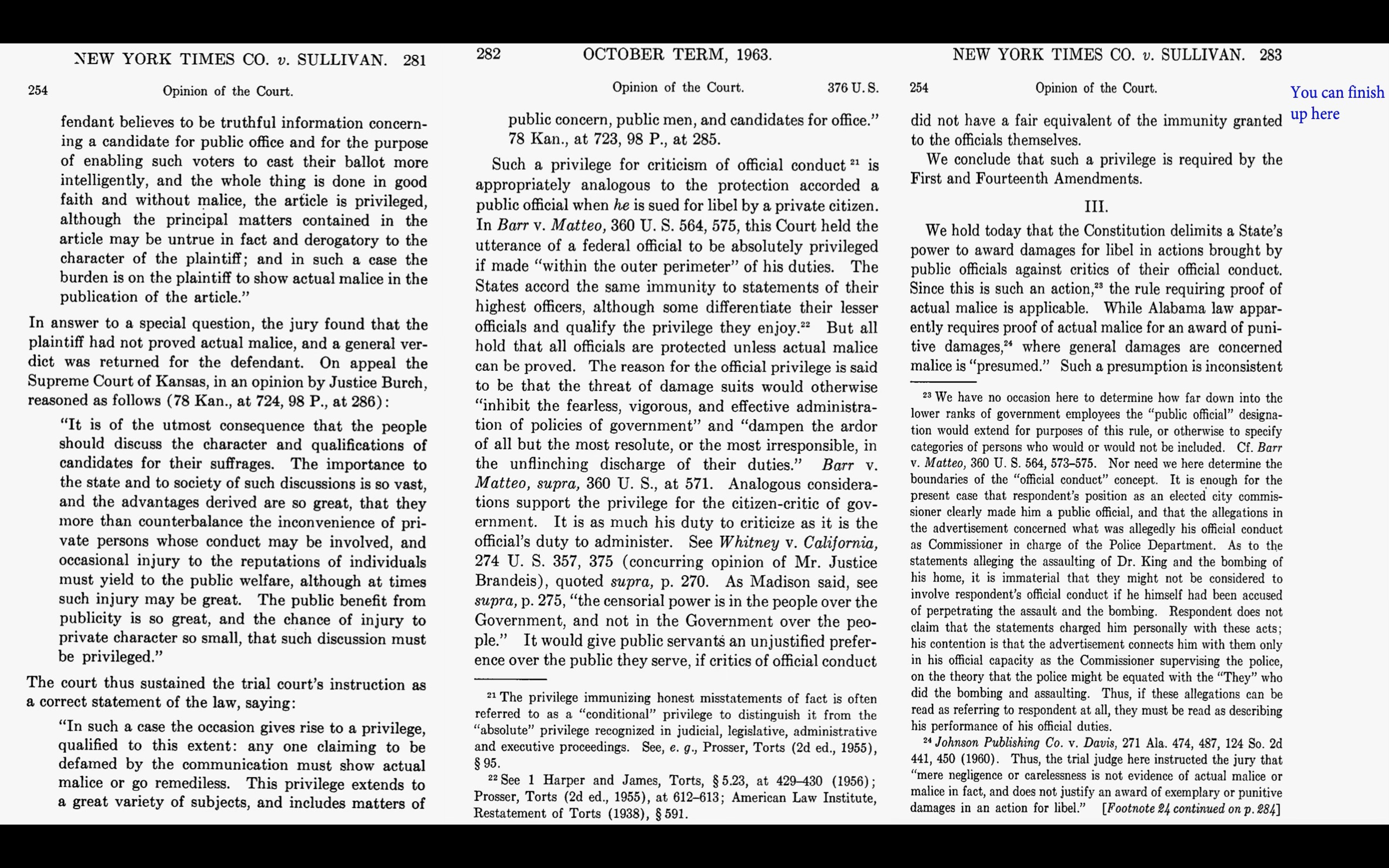
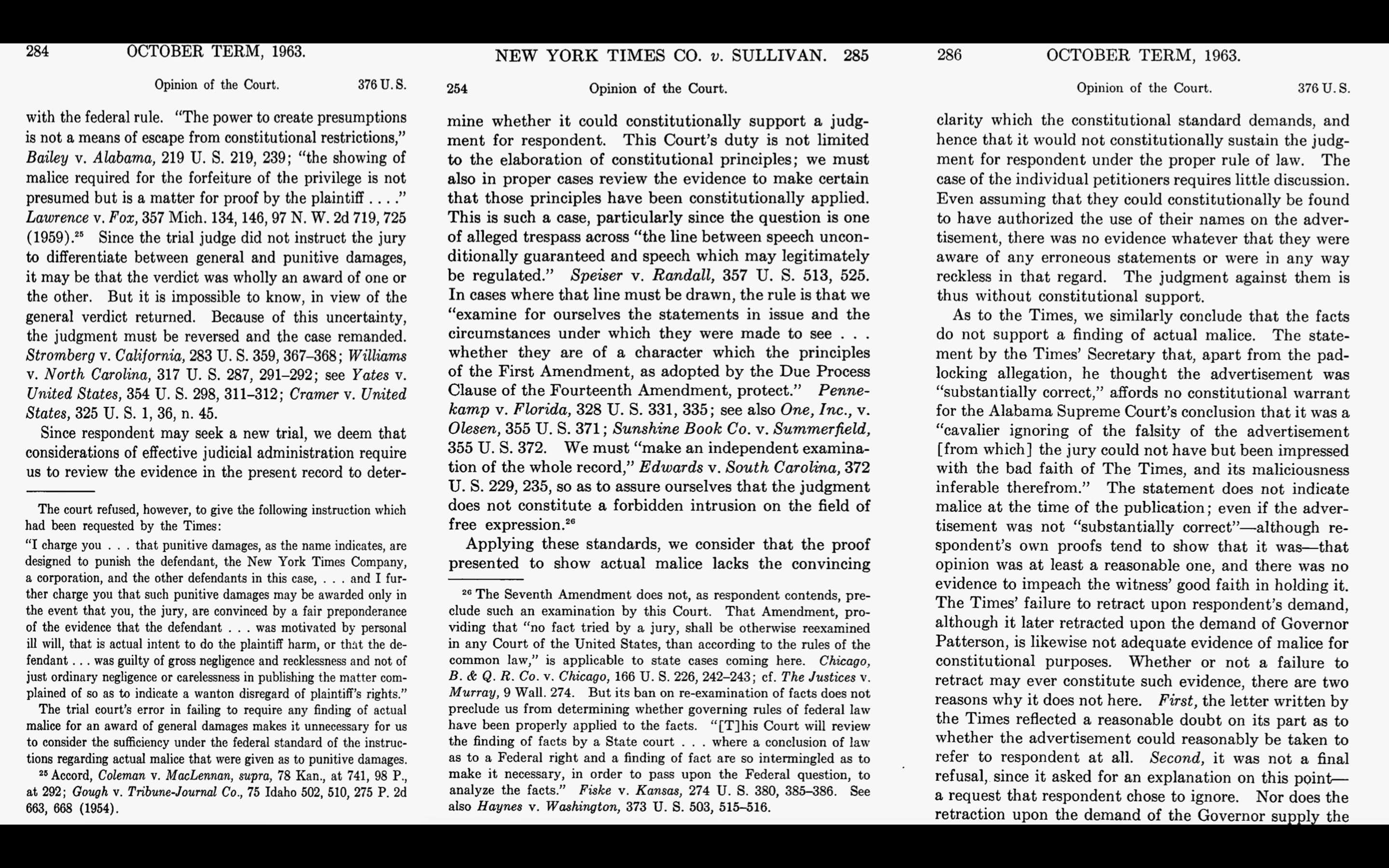
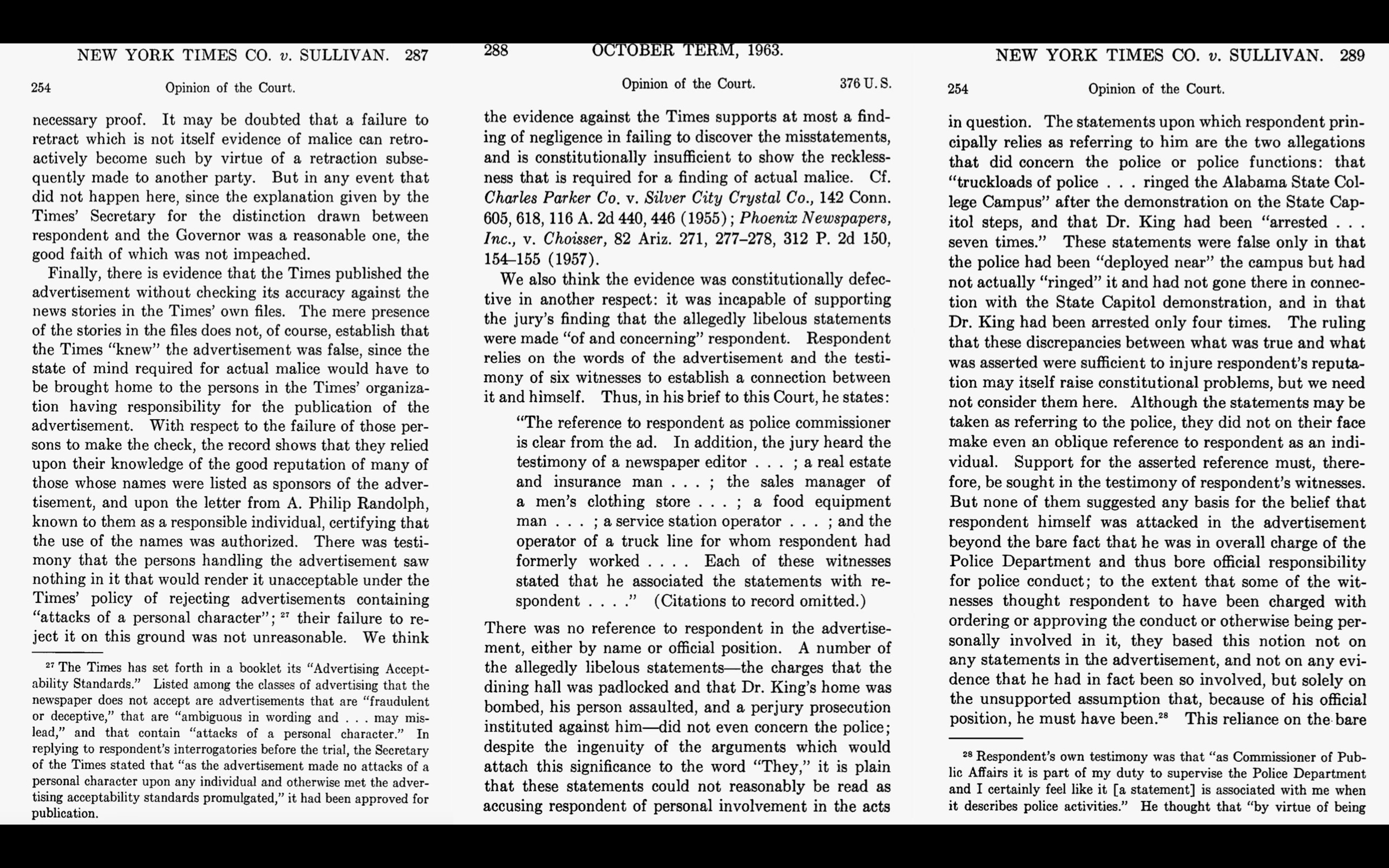
4) Finally, what is the standard that Brennan and the Court establish--in other words, what bar does a public figure have to clear/what do they have to prove in order to sue for damages in a libel case even if there are some factual errors in a statement or publication made about them? What is the result of applying this standard to the case in Alabama? Is the New York Times liable? Why or why not?
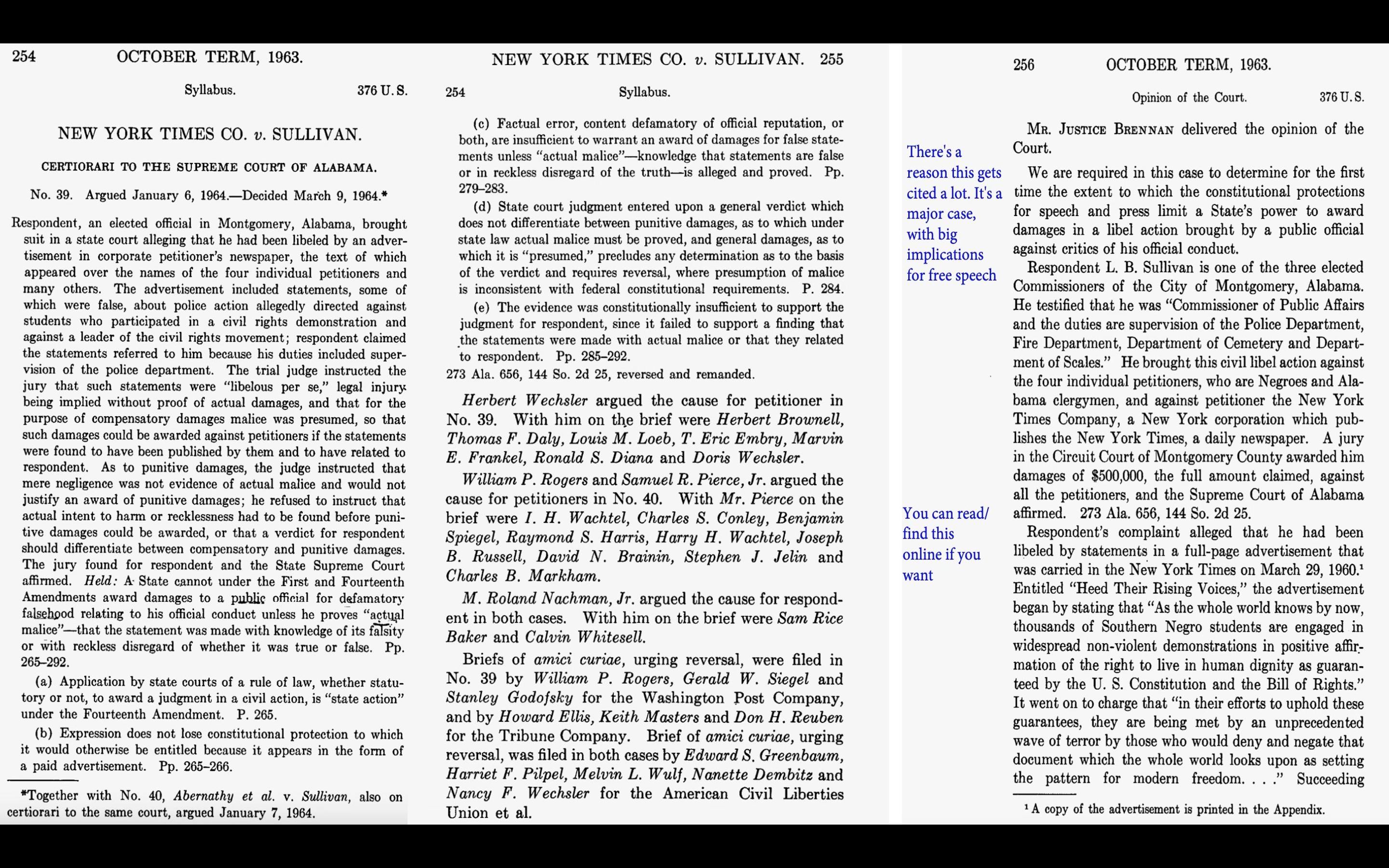
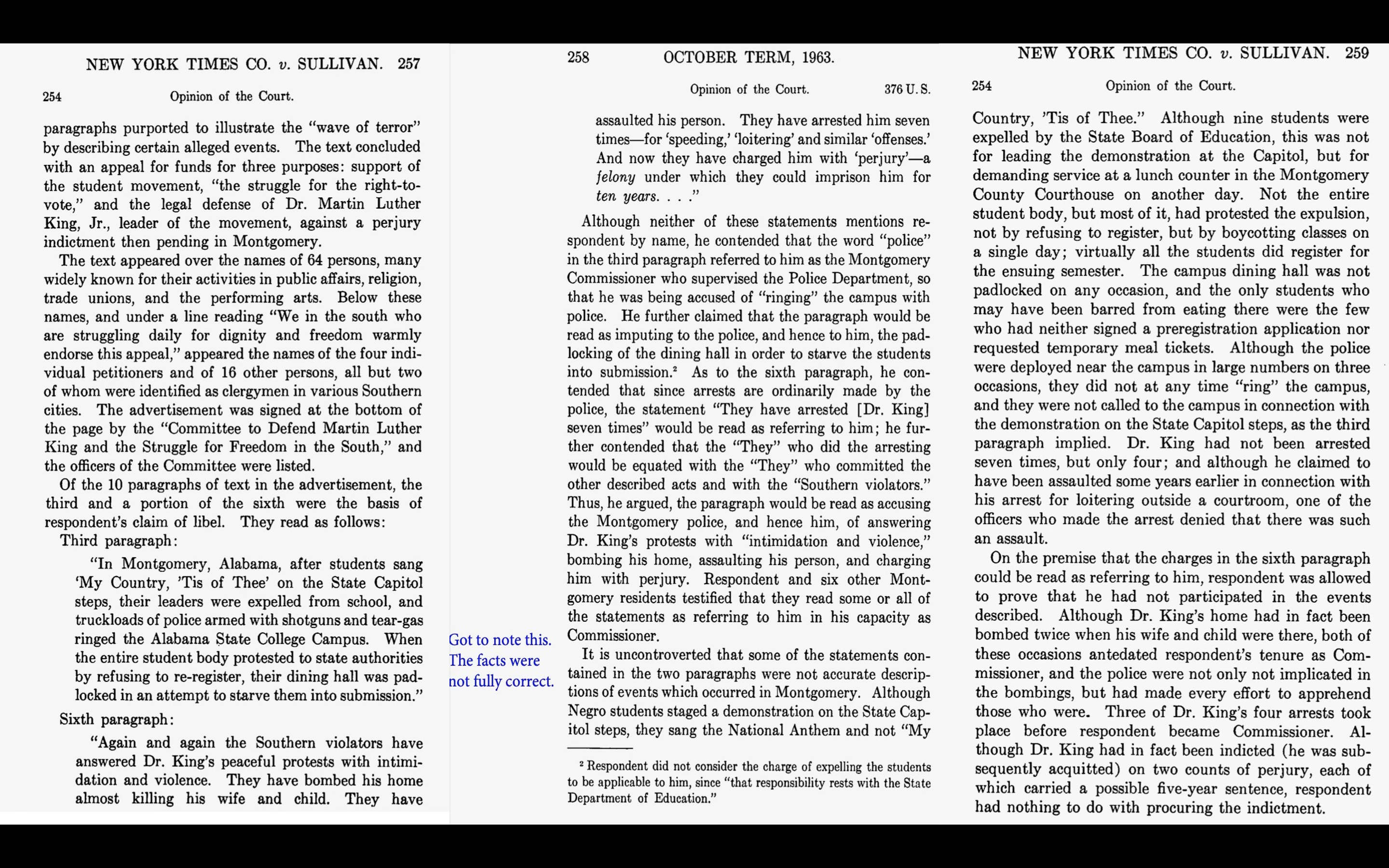
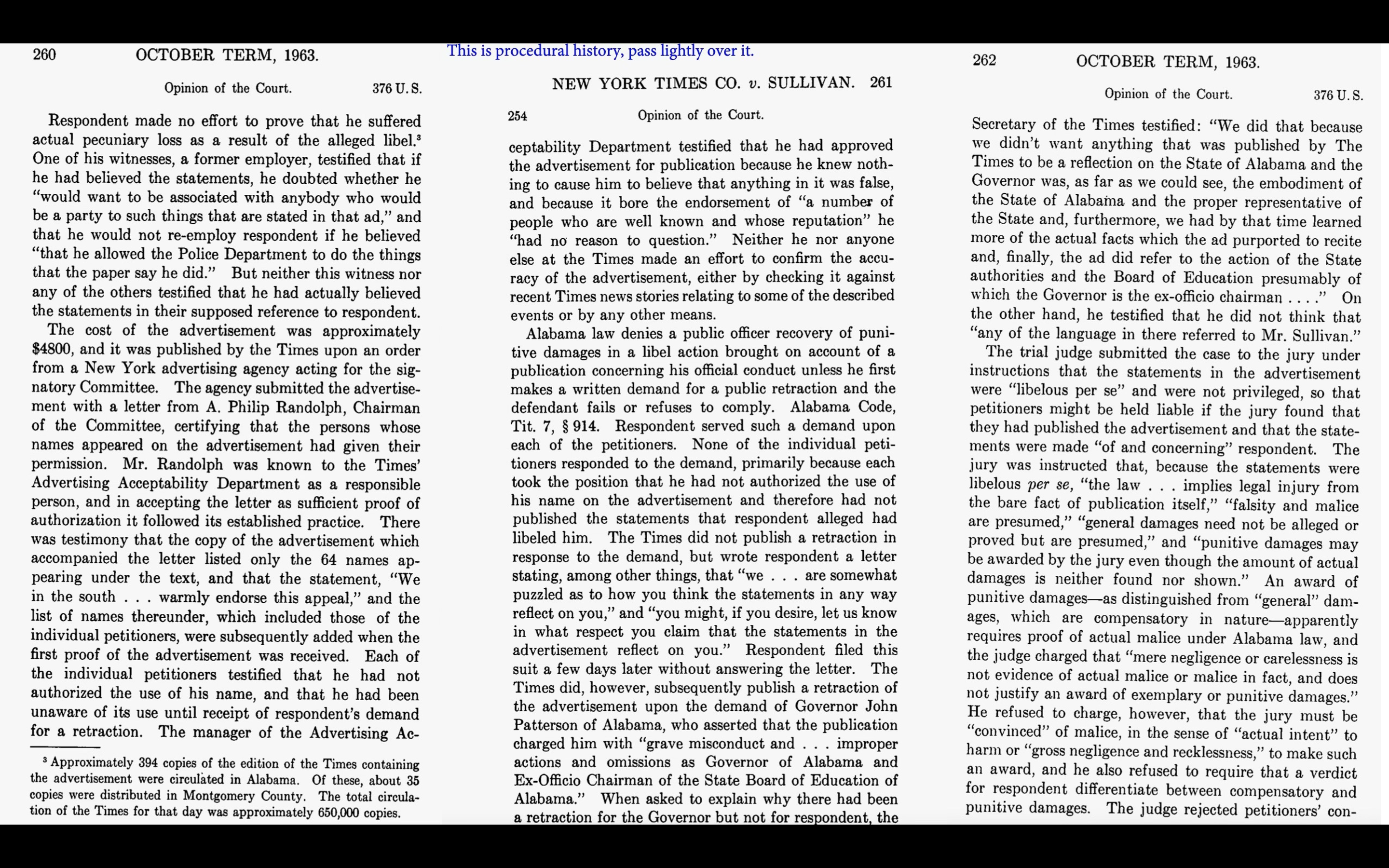
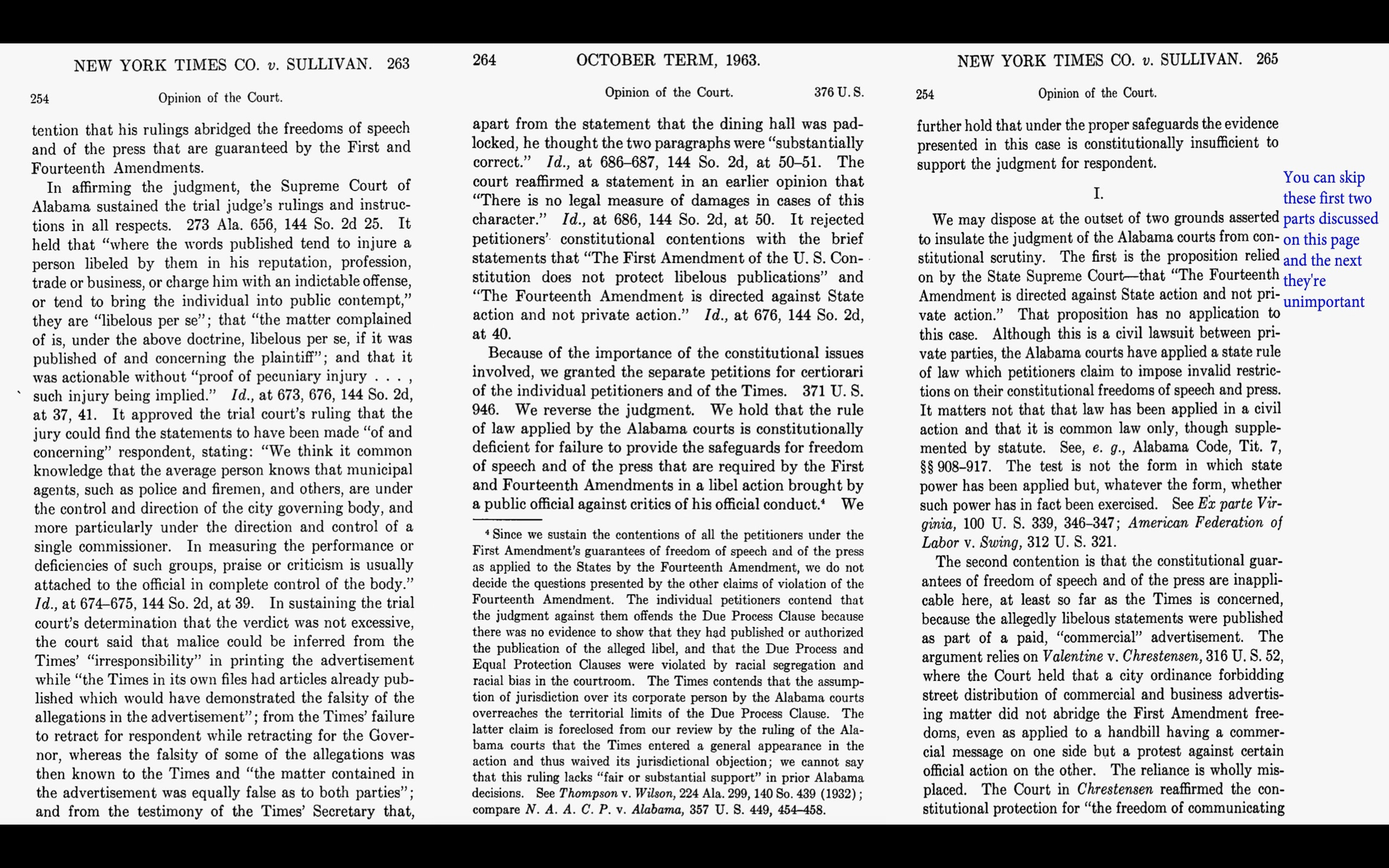
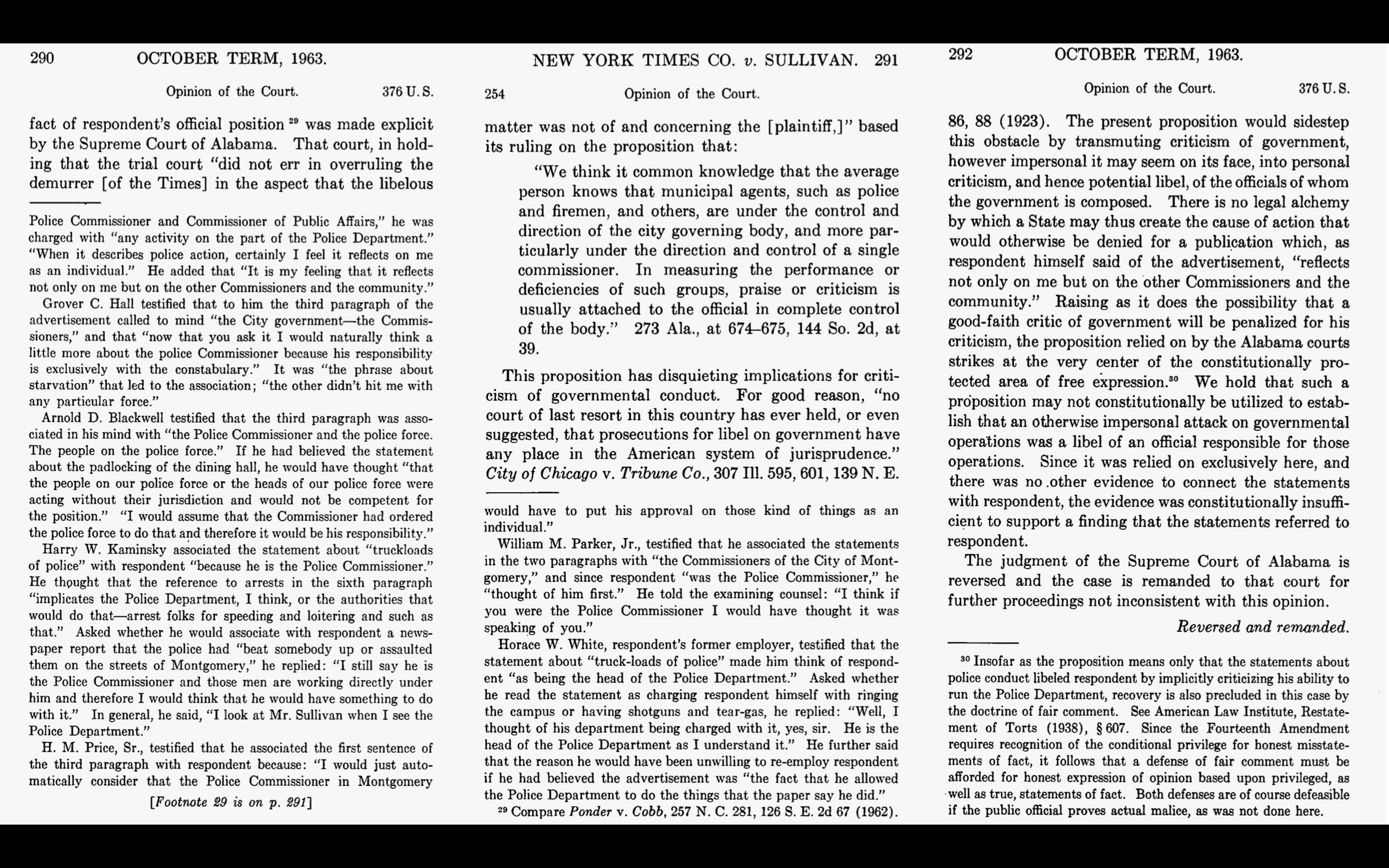
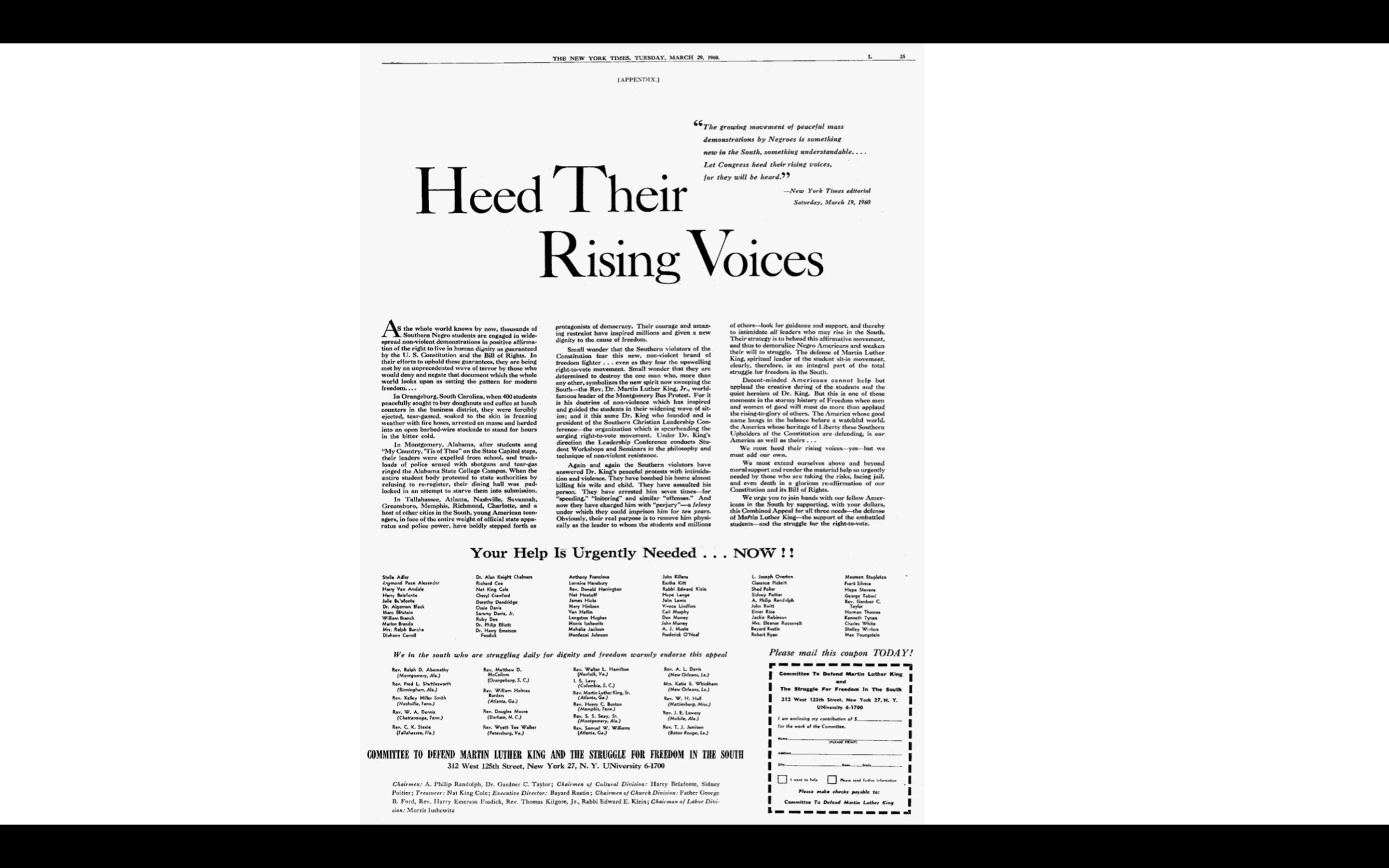
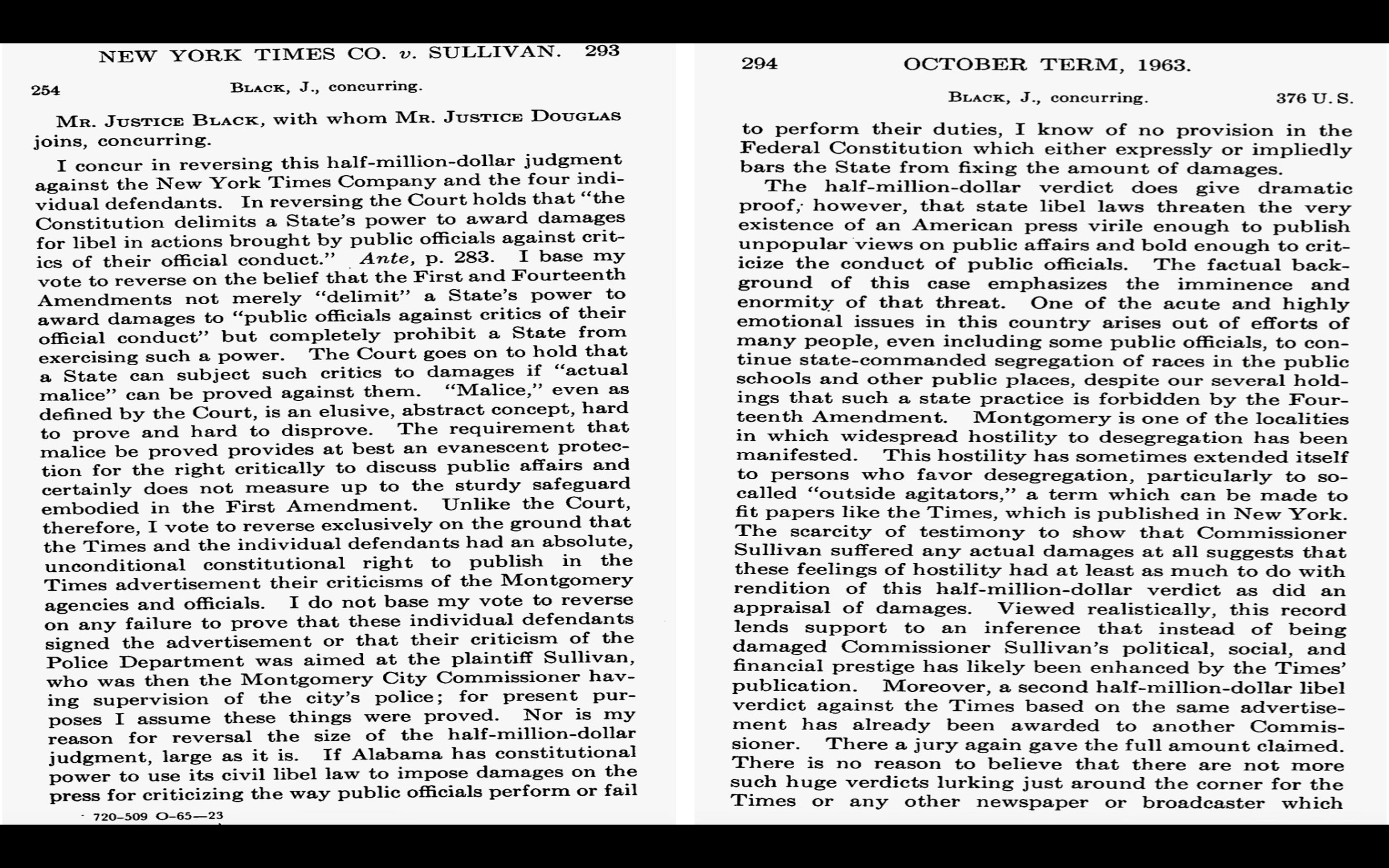
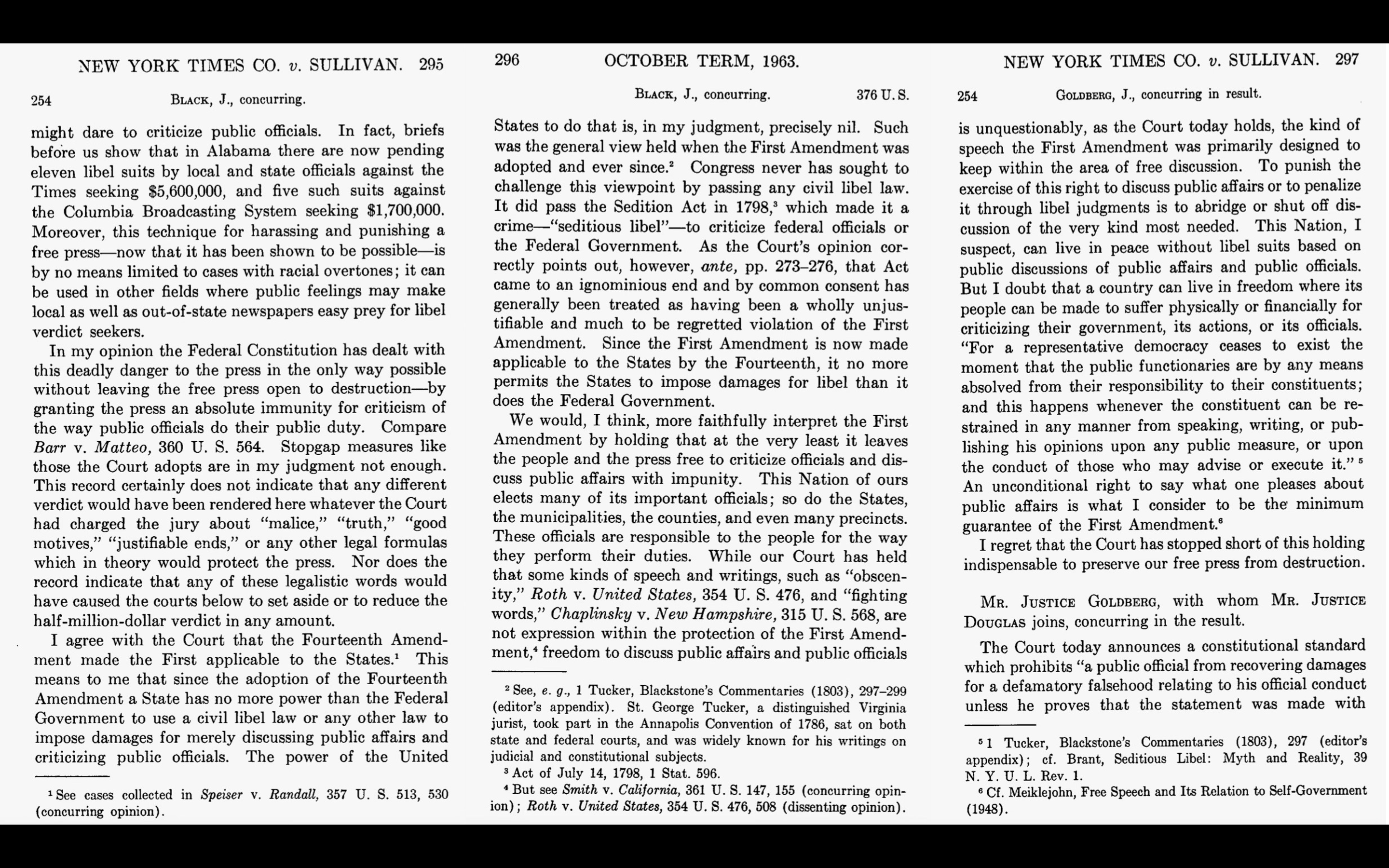
254 OCTOBER TERM, 1963. NEW YORK TIMES CO. v. SULLIVAN. 255 256 OCTOBER TERM, 1963. Syllabus. 376 U. S. 254 Syllabus. Opinion of the Court. 376 U.S. NEW YORK TIMES CO. v. SULLIVAN. (c) Factual error, content defamatory of official reputation, or MR. JUSTICE BRENNAN delivered the opinion of the both, are insufficient to warrant an award of damages for false state- ments unless "actual malice"-knowledge that statements are false There's a Court. CERTIORARI TO THE SUPREME COURT OF ALABAMA. or in reckless disregard of the truth-is alleged and proved. Pp. reason this gets We are required in this case to determine for the first No. 39. Argued January 6, 1964.-Decided March 9, 1964.* 279-283. cited a lot. It's a time the extent to which the constitutional protections (d) State court judgment entered upon a general verdict which for speech and press limit a State's power to award does not differentiate between punitive damages, as to which under major case, Respondent, an elected official in Montgomery, Alabama, brought damages in a libel action brought by a public official suit in a state court alleging that he had been libeled by an adver- state law actual malice must be proved, and general damages, as to with big tisement in corporate petitioner's newspaper, the text of which which it is "presumed," precludes any determination as to the basis implications against critics of his official conduct. appeared over the names of the four individual petitioners and of the verdict and requires reversal, where presumption of malice for free speech Respondent L. B. Sullivan is one of the three elected many others. The advertisement included statements, some of is inconsistent with federal constitutional requirements. P. 284. Commissioners of the City of Montgomery, Alabama. which were false, about police action allegedly directed against (e) The evidence was constitutionally insufficient to support the He testified that he was "Commissioner of Public Affairs students who participated in a civil rights demonstration and judgment for respondent, since it failed to support a finding that and the duties are supervision of the Police Department, against a leader of the civil rights movement; respondent claimed the statements were made with actual malice or that they related Fire Department, Department of Cemetery and Depart- the statements referred to him because his duties included super- to respondent. Pp. 285-292. vision of the police department. The trial judge instructed the ment of Scales." He brought this civil libel action against 273 Ala. 656, 144 So. 2d 25, reversed and remanded. jury that such statements were "libelous per se," legal injury the four individual petitioners, who are Negroes and Ala- being implied without proof of actual damages, and that for the Herbert Wechsler argued the cause for petitioner in bama clergymen, and against petitioner the New York purpose of compensatory damages malice was presumed, so that No. 39. With him on the brief were Herbert Brownell, Times Company, a New York corporation which pub- such damages could be awarded against petitioners if the statements Thomas F. Daly, Louis M. Loeb, T. Eric Embry, Marvin lishes the New York Times, a daily newspaper. A jury were found to have been published by them and to have related to E. Frankel, Ronald S. Diana and Doris Wechsler. in the Circuit Court of Montgomery County awarded him respondent. As to punitive damages, the judge instructed that mere negligence was not evidence of actual malice and would not William P. Rogers and Samuel R. Pierce, Jr. argued the damages of $500,000, the full amount claimed, against justify an award of punitive damages; he refused to instruct that cause for petitioners in No. 40. With Mr. Pierce on the all the petitioners, and the Supreme Court of Alabama actual intent to harm or recklessness had to be found before puni- brief were I. H. Wachtel, Charles S. Conley, Benjamin You can read/ affirmed. 273 Ala. 656, 144 So. 2d 25. tive damages could be awarded, or that a verdict for respondent Spiegel, Raymond S. Harris, Harry H. Wachtel, Joseph find this Respondent's complaint alleged that he had been should differentiate between compensatory and punitive damages. B. Russell, David N. Brainin, Stephen J. Jelin and online if you libeled by statements in a full-page advertisement that The jury found for respondent and the State Supreme Court Charles B. Markham. want was carried in the New York Times on March 29, 1960.' affirmed. Held: A State cannot under the First and Fourteenth Amendments award damages to a public official for defamatory M. Roland Nachman, Jr. argued the cause for respond- Entitled "Heed Their Rising Voices," the advertisement falsehood relating to his official conduct unless he proves "actual ent in both cases. With him on the brief were Sam Rice began by stating that "As the whole world knows by now, malice"-that the statement was made with knowledge of its falsity thousands of Southern Negro students are engaged in or with reckless disregard of whether it was true or false. Pp. Baker and Calvin Whitesell. widespread non-violent demonstrations in positive affir, 265-292. Briefs of amici curiae, urging reversal, were filed in mation of the right to live in human dignity as guaran- (a) Application by state courts of a rule of law, whether statu- No. 39 by William P. Rogers, Gerald W. Siegel and teed by the U. S. Constitution and the Bill of Rights." tory or not, to award a judgment in a civil action, is "state action" Stanley Godofsky for the Washington Post Company, It went on to charge that "in their efforts to uphold these under the Fourteenth Amendment. P. 265. and by Howard Ellis, Keith Masters and Don H. Reuben guarantees, they are being met by an unprecedented b) Expression does not lose constitutional protection to which for the Tribune Company. Brief of amici curiae, urging wave of terror by those who would deny and negate that it would otherwise be entitled because it appears in the form of reversal, was filed in both cases by Edward S. Greenbaum, a paid advertisement. Pp. 265-266. document which the whole world looks upon as setting Harriet F. Pilpel, Melvin L. Wulf, Nanette Dembitz and the pattern for modern freedom. .. ." Succeeding Together with No. 40, Abernathy et al. v. Sullivan, also on Nancy F. Wechsler for the American Civil Liberties certiorari to the same court, argued January 7, 1964. Union et al. 1 A copy of the advertisement is printed in the Appendix.NEW YORK TIMES CO. v. SULLIVAN. 257 254 Opinion of the Court. paragraphs purported to illustrate the "wave of terror\" by describing certain alleged events. The text concluded with an appeal for funds for three purpms: support of the student movement, \"the struggle for the right-to- vote,\" and the legal defense of Dr. Martin Luther King, Jr., leader of the movement, against a perjury indictment then pending in Montgomery. The text appeared over the names of 64 persons, many widely known for their activities in public affairs, religion, trade unions, and the performing arts. Below these names, and under a line reading \"We in the south who are struggling daily for dignity and freedom warmly endorse this appeal,\" appeared the names of the four indi- vidual petitioners and of 16 other persons, all but two of whom were identied as clergymen in various Southern cities. The advertisement was signed at the bottom of the page by the \"Committee to Defend Martin Luther King and the Struggle for Freedom in the South,\" and the ofcers of the Committee were listed. 0f the 10 paragraphs of text in the advertisement, the third and a portion of the sixth were the basis of respondent's claim of libel. They read as follows: Third paragraph: \"In Montgomery, Alabama, after students sang 'My Country, 'Tis of Thee' on the State Capitol steps, their leaders were expelled from school, and truckloads of police armed with shotguns and tear-gas ringed the Alabama State College Campus. When the entire student body protested to state authorities by refusing to re-register, their dining hall was pad- locked in an attempt to starve them into submission.\" Sixth paragraph: \"Again and again the Southern violators have answered Dr. King's peaceful protests with intimi- dation and violence. They have bombed his home almost killing his wife and child. They have Got to note this. The facts were not fully correct. 258 OCTOBER TERM, 1963. Opinion of the Court. 376U. S. assaulted his person. They have arrested him seven timesfor 'speeding,' 'loitering' and similar 'o'enses.' And now they have charged him with 'perjury'a felony under which they could imprison him for ten years. . . ." Although neither of these statements mentions re- spondent by name, he contended that the word \"police\" in the third paragraph referred to him as the Montgomery Commissioner who supervised the Police Department, so that he was being accused of "ringing\" the campus with police. He further claimed that the paragraph would be read as imputing to the police, and hence to him, the pad- locking of the dining hall in order to starve the students into submission.' As to the sixth paragraph, he con- tended that since arrests are ordinarily made by the police, the statement \"They have arrested (Dr. King] seven times\" would be read as referring to him; he fur- ther contended that the \"They\" who did the arresting would be equated with the \"They\" who committed the other described acts and with the \"Southern violators.\" Thus, he argued, the paragraph would be read as accusing the Montgomery police, and hence him, of answering Dr. King's protests with \"intimidation and violence,\" bombing his home, assaulting his person, and charging him with perjury. Respondent and six other Mont- gomery residents testied that they read some or all of the statements as referring to him in his capacity as Commissioner. It is uncontroverted that some of the statements con- tained in the two paragraphs were not accurate descrip- tions of events which occurred in Montgomery. Although Negro students staged a demonstration on the State Cap- itol steps, they sang the National Anthem and not \"My 'Respondcnt did not consider the charge of expelling the students to be applicable to him, since \"that responsibility rests with the State Department of Education.\" NEW YORK TIMES CO. v. SULLIVAN. 259 254 Opinion of the Court. Country, 'Tis of Thee.\" Although nine students were expelled by the State Board of Education, this was not for leading the demonstration at the Capitol, but for demanding service at a lunch counter in the Montgomery County Courthouse on another day. Not the entire student body, but most of it, had protested the expulsion, not by refusing to register, but by boycotting classes on a single day; virtually all the students did register for the ensuing semester. The campus dining hall was not padlocked on any occasion, and the only students who may have been barred from eating there were the few who had neither signed a preregistration application nor requested temporary meal tickets. Although the police were deployed near the campus in large numbers on three occasions, they did not at any time "ring\" the campus, and they were not called to the campus in connection with the demonstration on the State Capitol steps, as the third paragraph implied. Dr. King had not been arrested seven times, but only four; and although he claimed to have been assaulted some years earlier in connection with his arrest for loitering outside a courtroom, one of the ofcers who made the arrest denied that there was such an assault. On the premise that the charges in the sixth paragraph could be read as referring to him, respondent was allowed to prove that he had not participated in the events described. Although Dr. King's home had in fact been bombed twice when his wife and child were there, both of these occasions antedated respondent's tenure as Com- missioner, and the police were not only not implicated in the bombings, but had made every effort to apprehend those who were. Three of Dr. King's four arrests took place before respondent became Commissioner. Al- though Dr. King had in fact been indicted (he was sub- sequently acquitted) on two counts of perjury, each of which carried a possible ve-year sentence, respondent had nothing to do with procuring the indictment. 260 OCTOBER TERM, 1963. Tlis is prowl! l'story, pass LE}, over it. 262 Opinion of the Court. 376 U. 3. Respondent. made no effort to prove that he suffered actual pecuniary loss as a result of the alleged libel.' One of his witnesses, a former employer, testied that if he had believed the statements, be doubted whether he \"would want to be associated with anybody who would be a party to such things that are stated in that ad,\" and that he would not reemploy respondent if he believed \"that he allowed the Police Department to do the things that the paper say he did." But neither this witness nor any of the others testied that he had actually believed the statements in their supposed reference to respondent. The cost of the advertisement was approximately 84800, and it was published by the Times upon an order from a New York advertising agency acting for the sig- natory Committee. The agency submitted the advertise- ment with a letter from A. Philip Randolph, Chairman of the Committee, certifying that the persons whose names appeared on the advertisement had given their permission. Mr. Randolph was known to the Times' Advertising Acceptability Department as a responsible person, and in accepting the letter as sufcient proof of authorization it followed its established practice, There was testimony that the copy of the advertisement which accompanied the letter listed only the 64 names ap- pearing under the text, and that the statement, \"We in the south . . . warmly endorse this appeal,\" and the list of names thereunder, which included those of the individual petitioners, were subsequently added when the rst proof of the advertisement was received. Each of the individual petitioners testied that he had not authorized the use of his name, and that he had been unaware of its use until receipt of respondent's demand for a retraction. The manager of the Advertising Ac 'Approximately 394 copies of the edition of the Times containing the advertisement were circulirted in Alabama. Of these, about 35 copies were distributed in Montgomery County. The total circula- NEW YORK TIMES 00. v. SULLIVAN. 261 254 Opinion of the Court. ceptability Department testied that he had approved the advertisement for publication because he knew noth- ing to cause him to believe that anything in it was false, and because it bore the endorsement of \"a number of people who are well known and whose reputation\" he \"had no reason to question.\" Neither he nor anyone else at the Times made an e'ort to conrm the accu- racy of the advertisement, either by checking it against recent Times news stories relating to some of the described events or by any other means. Alabama law denies a public oicer recovery of puni tive damages in a libel action brought on account of a publication concerning his oicial conduct unless he rst makes a written demand for a public retraction and the defendant fails or refuses to comply. Alabama Code, Tit. 7, 914. Respondent served such a demand upon each of the petitioners. None of the individual peti- tioners responded to the demand, primarily because each took the position that he had not authorized the use of his name on the advertisement and therefore had not published the statements that respondent alleged had libeled him. The Times did not publish a retraction in response to the demand, but wrote respondent a letter stating, among other things, that \"we . . . are somewhat puzzled as to how you think the statements in any way reect on you," and "you might, if you desire, let us know in what respect you claim that the statements in the advertisement reect on you.\" Respondent led this suit a few days later without answering the letter. The Times did, however, subsequently publish a retraction of the advertisement upon the demand of Governor John Patterson of Alabama, who asserted that the publication charged him with "grave misconduct and . . . improper actions and omissions as Governor of Alabama and Ex-Ocio Chairman of the State Board of Education of Alabama.\" When asked to explain why there had been OCTOBER TERM, 1963. Opinion of the Court. 376 U. S. Secretary of the Times testied: \"We did that because we didn't want anything that was published by The Times to be a reection on the State of Alabama and the Governor was, as far as we could see, the embodiment of the State of Alabama and the proper representative of the State and, furthermore, we had by that time learned more of the actual facts which the ad purported to recite and, nally, the ad did refer to the action of the State authorities and the Board of Education presumably of which the Governor is the exoicio chairman . . . 3' 0n the other hand, he testied that he did not think that \"any of the language in there referred to Mr. Sullivan.\" The trial judge submitted the case to the jury under instructions that the statements in the advertisement were \"libelous per se" and were not privileged, so that petitioners might be held liable if the jury found that they had published the advertisement and that the state- ments were made \"of and concerning\" respondent. The jury was instructed that, because the statements were libelous per se, \"the law . . . implies legal injury from the bare fact of publication itself,\" \"falsity and malice are presumed,\" \"general damages need not be alleged or proved but are presumed,\" and \"punitive damages may be awarded by the jury even though the amount of actual damages is neither found nor shown.\" An award of punitive damagesas distinguished from \"general\" dam- ages, which are compensatory in natureapparently requires proof of actual malice under Alabama law, and the judge charged that \"mere negligence or carelessness is not evidence of actual malice or malice in fact, and does not justify an award of exemplary or punitive damages.\" He refused to charge, however, that the jury must be \"convinced\" of malice, in the sense of \"actual intent\" to harm or \"gross negligence and recklessness,\" to make such an award, and he also refused to require that a verdict for respondent dierentiate between compensatory and punitive damages. The judge rejected petitioners' con- tion of the Times for that day was approximately 650,000 wpies. a retraction for the Governor but not for resindentl the - NEW YORK TIMES CO. v. SULLIVAN. 263 254 Opinion of the Court. tention that his rulings abridged the freedoms of speech and of the press that are guaranteed by the First and Fourteenth Amendments. In affirming the judgment, the Supreme Court of Alabama sustained the trial judge's rulings and instruc- tions in all respects. 273 Ala. 656, 144 So. 2d 25. It held that \"where the words published tend to injure a person libeled by them in his reputation, profession, trade or business, or charge him with an indictable offense, or tend to bring the individual into public contempt,\" they are \"libelous per se\"; that \"the matter complained of is, under the above doctrine, libelous per so, if it was published of and concerning the plaintiff\"; and that it was actionable without \"proof of pecuniary injury . . . , such injury being implied." Id., at 673, 676, 144 So. 2d, at 37, 41. It approved the trial court's ruling that the jury could find the statements to have been made "of and concerning\" respondent, stating: \"We think it common knowledge that the average person knows that municipal agents, such as police and remen, and others, are under the control and direction of the city governing body, and more particularly under the direction and control of a single commissioner. In measuring the performance or deciencies of such groups, praise or criticism is usually attached to the ofcial in complete control of the body.\" 1d,, at 674675. 144 So. 2d, at 39. In sustaining the trial court's determination that the verdict was not excessive, the court said that malice could be inferred from the Times' \"irresponsibility\" in printing the advertisement while \"the Times in its own les had articles already pub- lished which would have demonstrated the falsity of the allegations in the advertisement"; from the Times' failure to retract for respondent while retracting for the Gover- nor, whereas the falsity of some of the allegations was then known to the Times and \"the matter contained in the advertisement was equally false as to both parties\"; and from the testimony of the Times' Secretary that, 264 OCTOBER TERM, 1963. Opinion of the Court. 376 U. S. apart from the statement that the dining hall was pad- locked, he thought the two paragraphs were "substantially correct.\" [11,, at 686687, 144 So. 2d, at 50-51. The court rearmed a statement in an earlier opinion that \"There is no legal measure of damages in cases of this character.\" Int, at 686, 144 So. 2d, at 50. It rejected petitioners'- constitutional contentions with the brief statements that \"The First Amendment of the U. S. Con- - atitution does not protect libelous publications\" and \"The Fourteenth Amendment is directed against State action and not private action.\" 141., at 676, 144 So. 2d, at 40. Because of the importance of the constitutional issues involved, we granted the separate petitions for certiorari of the individual petitioners and of the Times. 371 U. S. 946. We reverse the judgment. We hold that the rule of law applied by the Alabama. courts is constitutionally decient for failure to provide the safeguards for freedom of speech and of the press that are required by the First and Fourteenth Amendments in a libel action brought by a public ofcial against critics of his oicial conduct.' We ' Since we sustain the contentions of all the petitioners under the First Amendment's guarantees of freedom of speech and of the press as applied to the States by the Fourteenth Amendment, we do not decide the questions presented by the other claims of violation of the Fourteenth Amendment. The individual petitioners contend that the judgment against them offends the Due Process Clause because there was no evidence to show that they had published or authorized the publication of the alleged libel, and that the Due Process and Equal Protection Clause: were violated by racial segregation and racial bias in the courtroom. The Times contends that the assump- tion of jurisdiction over its corporate person by the Alabama courts overreaches the territorial limits of the Due Process Clause. The latter claim is foreclosed from our review by the ruling of the Ala- bama courts that the Times entered a general appearance in the action and thus waived its jurisdictional objection; we cannot say that this ruling lacks "fair or substantial support\" in prior Alabama decisions. See Thompson v. Wilson, 224 Ala. 299, 140 So. 439 (1932) ; compare N. A. A. C. P. v. Alabama, 357 U. S. 449, 454458. NEW YORK TIMES CO. v. SULLIVAN. 265 254 Opinion of the Court. further hold that under the proper safeguards the evidence presented in this case is constitutionally insufcient to support the judgment for respondent. You can skip 1- these rst two We may dispose at the outset of two grounds asserted parts discussed to insulate the judgment of the Alabama courts from con- on this page stitutional scrutiny. The rst is the proposition relied and the next on by the State Supreme Courtthat \"The Fourteenth Amendment is directed against State action and not pri- vate action.\" That proposition has no application to this case. Although this is a civil lawsuit between pri- vate parties, the Alabama courts have applied a state rule of law which petitioners claim to impose invalid restric
Step by Step Solution
There are 3 Steps involved in it

Get step-by-step solutions from verified subject matter experts
 Study Help