



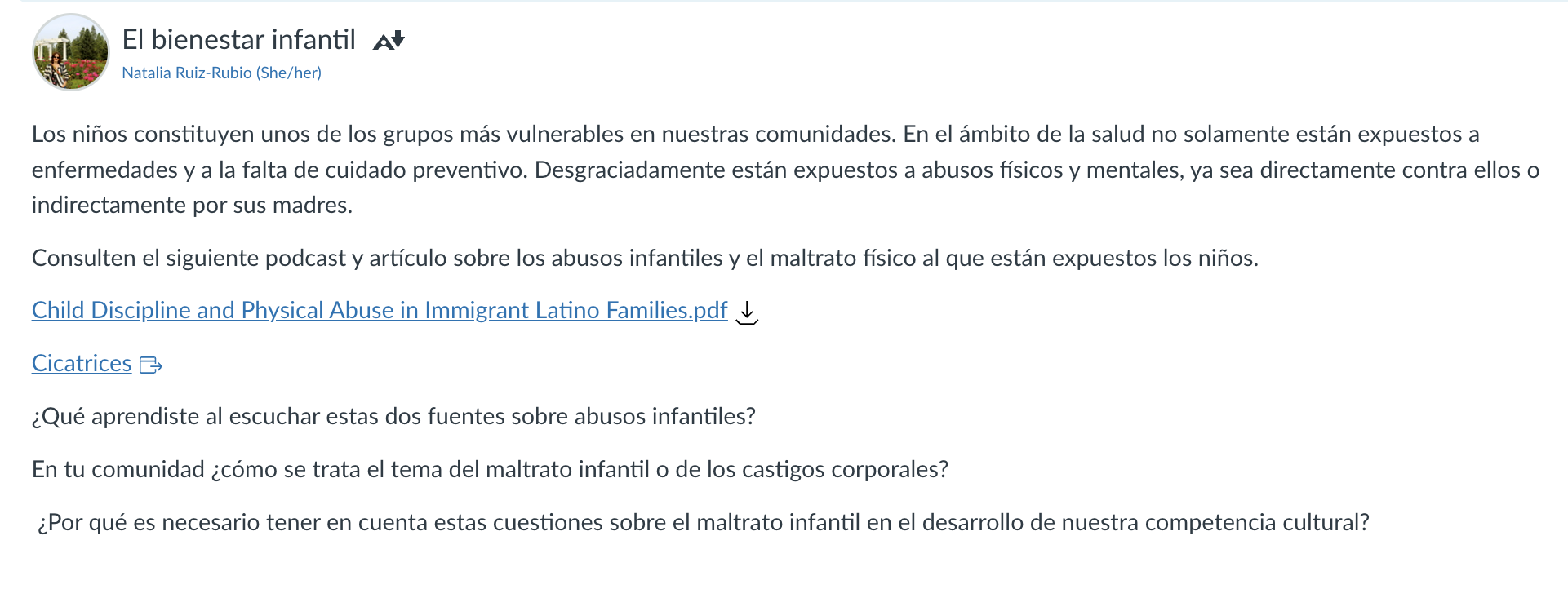
Question: SOS I need help answering the following questions below. The podcast is called Cicatrices and here's the link to it https://radioambulante.org/audio/cicatrices and the article is
SOS I need help answering the following questions below. The podcast is called Cicatrices and here's the link to it https://radioambulante.org/audio/cicatrices and the article is provided below
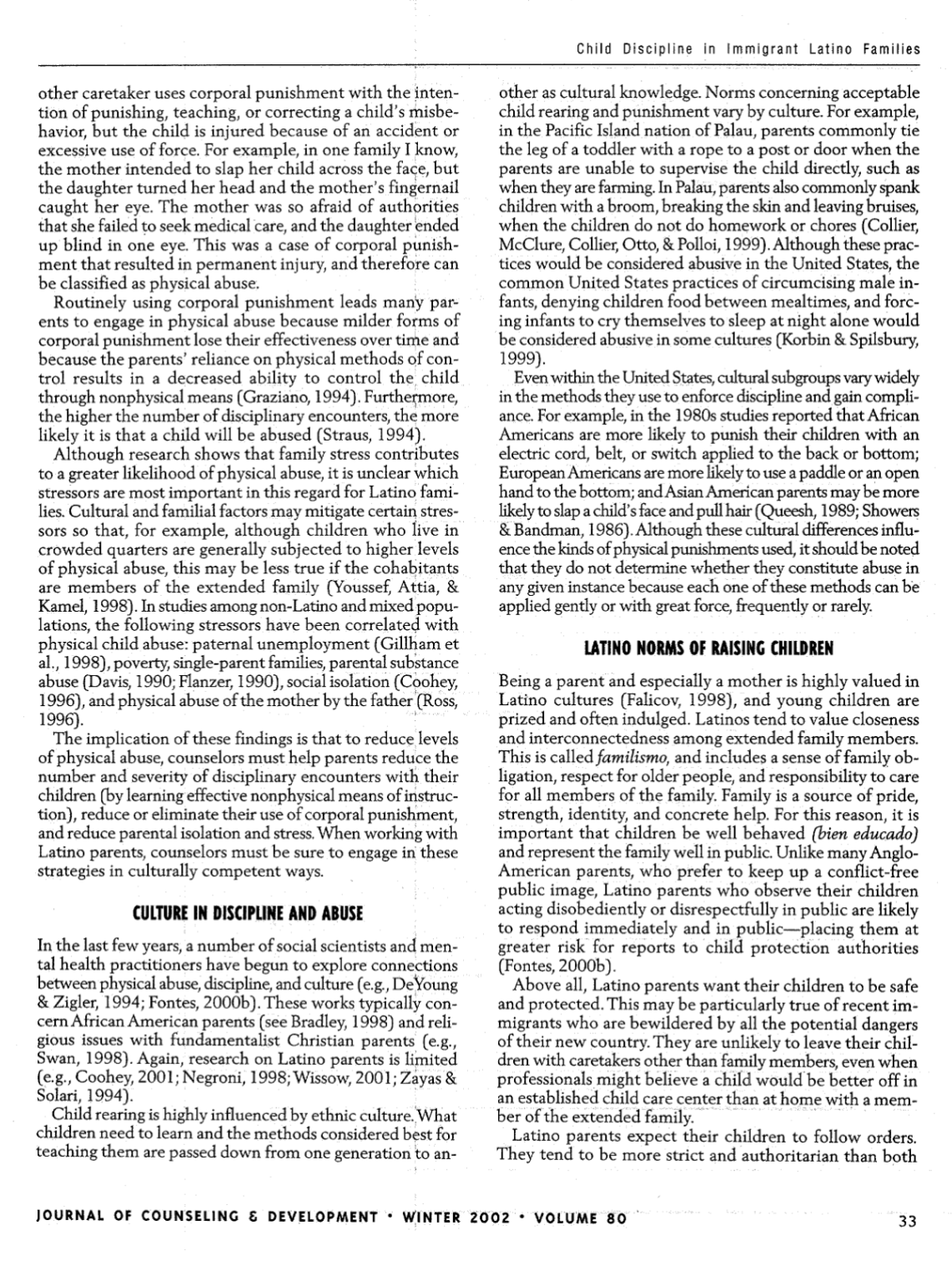
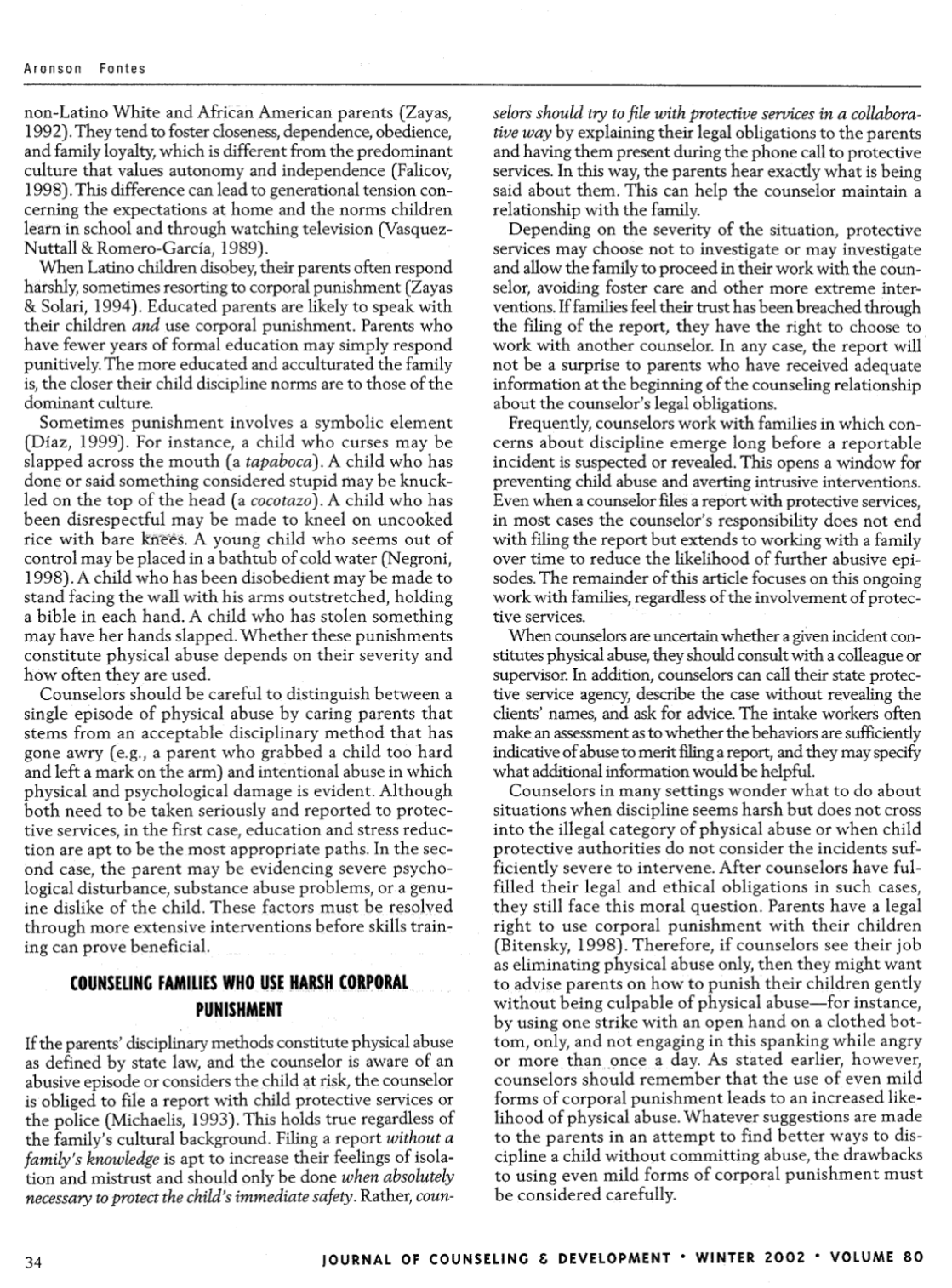
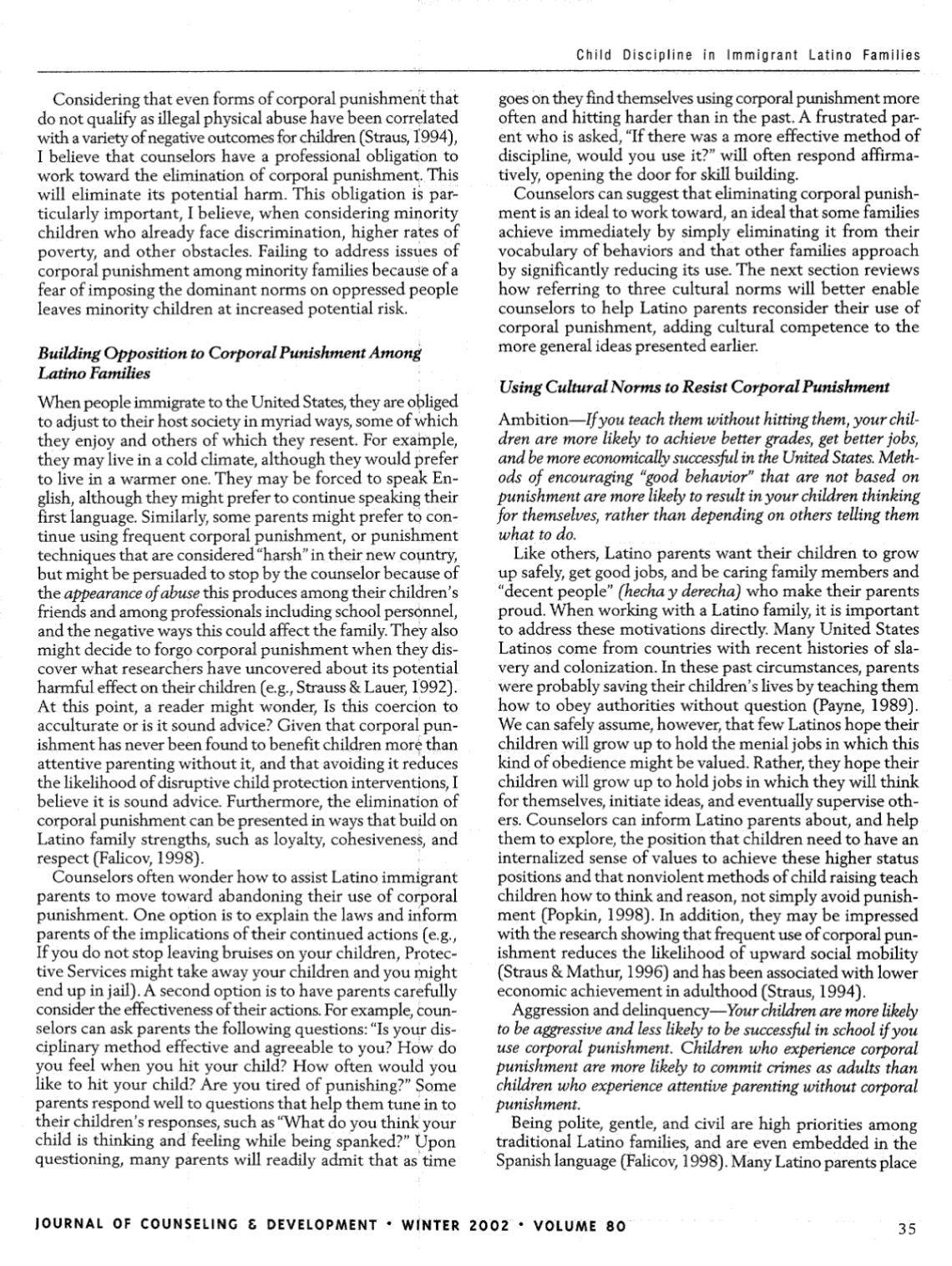
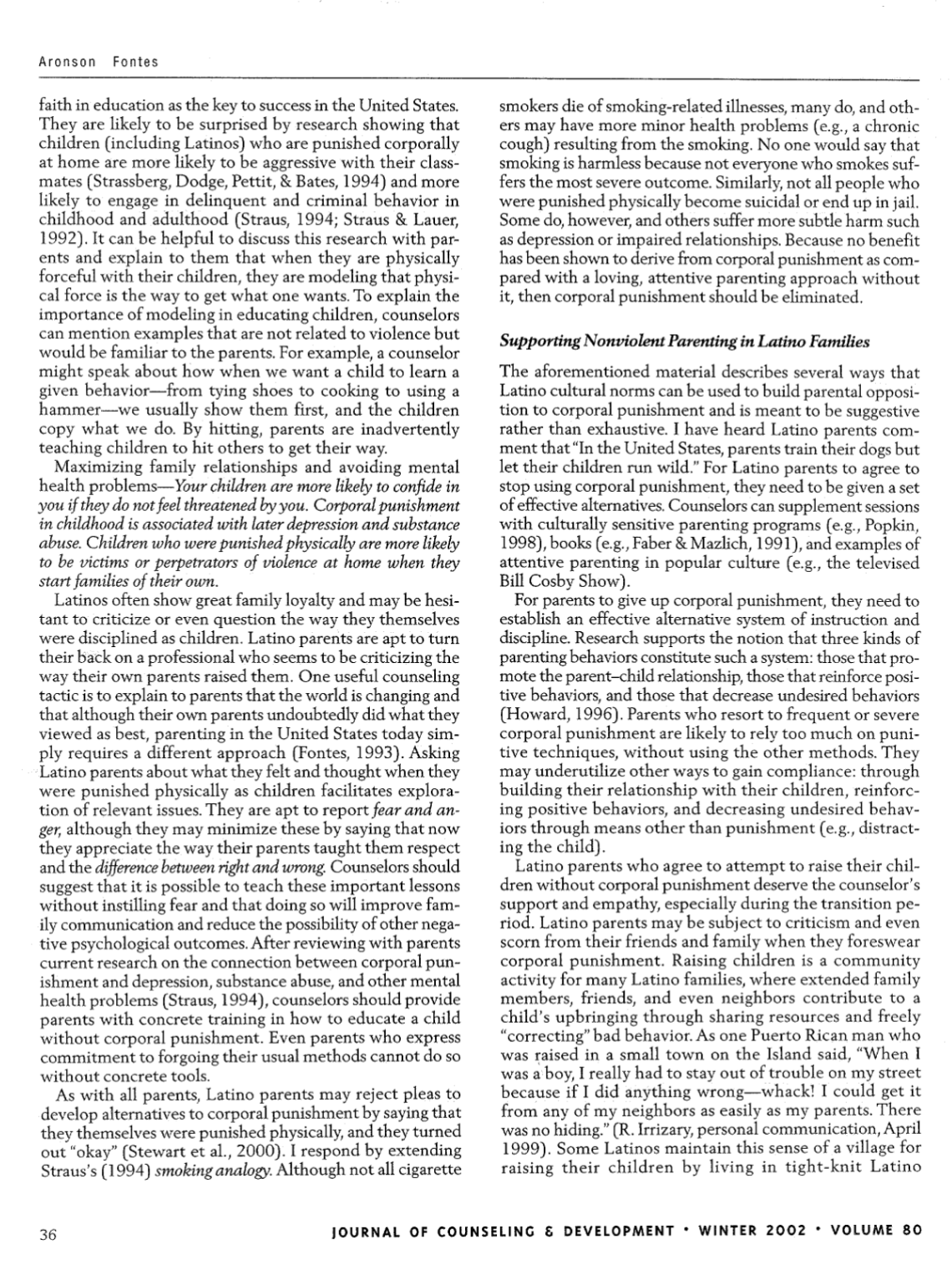
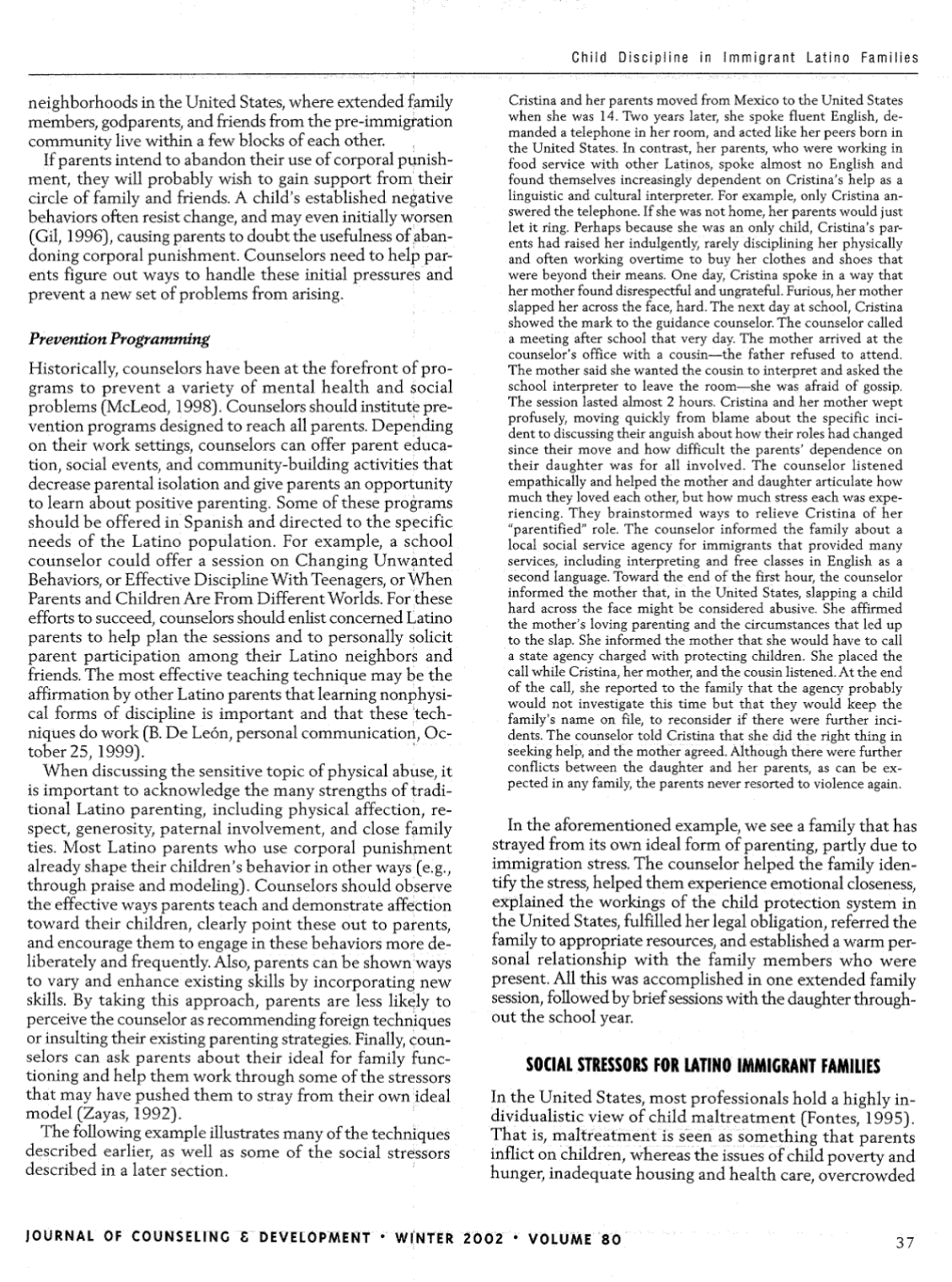
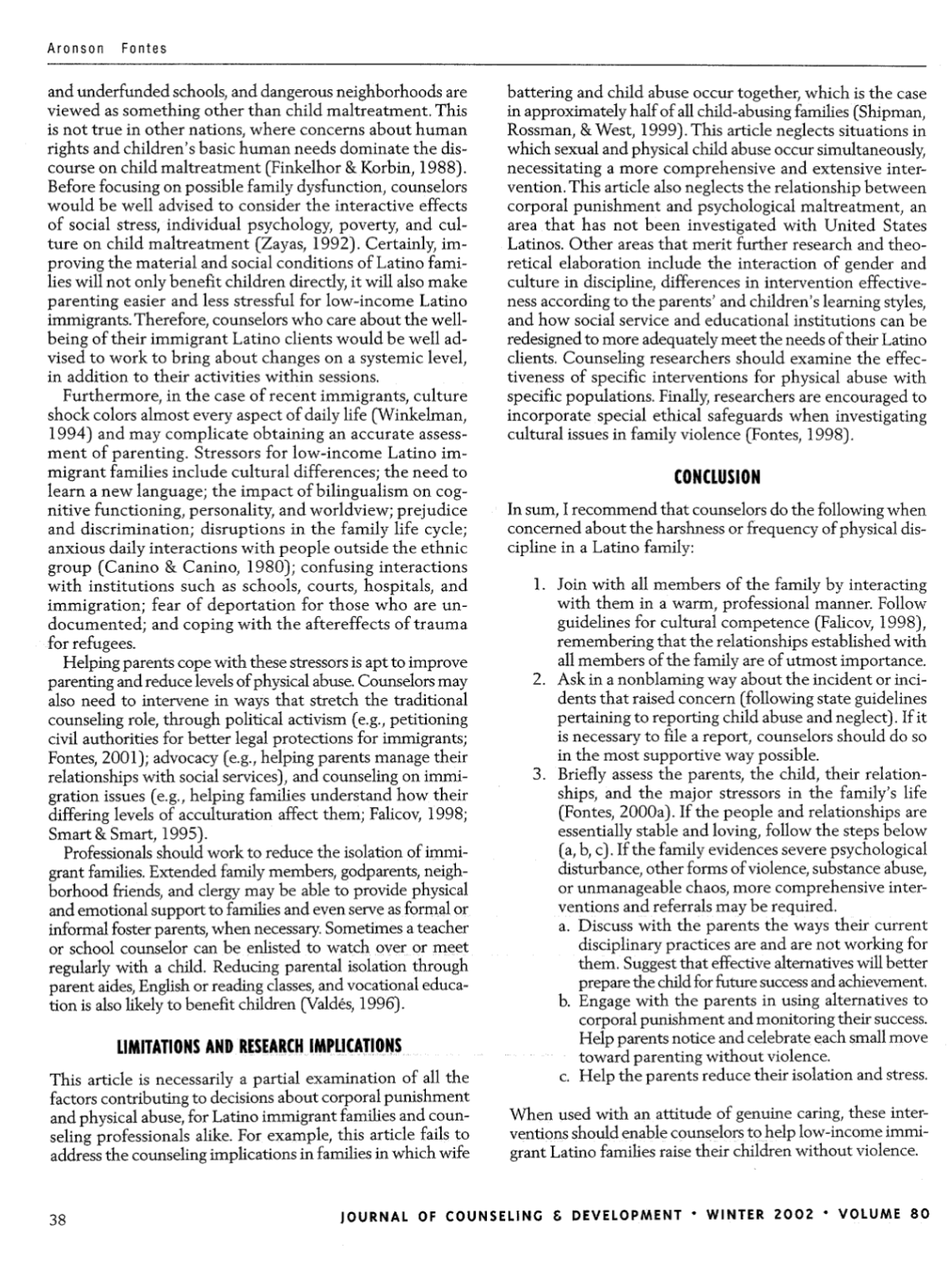
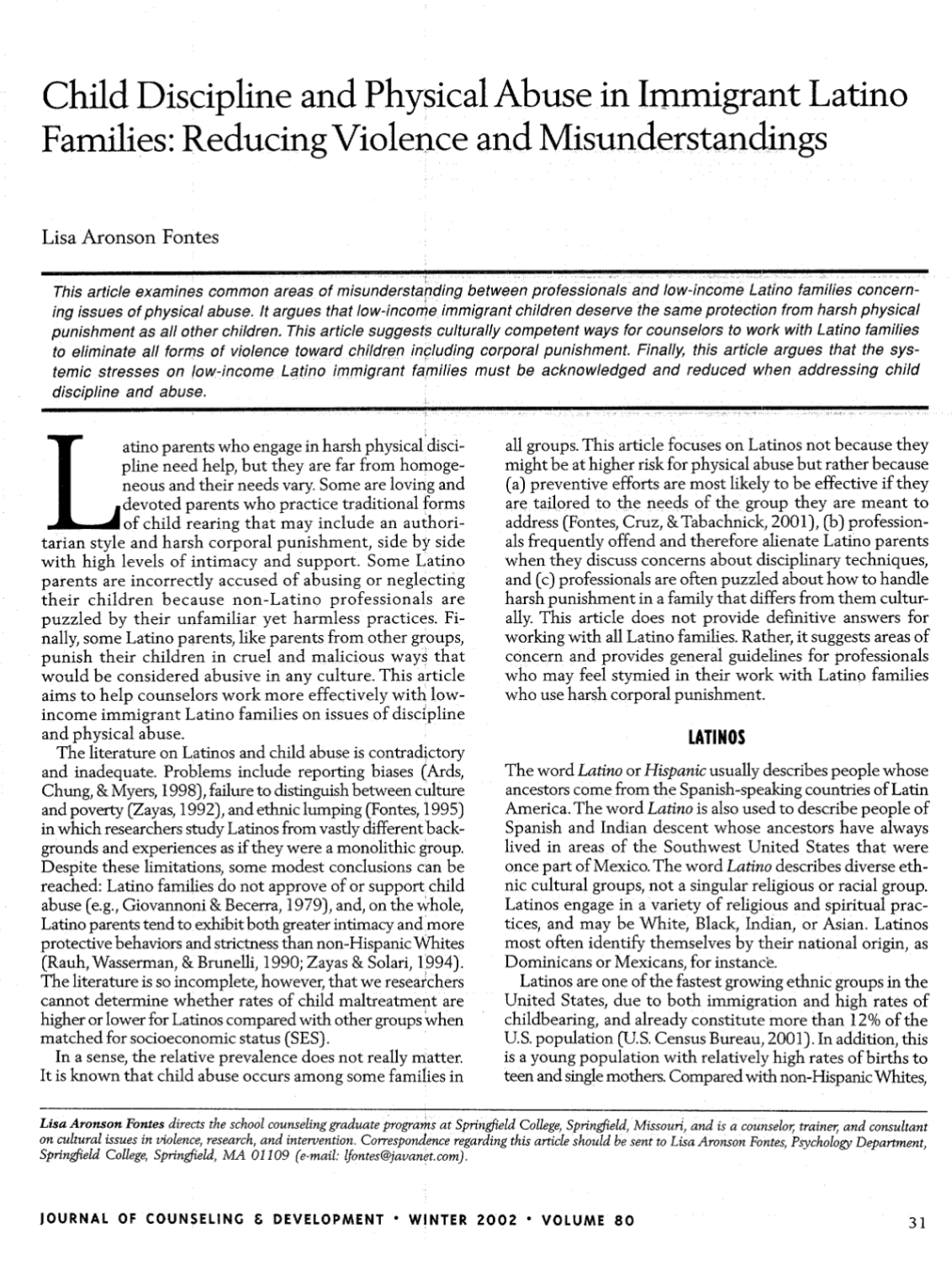
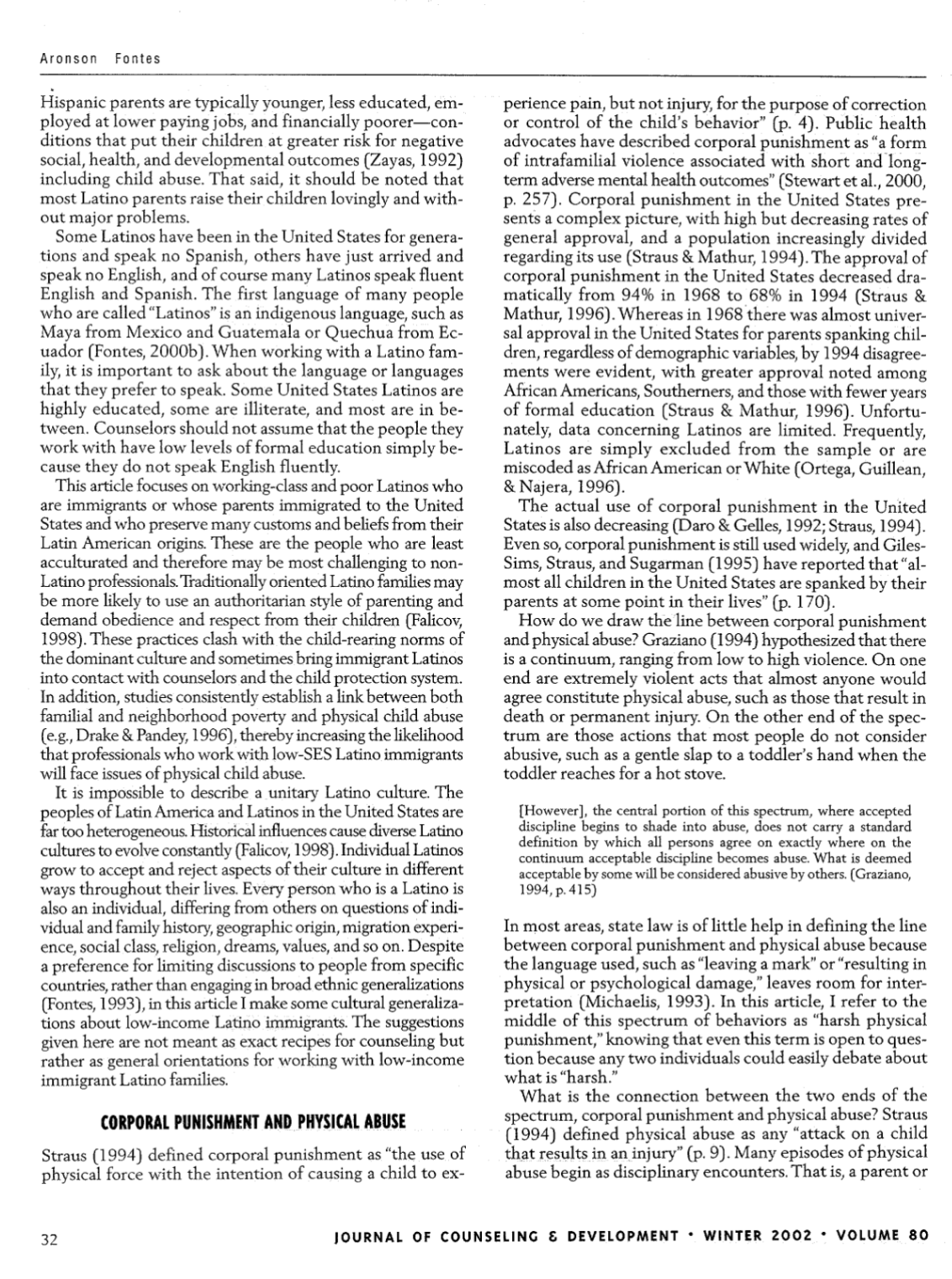
other caretaker uses corporal punishment with the inten- tion ofpunishing, teaching, or correcting a child's misbe- havior, but the child is injured because of an aceident or excessive use of force. For example, in one family 1 know, the mother intended to slap her child across the face, but the daughter turned her head and the mother's fingernail caught her eye. The mother was so afraid of authorities that she failed to seek medical care, and the daughter ended up blind in one eye. This was a case of corporal punish- ment that resulted in permanent injury, and therefore can be classied as physical abuse. Routinely using corporal punishment leads many par ents to engage in physical abuse because milder forms of corporal punishment lose their effectiveness over time and because the parents' reliance on physical methods of con trol results in a decreased ability to control the child through nonphysical means [Grazianq 1994]. Furthermore, the higher the number of disciplinary encounters, the more likely it is that a child will be abused (Straus, 1994). Although research shows that family stress contributes to a greater likelihood of physical abuse, it is unclear which stressors are most important in this regard for Latino fami- lies. Cultural and familial factors may mitigate certain stres- sors so that, for example, although children who live in crowded quarters are generally subjected to higher levels of physical abuse, this may be less true if the cohabitants are members of the extended family [Yousse Attia, 3t Kamel, 1998). In studies among non-Latino and mixed popu- lations, the following stressors have been correlated with physical child abuse: paternal unemployment (Gillham et 31., 1998], poverty, single-parent families, parental substance abuse (Davis, 1990,- Flanzer, 1990), social isolation (Coohey, 1996), and physical abuse of the mother by the father(Ross, 1996). ' The implication of these ndings is that to reduce levels of physical abuse, counselors must help parents reduce the number and severity of disciplinary encounters with their children [by learning effective nonphysical means of instruc- tiOn), reduce or eliminate their use of corporal punishment, and reduce parental isolation and stress. When working with Latino parents, counselors must be sure to engage in these strategies in culturally competent ways. (ULTUIE II DISCIPLINE MED AIIISE In the last few years, a number of social scientists and men- tal health practitioners have begun to explore connections between physical abuse, discipline, and culture (cg, DeYoung 81 Zigler, 1994; Fontes, 2000b]. These works typically con- cern African American parents (see Bradley, 1998] and reli- gious issues with fundamentalist Christian parents [e.g., Swan, 1998]. Again, research on Latino parents is limited (e.g., Coohey, 2001;Negroni, 1998;Wissow, 2001 ; zayas 8: Solari, 1994). Child rearing is highly influenced by ethnic cultureVV'hat children need to learn and the methods considered best for teaching them are passed down from one generation to an- Child Discipline In Immigrant Latino Families other as cultural knowledge. Norms concerning acceptable child rearing and punishment vary by culture. For example, in the Pacific Island nation of Palau, parents commonly tie the leg of a toddler with a rope to a post or door when the parents are unable to supervise the child directly, such as when they are farming. 1n Palau, parents also commonly spank children with a broom, breaking the skin and leaving bruises, when the children do not do homework or chores (Collier, McClure, Collier, Otto, 8v. Polloi, 1999). Although these prac- tices would be considered abusive in the United States, the common United States practices of circumcising male in- fants. denying children food between mealtimes, and forc ing infants to cry themselves to sleep at night alone would be considered abusive in some cultures [Korbin St Spilsbury, 1999) . Even within the United States, cultural subgroups vary widely in the methods they use to enforce discipline and gain compli- ance. For example, in the 19805 studies reported that African Americans are more likely to punish their children with an electric cord, belt, or switch applied to the back or bottom; European Americans are more likely to use a paddle or an open hand to the bottom; and Asian American parents may be more likely to slap a child's face and pull hair (Queh, 1989; Showers 8i. Bandman, 1986). Although these cultural differences: influ- ence the kinds of physical punishments used, it should be noted that they do not determine whether they constitute abuse in any given instance because each one of these methods can be applied gently or with great force, frequently or rarely. llll low 01 \"151116 CIIILBIEIl Being a parent and especially a mother is highly valued in Latino cultures [Falicov, 1998), and young children are prized and often indulged. Latinos tend to value closeness and interconnectedness among extended family members. This is called familismo, and includes a sense of family ob- ligation, respect for older people, and responsibility to care for all members of the family. Family is a source of pride, strength, identity, and concrete help. For this reason, it is important that children be Well behaved (bier: educado) and represent the family well in public. Unlike many Anglo- American parents, who prefer to keep up a conict-free public image, Latino parents who observe their children acting disobediently or disrespectfully in public are likely to respond immediately and in publicplacing them at greater risk for reports to child protection authorities (Fontes, 2000b). Above all, Latino parents want their children to be safe and protected. This may be particularly true of recent im- migrants who are bewildered by all the potential dangers of their new country. They are unlikely to leave their chil- dren with caretakers other than family members, even when professionals might believe a child would be better off in an established child care center than at home with a mem- ber of the extended family. Latino parents expect their children to follow orders. They tend to be more strict and authoritarian than both JOURNAL OF COUNSELING 6 DEVELOPMENT ' WINTER 2002 ' VOLUME 80 I 33 Aronson Fontes non-Latino White and African American parents [Zayas, l 992). They tend to foster closeness, dependence, obedience, and family loyalty, which is different from the predominant culture that values autonomy and independence [Falicov, 1998).This difference can lead to generational tension con- cerning the expectations at home and the norms children learn in school and through watching television [Vasquez- Nuttall 8r Romero-Garcia, 1989). When Latino children disobey. their parents often respond harshly, sometimes resorting to corporal punishment [Zayas 8i Solari, 1994). Educated parents are likely to speak with their children and use corporal punishment. Parents who have fewer years of formal education may simply respond punitively. The more educated and acculturated the family is, the closer their child discipline norms are to those ofthe dominant culture. Sometimes punishment involves a symbolic element [Diaz, 1999). For instance, a child who curses may be slapped across the mouth (a tapaboca). A child who has done or said something considered stupid may be knuck- led on the top of the head {a cocotazo). A child who has been disrespectful may be made to kneel on uncooked rice with bare kn'e'es. A young child who seems out of control may be placed in a bathtub of cold water [Negroni, 1998). A child who has been disobedient may be made to stand facing the wall with his arms outstretched, holding a bible in each hand. A child who has stolen something may have her hands slapped. Whether these punishments constitute physical abuse depends on their severity and how often they are used. Counselors should be careful to distinguish between a single episode of physical abuse by caring parents that stems from an acceptable disciplinary method that has gone awry (e.g., a parent who grabbed a child too hard and left a mark on the arm) and intentional abuse in which physical and psychological damage is evident. Although both need to be taken seriously and reported to protec- tive services, in the first case, education and stress reduc- tion are apt to be the most appropriate paths. In the sec- ond case, the parent may be evidencing severe psycho- logical disturbance, substance abuse problems, or a genu- ine dislike of the child. These factors must be resolved through more extensive interventions before skills train- ing can prove benecial. COUNSELING FAMILIES mil) IISE HANS" CORPOIML PUNISHMENT If the parents' disciplinary methods constitute physical abuse as defined by state law, and the counselor is aware of an abusive episode or considers the child at risk, the counselor is obliged to file a report with child protective services or the police [Michaelis 1993). This holds true regardlese of the family's cultural background. Filing a report without a family '5 knowledge is apt to increase their feelings of isola- tion and mistrust and should only be done when absolutely necessary to protect the child's immediate safety. Rather, coun- selors should try to file with protective services in a collabora- tive way by explaining their legal obligations to the parents and having them present during the phone call to protective services. In this way, the parents hear exactly what is being said about them. This can help the counselor maintain a relationship with the family. Depending on the severity of the situation, protective services may choose not to investigate or may investigate and allow the family to proceed in their work with the coun- selor, avoiding foster care and other more extreme inter- ventions. If families feel their trust has been breached through the filing of the report, they have the right to choose to work with another counselor. ln any case, the report will not be a surprise to parents who have received adequate information at the beginning of the counseling relationship about the counselor's legal obligations. Frequently, counselors work with families in which con- cerns about discipline emerge long before a reportable incident is suspected or revealed. This opens a window for preventing child abuse and averting intrusive interventions. Even when a counselor files a report with protective services, in most cases the counselor's responsibility does not end with filing the report but extends to working with a family over time to reduce the likelihood of further abusive epi- sodes. The remainder of this article focuses on this ongoing work with families, regardless of the involvement of protec- tive services. When counselors are uncertain whether a given incident con- stitutes physical abuse, they should consult with a colleague or supervisor. In addition, counselors can call their state protec- tiveservice agency, describe the case without revealing the clients' names, and ask for advice The intake workers often make an assessment as to whetherthe behaviors are sufciently indicative of abuse to merit ling a report, and they may specify what additional information would be helpful. Counselors in many settings wonder what to do about situations when discipline seems harsh but does not cross into the illegal category of physiCal abuse or when child protective authorities do not consider the incidents suf- ficiently severe to intervene. After counselors have ful- lled their legal and ethical obligations in such cases, they still face this moral question. Parents have a legal right to use corporal punishment with their children [Bitensky, 1998). Therefore, if counselors see their job as eliminating physical abuse only, then they might want to advise parents on how to punish their children gently without being culpable of physical abusefor instance, by using one strike with an open hand on a clothed bot- tom, only, and not engaging in this spanking while angry or more than once a day. As stated earlier, however, counselors should remember that the use of even mild forms of corporal punishment leads to an increased like- lihood of physical abuse. Whatever suggestions are made to the parents in an attempt to find better ways to dis- cipline a child without committing abuse, the drawbacks to using even mild forms of corporal punishment must be considered carefully. 34 JOURNAL OF COUNSELING 6 DEVELOPMENT ' WINTER 2002 ' VOLUME 80 Considering that even forms of corporal punishment that do not qualify as illegal physical abuse have been correlated with a variety of negative outcomes for children (So-ans, 1994], I believe that counselors have a professional obligation to work toward the elimination of corporal punishment. This will eliminate its potential harm. This obligation is par~ ticularly important, Ibelieve, when considering minority children who already face discrimination, higher rates of poverty, and other obstacles. Failing to address issues of corporal punishment among minority families because of a fear of imposing the dominant norms on oppressed people leaves minority children at increased potential risk. Building Opposition to Corporal Punishment Among [Alina Families When people immigrate to the United States, they are obliged to adjust to their host society in myriad ways, some of which they enjoy and others of which they resent. For example, they may live in a cold climate, although they would prefer to live in a warmer one. They may be forced to speak En- glish, although they might prefer to continue speaking their rst language. Similarly, some parents might prefer to con tinue using frequent corporal punishment, or punishment techniques that are considered \"harsh\" in their new country, but might be persuaded to stop by the counselor because of the appearance of abuse this produces among their children's friends and among professionals including school personnel, and the negative ways this could affect the family. They also might decide to forgo corporal punishment when they dis- cover what researchers have uncovered about its potential harmful effect on their children [eg., Strauss & Latter, 1992]. At this point, a reader might wonder, Is this coercion to acculturate or is it sound advice? Given that corporal pun- ishment has never been found to benefit children more than attentive parenting without it, and that avoiding it reduces the likelihood of disruptive child protection interventions, I believe it is sound advice. Furthermore, the elimination of corporal punishment can be presented in ways that build on Latino family strengths, such as loyalty, cohesiveness, and respect [Falicov, 199 8). Counselors often wonder how to assist Latino immigrant parents to move toward abandoning their use of corporal punishment. One option is to explain the laws and inform parents of the implications oftheir continued actions [e.g., If you do not stop leaving bruises on your children, Protec tive Services might take away your children and you might end up in jail).A second option is to have parents carefully consider the effectiveness of their actions For example, coun- selors can ask parents the following questions: \"Is your dis ciplinary method effective and agreeable to you? How do you feel when you hit your child? How often would you like to hit your child? Are you tired of punishing?\" Some parents respond well to questions that help them tune in to their children's responses, such as "Wh at do you think your child is thinking and feeling while being spanked?" Upon questioning, many parents will readily admit that as'time Child Discipline in lmrnigrant Latino Families goes on they nd themselves using corporal punishment more often and hitting harder than in the past. A frustrated par- ent who is asked, "If there was a more effective method of discipline, would you use it?\" will often respond affirma- tively, opening the door for skill building. Counselors can suggest that eliminating corporal punish- ment is an ideal to work toward, an ideal that some families achieve immediately by simply eliminating it from their vocabulary of behaviors and that other families approach by significantly reducing its use. The next section reviews how referring to three cultural norms will better enable counselors to help Latino parents reconsider their use of corporal punishment, adding cultural competence to the more general ideas presented earlier. Using Cultural Norms to Resist Corporal Punishmem Ambitionlfyou teach them without hitting them, your chil dren are more likely to achieve better grades, get better jobs, and be more economically successtl in the United States Meth ods of encouraging "good behavior\" that are not based on punishment are more likely to result in your children thinking for themselves, rather than depending on others telling them what to do. Like others, Latino parents want their children to grow up safely, get good jobs, and be caring family members and \"decent people" (heclta y demclta) who make their parents proud. When working with a Latino family, it is important to addreSs these motivations directly. Many United States Latinos come from countries with recent histories of sla- very and colonization. In these past circumstances, parents were probably saving their children's lives by teaching them how to obey authorities without question (Payne, 1989]. We can safely assume, however, that few Latinos hope their children will grow up to hold the menial jobs in which this kind of obedience might be valued. Rather, they hope their children will grow up to hold jobs in which they will think for themselves, initiate ideas, and eventually supervise oth- ers. C0unselors can inform Latino parents about, and help them to explore, the position that children need to have an internalized sense of values to achieve these higher status positions and that nonviolent methods of child raising teach children how to think and reason, not simply avoid punish- ment [Popkim 1998]. In addition, they may be impressed with the research showing that frequent use of corporal pun- ishment reduces the likelihood of upward social mobility [Straus 8:. Mathur, 1996) and has been associated with lower economic achievement in adulthood (Straus, 1994). Aggression and delinquencyYour children are more likely to be agressive and less lilzely to be mssful in school if you use corporal punishment. Children who experience corporal punishment are more likely to commit crimes as adults than children who experience attentive parenting without camaral punishment. Being polite, gentle, and civil are high priorities among traditional Latino families, and are even embedded in the Spanish language [Falicov, 1998]. Many Latino parents place IOURNAL OF COUNSELING 8 DEVELOPMENT ' WINTER 2002 ' VOLUME 80 35 Aronson Fonies faith in education as the key to success in the United States. They are likely to be surprised by research showing that children (including Latinos) who are punished corporally at home are more likely to be aggressive with their class- mates [Strassberg, Dodge, Pettit, 8r Bates, l994) and more likely to engage in delinquent and criminal behavior in childhood and adulthood (Straus, 1994; Straus 8; Lauer, 1992}. It can be helpful to discuss this research with par- ents and explain to them that when they are physically forceful with their children, they are modeling that physi- cal force is the way to get what one wants. To explain the importance of modeling in educating children, counselors can mention examples that are not related to violence but would be familiar to the parents. For example, a counselor might speak about how when we want a child to learn a given behaviorfrom tying shoes to cooking to using a hammerwe usually show them first, and the children copy what we do. By hitting, parents are inadvertently teaching children to hit others to get their way. Maximizing family relationships and avoiding mental health problemsYour children are more likely to confide in you if they do not feel threatened by you. Corporal punishment in childhood is associated with later depression and substance abuse. Children who were punished physically are more likely to be victims or perpetrators of violence at home when they start families of their own. Latinos often show great family loyalty and may be hesi- tant to criticize or even question the way they themselves were disciplined as children. Latino parents are apt to turn their back on a professional who seems to be criticizing the way their own parents raised them. One useful counseling tactic is to explain to parents that the world is changing and that although their own parents undoubtedly did what they viewed as best, parenting in the United States today sim- ply requires a different approach (Fontes, 1993). Asking Latino parents about what they felt and thought when they were punished physically as children facilitates explora- tion of relevant issues. They are apt to report fear and an- ger, although they may minimize these by saying that now they appreciate the way their parents taught them respect and the di'erence between right and wrong, Counselors should suggest that it is possible to teach these important lessons without instilling fear and that doing so will imprOve fam ily communication and reduce the possibility of other nega- tive psychological outcomes. After reviewing with parents current research on the connection between corporal pun- ishment and depression, substance abuse, and other mental health problems (Straus, 1994), counselors should provide parents with concrete training in how to educate a child without corporal punishment. Even parents who express commitment to forgoing their usual methods cannot do so without concrete tools. As with all parents, Latino parents may reject pleas to develop alternatives to corporal punishment by saying that they themselves were punished physically, and they turned out "okay\" [Stewart et al., 2000). I respond by extending Straus's (1994] smoking analogy. Although not all cigarette smokers die of smoking-related illnesses, many do, and oth- ers may have more minor health problems (e.g., a chronic cough) resulting from the smoking. No one would say that smoking is harmless because not everyone who smokes suf- fers the most severe outcome. Similarly, not all people who were punished physically become suicidal or end up in jail. Some do, however, and others suffer more subtle harm such as depression or impaired relationships. Because no benet has been shown to derive from corporal punishment as com- pared with a loving, attentive parenting approach without it, then corporal punishment should be eliminated. Supporting Nonviolent Parenting in Latim) Families The aforementioned material describes several ways that Latino cultural norms can be used to build parental opposi- tion to corporal punishment and is meant to be suggestive rather than exhaustive. I have heard Latino parents com- ment that \"In the United States, parents train their dogs but let their children run wild." For Latino parents to agree to stop using corporal punishment, they need to be given a set of effective alternatives. Counselors can supplement sessions with culturally sensitive parenting programs (e.g., Poplcin, 1998], books (e.g., Faber & Mazlich, 1991), and examples of attentive parenting in pepular culture (e.g., the televised Bill Cosby Show]. For parents to give up corporal punishment, they need to establish an effective alternative system of instruction and discipline. Research supports the notion that three kinds of parenting behaviors constitute such a system; those that pro- mote the parentchild relationship, those that reinforce posi- tive behaviors, and those that decrease undesired behaviors (Howard, 1996]. Parents who resort to frequent or severe corporal punishment are likely to rely too much on puni- tive techniques, without using the other methods. They may underutilize other ways to gain compliance: through building their relationship with their children, reinforc- ing positive behaviors, and decreasing undesired behav- iors through means other than punishment (e.g., distract- ing the child]. Latino parents who agree to attempt to raise their chil- dren without corporal punishment deserve the counselor's support and empathy, especially during the transition pe- riod. Latino parents may be subject to criticism and even scorn from their friends and family when they foreswcar corporal punishment. Raising children is a community activity for many Latino families, where extended family members, friends, and even neighbors contribute to a child's upbringing through sharing resources and freely "correcting"bad behavior. As one Puerto Rican man who was raised in a small town on the Island said, \"When I was a boy, I really had to stay out of trouble on my street because if] did anything wrongwhack! I could get it from any of my neighbors as easily as my parents. There was no hiding.\" (R. Irrizary, personal communication, April 1999). Some Latinos maintain this sense of a village for raising their children by living in tight-knit Latino 36 IOURNAL 0F COUNSELING 6 DEVELOPMENT ' WINTER 2002 ' VOLUME 80 Child Discipline in Immigrant Latino Families neighborhoods in the United States, where extended family members, godparents, and friends from the pre-immigration community live within a few blocks of each other. If parents intend to abandon their use of corporal punish- ment, they will probably wish to gain support from their circle of family and friends. A child's established negative behaviors often resist change, and may even initially worsen (Gil, 1996], causing parents to doubt the usefulness of aban- cloning corporal punishment. Counselors need to help par- ents figure out ways to handle these initial pressures and prevent a new set of problems from arising. Prevention Programming Historically, counselors have been at the forefront ofpro grams to prevent a variety of mental health and social problems (McLeod, 1998]. Counselors should institute pre- vention programs designed to reach all parents. Depending on their work settings, counselors can offer parent educa- tion, social events, and community-building activities that decrease parental isolation and give parents an opportunity to learn about positive parenting. Some of these programs should be offered in Spanish and directed to the specific needs of the Latino population. For example, a school counselor could offer a session on Changing Unwanted Behaviors, or Effective Discipline With Teenagers, or When Parents and Children Are From Different Worlds. For these efforts to succeed, counselors should enlist concerned Latino parents to help plan the motions and to penmnally solicit parent participation among their Latino neighbors and friends. The most effective teaching technique may be the affirmation by other Latino parents that learning nonphysi- cal forms of discipline is important and that these 'tech- niques do work (B. De Leon, personal communication, Oc- tober 25. 1999). I When discussing the sensitive topic of physical abuse, it is important to acknowledge the many strengths of tradi- tional Latino parenting, including physical affection, re- spect, generosity, paternal involvement, and close family ties. Most Latino parents who use corporal punishment already shape their children's behavior in other ways [e.g., through praise and modeling). Counselors should observe the effective ways parents teach and demonstrate affection toward their children, clearly point these out to parents, and encourage them to engage in these behaviors more de- liberately and frequently. Also, parents can be shown ways to vary and enhance existing skills by incorporating new skills. By taking this approach, parents are less likely to perceive the counselor as recommending foreign techniques or insulting their existing parenting strategies. Finally, coun- selors can ask parents about their ideal for family func tioning and help them work through some of the stressors that may have pushed them to stray from their own ideal model (Zayas, 1992). The following example illustrates many of the techniques described earlier, as well as some of the social stressors described in a later section. Cristina and her parents moved from Mexico to the United States when she was 14. Two years later, she spoke uent English, de- manded a telephone in her room, and acted like her peers born in the United States. In contrast, her parents, who were working in food service with other Latinos, spoke almost no English and found themselves increasingly dependent on Cristina's help as a linguistic and cultural interpreter. For example, only Cristina an swered the telephone. If she was not home, her parents would just let it ring. Perhaps because she was an only child. Cristina's par- ents had raised her indulgently, rarely disciplining her physically and often working overtime to buy her clothes and shoes that were beyond their means. One day, Cristina spoke in a way that her mother found disrespectful and ungrateful. Furious, her mother slapped her across the face, hard. The next day at school, Cristina showed the mark to the guidance counselor: The counselor called a meeting after school that very day. The mother arrived at the counselor's office with a cousinthe father refused to attend. The mother said she wanted the cousin to interpret and asked the school interpreter to leave the roomshe was afraid of gossip. The session lasted almost 2 hours. Cristina and her mother wept profusely, moving quickly from blame about the Specific inci- dent to discussing their anguish about how their roles had changed since their move and how difficult the parents' dependence on their daughter was for all involved. The counselor listened empathically and helped the mother and daughter articulate how much they loved each other, but haw much stress each was expe riencing. They brainstormed ways to relieve Cristina of her "parentified" role. The counselor informed the family about a local social service agency for immigrants that provided many services, including interpreting and free classes in English as a second language. Toward the end of the first hour, the counselor informed the mother that, in the United States, slapping a child hard across the face might be considered abusive. She affirmed the mother's loving parenting and the circumstances that led up to the slap. She informed the mother that she would have to call a state agency charged with protecting children. She placed the call while Cristina, her mother, and the cousin listened. At the end of the call, she reported to the family that the agency probably would not investigate this time but that they would keep the family's name on le, to reconsider if there were further inci- dents. The counselor told Cristina that she did the right thing in seeking help, and the mother agreed. Although there were further conflicts between the daughter and her parents, as can be ex pected in any family, the parents never resorted to violence again. In the aforementioned example, we see a family that has strayed from its own ideal form of parenting, partly due to immigration stress. The counselor helped the family iden- tify the stress, helped them experience emotional closeness, explained the workings of the child protection system in the United States, fullled her legal obligation, referred the family to appropriate resources, and established a warm per- sonal relationship with the family members who were present. All this was accomplished in one extended family session, followed by brief sessions with the daughter through- out the school year. $00\" mots HI! INHIO IMMIGRANT FMIlIES In the United States, most professionals hold a highly in- dividualistic view of child maltreatment (Fontes, 1995]. That is, maltreatment is seen as something that parents inict on children, whereas the issues of child poverty and hunger, inadequate housing and health care, overcrowded JOURNAL OF COUNSELING 8 DEVELOPMENT ' WINTER 2002 ' VOLUME 80 37 Aronson Fontes and underfunded schools, and dangerous neighborhoods are viewed as something other than child maltreatment. This is not true in other nations, where concerns about human rights and children's basic human needs dominate the dis- course on child maltreatment [Finkelhor 8t Korbin, 1988). Before focusing on possible family dysfunction, counselors would be well advised to consider the interactive effects of social stress, individual psychology, poverty, and cul- ture on child maltreatment [Zayas, 1992). Certainly, im- proving the material and social conditions of Latino fami- lies will not only benefit children directly, it will also make parenting easier and less stressful for low-income Latino immigrants. Therefore, counselors who care about the well being of their immigrant Latino clients would be well ad- vised to work to bring about changes on a systemic level, in addition to their activities within sessions. Furthermore, in the case of recent immigrants, culture shock colors almost every aspect of daily life (Winkelrnan, 1994) and may complicate obtaining an accurate assess- ment of parenting. Stressors for low-income Latino im- migrant families include cultural differences; the need to learn a new language; the impact of bilingualism on cog- nitive functioning, personality, and worldview; prejudice and discrimination; disruptions in the family life cycle; anxious daily interactions with people outside the ethnic group (Canino 8t Canine, 1980); confusing interactions with institutions such as schools, courts, hospitals, and immigration; fear of deportation for those who are un- documented; and coping with the aftereffects of trauma for refugees. Helping parents cope with these stressors is apt to improve parenting and reduce levels of physical abuse Counselors may also need to intervene in ways that stretch the traditional counseling role, through political activism (e.g., petitioning civil authorities for better legal protections for immigrants; Fontes, 2001); advocacy (e.g., helping parents manage their relationships with social services), and counseling on immi- gration issues [e.g., helping families understand how their differing levels of acculturation affect them; Falicov, 1998; Smart 8L Smart, 1995). Professionals should work to reduce the isolation of immi- grant families. Extended family members, godparents, neigh- borhood friends, and clergy may be able to provide physical and emotional support to families and even serve as formal or informal foster parents, when necessary. Sometimes a teacher or school counselor can be enlisted to watch over or meet regularly with a child. Reducing parental isolation through parent aides, English or reading classes, and vocational educa- tion is also likely to benefit children (Valds, 1996). lll'll'llls Mil \"SEARCH IIPUGTIIIHS This article is necessarily a partial examination of all the factors contributing to decisions about corporal punishment and physical abuse, for Latino immigrant families and coun- seling professionals alike. For example, this article fails to address the counseling implications in families in which wife battering and child abuse occur together, which is the case in approximately half of all child-abusing families (Shipman, Rossman, 81 West, 1999). This article neglects situations in which sexual and physical child abuse occur simultaneously, necessitating a more comprehensive and extensive inter- vention. This article also neglects the relationship between corporal punishment and psychological maltreatment, an area that has not been investigated with United States Latinos. Other areas that merit further research and theo- retical elaboration include the interaction of gender and culture in discipline, differences in intervention effective- ness according to the parents' and children's learning styles, and how social service and educational institutions can be redesigned to more adequately meet the needs of their Latino clients. Counseling researchers should examine the effec- tiveness of specic interventions for physical abuse with specific populations. Finally, researchers are encouraged to incorporate special ethical safeguards when investigating cultural issues in family violence [Fontes, 1998). (tlIISIllI In sum, I recommend that counselors do the following when concerned about the harshness or frequency of physical dis- cipline in a Latino family: 1. Join with all members of the family by interacting with them in a warm, professional manner. Follow guidelines for cultural competence (Falicov, 1998), remembering that the relationships established with all members of the family are of utmost importance. 2. Ask in a nonblaming way about the incident or inci- dents that raised concern (following state guidelines pertaining to reporting child abuse and neglect]. If it is necessary to le a report, counselors should do so in the most supportive way possible. 3. Briey assess the parents, the child, their relation- ships, and the major stressors in the family's life (Fontes, 2000a). If the people and relationships are essentially stable and loving, follow the steps below (a, b, c). If the family evidences severe psychological disturbance, other forms of violence, substance abuse, or unmanageable chaos, more comprehensive inter- ventions and referrals may be required. a. Discuss with the parents the ways their current disciplinary practices are and are not working for them. Suggest that efective alternatives will better prepare the child for future success and achievement. b. Engage with the parents in using alternatives to corporal punishment and monitoring their success. Help parents notice and celebrate each small move toward parenting without violence. c. Help the parents reduce their isolation and stress. When used with an attitude of genuine caring, these inter- ventions should enable counselors to help low-income immi- grant Latino families raise their children without violence. 38 JOURNAL OF COUNSELING 8 DEVELOPMENT ' WINTER 2002 ' VOLUME 80 El bienestar infantil At Natalia Ruiz-Rubio (She/her) Los ninos constituyen unos de los grupos mas vulnerables en nuestras comunidades. En el ambito de la salud no solamente estan expuestos a enfermedades y a la falta de cuidado preventivo. Desgraciadamente estan expuestos a abusos fisicos y mentales, ya sea directamente contra ellos o indirectamente por sus madres. Consulten el siguiente podcast y articulo sobre los abusos infantiles y el maltrato fisico al que estan expuestos los ninos. Child Discipline and Physical Abuse in Immigrant Latino Families.pdf Cicatrices E Que aprendiste al escuchar estas dos fuentes sobre abusos infantiles? En tu comunidad como se trata el tema del maltrato infantil o de los castigos corporales? Por que es necesario tener en cuenta estas cuestiones sobre el maltrato infantil en el desarrollo de nuestra competencia cultural?Child Discipline and Physical Abuse in Immigrant Latino Families: Reducing Violence and Misunderstandings Lisa Aronson Fontes This article examines common areas of misunderstanding between professionals and low-income Latino families concern- ing issues of physical abuse. It argues that low-income immigrant children deserve the same protection from harsh physical punishment as all other children. This article suggests culturally competent ways for counselors to work with Latino families to eliminate all forms of violence toward children including corporal punishment. Finally, this article argues that the sys- temic stresses on low-income Latino immigrant families must be acknowledged and reduced when addressing child discipline and abuse. atino parents who engage in harsh physical disci- all groups. This article focuses on Latinos not because they pline need help, but they are far from homoge- might be at higher risk for physical abuse but rather because neous and their needs vary. Some are loving and (a) preventive efforts are most likely to be effective if they devoted parents who practice traditional forms are tailored to the needs of the group they are meant to of child rearing that may include an authori- address (Fontes, Cruz, & Tabachnick, 2001), (b) profession- tarian style and harsh corporal punishment, side by side als frequently offend and therefore alienate Latino parents with high levels of intimacy and support. Some Latino when they discuss concerns about disciplinary techniques, parents are incorrectly accused of abusing or neglecting and (c) professionals are often puzzled about how to handle their children because non-Latino professionals are harsh punishment in a family that differs from them cultur- puzzled by their unfamiliar yet harmless practices. Fi- ally. This article does not provide definitive answers for nally, some Latino parents, like parents from other groups, working with all Latino families. Rather, it suggests areas of punish their children in cruel and malicious ways that concern and provides general guidelines for professionals would be considered abusive in any culture. This article who may feel stymied in their work with Latino families aims to help counselors work more effectively with low- who use harsh corporal punishment. income immigrant Latino families on issues of discipline and physical abuse. LATINOS The literature on Latinos and child abuse is contradictory and inadequate. Problems include reporting biases (Ards, The word Latino or Hispanic usually describes people whose Chung, & Myers, 1998), failure to distinguish between culture ancestors come from the Spanish-speaking countries of Latin and poverty (Zayas, 1992), and ethnic lumping (Fontes, 1995) America. The word Latino is also used to describe people of in which researchers study Latinos from vastly different back- Spanish and Indian descent whose ancestors have always grounds and experiences as if they were a monolithic group. lived in areas of the Southwest United States that were Despite these limitations, some modest conclusions can be once part of Mexico. The word Latino describes diverse eth- reached: Latino families do not approve of or support child nic cultural groups, not a singular religious or racial group abuse (e.g., Giovannoni & Becerra, 1979), and, on the whole, Latinos engage in a variety of religious and spiritual prac- Latino parents tend to exhibit both greater intimacy and more tices, and may be White, Black, Indian, or Asian. Latinos protective behaviors and strictness than non-Hispanic Whites most often identify themselves by their national origin, as (Rauh, Wasserman, & Brunelli, 1990; Zayas & Solari, 1994). Dominicans or Mexicans, for instance. The literature is so incomplete, however, that we researchers Latinos are one of the fastest growing ethnic groups in the cannot determine whether rates of child maltreatment are United States, due to both immigration and high rates of higher or lower for Latinos compared with other groups when childbearing, and already constitute more than 12% of the matched for socioeconomic status (SES) U.S. population (U.S. Census Bureau, 2001). In addition, this In a sense, the relative prevalence does not really matter. is a young population with relatively high rates of births to It is known that child abuse occurs among some families in teen and single mothers. Compared with non-Hispanic Whites, Lisa Aronson Fontes directs the school counseling graduate programs at Springfield College, Springfield, Missouri, and is a counselor, trainer, and consultant on cultural issues in violence, research, and intervention. Correspondence regarding this article should be sent to Lisa Aronson Fontes, Psychology Department, Springfield College, Springfield, MA 01109 (e-mail: Ifontes@javanet.com) JOURNAL OF COUNSELING & DEVELOPMENT . WINTER 2002 . VOLUME 80 31Aronson Fontes Hispanic parents are typically younger, less educated, em- perience pain, but not injury, for the purpose of correction ployed at lower paying jobs, and financially poorer-con- or control of the child's behavior" (p. 4). Public health ditions that put their children at greater risk for negative advocates have described corporal punishment as "a form social, health, and developmental outcomes (Zayas, 1992) of intrafamilial violence associated with short and long- including child abuse. That said, it should be noted that term adverse mental health outcomes" (Stewart et al., 2000 most Latino parents raise their children lovingly and with- p. 257). Corporal punishment in the United States pre- out major problems. sents a complex picture, with high but decreasing rates of Some Latinos have been in the United States for genera- general approval, and a population increasingly divided tions and speak no Spanish, others have just arrived and regarding its use (Straus & Mathur, 1994). The approval of speak no English, and of course many Latinos speak fluent corporal punishment in the United States decreased dra- English and Spanish. The first language of many people matically from 94% in 1968 to 68% in 1994 (Straus & who are called "Latinos" is an indigenous language, such as Mathur, 1996). Whereas in 1968 there was almost univer- Maya from Mexico and Guatemala or Quechua from Ec- sal approval in the United States for parents spanking chil- uador (Fontes, 2000b). When working with a Latino fam- dren, regardless of demographic variables, by 1994 disagree- ily, it is important to ask about the language or languages ments were evident, with greater approval noted among that they prefer to speak. Some United States Latinos are African Americans, Southerners, and those with fewer years highly educated, some are illiterate, and most are in be- of formal education (Straus & Mathur, 1996). Unfortu tween. Counselors should not assume that the people they nately, data concerning Latinos are limited. Frequently, work with have low levels of formal education simply be- Latinos are simply excluded from the sample or are cause they do not speak English fluently. miscoded as African American or White (Ortega, Guillean, This article focuses on working-class and poor Latinos who & Najera, 1996). are immigrants or whose parents immigrated to the United The actual use of corporal punishment in the United States and who preserve many customs and beliefs from their States is also decreasing (Daro & Gelles, 1992; Straus, 1994). Latin American origins. These are the people who are least Even so, corporal punishment is still used widely, and Giles- acculturated and therefore may be most challenging to non- Sims, Straus, and Sugarman (1995) have reported that "al- Latino professionals. Traditionally oriented Latino families may most all children in the United States are spanked by their be more likely to use an authoritarian style of parenting and parents at some point in their lives" (p. 170). demand obedience and respect from their children (Falicov, How do we draw the line between corporal punishment 1998). These practices clash with the child-rearing norms of and physical abuse? Graziano (1994) hypothesized that there the dominant culture and sometimes bring immigrant Latinos is a continuum, ranging from low to high violence. On one into contact with counselors and the child protection system. end are extremely violent acts that almost anyone would In addition, studies consistently establish a link between both agree constitute physical abuse, such as those that result in familial and neighborhood poverty and physical child abuse death or permanent injury. On the other end of the spec- (e.g., Drake & Pandey, 1996), thereby increasing the likelihood trum are those actions that most people do not consider that professionals who work with low-SES Latino immigrants abusive, such as a gentle slap to a toddler's hand when the will face issues of physical child abuse. toddler reaches for a hot stove. It is impossible to describe a unitary Latino culture. The peoples of Latin America and Latinos in the United States are [However], the central portion of this spectrum, where accepted far too heterogeneous. Historical influences cause diverse Latino discipline begins to shade into abuse, does not carry a standard cultures to evolve constantly (Falicov, 1998). Individual Latinos definition by which all persons agree on exactly where on the continuum acceptable discipline becomes abuse. What is deemed grow to accept and reject aspects of their culture in different acceptable by some will be considered abusive by others. (Graziano, ways throughout their lives. Every person who is a Latino is 1994, p. 415) also an individual, differing from others on questions of indi- vidual and family history, geographic origin, migration experi- In most areas, state law is of little help in defining the line ence, social class, religion, dreams, values, and so on. Despite between corporal punishment and physical abuse because a preference for limiting discussions to people from specific the language used, such as "leaving a mark" or "resulting in countries, rather than engaging in broad ethnic generalizations physical or psychological damage," leaves room for inter- (Fontes, 1993), in this article I make some cultural generaliza- pretation (Michaelis, 1993). In this article, I refer to the tions about low-income Latino immigrants. The suggestions middle of this spectrum of behaviors as "harsh physical given here are not meant as exact recipes for counseling but punishment," knowing that even this term is open to ques- rather as general orientations for working with low-income tion because any two individuals could easily debate about immigrant Latino families. what is "harsh." What is the connection between the two ends of the CORPORAL PUNISHMENT AND PHYSICAL ABUSE spectrum, corporal punishment and physical abuse? Straus (1994) defined physical abuse as any "attack on a child Straus (1994) defined corporal punishment as "the use of that results in an injury" (p. 9). Many episodes of physical physical force with the intention of causing a child to ex- abuse begin as disciplinary encounters. That is, a parent or 32 JOURNAL OF COUNSELING & DEVELOPMENT . WINTER 2002 . VOLUME 80
Step by Step Solution
There are 3 Steps involved in it

Get step-by-step solutions from verified subject matter experts