



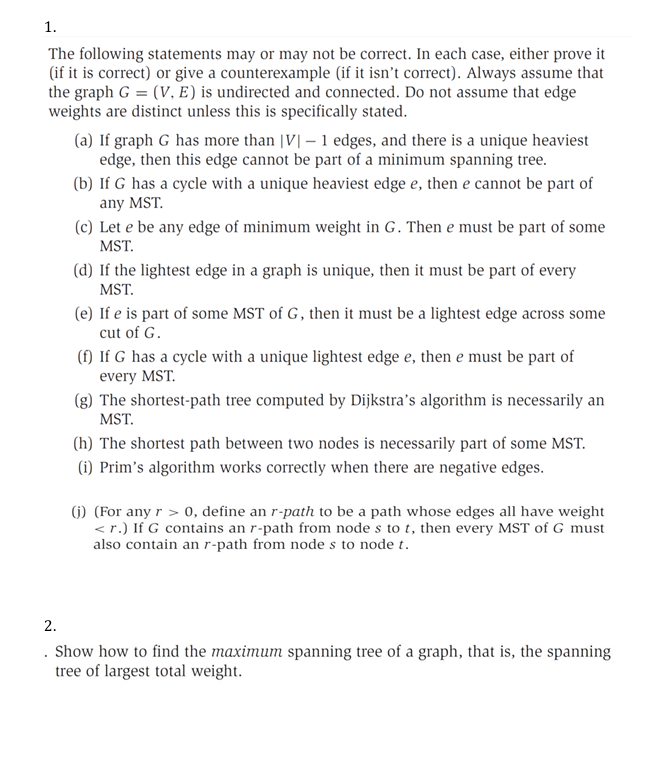
Question: The following statements may or may not be correct. In each case, either prove it ( if it is correct ) or give a counterexample
The following statements may or may not be correct. In each case, either prove it
if it is correct or give a counterexample if it isn't correct Always assume that
the graph GVE is undirected and connected. Do not assume that edge
weights are distinct unless this is specifically stated.
a If graph G has more than V edges, and there is a unique heaviest
edge, then this edge cannot be part of a minimum spanning tree.
b If G has a cycle with a unique heaviest edge e then e cannot be part of
any MST
c Let e be any edge of minimum weight in G Then e must be part of some
MST
d If the lightest edge in a graph is unique, then it must be part of every
MST
e If e is part of some MST of G then it must be a lightest edge across some
cut of G
f If G has a cycle with a unique lightest edge e then e must be part of
every MST
g The shortestpath tree computed by Dijkstra's algorithm is necessarily an
MST
h The shortest path between two nodes is necessarily part of some MST
i Prim's algorithm works correctly when there are negative edges.
jFor any r define an rpath to be a path whose edges all have weight
r If G contains an rpath from node s to t then every MST of G must
also contain an rpath from node s to node t
Show how to find the maximum spanning tree of a graph, that is the spanning
tree of largest total weight.
solve these questions design and analysis of algorithms
Step by Step Solution
There are 3 Steps involved in it
1 Expert Approved Answer
Step: 1 Unlock

Question Has Been Solved by an Expert!
Get step-by-step solutions from verified subject matter experts
Step: 2 Unlock
Step: 3 Unlock