







Question: These are the tables create table EMP(empNo number(6) primary key,fname varchar(50),lname varchar(50),address varchar(50), sex varchar(1),salary decimal(15,2), position varchar(50),deptNo number(4)); create table DEPT(deptNo number(6) primary key,deptName
These are the tables
create table EMP(empNo number(6) primary key,fname varchar(50),lname varchar(50),address varchar(50), sex varchar(1),salary decimal(15,2), position varchar(50),deptNo number(4));
create table DEPT(deptNo number(6) primary key,deptName varchar(50),Mgr number(6));
create table PROJ(projNo number(6) primary key,projName varchar(50),deptNum number(6));
create table EMP_PROJ(empno number(6),projNo number(6) ,hourSpent number(6));
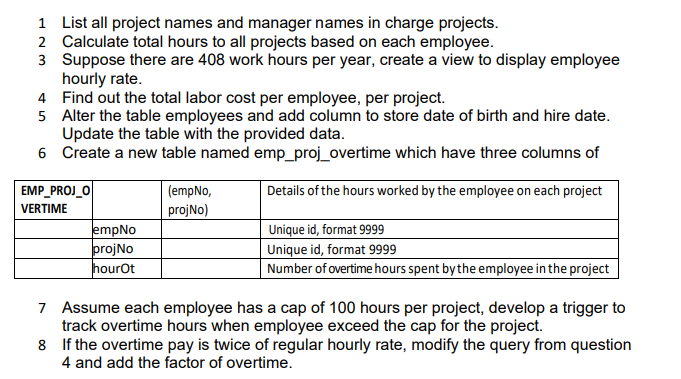
1 List all project names and manager names in charge projects. 2 Calculate total hours to all projects based on each employee. 3 Suppose there are 408 work hours per year, create a view to display employee hourly rate. 4 Find out the total labor cost per employee, per project. 5 Alter the table employees and add column to store date of birth and hire date. Update the table with the provided data. 6 Create a new table named emp_proj_overtime which have three columns of Details of the hours worked by the employee on each project Unique id, format 9999 Unique id, format 9999 Number of overtime hours spent by the employee in the project EMP_PROJ_O VERTIME 7 empNo projNo hourOt (empNo, projNo) Assume each employee has a cap of 100 hours per project, develop a trigger to track overtime hours when employee exceed the cap for the project. 8 If the overtime pay is twice of regular hourly rate, modify the query from question 4 and add the factor of overtime.
Step by Step Solution
3.34 Rating (151 Votes )
There are 3 Steps involved in it
Lets tackle these tasks one by one 1 List all project names and manager names in charge of projects To achieve this well join the PROJ and DEPT tables ... View full answer

Get step-by-step solutions from verified subject matter experts
 Study Help