







Question: this is for MIS and the pages to reference are provided in pic 1.Using your own words, explain how third-party cookies are created. 2.Suppose you
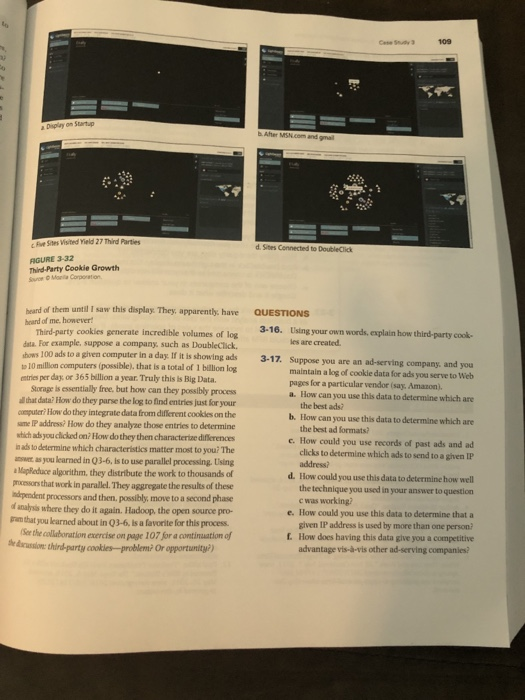
this is for MIS and the pages to reference are provided in pic 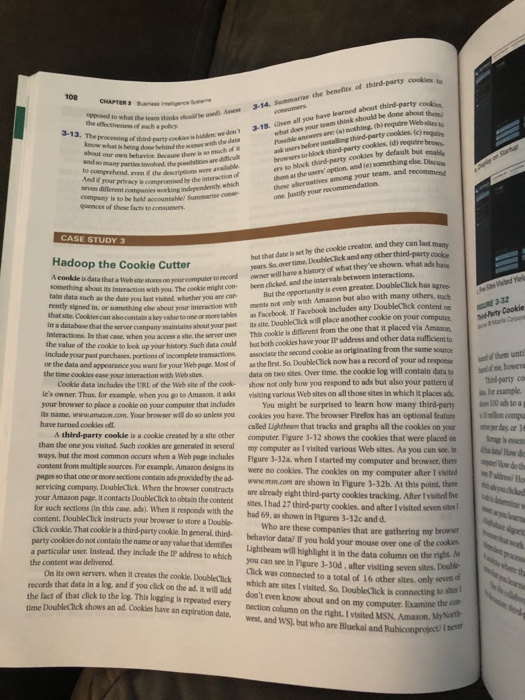
3-14. Save the benefits of third-party cookies to you. Se over time. Declick and any other third-party code nection column on the right. I visited MSN, Amazon. My North 108 CHAPTER whethed 3-13. The produced 3-15. we all you have learned about third-party cock what is your think should be done about the we were nothing. hirequire Website askusering third-party cookies, che about our own behar and many parties to the parent browser toe third-party cookies, id require brows Nock third-party cookies by default but enable to comprehend the descripcions them at the option, and something else. Dis duracy or the of these are your fam and recommend en engindendent which company is to be held accountable Summarecon quences of these facts to consumers. y your recommendation CASE STUDY 3 Swety Cookie Hadoop the Cookie Cutter A cookie is data that a Web site stores on your computer to record something about its interaction with you. The cookie might con tata data such as the date you last visited. whether you are cur rently signed in, or something else about your interaction with that site. Cookies can also contain a key value to one or more tables in a database that the server company maintains about your past Interactions. In that case, when you acces a site, the server uses the value of the cookie to look up your history. Such data could include your past purchases. portions of incomplete transactions or the data and appearance you want for your web page. Most of the time cookies ease your interaction with Websites Cookie data includes the URL of the Web site of the cook- le's owner. Thus, for example, when you go to Amazon.it asks your browser to place a cookie on your computer that includes Its name, www.amazon.com. Your browser will do so unless you have turned cookies of A third-party cookie is a cookie created by a site other than the one you visited. Such cookies are generated in several ways, but the most common occurs when a Web page includes content from multiple sources. For example. Amazon designs its pages so that one or more sections contain ads provided by the ad- servicing company, DoubleClick. When the browser constructs your Amazon page. It contacts DoubleClick to obtain the content for such sections in this case, ads. When it responds with the content. DoubleClick instructs your browser to store a Double Click cookie. That cookie is a third-party cookie. In general third- party cookies do not contain the name or any value that identifies a particular user. Instead, they include the IP address to which the content was delivered. On its own servers, when it creates the cookie. DoubleClick records that data in a log, and if you click on the ad. It will add the fact of that click to the long. This logging is repeated every time DoubleClick shows an ad. Cookies have an expiration date we will have a history of what they've shown. what ads hers been dicked, and the intervals between interactions. But the opportunity is even greater. DoubleClick has agree ments not only with Amazon but also with many others, fast as Facebook. Facebook Includes any DoubleClick content Its site. DoubleClick will place another cookie on your computer This cookie is different from the one that it placed via Amaron but both cookies have your IP address and other data suficient to associate the second cookie as originating from the same source as the first. So. DoubleClick now has a record of your ad response data on two sites. Over time, the cookie log will contain datate show not only how you respond to ads but also your pattern of visiting various Websites on all those sites in which it places ads You might be surprised to learn how many third-party cookies you have. The browser Firefox has an optional feature called Lighbeam that tracks and graphs all the cookies on your computer. Figure 3-32 shows the cookies that were placed on my computer as I visited various Web sites. As you can see in Figure 3-32, when I started my computer and browser there were no cookies. The cookies on my computer after I visited WWW.com are shown in Figure 3-32h. At this point, there are already eight third-party cookies tracking. After I visited the sites, Thad 27third-party cookies, and after I visited seven sites Third party co EL. 100 ads to a had 69, as shown in Figures 3-32c and d. Who are these companies that are gathering my browser behavior data? If you hold your mouse over one of the cookies Lightbeam will highlight it in the data column on the right you can see in Figure 3-30d after visiting seven sites. Double Click was connected to a total of 16 other sites only seven which are sites I visited. So, Doubleclick is connecting a don't even know about and on my computer. Examine the con west, and WS), but who are Bluekal and Rubiconproject? | new C 109 Day on Star A MSN.com and d. Sites Connected to DoubleClick Rue Shes Visited Yuld 27 Third Parties FIGURE 3-32 Third-Party Cookie Growth Mon Corporation heard of them until I saw this display. They apparently have heard of me, however! Third-party cookies generate incredible volumes of log data. For example, suppose a company, such as DoubleClick shows 100 ads to a given computer in a day. If it is showing ads to 10 million computers (possible), that is a total of 1 billion log entries per day or 365 billion a year. Truly this is Big Data. Storage is essentially free, but how can they possibly process all that data? How do they purse the log to find entries just for your computer? How do they integrate data from different cookies on the same IP address? How do they analyze those entries to determine which ads you clicked on? How do they then characterize differences in ads to determine which characteristics matter most to you? The as you learned in Q3-6, is to use parallel processing. Using MapReduce algorithm, they distribute the work to thousands of processors that work in parallel. They aggregate the results of these Independent processors and then, possibly move to a second phase danalysis where they do it again. Hadoop, the open source pro- pram that you learned about in Q3-6, is a favorite for this process. See the collaboration exercise on page 107 for a continuation of the dression third party cookies--problem? Or opportunity) QUESTIONS 3-16. Using your own words, explain how third-party cook les are created 3-17. Suppose you are an ad-serving company, and you maintain a log of cookie data for ads you serve to Web pages for a particular vendor (say, Amazon). a. How can you use this data to determine which are the best ads? b. How can you use this data to determine which are the best ad formats? c. How could you use records of past ads and ad clicks to determine which ads to send to a given IP address? d. How could you use this data to determine how well the technique you used in your answer to question c was working) e. How could you use this data to determine that a given IP address is used by more than one person? How does having this data give you a competitive advantage vis--vis other ad-serving companies
1.Using your own words, explain how third-party cookies are created.
2.Suppose you are an ad-serving company, and you maintain a log of cookie data for ads you serve to Web pages for a particular vendor (say, Amazon).
a. How can you use this data to determine which are the best ads?
b. How can you use this data to determine which are the best ad formats?
c. How could you use records of past ads and ad clicks to determine which ads to send to a given IP address?
d. How could you use this data to determine how well the technique you used in your answer to question c was working?
e. How could you use this data to determine that a given IP address is used by more than one person?
f. How does having this data give you a competitive advantage vis--vis other ad-serving companies?
3. Suppose you are an ad-serving company, and you have a log of cookie data for ads served to Web pages of all your customers (Amazon, Facebook, etc.).
a. Describe, in general terms, how you can process the cookie data to associate log entries for a particular IP address.
b. Explain how your answers to question 3-10 change, given that you have this additional data.
c. Describe how you can use this log data to determine users who consistently seek the lowest price.
d. Describe how you can use this log data to determine users who consistently seek the latest fashion.
e. Explain why uses like those in c and d above are only possible with MapReduce or a similar technique.
4. As stated, third-party cookies usually do not contain, in themselves, data that identifies you as a particular person. However, Amazon, Facebook, and other first-party cookie vendors know who you are because you signed in. Only one of them needs to reveal your identity to the ad-server and your identity can then be correlated with your IP address. At that point, the ad server and potentially all of its clients know who you are. Are you concerned about the invasion of your privacy that third-party cookies enable? Explain your answer.
Step by Step Solution
There are 3 Steps involved in it
1 Expert Approved Answer
Step: 1 Unlock

Question Has Been Solved by an Expert!
Get step-by-step solutions from verified subject matter experts
Step: 2 Unlock
Step: 3 Unlock
 Study Help