







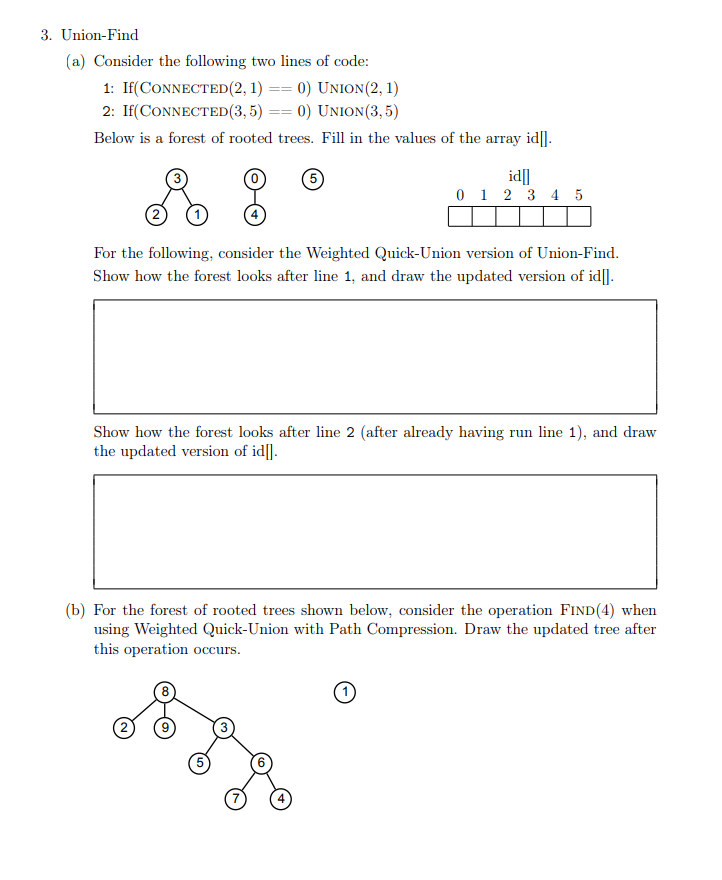
Question: Union-Find Consider the following two lines of code: 1: If(Connected(2, 1) == 0) Union(2, 1) 2: If(Connected(3, 5) == 0) Union(3, 5) Below is a
Union-Find
Consider the following two lines of code: 1: If(Connected(2, 1) == 0) Union(2, 1) 2: If(Connected(3, 5) == 0) Union(3, 5)
Below is a forest of rooted trees. Fill in the values of the array id[].
For the following, consider the Weighted Quick-Union version of Union-Find. Show how the forest looks after line 1, and draw the updated version of id[].
Show how the forest looks after line 2 (after already having run line 1), and draw the updated version of id[].
(b) For the forest of rooted trees shown below, consider the operation Find(4) when using Weighted Quick-Union with Path Compression. Draw the updated tree after this operation occurs.
3. Union-Find (a) Consider the following two lines of code: 1: If(CONNECTED(2, 1) == 0) UNION(2, 1) 2: If(CONNECTED(3,5) == 0) UNION(3,5) Below is a forest of rooted trees. Fill in the values of the array idll. 5 idll 0 1 2 3 4 5 For the following, consider the Weighted Quick-Union version of Union-Find. Show how the forest looks after line 1, and draw the updated version of id[]. Show how the forest looks after line 2 (after already having run line 1), and draw the updated version of idl. (b) For the forest of rooted trees shown below, consider the operation FIND(4) when using Weighted Quick-Union with Path Compression. Draw the updated tree after this operation occurs
Step by Step Solution
There are 3 Steps involved in it

Get step-by-step solutions from verified subject matter experts
 Study Help