







Question: We know from experience that most oscillatory movements that occur in nature gradually decrease until the displacement becomes zero; this type of movement is
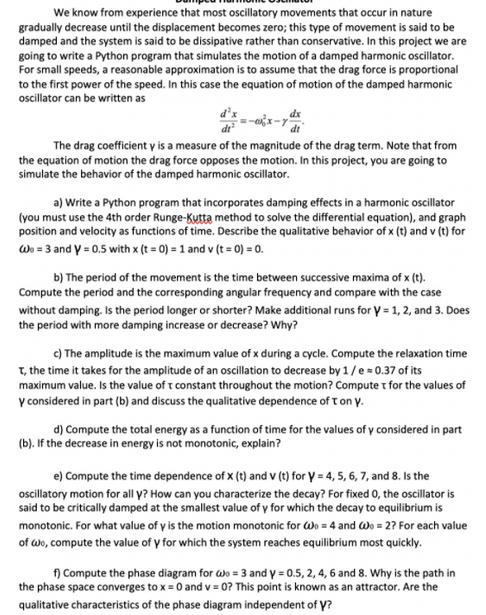
We know from experience that most oscillatory movements that occur in nature gradually decrease until the displacement becomes zero; this type of movement is said to be damped and the system is said to be dissipative rather than conservative. In this project we are going to write a Python program that simulates the motion of a damped harmonic oscillator. For small speeds, a reasonable approximation is to assume that the drag force is proportional to the first power of the speed. In this case the equation of motion of the damped harmonic oscillator can be written as dx The drag coefficient y is a measure of the magnitude of the drag term. Note that from the equation of motion the drag force opposes the motion. In this project, you are going to simulate the behavior of the damped harmonic oscillator. a) Write a Python program that incorporates damping effects in a harmonic oscillator (you must use the 4th order Runge-Kutta method to solve the differential equation), and graph position and velocity as functions of time. Describe the qualitative behavior of x (t) and v (t) for We = 3 and V = 0.5 with x (t = 0) = 1 and v (t = 0) = 0. b) The period of the movement is the time between successive maxima of x (t). Compute the period and the corresponding angular frequency and compare with the case without damping. Is the period longer or shorter? Make additional runs for Y = 1, 2, and 3. Does the period with more damping increase or decrease? Why? c) The amplitude is the maximum value of x during a cycle. Compute the relaxation time T, the time it takes for the amplitude of an oscillation to decrease by 1/ e = 0.37 of its maximum value. Is the value of t constant throughout the motion? Computer for the values of y considered in part (b) and discuss the qualitative dependence of t on y. d) Compute the total energy as a function of time for the values of y considered in part (b). If the decrease in energy is not monotonic, explain? e) Compute the time dependence of x (t) and v (t) for Y = 4, 5, 6, 7, and 8. Is the oscillatory motion for all y? How can you characterize the decay? For fixed 0, the oscillator is said to be critically damped at the smallest value of y for which the decay to equilibrium is monotonic. For what value of y is the motion monotonic for Wo=4 and Wo = 2? For each value of wo, compute the value of y for which the system reaches equilibrium most quickly. f) Compute the phase diagram for wo = 3 and y = 0.5, 2, 4, 6 and 8. Why is the path in the phase space converges to x = 0 and v=0? This point is known as an attractor. Are the qualitative characteristics of the phase diagram independent of Y?
Step by Step Solution
3.36 Rating (149 Votes )
There are 3 Steps involved in it

Get step-by-step solutions from verified subject matter experts
 Study Help