







Question: What THREE recommendations for improvement would you make to Kevin Plank regarding the turnaround strategy put in place at Under Armour? (Justify using Chapter 5
What THREE recommendations for improvement would you make to Kevin Plank regarding the turnaround strategy put in place at Under Armour? (Justify using Chapter 5 generic strategies which three of those generic strategies should they use; also use material from Chapter 7 International which geographic markets they should enter and why?
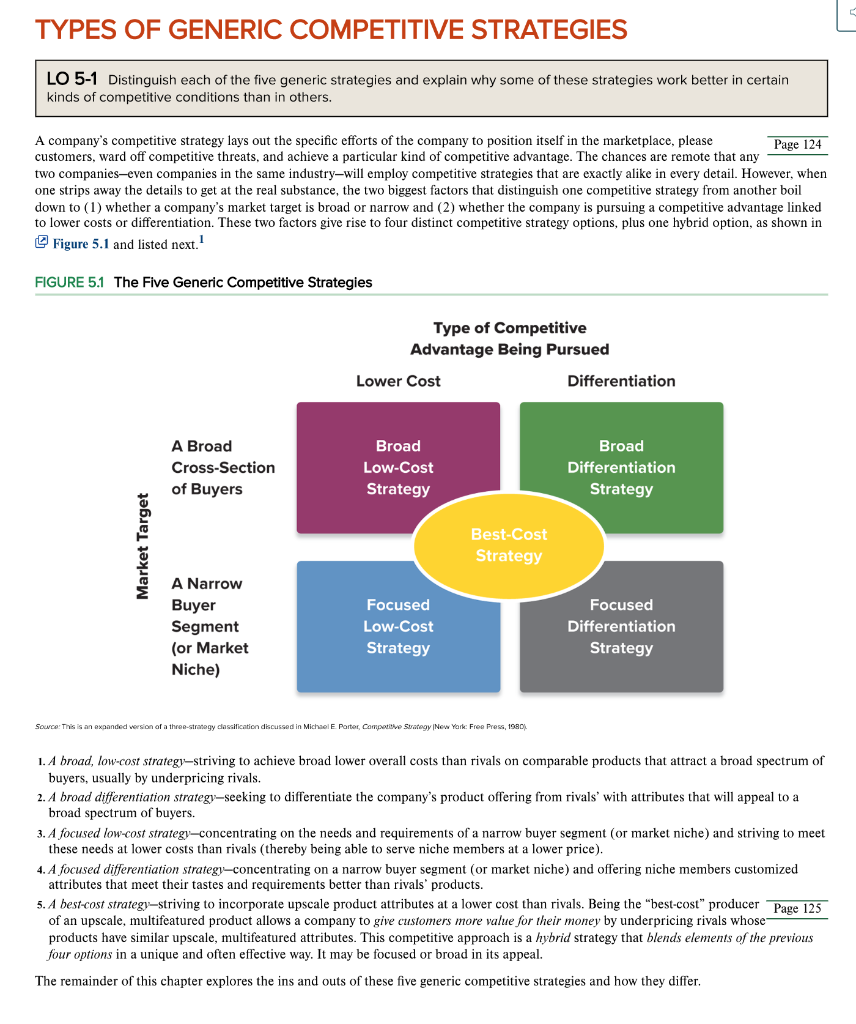
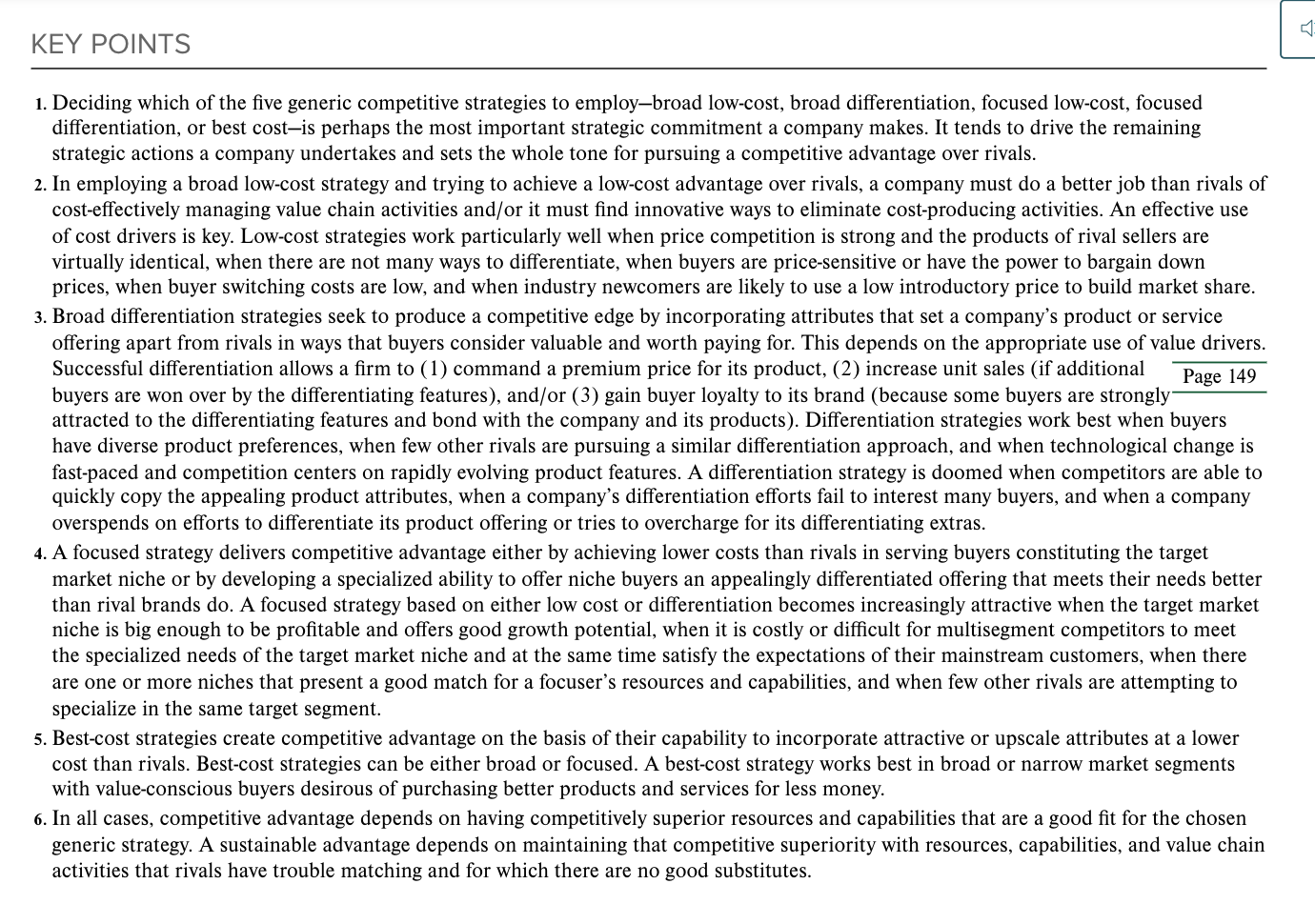
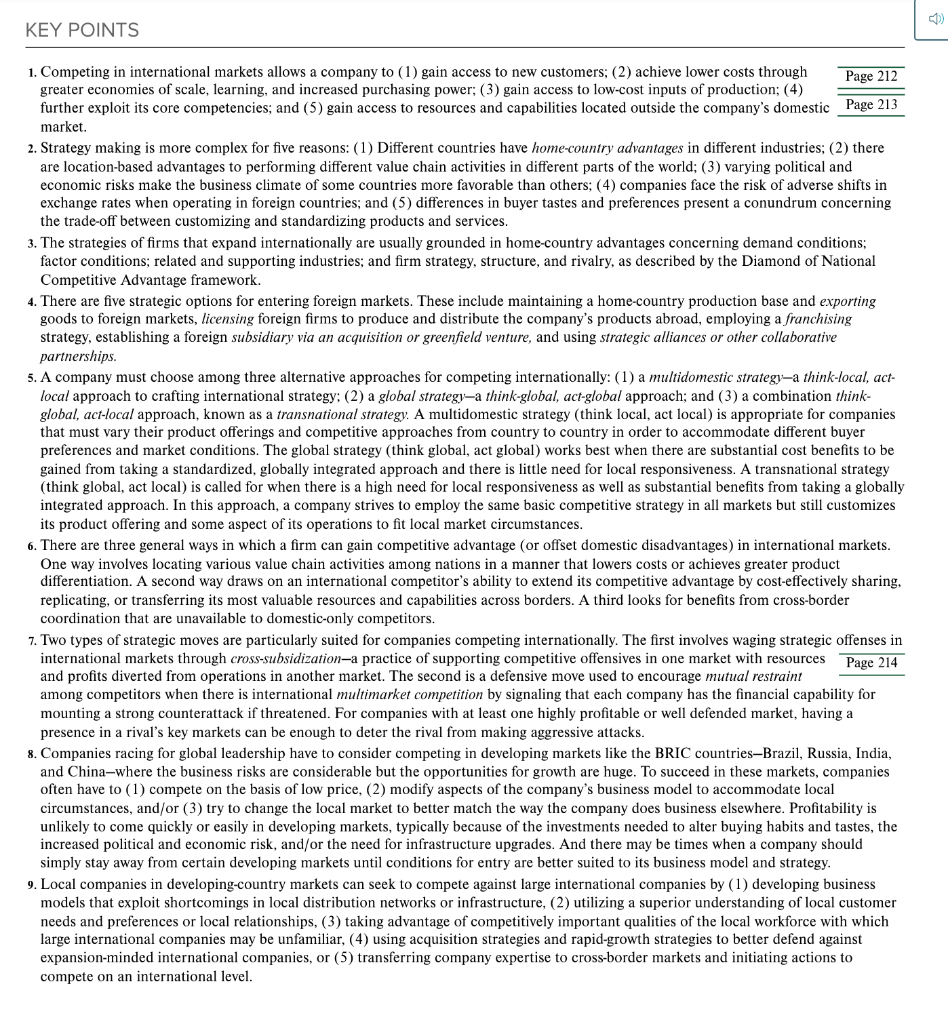
TYPES OF GENERIC COMPETITIVE STRATEGIES LO 5-1 Distinguish each of the five generic strategies and explain why some of these strategies work better in certain kinds of competitive conditions than in others. A company's competitive strategy lays out the specific efforts of the company to position itself in the marketplace, please customers, ward off competitive threats, and achieve a particular kind of competitive advantage. The chances are remote that any two companies-even companies in the same industry-will employ competitive strategies that are exactly alike in every detail. However, when one strips away the details to get at the real substance, the two biggest factors that distinguish one competitive strategy from another boil down to (1) whether a company's market target is broad or narrow and (2) whether the company is pursuing a competitive advantage linked to lower costs or differentiation. These two factors give rise to four distinct competitive strategy options, plus one hybrid option, as shown in Figure 5.1 and listed next. 1 FIGURE 5.1 The Five Generic Competitive Strategies Sounce: This is an expanded wersion of a three-strasegy dascification discussed in Michnel E Parter, Campetilwe Strategy/New Yark: Free Press, 19sch 1. A broad, low-cost strategy-striving to achieve broad lower overall costs than rivals on comparable products that attract a broad spectrum of buyers, usually by underpricing rivals. 2. A broad differentiation strategy-seeking to differentiate the company's product offering from rivals' with attributes that will appeal to a broad spectrum of buyers. 3. A focused low-cost strategy-concentrating on the needs and requirements of a narrow buyer segment (or market niche) and striving to meet these needs at lower costs than rivals (thereby being able to serve niche members at a lower price). 4. A focused differentiation strategy-concentrating on a narrow buyer segment (or market niche) and offering niche members customized attributes that meet their tastes and requirements better than rivals' products. 5. A best-cost strategy-striving to incorporate upscale product attributes at a lower cost than rivals. Being the "best-cost" producer Page 125 of an upscale, multifeatured product allows a company to give customers more value for their money by underpricing rivals whose products have similar upscale, multifeatured attributes. This competitive approach is a hybrid strategy that blends elements of the previous four options in a unique and often effective way. It may be focused or broad in its appeal. The remainder of this chapter explores the ins and outs of these five generic competitive strategies and how they differ. 1. Deciding which of the five generic competitive strategies to employ-broad low-cost, broad differentiation, focused low-cost, focused differentiation, or best cost-is perhaps the most important strategic commitment a company makes. It tends to drive the remaining strategic actions a company undertakes and sets the whole tone for pursuing a competitive advantage over rivals. 2. In employing a broad low-cost strategy and trying to achieve a low-cost advantage over rivals, a company must do a better job than rivals of cost-effectively managing value chain activities and/or it must find innovative ways to eliminate cost-producing activities. An effective use of cost drivers is key. Low-cost strategies work particularly well when price competition is strong and the products of rival sellers are virtually identical, when there are not many ways to differentiate, when buyers are price-sensitive or have the power to bargain down prices, when buyer switching costs are low, and when industry newcomers are likely to use a low introductory price to build market share. 3. Broad differentiation strategies seek to produce a competitive edge by incorporating attributes that set a company's product or service offering apart from rivals in ways that buyers consider valuable and worth paying for. This depends on the appropriate use of value drivers. Successful differentiation allows a firm to (1) command a premium price for its product, (2) increase unit sales (if additional Page 149 buyers are won over by the differentiating features), and/or (3) gain buyer loyalty to its brand (because some buyers are strongly attracted to the differentiating features and bond with the company and its products). Differentiation strategies work best when buyers have diverse product preferences, when few other rivals are pursuing a similar differentiation approach, and when technological change is fast-paced and competition centers on rapidly evolving product features. A differentiation strategy is doomed when competitors are able to quickly copy the appealing product attributes, when a company's differentiation efforts fail to interest many buyers, and when a company overspends on efforts to differentiate its product offering or tries to overcharge for its differentiating extras. 4. A focused strategy delivers competitive advantage either by achieving lower costs than rivals in serving buyers constituting the target market niche or by developing a specialized ability to offer niche buyers an appealingly differentiated offering that meets their needs better than rival brands do. A focused strategy based on either low cost or differentiation becomes increasingly attractive when the target market niche is big enough to be profitable and offers good growth potential, when it is costly or difficult for multisegment competitors to meet the specialized needs of the target market niche and at the same time satisfy the expectations of their mainstream customers, when there are one or more niches that present a good match for a focuser's resources and capabilities, and when few other rivals are attempting to specialize in the same target segment. 5. Best-cost strategies create competitive advantage on the basis of their capability to incorporate attractive or upscale attributes at a lower cost than rivals. Best-cost strategies can be either broad or focused. A best-cost strategy works best in broad or narrow market segments with value-conscious buyers desirous of purchasing better products and services for less money. 6. In all cases, competitive advantage depends on having competitively superior resources and capabilities that are a good fit for the chosen generic strategy. A sustainable advantage depends on maintaining that competitive superiority with resources, capabilities, and value chain activities that rivals have trouble matching and for which there are no good substitutes. : CHAPTER 7 Page 182 Strategies for Competing in International Markets Learning Objectives This chapter will help you ( LO 7-1 Identify the primary reasons companies choose to compete in international markets. [ LO 7-2 Explain how and why differing market conditions across countries influence a company's strategy choices in international markets. [ LO 7-3 Explain the differences among the five primary modes of entry into foreign markets ( LO 7-4 Identify the three main strategic approaches for competing internationally. LO 7-5 Explain how companies are able to use international operations to improve overall competitiveness. LO 7-6 Identify the unique characteristics of competing in developing-country markets. 1. Competing in international markets allows a company to (1) gain access to new customers; (2) achieve lower costs through greater economies of scale, learning, and increased purchasing power; (3) gain access to low-cost inputs of production; (4) further exploit its core competencies; and (5) gain access to resources and capabilities located outside the company's domestic Page 213 market. 2. Strategy making is more complex for five reasons: (1) Different countries have home-country advantages in different industries; (2) there are location-based advantages to performing different value chain activities in different parts of the world; (3) varying political and economic risks make the business climate of some countries more favorable than others; (4) companies face the risk of adverse shifts in exchange rates when operating in foreign countries; and (5) differences in buyer tastes and preferences present a conundrum concerning the trade-off between customizing and standardizing products and services. 3. The strategies of firms that expand internationally are usually grounded in home-country advantages concerning demand conditions; factor conditions; related and supporting industries; and firm strategy, structure, and rivalry, as described by the Diamond of National Competitive Advantage framework. 4. There are five strategic options for entering foreign markets. These include maintaining a home-country production base and exporting goods to foreign markets, licensing foreign firms to produce and distribute the company's products abroad, employing a franchising strategy, establishing a foreign subsidiary via an acquisition or greenfield venture, and using strategic alliances or other collaborative partnerships. 5. A company must choose among three alternative approaches for competing internationally: (1) a multidomestic strategy-a think-local, actlocal approach to crafting international strategy; (2) a global strategy-a think-global, act-global approach; and (3) a combination thinkglobal, act-local approach, known as a transnational strategy. A multidomestic strategy (think local, act local) is appropriate for companies that must vary their product offerings and competitive approaches from country to country in order to accommodate different buyer preferences and market conditions. The global strategy (think global, act global) works best when there are substantial cost benefits to be gained from taking a standardized, globally integrated approach and there is little need for local responsiveness. A transnational strategy (think global, act local) is called for when there is a high need for local responsiveness as well as substantial benefits from taking a globally integrated approach. In this approach, a company strives to employ the same basic competitive strategy in all markets but still customizes its product offering and some aspect of its operations to fit local market circumstances. 6. There are three general ways in which a firm can gain competitive advantage (or offset domestic disadvantages) in international markets. One way involves locating various value chain activities among nations in a manner that lowers costs or achieves greater product differentiation. A second way draws on an international competitor's ability to extend its competitive advantage by cost-effectively sharing, replicating, or transferring its most valuable resources and capabilities across borders. A third looks for benefits from cross-border coordination that are unavailable to domestic-only competitors. 7. Two types of strategic moves are particularly suited for companies competing internationally. The first involves waging strategic offenses in international markets through cross-subsidization-a practice of supporting competitive offensives in one market with resources and profits diverted from operations in another market. The second is a defensive move used to encourage mutual restraint among competitors when there is international multimarket competition by signaling that each company has the financial capability for mounting a strong counterattack if threatened. For companies with at least one highly profitable or well defended market, having a presence in a rival's key markets can be enough to deter the rival from making aggressive attacks. 8. Companies racing for global leadership have to consider competing in developing markets like the BRIC countries-Brazil, Russia, India, and China-where the business risks are considerable but the opportunities for growth are huge. To succeed in these markets, companies often have to (1) compete on the basis of low price, (2) modify aspects of the company's business model to accommodate local circumstances, and/or (3) try to change the local market to better match the way the company does business elsewhere. Profitability is unlikely to come quickly or easily in developing markets, typically because of the investments needed to alter buying habits and tastes, the increased political and economic risk, and/or the need for infrastructure upgrades. And there may be times when a company should simply stay away from certain developing markets until conditions for entry are better suited to its business model and strategy. 9. Local companies in developing-country markets can seek to compete against large international companies by (1) developing business models that exploit shortcomings in local distribution networks or infrastructure, (2) utilizing a superior understanding of local customer needs and preferences or local relationships, (3) taking advantage of competitively important qualities of the local workforce with which large international companies may be unfamiliar, (4) using acquisition strategies and rapid-growth strategies to better defend against expansion-minded international companies, or (5) transferring company expertise to cross-border markets and initiating actions to compete on an international level
Step by Step Solution
There are 3 Steps involved in it

Get step-by-step solutions from verified subject matter experts
 Study Help