







Question: When defining the impulse or δ(t) signal the shape of the signal used to do so is not important. Whether we use the rectangular pulse
When defining the impulse or δ(t) signal the shape of the signal used to do so is not important. Whether we use the rectangular pulse we considered in this Chapter or another pulse, or even a signal that is not a pulse, in the limit we obtain the same impulse signal. Consider the following cases:
(a) The triangular pulse

Carefully plot it, compute its area, and find its limit as ˆ††’0. What do you obtain in the limit? Explain.
(b) Consider the signal
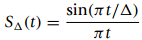
Use the properties of the sinc signal S(t) =sin(Ï€t)/(Ï€t) to express Sˆ†(t)in terms of S(t). Then find its area, and the limit as ˆ††’0. Use symbolic MATLAB to show that for decreasing values of ˆ† the Sˆ†(t) becomes like the impulse signal.
(1 (t + Δ)- u(t-Δ) ) ΛAt)- Δ sin(at/A) SA(t) =
Step by Step Solution
3.40 Rating (166 Votes )
There are 3 Steps involved in it
a The triangular pulse has a width of 2 and a height of 1 it... View full answer
Get step-by-step solutions from verified subject matter experts
 Study Help