







Question: Mutations in genes that control the early stages of development are often lethal (e.g., see Figure 26.7b). To circumvent this problem in studies of early
Mutations in genes that control the early stages of development are often lethal (e.g., see Figure 26.7b). To circumvent this problem in studies of early development, developmental geneticists may try to isolate temperature-sensitive developmental mutants, or ts alleles. If an embryo carries a ts allele, it will develop correctly at the permissive temperature (e.g., 25°C) but will fail to develop if incubated at the nonpermissive temperature (e.g., 30°C). In most cases, ts alleles result from missense mutations that slightly alter the amino acid sequence of a protein, causing a change in its structure that prevents it from working properly at the nonpermissive temperature. In research, ts alleles are particularly useful because they can provide insight regarding the stage of development when the protein encoded by the gene is necessary.
Researchers can take groups of embryos that carry a ts allele and expose them to the permissive or nonpermissive temperature at different stages of development. In the experiment whose results are presented next, embryos were divided into five groups and exposed to the permissive or nonpermissive temperature at different times after fertilization.
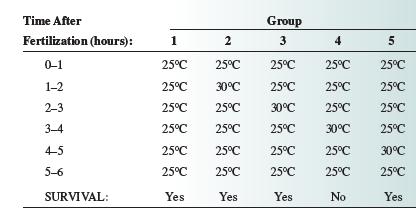
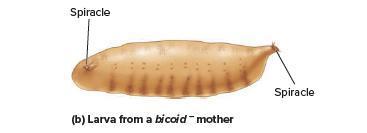
Figure 26.7b:
Time After Group Fertilization (hours): 1 2 3 4 5 0-1 25C 25C 25C 25C 25C 1-2 25C 30C 25C 25C 25C 2-3 25C 25C 30C 25C 25C 3-4 25C 25C 25C 30C 25C 4-5 25C 25C 25C 25C 30C 5-6 25C 25C 25C 25C 25C SURVIVAL: Yes Yes Yes No Yes
Step by Step Solution
There are 3 Steps involved in it

Get step-by-step solutions from verified subject matter experts
 Study Help