







Question: The Otto cycle is a model for a spark ignition engine and represents the mode of operation of most non-diesel car engines. It consists of
The Otto cycle is a model for a spark ignition engine and represents the mode of operation of most non-diesel car engines. It consists of four processes when the system is closed, and of two additional isobaric processes when the system is open, corresponding to air intake and exhaust. Thus, we have,• 0−→ 1 isobaric air intake• 1−→ 2 adiabatic compression• 2−→ 3 isochoric heating• 3−→ 4 adiabatic expansion• 4−→ 1 isochoric cooling• 1−→ 0 isobaric gas exhaust Assume that the adiabatic processes are reversible and that the gas is an ideal gas characterised by the coefficient c found in relation (5.62) and coefficient γ = (c + 1) /c. The following values of state variables are assumed to be known: the pressure p1, the volumes V1 = V4 and V2 = V3, the temperature T3, and the number of moles N of air at the intake. Analyse this cycle by using the following instructions:a) Draw the (p, V) and (T, S) diagrams of the cycle. On the (p, V) diagram, show also the intake and exhaust processes.b) Describe what the engine does in each of the processes.c) Explain why an exchange of air with the exterior is needed.d) On the (p, V) and (T, S) diagrams determine the relation between the area enclosed in the cycles and the work W and the heat Q per cycle.e) Determine all the state variables at points 1, 2, 3 and 4 of the cycle, i.e. find p2, p3, p4, T2 and T4.f) Compute the work W performed per cycle and the heat Q exchanged during a cycle.g) Determine the efficiency of the Otto cycle,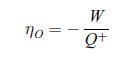
where Q+ = Q23.
no W et
Step by Step Solution
3.40 Rating (172 Votes )
There are 3 Steps involved in it
A closed loop with four processes 012341 and two extra isobaric processes 10 41 for air intake and exhaust can be seen in the Otto cycles p V diagram Isobaric air intake process 01 marks the beginning ... View full answer

Get step-by-step solutions from verified subject matter experts
 Study Help