







Question: A process has been modeled and Laplace transformed to obtain the following two equations: where the outputs are Y1 and Y2, and the inputs are
A process has been modeled and Laplace transformed to obtain the following two equations: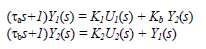 where the outputs are Y1 and Y2, and the inputs are U1 and U2.(a) Find the transfer functions
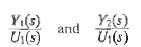 (b) What is the gain of each transfer function? (You may develop these analytically or use the Final Value Theorem.)(c) What can you conclude about the form of Y2(s)/U1(s)? In other words, is it first or second order? If second order, can you determine if it is over or underdamped? Is there some choice of parameters (?a, ?b, K1, K2, and Kb) that would make this process operate as an integrator, that is, produce an s term in the denominator?(d) For parameter values ?a, 2, ?b = 1, Kb 0.5, would y2 respond faster or slower to a step change in u1 for this process compared to a process with transfer function: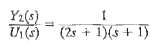
(T,s+1)Y;(s) = K;U:(s) + K; Y:(s) (Ts+1)Y:(s) = K;U:(s) + Y;(5)
Step by Step Solution
3.32 Rating (170 Votes )
There are 3 Steps involved in it
a Since the only transfer functions requested involve ... View full answer

Get step-by-step solutions from verified subject matter experts
Document Format (1 attachment)

38-E-C-E-P-C (82).docx
120 KBs Word File
 Study Help