







Question: Laminar flow in a triangular duct (Figure 3B.2) 2 one type of compact heat exchanger is shown in Figure 3B.2 (a). In order to analyze
Laminar flow in a triangular duct (Figure 3B.2)2 one type of compact heat exchanger is shown in Figure 3B.2 (a). In order to analyze the performance of such an apparatus, it is necessary to understand the flow in a duct whose cross section is an equilateral triangle. This is done most easily by installing a coordinate system as shown in Fig. 3B.2 (b).
(a) Verify that the velocity distribution for the laminar flow of a Newtonian fluid in a duct of this type is given by Fig. 3B.2. (a) Compact heat-exchanger element, showing channels of a triangular cross section; (b) coordinate system for an equilateral-triangular duct
(b) From Eq. 3B.2-1 find the average velocity, maximum velocity, and mass flow rate.
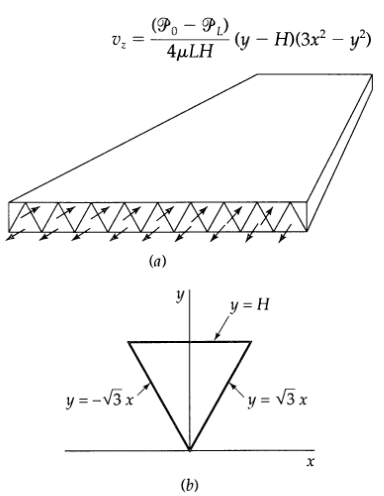
(Po - PL) v, = (y H)(3x y) 4LH (a) y = H y = -V3x `y = v3 x (b)
Step by Step Solution
3.41 Rating (167 Votes )
There are 3 Steps involved in it
Laminar flow in a triangular duct a It is clear that the boundary conditions that v 0 at ... View full answer

Get step-by-step solutions from verified subject matter experts
Document Format (1 attachment)

6-E-C-E-T-P (49).docx
120 KBs Word File
 Study Help