







Question: Let h c (t) denote the impulse response of a linear time-invariant continuous-time filter and h d [n] the impulse response of a linear time-invariant
Let hc(t) denote the impulse response of a linear time-invariant continuous-time filter and hd[n] the impulse response of a linear time-invariant discrete-time filter.
(a) If
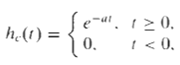
(b) If hd[n] = Thc(nT) with hc(t) as in part (a), determine the discrete-time filter frequency response and sketch its magnitude.
(c) For a given value of α, determine, as a function of T. the minimum magnitude of the discrete-time filter frequency response.
-at h.(1) : 0. = : 0. I < 0,
Step by Step Solution
3.43 Rating (166 Votes )
There are 3 Steps involved in it
a The Fourier transform of the filter impulse response So ... View full answer

Get step-by-step solutions from verified subject matter experts
Document Format (1 attachment)

30-E-T-E-D-S-P (151).docx
120 KBs Word File
 Study Help