







Question: A (28.0 mathrm{~cm}) long column packed with gas-phase activated carbon is initially filled with clean air. At (mathrm{t}=0), a feed gas containing (mathrm{y}=0.10 mathrm{wt} %)
A \(28.0 \mathrm{~cm}\) long column packed with gas-phase activated carbon is initially filled with clean air. At \(\mathrm{t}=0\), a feed gas containing \(\mathrm{y}=0.10 \mathrm{wt} \%\) toluene in air is started. This feed continues until \(\mathrm{t}=30.0\) hours at which time pure air is introduced and continued throughout the remainder of operation. Superficial velocity is always \(24.0 \mathrm{~cm} / \mathrm{s}\). Find the breakthrough time of shock wave and times the following outlet concentrations exit: \(\mathrm{y}=\) \(0.10,0.075,0.050,0.025\), and \(0.0 \mathrm{wt} \%\). Pressure is \(150.0 \mathrm{kPa}\). Data are in Problem 20.D16.
Problem 20.D16.
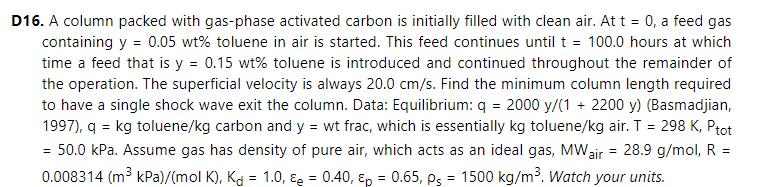
D16. A column packed with gas-phase activated carbon is initially filled with clean air. At t = 0, a feed gas containing y = 0.05 wt% toluene in air is started. This feed continues until t = 100.0 hours at which time a feed that is y = 0.15 wt% toluene is introduced and continued throughout the remainder of the operation. The superficial velocity is always 20.0 cm/s. Find the minimum column length required to have a single shock wave exit the column. Data: Equilibrium: q = 2000 y/(1 + 2200 y) (Basmadjian, 1997), q = kg toluene/kg carbon and y = wt frac, which is essentially kg toluene/kg air. T = 298 K, Ptot = 50.0 kPa. Assume gas has density of pure air, which acts as an ideal gas, MW air = 28.9 g/mol, R = 0.008314 (m kPa)/(mol K), Kd = 1.0, e = 0.40, p = 0.65, p = 1500 kg/m. Watch your units.
Step by Step Solution
3.34 Rating (154 Votes )
There are 3 Steps involved in it

Get step-by-step solutions from verified subject matter experts
 Study Help