



Question: A (50.0 mathrm{~cm}) long column is packed with activated alumina adsorbent to adsorb anthracene (A) from cyclohexane. The adsorbent is initially in equilibrium with a
A \(50.0 \mathrm{~cm}\) long column is packed with activated alumina adsorbent to adsorb anthracene (A) from cyclohexane. The adsorbent is initially in equilibrium with a fluid with \(\mathrm{c}=0.0030\) \(\mathrm{mol} \mathrm{A} / \mathrm{L}\). At time \(\mathrm{t}=0\), a feed that is \(0.0060 \mathrm{~mol} \mathrm{A/L}\) is input to the column at a superficial velocity of \(v_{\text {super }}=8.0 \mathrm{~cm} / \mathrm{min}\). At time \(t=6.0 \mathrm{~min}\), a feed that is \(0.011 \mathrm{~mol} \mathrm{~A} / \mathrm{L}\) is input at the same velocity. Predict the outlet concentration of anthracene. Data: See Examples 20-6 and \(20-7\).
Example 20-6
Example 20-7
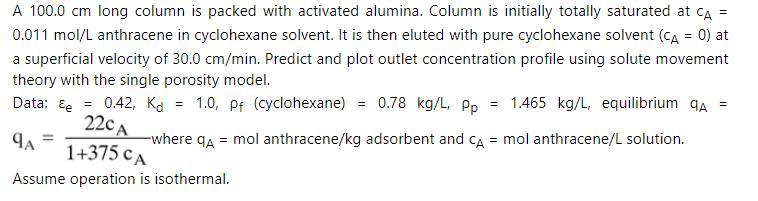
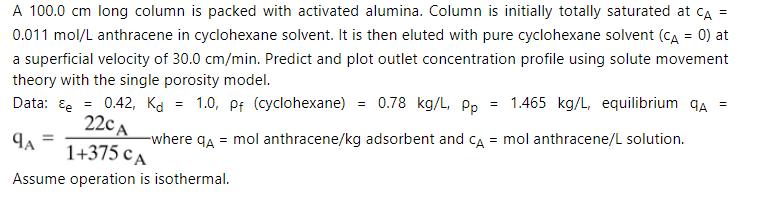
A 100.0 cm long column is packed with activated alumina. Column is initially totally saturated at C = 0.011 mol/L anthracene in cyclohexane solvent. It is then eluted with pure cyclohexane solvent (C = 0) at a superficial velocity of 30.0 cm/min. Predict and plot outlet concentration profile using solute movement theory with the single porosity model. Data: 0.42, Kd = 1.0, pf (cyclohexane) = 0.78 kg/L, Pp = 1.465 kg/L, equilibrium q = = 22CA 1+375 CA where q mol anthracene/kg adsorbent and CA = mol anthracene/L solution. Assume operation is isothermal.
Step by Step Solution
3.48 Rating (148 Votes )
There are 3 Steps involved in it

Get step-by-step solutions from verified subject matter experts