







Question: Repeat Problem 10.D9, calculating the diameter at the top, but condense the feed to a saturated liquid. Determine ((mathrm{L} / mathrm{D})_{min }) and (mathrm{L} /
Repeat Problem 10.D9, calculating the diameter at the top, but condense the feed to a saturated liquid. Determine \((\mathrm{L} / \mathrm{D})_{\min }\) and \(\mathrm{L} / \mathrm{D}=\) \(1.43 \times(\mathrm{L} / \mathrm{D})_{\text {min }}\). Compare the diameter of this column to the diameter of \(10.27 \mathrm{ft}\) calculated for Problem 10.D9. Calculate the ratio \(Q_{R, \text { liquid_feed }} / Q_{R, \text { vapor_feed }}\) for this problem.
Problem 10.D9
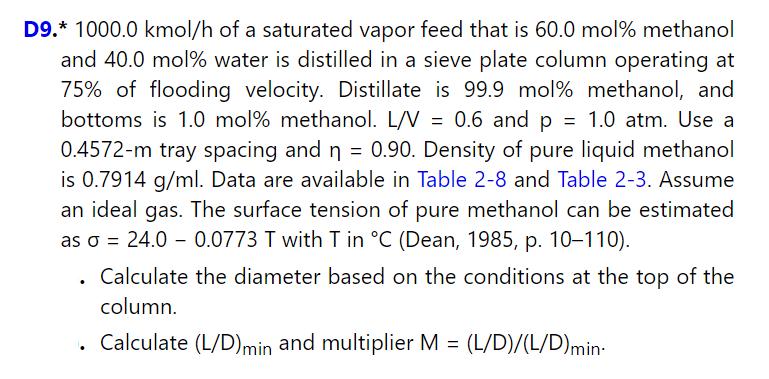
Table 2-3
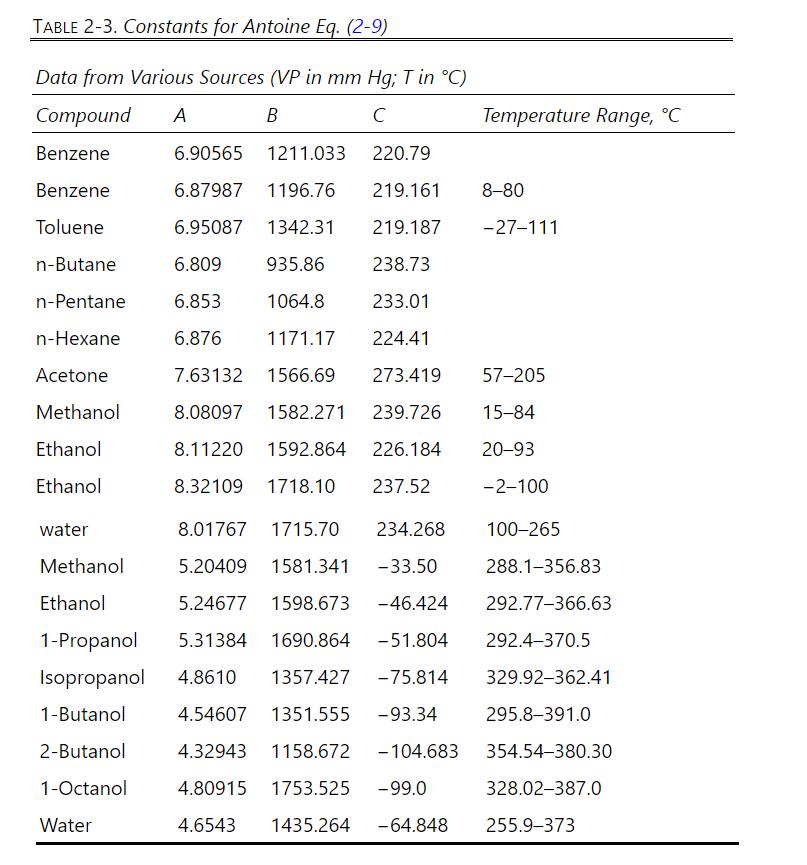
Table 2-8
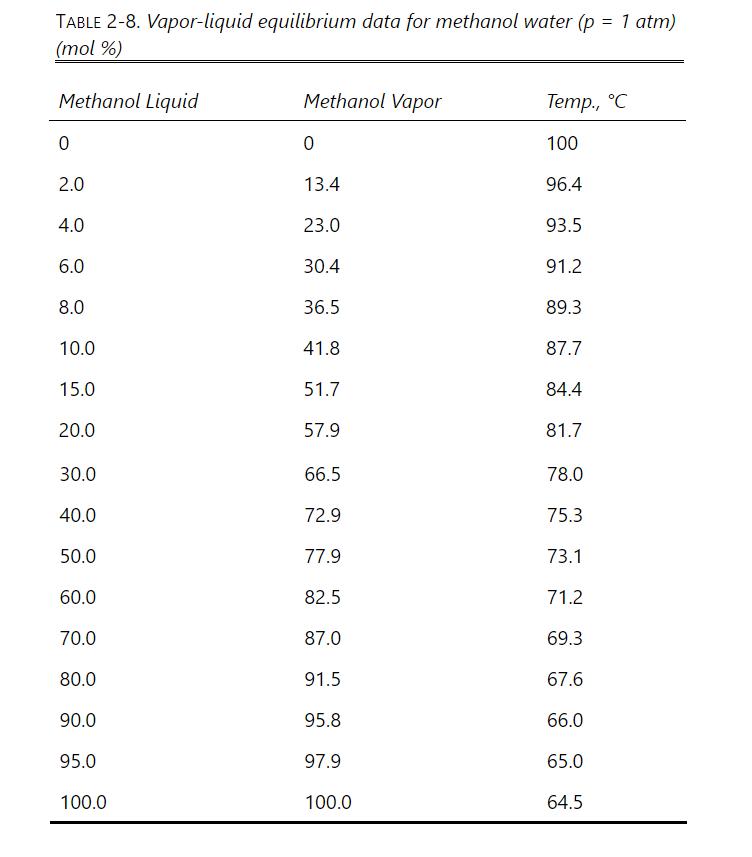
D9.* 1000.0 kmol/h of a saturated vapor feed that is 60.0 mol% methanol and 40.0 mol% water is distilled in a sieve plate column operating at 75% of flooding velocity. Distillate is 99.9 mol% methanol, and bottoms is 1.0 mol% methanol. L/V = 0.6 and p = 1.0 atm. Use a 0.4572-m tray spacing and n = 0.90. Density of pure liquid methanol is 0.7914 g/ml. Data are available in Table 2-8 and Table 2-3. Assume an ideal gas. The surface tension of pure methanol can be estimated as = 24.0 - 0.0773 T with T in C (Dean, 1985, p. 10-110). . Calculate the diameter based on the conditions at the top of the column. Calculate (L/D) min and multiplier M = (L/D)/(L/D)min-
Step by Step Solution
3.44 Rating (160 Votes )
There are 3 Steps involved in it
Given Feed 1000 k molh saturated liquid 60 mol methanol Distillate 999 mol methanol Bottoms 10 mol m... View full answer

Get step-by-step solutions from verified subject matter experts
 Study Help