



Question: 1. Again, the chickenegg problem! A chicken lays a number of eggs, N, which follows a Poisson[)) distribution. Each egg hatches a chick with probability
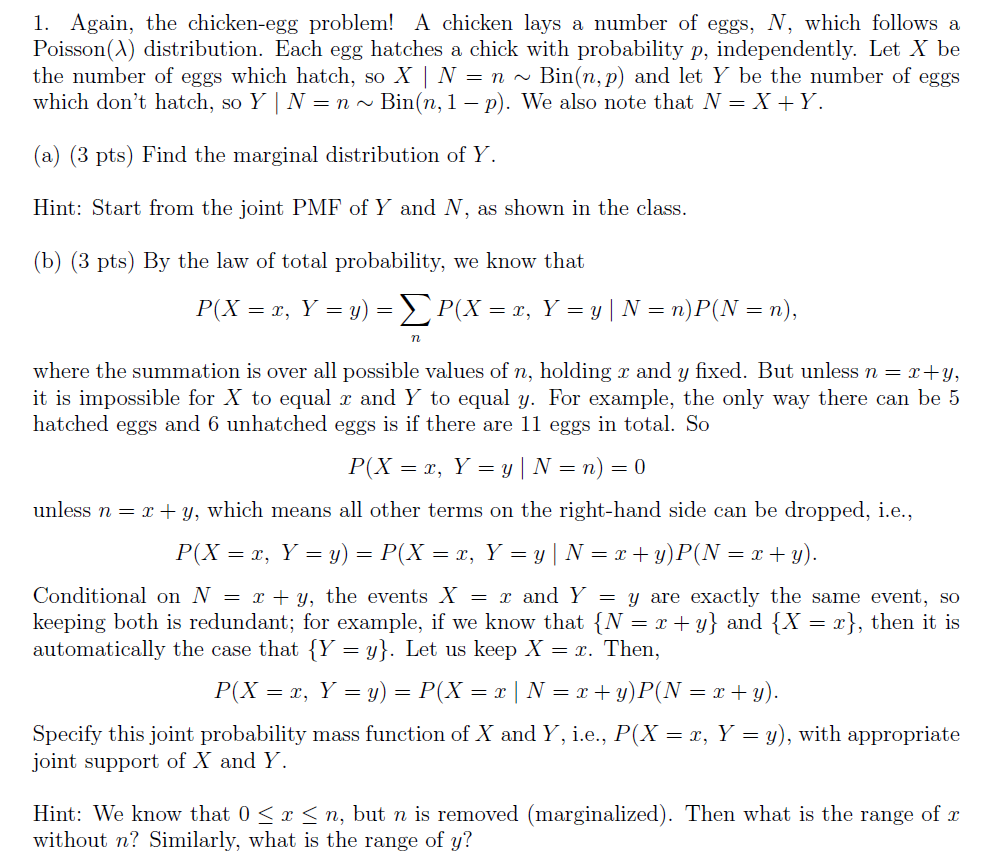
1. Again, the chickenegg problem! A chicken lays a number of eggs, N, which follows a Poisson[)\\) distribution. Each egg hatches a chick with probability 33, independently. Let X be the number of eggs which hatch, so X | N = 'n. m Bin['n, p) and let Y be the number of eggs which don't hatch, so Y | N = n N Bin(n, 1 30). We also note that N = X + Y. (a) [3 pts) Find the marginal distribution of Y. Hint: Start from the joint PMF of Y and N, as shown in the class. (b) (3 pts) By the law of total probability, we know that P(X=:r, Yzy)=ZP(X=m, Y=y|N=n)P(N=n), where the summation is over all possible values of as, holding a: and 3; xed. But unless it = :cly, it is impossible for X to equal :5 and Y to equal y. For example, the only way there can be 5 hatched eggs and 6 unhatched eggs is if there are 11 eggs in total. So P(X=:r:, Y=y|N=n)=0 unless n = 3: + 3;, which means all other terms on the righthand side can be dropped, i.e., P(X=:c, Yzy) =P[X=:B, Y=y|N=LE+y)P(N=:-C+y). Conditional on N = :r + y, the events X = a: and Y = y are exactly the same event, so keeping both is redundant; for example, if we know that {N = :1: + y} and {X = I}, then it is automatically the case that {Y = 3;}. Let us keep X = 3:. Then, P(X=:r:, Y=y) = P(X=:c | N=m+y)P[N=:B+y). Specify this joint probability mass function of X and Y, i.e., P(X = 1r, Y = y), with appropriate joint support of X and Y. Hint: We know that 0 55' g 1'1, but it is removed (marginalized). Then what is the range of :E without n? Similarly, what is the range of y
Step by Step Solution
There are 3 Steps involved in it

Get step-by-step solutions from verified subject matter experts