



Question: A thin coating of dielectric material is deposited onto the surface of a glass lens, so that the light entering the lens first goes
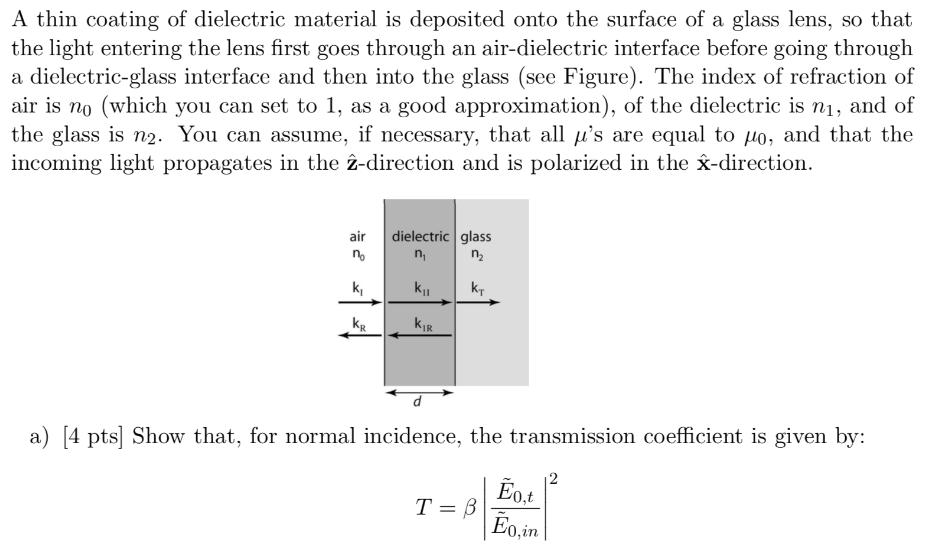
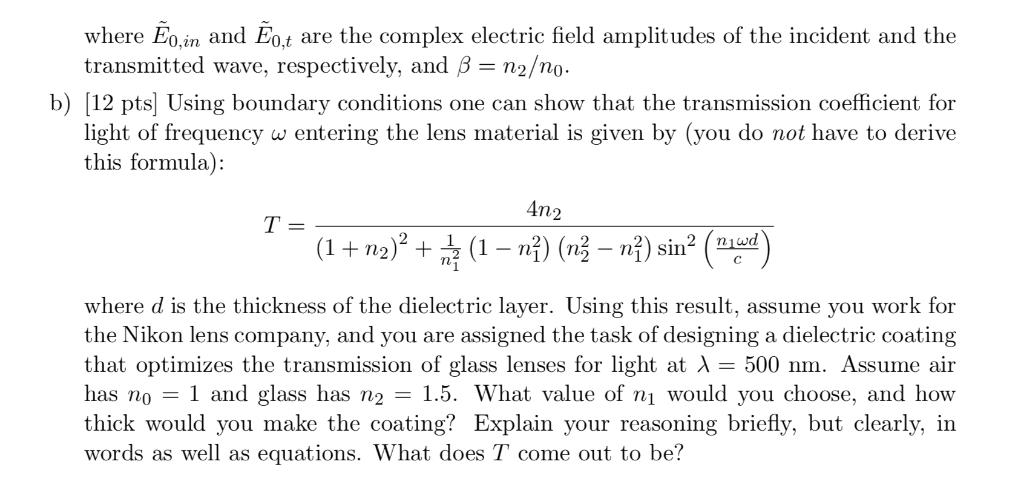
A thin coating of dielectric material is deposited onto the surface of a glass lens, so that the light entering the lens first goes through an air-dielectric interface before going through a dielectric-glass interface and then into the glass (see Figure). The index of refraction of air is no (which you can set to 1, as a good approximation), of the dielectric is n1, and of the glass is n2. You can assume, if necessary, that all u's are equal to uo, and that the incoming light propagates in the 2-direction and is polarized in the x-direction. air dielectric glass no n, n, k, kr KIR a) [4 pts] Show that, for normal incidence, the transmission coefficient is given by: 2 T = B Eo,in where Eo,in and Eo,t transmitted wave, respectively, and B n2/no. are the complex electric field amplitudes of the incident and the b) [12 pts Using boundary conditions one can show that the transmission coefficient for light of frequency w entering the lens material is given by (you do not have to derive this formula): 4n2 T = (1+ ne)? + (1-ni) (n-n) sin2 (nud C where d is the thickness of the dielectric layer. Using this result, assume you work for the Nikon lens company, and you are assigned the task of designing a dielectric coating that optimizes the transmission of glass lenses for light at A = 500 nm. Assume air has no = 1 and glass has n2 = 1.5. What value of n would you choose, and how thick would you make the coating? Explain your reasoning briefly, but clearly, in words as well as equations. What does T come out to be?
Step by Step Solution
3.40 Rating (156 Votes )
There are 3 Steps involved in it
Our experts were unable to provide an answ... View full answer

Get step-by-step solutions from verified subject matter experts