







Question: [E] Section 2.9 describes how the two instructions Or and OrHigh can be used to load a 32-bit value into a register. What additional functionality
![[E] Section 2.9 describes how the two instructions Or and OrHigh](https://s3.amazonaws.com/si.experts.images/answers/2024/09/66e196486eabb_10466e19648097b9.jpg)
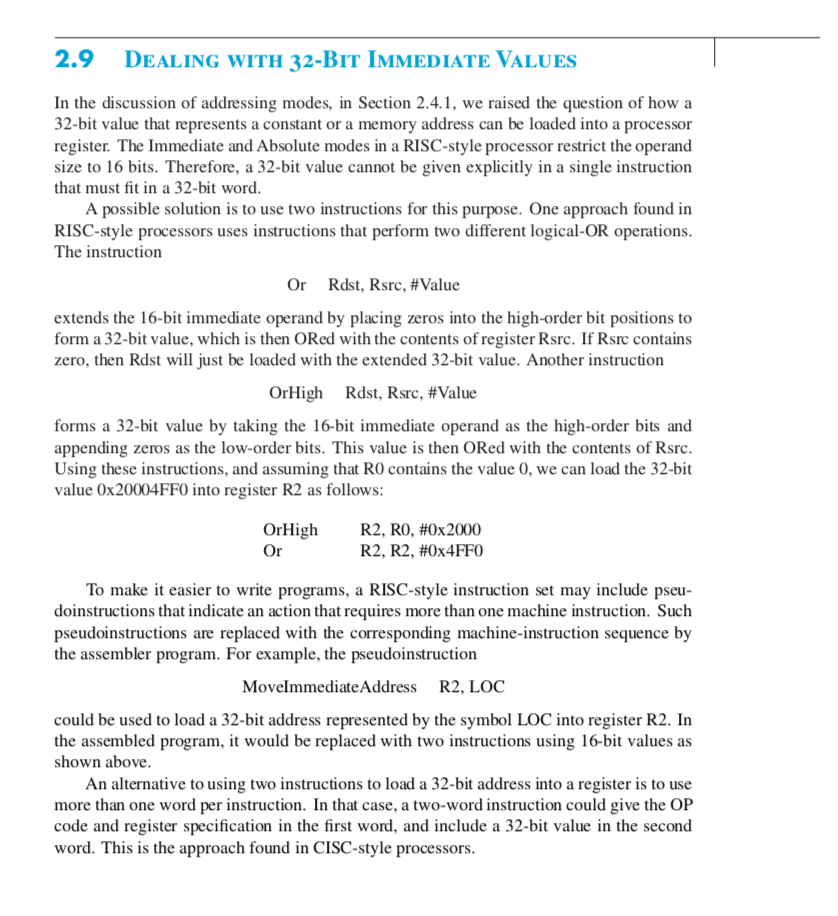
[E] Section 2.9 describes how the two instructions Or and OrHigh can be used to load a 32-bit value into a register. What additional functionality is needed in the processor's datapath to implement the OrHigh instruction? Give the sequence of actions needed to fetch and execute the instruction. 2.9 DEALING WITH 32-Bit IMMEDIATE VALUES In the discussion of addressing modes, in Section 2.4.1, we raised the question of how a 32-bit value that represents a constant or a memory address can be loaded into a processor register. The Immediate and Absolute modes in a RISC-style processor restrict the operand size to 16 bits. Therefore, a 32-bit value cannot be given explicitly in a single instruction that must fit in a 32-bit word. A possible solution is to use two instructions for this purpose. One approach found in RISC-style processors uses instructions that perform two different logical-OR operations. The instruction Or Rdst, Rsrc, #Value extends the 16-bit immediate operand by placing zeros into the high-order bit positions to form a 32-bit value, which is then ORed with the contents of register Rsrc. If Rsrc contains zero, then Rdst will just be loaded with the extended 32-bit value. Another instruction OrHigh Rdst, Rsrc, #Value forms a 32-bit value by taking the 16-bit immediate operand as the high-order bits and appending zeros as the low-order bits. This value is then ORed with the contents of Rsre. Using these instructions, and assuming that RO contains the value 0, we can load the 32-bit value Ox20004FF0 into register R2 as follows: OrHigh R2, RO, #0x2000 R2, R2, #0x4FFO Or To make it easier to write programs, a RISC-style instruction set may include pseu- doinstructions that indicate an action that requires more than one machine instruction. Such pseudoinstructions are replaced with the corresponding machine-instruction sequence by the assembler program. For example, the pseudoinstruction MoveImmediate Address R2, LOC could be used to load a 32-bit address represented by the symbol LOC into register R2. In the assembled program, it would be replaced with two instructions using 16-bit values as shown above. An alternative to using two instructions to load a 32-bit address into a register is to use more than one word per instruction. In that case, a two-word instruction could give the OP code and register specification in the first word, and include a 32-bit value in the second word. This is the approach found in CISC-style processors. [E] Section 2.9 describes how the two instructions Or and OrHigh can be used to load a 32-bit value into a register. What additional functionality is needed in the processor's datapath to implement the OrHigh instruction? Give the sequence of actions needed to fetch and execute the instruction. 2.9 DEALING WITH 32-Bit IMMEDIATE VALUES In the discussion of addressing modes, in Section 2.4.1, we raised the question of how a 32-bit value that represents a constant or a memory address can be loaded into a processor register. The Immediate and Absolute modes in a RISC-style processor restrict the operand size to 16 bits. Therefore, a 32-bit value cannot be given explicitly in a single instruction that must fit in a 32-bit word. A possible solution is to use two instructions for this purpose. One approach found in RISC-style processors uses instructions that perform two different logical-OR operations. The instruction Or Rdst, Rsrc, #Value extends the 16-bit immediate operand by placing zeros into the high-order bit positions to form a 32-bit value, which is then ORed with the contents of register Rsrc. If Rsrc contains zero, then Rdst will just be loaded with the extended 32-bit value. Another instruction OrHigh Rdst, Rsrc, #Value forms a 32-bit value by taking the 16-bit immediate operand as the high-order bits and appending zeros as the low-order bits. This value is then ORed with the contents of Rsre. Using these instructions, and assuming that RO contains the value 0, we can load the 32-bit value Ox20004FF0 into register R2 as follows: OrHigh R2, RO, #0x2000 R2, R2, #0x4FFO Or To make it easier to write programs, a RISC-style instruction set may include pseu- doinstructions that indicate an action that requires more than one machine instruction. Such pseudoinstructions are replaced with the corresponding machine-instruction sequence by the assembler program. For example, the pseudoinstruction MoveImmediate Address R2, LOC could be used to load a 32-bit address represented by the symbol LOC into register R2. In the assembled program, it would be replaced with two instructions using 16-bit values as shown above. An alternative to using two instructions to load a 32-bit address into a register is to use more than one word per instruction. In that case, a two-word instruction could give the OP code and register specification in the first word, and include a 32-bit value in the second word. This is the approach found in CISC-style processors
Step by Step Solution
There are 3 Steps involved in it

Get step-by-step solutions from verified subject matter experts
 Study Help