Question: For random migration a scaling analysis gives: ac_ _dcC =] - ot dL For which a scaling analysis gives: C C o 2 Tmndum .[.
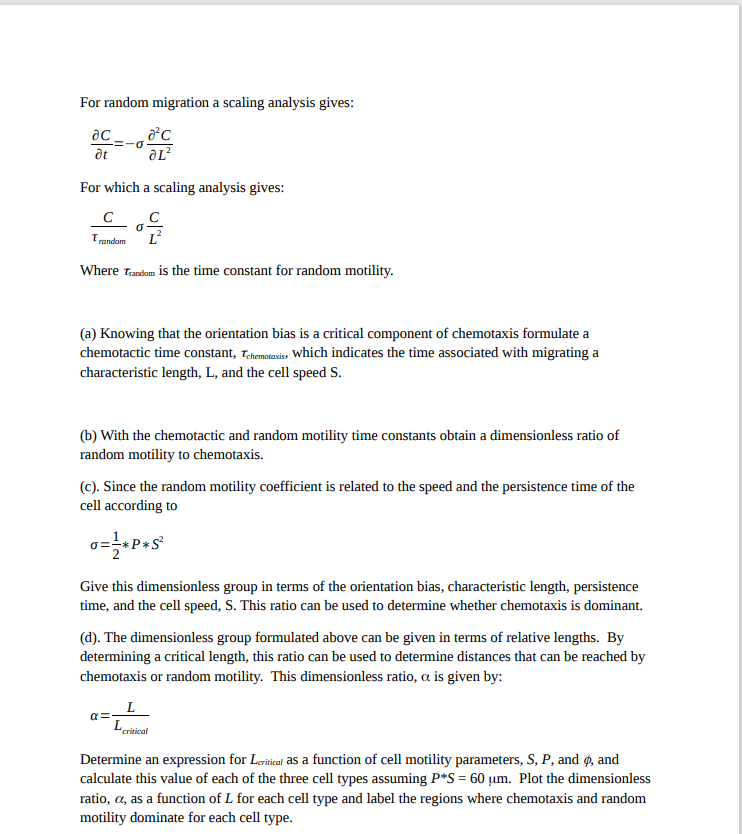
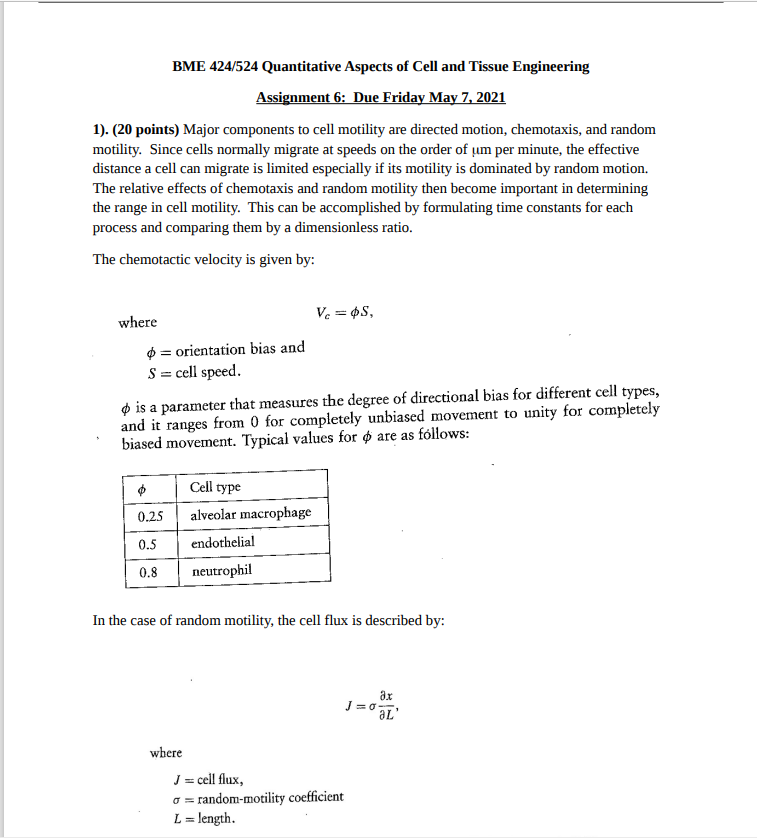
For random migration a scaling analysis gives: ac_ _dcC =] - ot dL\" For which a scaling analysis gives: C C o 2 Tmndum .[. Where Trudam is the time constant for random motility. (a) Knowing that the orientation bias is a critical component of chemotaxis formulate a chemotactic time constant, Toimemds Which indicates the time associated with migrating a characteristic length, L, and the cell speed S. (b) With the chemotactic and random motility time constants obtain a dimensionless ratio of random motility to chemotaxis. (c). Since the random motility coefficient is related to the speed and the persistence time of the cell according to a:%*PtSz Give this dimensionless group in terms of the orientation bias, characteristic length, persistence time, and the cell speed, S. This ratio can be used to determine whether chemotaxis is dominant. (d). The dimensionless group formulated above can be given in terms of relative lengths. By determining a critical length, this ratio can be used to determine distances that can be reached by chemotaxis or random motility. This dimensionless ratio, o is given by L critical o= L Determine an expression for Leiicar as a function of cell motility parameters, S, P, and , and calculate this value of each of the three cell types assuming P*5 = 60 um. Plot the dimensionless ratio, , as a function of L for each cell type and label the regions where chemotaxis and random motility dominate for each cell type. BME 424/524 Quantitative Aspects of Cell and Tissue Engineering Assignment 6: Due Friday May 7, 2021 1). (20 points) Major components to cell motility are directed motion, chemotaxis, and random motility. Since cells normally migrate at speeds on the order of um per minute, the effective distance a cell can migrate is limited especially if its motility is dominated by random motion. The relative effects of chemotaxis and random motility then become important in determining the range in cell motility. This can be accomplished by formulating time constants for each process and comparing them by a dimensionless ratio. The chemotactic velocity is given by: V. =S5, where e == = orientation bias and = cell speed. the degree of directional bias for different cell types, i ameter that measures ! i letely unbiased movement to unity for completely and it ranges from 0 for comp : biased movement. Typical values for are as follows: Cell type where J = cell flux, o = random-motility coefficient & =!r:ngth
Step by Step Solution
There are 3 Steps involved in it
1 Expert Approved Answer
Step: 1 Unlock
Question Has Been Solved by an Expert!
Get step-by-step solutions from verified subject matter experts
Step: 2 Unlock
Step: 3 Unlock
Students Have Also Explored These Related Law Questions!









 Study Help