





Question: Hi there, please use the definition outlined below to help answer the questions. I really appreciate your help and will love a good positive review

Hi there, please use the definition outlined below to help answer the questions. I really appreciate your help and will love a good positive review thanks dear!
Hi there, please use the definition outlined
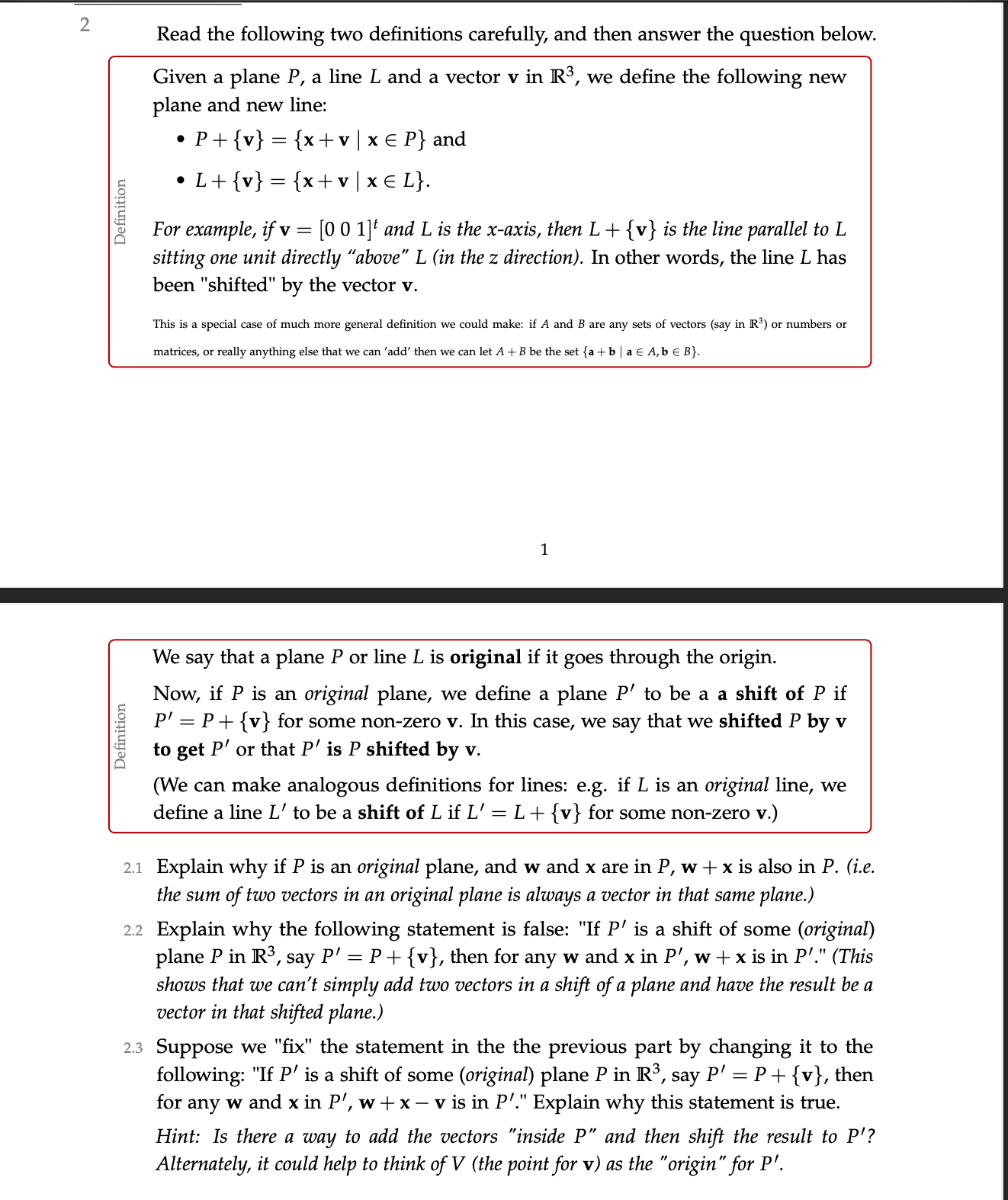
Definition Definition 2.1 2.2 2.3 Read the following two denitions carefully, and then answer the question below. Given a plane P, a line L and a vector v in R3, we dene the following new plane and new line: 0 P+{v} ={x+v|xEP}and 0 L+{v}= {x+v| xEL}. For example, ifv = [0 0 1]' and L is the xaxis, then L + {v} is the line parallel to L sitting one unit directly \"above\" L (in the z direction). In other words, the line L has been "shifted" by the vector v. This is a special case of much more general definition we could make: if A and B are any sets of vectors (say in R3) or numbers or matrices,orreallyany'thingelsethatwecan'add'thenwecanletA+Bbetheset{a+b \\ HEAJDEB}. We say that a plane P or line L is original if it goes through the origin. Now, if P is an original plane, we define a plane P' to be a a shift of P if P' : P + {v} for some non-zero v. In this case, we say that we shifted P by v to get P' or that P' is P shifted by v. (We can make analogous definitions for lines: e.g. if L is an original line, we define a line L' to be a shift of L if L" : L + {v} for some non-zero v.) Explain why if P is an original plane, and w and x are in P, w + x is also in P. (tie. the sum in\" two vectors in an original plane is always a vector in that same plane.) Explain why the following statement is false: "If P' is a shift of some (original) plane P in R3, say P' = P + {v}, then for any w and x in P', w + x is in P'." (This shows that we can't simply add two vectors in a shift of a plane and have the result he a vector in that shifted plane.) Suppose we "fix" the statement in the the previous part by changing it to the following: "If P' is a shift of some (original) plane P in R3, say P' : P + {v}, then for any w and x in P', w + x v is in P'." Explain why this statement is true. Hint: Is there a way to add the vectors \"inside P\" and then shift the result to P'? Altemately, it could help to think of V (the point for v) as the \"origin \" for P

Step by Step Solution

There are 3 Steps involved in it

1 Expert Approved Answer
Step: 1 Unlock blur-text-image

Question Has Been Solved by an Expert!

Get step-by-step solutions from verified subject matter experts

Step: 2 Unlock
Step: 3 Unlock

Students Have Also Explored These Related Mathematics Questions!