







Question: Suppose there are three languages (i.e., problems), of which we know the following: 1. LI is in P. 2. L2 is NP-complete. 3. L3 is
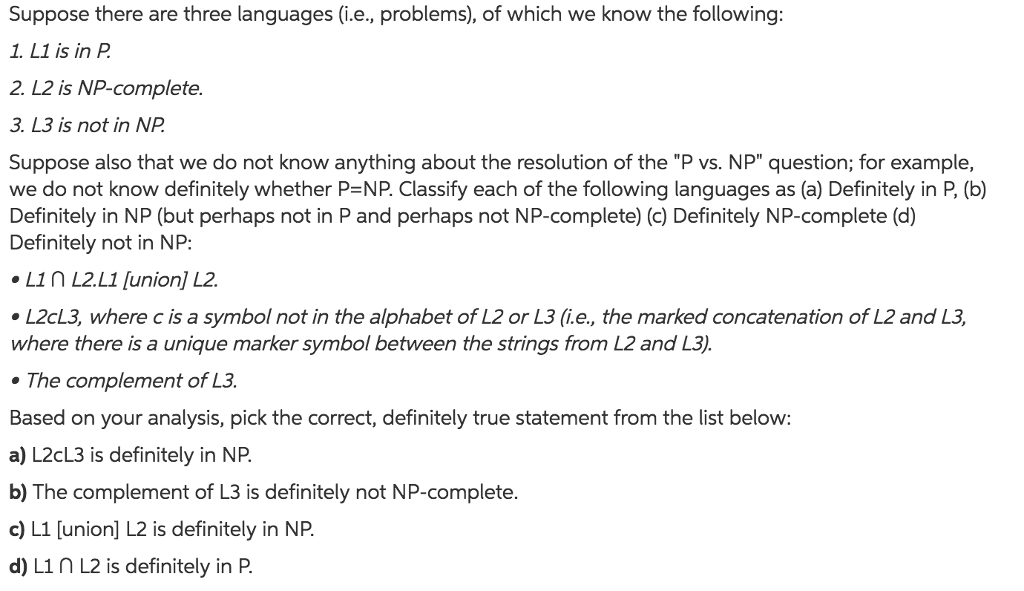
Suppose there are three languages (i.e., problems), of which we know the following: 1. LI is in P. 2. L2 is NP-complete. 3. L3 is not in NP. Suppose also that we do not know anything about the resolution of the "P vs. NP" question; for example, we do not know definitely whether P=NP. Classify each of the following languages as (a) Definitely in P, (b) Definitely in NP (but perhaps not in P and perhaps not NP-complete) (c) Definitely NP-complete (d) Definitely not in NP: L1 intersection L2.L1 [union] L2. L2cL3, where c is a symbol not in the alphabet of L2 or L3 (i.e., the marked concatenation of L2 and L3, where there is a unique marker symbol between the strings from L2 and L3). The complement of L3. Based on your analysis, pick the correct, definitely true statement from the list below: a) L2cL3 is definitely in NP. b) The complement of L3 is definitely not NP-complete. c) L1 [union] L2 is definitely in NP. d) L1 intersection L2 is definitely in P. Suppose there are three languages (i.e., problems), of which we know the following: 1. LI is in P. 2. L2 is NP-complete. 3. L3 is not in NP. Suppose also that we do not know anything about the resolution of the "P vs. NP" question; for example, we do not know definitely whether P=NP. Classify each of the following languages as (a) Definitely in P, (b) Definitely in NP (but perhaps not in P and perhaps not NP-complete) (c) Definitely NP-complete (d) Definitely not in NP: L1 intersection L2.L1 [union] L2. L2cL3, where c is a symbol not in the alphabet of L2 or L3 (i.e., the marked concatenation of L2 and L3, where there is a unique marker symbol between the strings from L2 and L3). The complement of L3. Based on your analysis, pick the correct, definitely true statement from the list below: a) L2cL3 is definitely in NP. b) The complement of L3 is definitely not NP-complete. c) L1 [union] L2 is definitely in NP. d) L1 intersection L2 is definitely in P
Step by Step Solution
There are 3 Steps involved in it

Get step-by-step solutions from verified subject matter experts
 Study Help