



Question: The van der Pol equation is an interesting example of a nonlinear differential equation that converges toward a limit cycle. The normalized van der Pol
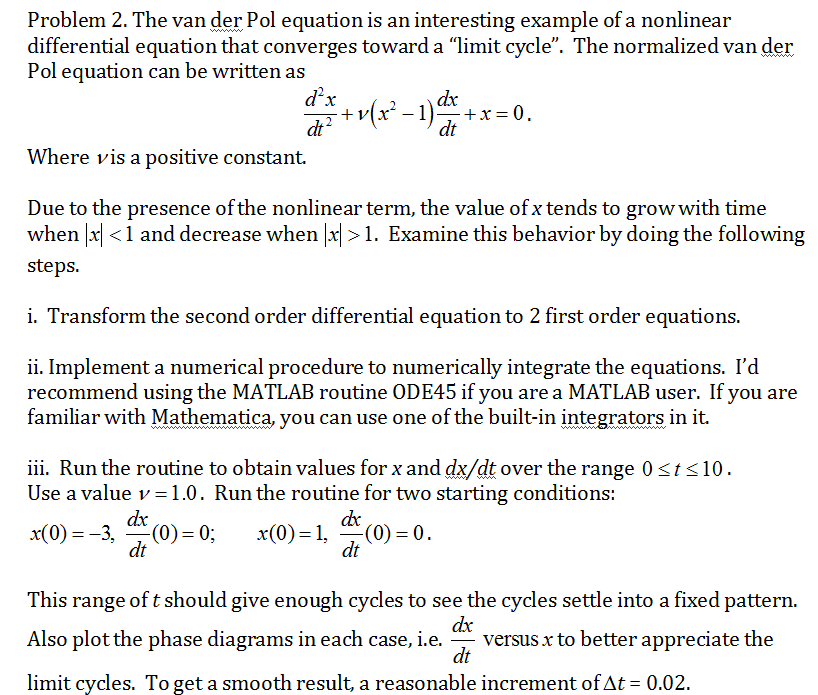
The van der Pol equation is an interesting example of a nonlinear differential equation that converges toward a limit cycle. The normalized van der Pol equation can be written as d^2x/dt^2 + v(x^2-1) dx/dt + x = 0. Where v is positive constant. Due to the presence of the nonlinear term, the value of x tends to grow with time when |x| less than 1 and decrease when |x| greater than 1. Examine this behavior by doing the following steps. Transform the second order differential equation to 2 first orders equations. Implement a numerical procedure to numerically integrate the equations. I'd recommend using the MATLAB routine ODE45 if you are a MATLAB user. If you are familiar with Mathematica, you can use one of the built-in integrators in it. Run the routine to obtain values of x and dx/dt over the range 0 less than or equal to t less than or equal to 10. Use a value v = 1.0. Run the routine for two starting conditions: x(0) = -3, dx/dt (0) = 0; x(0) = 1, dx/dt(0) = 0. This range of t should give enough cycles to see the cycles settle into a fixed pattern. Also plot the phase diagrams in each case, i.e. dx/dt versus x to better appreciate the limit cycles. To get a smooth results, a reasonable increment of delta t = 0.02
Step by Step Solution
There are 3 Steps involved in it

Get step-by-step solutions from verified subject matter experts