







Question: This exercise examines the impact of different cache designs, specifically comparing associative caches to the direct-mapped caches from Section 5.4. For these exercises, refer to
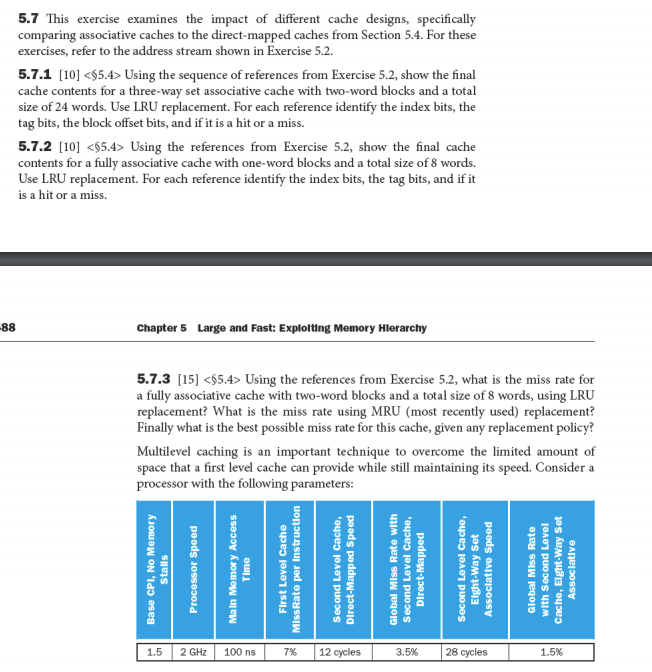
This exercise examines the impact of different cache designs, specifically comparing associative caches to the direct-mapped caches from Section 5.4. For these exercises, refer to the address stream shown in Exercise 5.2. Using the sequence of references from Exercise 5.2, show the final cache contents for a three-way set associative cache with two-word blocks and a total size of 24 words. Use LRU replacement. For each reference identify the index bits, the tag bits, the block offset bits, and if it is a hit or a miss. Using the references from Exercise 5.2, show' the final cache contents for a fully associative cache with one-word blocks and a total size of 8 words. Use LRU replacement. For each reference identify the index bits, the tag bits, and if it is a hit or a miss. Using the references from Exercise 5.2, what is the miss rate for a fully associative cache with two-word blocks and a total size of 8 words, using LRU replacement? What is the miss rate using MRU (most recently used) replacement? Finally what is the best possible miss rate for this cache, given any replacement policy? Multilevel caching is an important technique to overcome the limited amount of space that a first level cache can provide while still maintaining its speed. Consider a processor with the following parameters: This exercise examines the impact of different cache designs, specifically comparing associative caches to the direct-mapped caches from Section 5.4. For these exercises, refer to the address stream shown in Exercise 5.2. Using the sequence of references from Exercise 5.2, show the final cache contents for a three-way set associative cache with two-word blocks and a total size of 24 words. Use LRU replacement. For each reference identify the index bits, the tag bits, the block offset bits, and if it is a hit or a miss. Using the references from Exercise 5.2, show' the final cache contents for a fully associative cache with one-word blocks and a total size of 8 words. Use LRU replacement. For each reference identify the index bits, the tag bits, and if it is a hit or a miss. Using the references from Exercise 5.2, what is the miss rate for a fully associative cache with two-word blocks and a total size of 8 words, using LRU replacement? What is the miss rate using MRU (most recently used) replacement? Finally what is the best possible miss rate for this cache, given any replacement policy? Multilevel caching is an important technique to overcome the limited amount of space that a first level cache can provide while still maintaining its speed. Consider a processor with the following parameters
Step by Step Solution
There are 3 Steps involved in it

Get step-by-step solutions from verified subject matter experts
 Study Help