



Question: To be able to use Mohr's circle to find the principal moments of inertia for an area. Not every beam considered by engineers for a
To be able to use Mohr's circle to find the principal moments of inertia for an area.
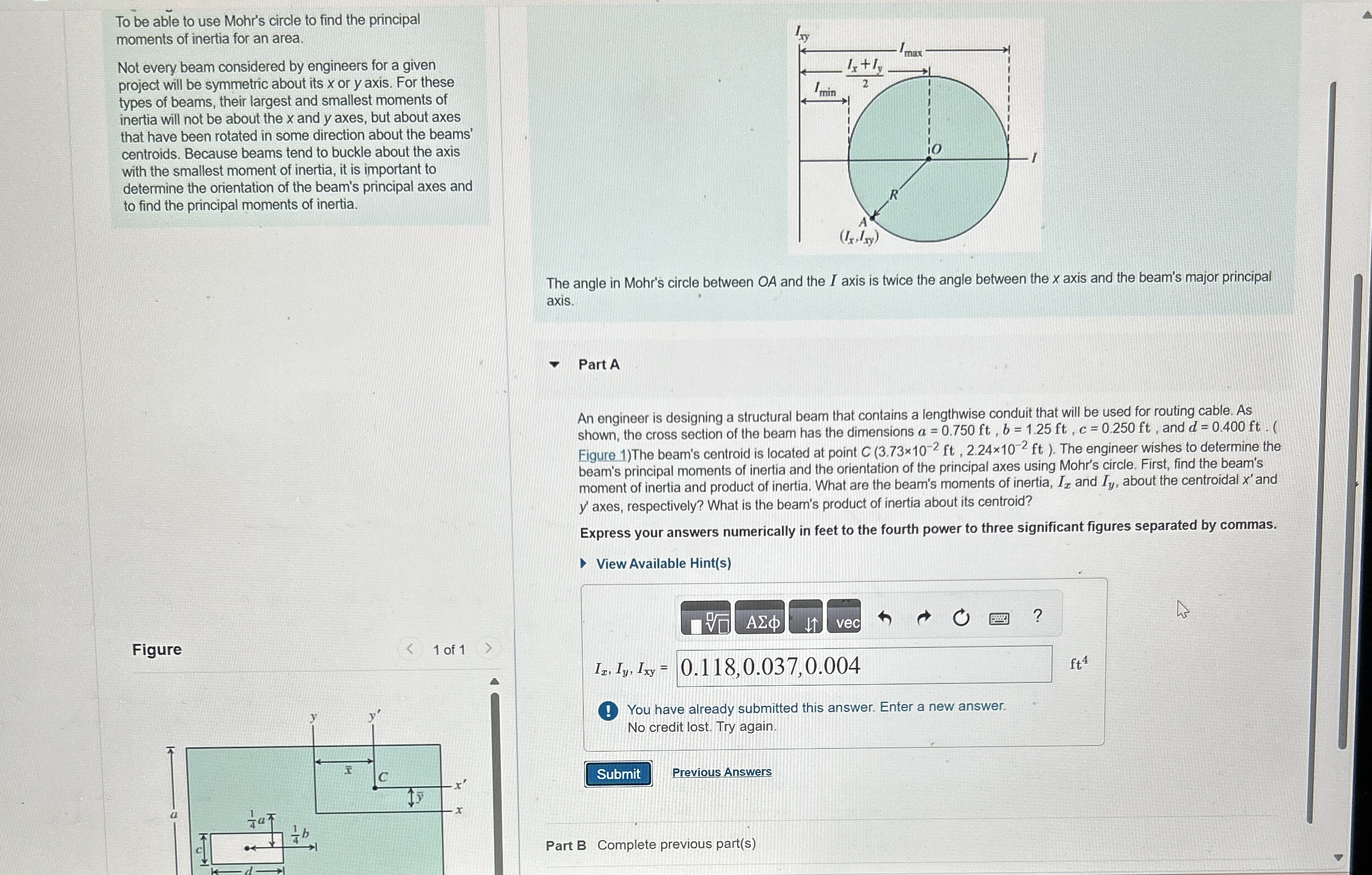
Not every beam considered by engineers for a given project will be symmetric about its or axis. For these types of beams, their largest and smallest moments of inertia will not be about the and axes, but about axes that have been rotated in some direction about the beams' centroids. Because beams tend to buckle about the axis with the smallest moment of inertia, it is important to determine the orientation of the beam's principal axes and to find the principal moments of inertia.
The angle in Mohr's circle between and the I axis is twice the angle between the axis and the beam's major principal axis.
Part A
An engineer is designing a structural beam that contains a lengthwise conduit that will be used for routing cable. As shown, the cross section of the beam has the dimensions and Figure The beam's centroid is located at point The engineer wishes to determine the beam's principal moments of inertia and the orientation of the principal axes using Mohr's circle. First, find the beam's moment of inertia and product of inertia. What are the beam's moments of inertia, and about the centroidal and axes, respectively? What is the beam's product of inertia about its centroid?
Express your answers numerically in feet to the fourth power to three significant figures separated by commas.
View Available Hints
You have already submitted this answer. Enter a new answer. No credit lost. Try again.
Previous Answers
Part B Complete previous parts
Step by Step Solution
There are 3 Steps involved in it
1 Expert Approved Answer
Step: 1 Unlock

Question Has Been Solved by an Expert!
Get step-by-step solutions from verified subject matter experts
Step: 2 Unlock
Step: 3 Unlock