







Question: Update: This is asking us to calculate relative error due to floating point approximations, but then suggests using exact operations (instead of floating point arithmetic).
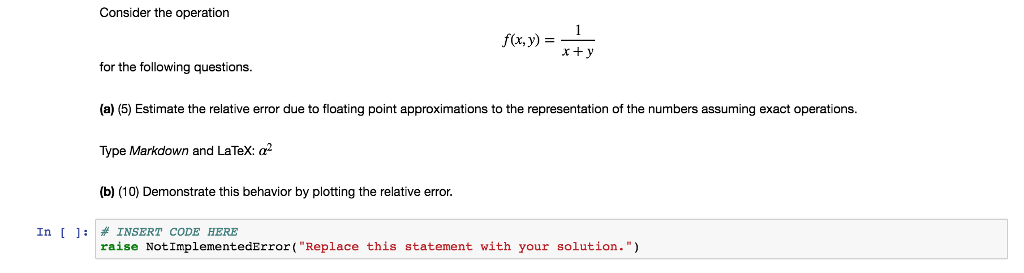 Update: This is asking us to calculate relative error due to floating point approximations, but then suggests using exact operations (instead of floating point arithmetic). Basically saying that fl(x+y)=x+y, but xx(1+x) and similarly for y. We just assume no error from the operations but the values x,y have intrinsic error themselves.
Consider the operation f(x,y) = x+y for the following questions (a) (5) Estimate the relative error due to floating point approximations to the representation of the numbers assuming exact operations Type Markdown and LaTeX: 2 (b) (10) Demonstrate this behavior by plotting the relative error. In [ ]: # INSERT CODE HERE raise NotImplementedError( "Replace this statement with your solution.") Consider the operation f(x,y) = x+y for the following questions (a) (5) Estimate the relative error due to floating point approximations to the representation of the numbers assuming exact operations Type Markdown and LaTeX: 2 (b) (10) Demonstrate this behavior by plotting the relative error. In [ ]: # INSERT CODE HERE raise NotImplementedError( "Replace this statement with your solution.")
Step by Step Solution
There are 3 Steps involved in it
To solve this problem well calculate and plot the relative error due to floating point approximation... View full answer

Get step-by-step solutions from verified subject matter experts
 Study Help