New Semester
Started
Get
50% OFF
Study Help!
--h --m --s
Claim Now
Question Answers
Textbooks
Find textbooks, questions and answers
Oops, something went wrong!
Change your search query and then try again
S
Books
FREE
Study Help
Expert Questions
Accounting
General Management
Mathematics
Finance
Organizational Behaviour
Law
Physics
Operating System
Management Leadership
Sociology
Programming
Marketing
Database
Computer Network
Economics
Textbooks Solutions
Accounting
Managerial Accounting
Management Leadership
Cost Accounting
Statistics
Business Law
Corporate Finance
Finance
Economics
Auditing
Tutors
Online Tutors
Find a Tutor
Hire a Tutor
Become a Tutor
AI Tutor
AI Study Planner
NEW
Sell Books
Search
Search
Sign In
Register
study help
engineering
geological engineering
Design Analysis in Rock Mechanics 1st edition William G. Pariseau - Solutions
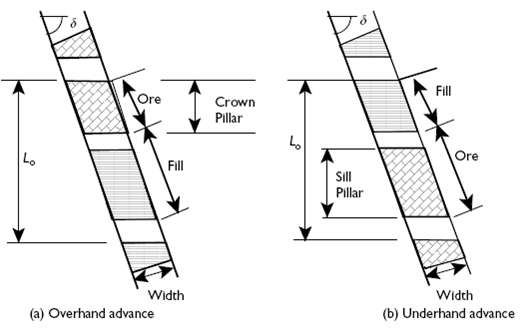
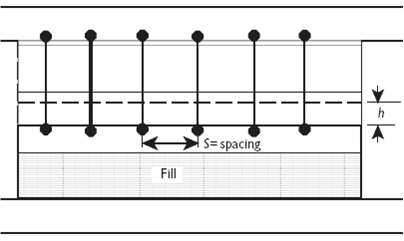
Consider a narrow vein overhand stope using cut and fill, as shown in the sketch. Cemented, hydraulic sand fill of modulus Ef is placed in the stope as mining proceeds up dip in a rock mass of modulus Er.? (a) Develop a formula for crown pillar safety factor assuming uniform closure across the
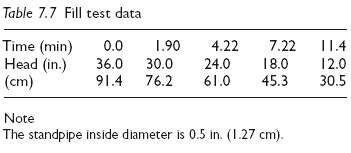
Laboratory test data from 4-in. (10.2 cm) diameter samples, 4 in. (10.2 cm) long (not cemented) are given in Table 7.5. Estimate the hydraulic conductivity of the fill(in./h).
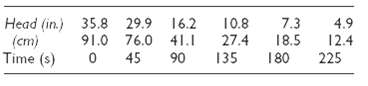
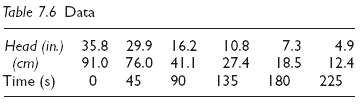
A hydraulic sand fill is tested using a falling head per-mea-meter that has a tube diameter of 1.27 cm (0.50 in.), sample diameter of 10.2 cm (4.0 in.), sample length of 20.4 cm (8.0 in.), and a starting head of 91 cm (35.8) in. The data collected are heads vs times and are given in Table 7.6. Is
Old room and pillar workings extend under Hometown where the strata roll to the horizontal (depth = 1,750 ft, 533 m) and where additional protection in the form of river-run sand fill is placed hydraulically through boreholes. The extraction ratio in this area is estimated to be about 40%. Once in
A large mechanized cut-and-fill stope in hard rock is cable bolted on a square pattern as shown in the sketch. A single 5/8 in. (1.59 cm) diameter cable bolt is installed per hole; cables have an ultimate strength of 56,000 lbf (251kN). Bond strength between grout and cable steel is 700 psi (4.83
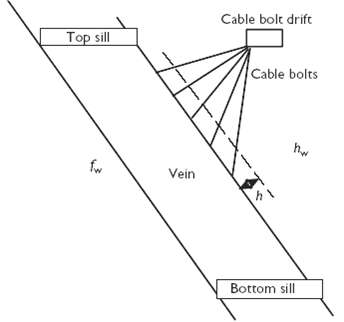
Consider the cable bolting array shown in the sketch. Develop an expression based on a requirement for equilibrium in the direction normal to the vein dip that brings into association vein dip ?, bolting angle (from the horizontal) ?, bolt spacing S (assume a square pattern), bolt tension T, and so
Consider a vein of medium width (50 ft, 15.2 m) that dips 65? and is mined by vertical crater retreat (VCR), as shown in the sketch for the previous problem. Level interval is 150 ft (45.7 m). Layout a hanging wall cable bolt pattern using two 5/8-in. (1.6 cm) diameter 25 ton (224kN) capacity bolts
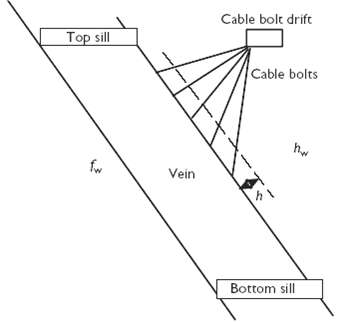
Consider a medium width vein (50 ft, 15.2 m) dipping 65? and mined by overhand mechanized cut and fill (MCF) with a level interval of 200 ft (61 m) as shown in the sketch. (a) Derive a bolting formula algebraically for bolt safety factor assuming n bolts per hole using cable of capacity Tb (lbf,
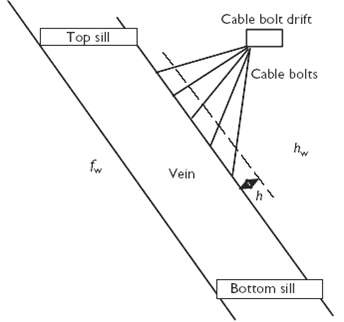
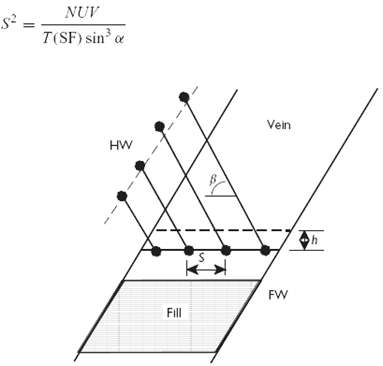
With reference to the sketch, verify the cable bolting formula below. If the formula is unsatisfactory, then derive a substitute formula based on a dead weight load analysis. Here S = spacing (ft, m) assuming a square pattern, N = number of cables per hole, U = ultimate tensile strength (tons, kN),
Consider a vertical shrinkage stope W (ft, m) wide, H (ft, m) high filled with muck having a specific weight γ along a strike length of L (ft, m). Further suppose wall friction angle φ' and angle of internal friction φ apply. Cohesion of the muck and adhesion at the stope walls is negligible.(a)
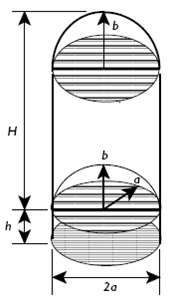
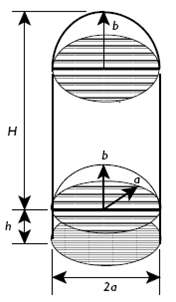
Derive a formula for the chimney cave height H shown in the sketch. Note that the initial void is roughly circular in plan and has a radius of a (ft, m). The circular region is h (ft, m) high. An elliptical vault forms in the back and extends b ft into the back at its highest point. Chimney caving
If the excavation width a in Problem 8.2 is 105 ft (32 m), the initial height of the circular region is 14 ft (4.3 m); the arch extends 35 ft (10.7 m) above the floor. What bulking porosity is indicated if the cave just reaches the surface from a seam depth (surface to seam top) of 1,150 ft (350m)?
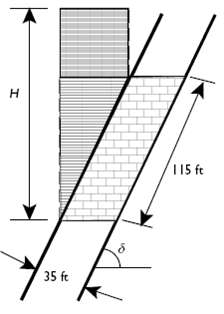
Consider the stope in the inclined vein shown in the sketch. If the stope height measured along the dip is 115 ft (35.1 m), the true width of the vein is 35 ft (10.7 m), and the bulking porosity, as determined from past observations at the mine, is 0.072, what cave height is expected if the caving
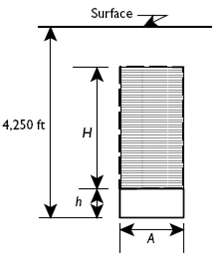
A panel block caving system operates at a depth of 4,250 ft (1,417 m) as shown in the sketch. Dimensions of the panels are 150 ft by 300 ft (45.7 ?? 91.4 m) in plan. The initial undercut is 21 ft (6.4 m) high. Initial bulking porosity at the start of the cave, which forms rubble, is 0.37. Estimate
With reference to Problem 8.5, the caved ground has a specific weight of 105 pcf (16.6kN/m3); the angle of friction between muck and rock is 23◦, while the angle of internal friction of the muck is 33◦. The ratio of horizontal to vertical stress in the caved ground is estimated to be 0.32.(a)
A panel block caving system operates at a depth of 1,295 m. Dimensions of the panels are 46 m by 92 m ft in plan. The undercut is 6.4 m high. Initial bulking porosity at the start of the cave, which forms rubble, is 0.25. Solid ground specific gravity is 2.60; caved ground has a specific gravity of
A panel block caving system operates at a depth of 4,250 ft. Dimensions of the panels are 150 ft by 300 ft in plan. The undercut is 21 ft high. Initial bulking porosity at the start of the cave, which forms rubble, is 0.37. The caved ground has a specific weight of 105 pcf; the angle of friction
Block caving studies indicate the rock mass has an associated bulking porosity of 0.015. A caving panel is developed 1,570 ft (479 m) below ground surface. Suppose the panel is A square feet in plan view, say, A = 20, 000 square feet (1,858 m2). How much ore (‘solid rock’) may be removed before
A circular ore pass 13 ft (4 m) in diameter has a muck cushion that extends 9 ft (9 m) above the bottom of the ore pass. The ore pass is vertical and extends 150 ft from level to level. The muck has a specific weight of 105 pcf (16.6kN/m3), is considered cohesion less with an angle of internal
A proposal for panel caving a massive ore zone using undercuts 250 ft by 600 ft (76.2 × 183 m) in plan and 14 ft (5.4 m) high is made. If the bulking porosity is 0.075 and caving occurs directly over the undercut, how high above the undercut will the cave zone extend? Draw of ore removes solid
With reference to the paper by F. Kendorski (chapter 4, 1977) and the example calculations for Mine C (which relates to Mine B), a wall shear check is made using the equation FD = Ff + Fr + Fri. The numbers are given as(48,400)(0.707) = (10) (144) (5) (1.414) + (48,000) (0.707) (0.21) + (0.5)
With reference to Problems 8.5 and 8.6, 9 ft wide by 12 ft high grizzly drifts below the undercut level are first supported with 3/4 in diameter, grade 55 resin bolts 6 ft long (grouted full length) and wire mesh. A continuous concrete liner may be added later. Compressive strength of concrete is
With reference to Problems 8.5 and 8.6, 2.7 m wide by 3.7 m high grizzly drifts below the undercut level are first supported with 3/4 in diameter, grade 55 (379 MPa yield strength) resin bolts 1.8 m long (grouted full length), and wire mesh. A continuous concrete liner may be added later.
A semicircular arched back heading 14 ft (4.3 m) wide and 17 ft (5.2 m) high is driven due north. Two joints are present; both strike due north. Set 1 dips 60◦ east; Set 2 dips 60◦ west. No other data are available. Yet, some support planning is required. Would conventional rock bolting be
A caving operation is conducted in a relatively weak rock mass where the joint persistence is 88%. Laboratory testing of intact core shows that Co = 12,750 psi, and φ = 29◦. Specific weight of rock is 157 pcf. Joint cohesion is 75 psi and joint friction angle is 20◦. Depth of the undercut is
A caving operation is conducted in a relatively weak rock mass where the joint persistence is 88%. Laboratory testing of intact core shows that Co = 88 MPa, and φ = 29◦. Specific weight of rock is 24.8kN/m3. Joint cohesion is 517 kPa and joint friction angle is 20◦. Depth of the undercut is
With reference to the data below, an open pit mine has reached an economic limit (3,000 ft, 914 m depth), so underground mining is being considered using a block caving method. A mainline ramp 16 ft (4.9 m) wide with semicircular backs 16 ft (4.9 m) high is planned from the pit bottom to spiral
A caving operation is conducted in a relatively weak rock mass where the joint persistence is 88%. Laboratory testing of intact core shows that Co = 12,750 psi, and φ = 29◦. Specific weight of rock is 157 pcf. Joint cohesion is 75 psi and joint friction angle is 20◦. Depth of the undercut is
A caving operation is conducted in a relatively weak rock mass where the joint persistence is 88%. Laboratory testing of intact core shows that Co = 87.9 MPa, and φ = 29◦. Specific weight of rock is 24.8kN/m3. Joint cohesion is 517 kPa and joint friction angle is 20◦. Depth of the undercut is
A long wall panel 6,200 ft long with a face length of 820 ft is planned for a seam 1,300 ft deep and 16.5 ft thick. Mining is full seam height. Assume UK conditions apply. Find:1 The maximum subsidence that will develop during the life of the panel.2 The maximum subsidence after the face has
A long wall panel 1,900mlong with a face length of 250mis planned for a seam 396m deep and 5.0 m thick. Mining is full seam height. Assume UK conditions apply. Find (in m when):1 The maximum subsidence that will develop during the life of the panel.2 The maximum subsidence after the face has
A long wall panel 6,200 ft long with a face length of 820 ft is planned for a seam 1,300 ft deep and 16.5 ft thick. Mining is full seam height. Assume UK conditions apply. Find:1 The maximum subsidence that will develop during the life of the panel.2 The maximum subsidence after the face has
Consider a single long wall panel in a seam mined full height of5mat a depth of 400 m. The panel has a face width of 300 m; panel length will eventually reach 3,000 m. The seam is flat. Mining occurs at a rate of 8,000 tons per shift (1 ton = 2,000 lbs), two production and one maintenance shift per
Coal is mined 15 ft high underground in flat strata by the long wall method at a depth of 1,500 ft. Panels are 750 ft wide and 7,500 ft long. Assume US conditions, then considering trough subsidence, estimate (in ft):a. Maximum subsidence over a single panel (ft),b. Critical width (ft),c. Maximum
A solution mine for nacholite that is processed into soda ash is developed by wells 1,800 ft below the surface in the Piceance basin of Colorado. The mine will produce about 1 million short tons per year initially. Assume the “pay zone” is 90 ft thick, dips 5◦ and that dissolvable nacholite
Showing 300 - 400
of 335
1
2
3
4
Step by Step Answers

 Get 50% OFF
Claim Now
Get 50% OFF
Claim Now