New Semester
Started
Get
50% OFF
Study Help!
--h --m --s
Claim Now
Question Answers
Textbooks
Find textbooks, questions and answers
Oops, something went wrong!
Change your search query and then try again
S
Books
FREE
Study Help
Expert Questions
Accounting
General Management
Mathematics
Finance
Organizational Behaviour
Law
Physics
Operating System
Management Leadership
Sociology
Programming
Marketing
Database
Computer Network
Economics
Textbooks Solutions
Accounting
Managerial Accounting
Management Leadership
Cost Accounting
Statistics
Business Law
Corporate Finance
Finance
Economics
Auditing
Tutors
Online Tutors
Find a Tutor
Hire a Tutor
Become a Tutor
AI Tutor
AI Study Planner
NEW
Sell Books
Search
Search
Sign In
Register
study help
engineering
engineering mechanics statics
Engineering Mechanics Statics & Dynamics 15th Edition Russell C. Hibbeler - Solutions
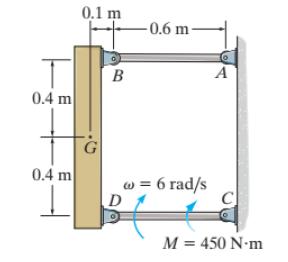
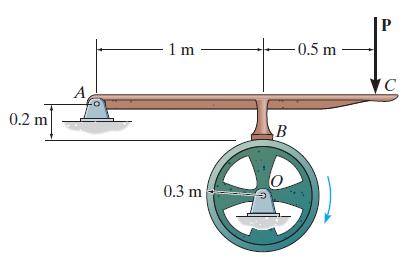
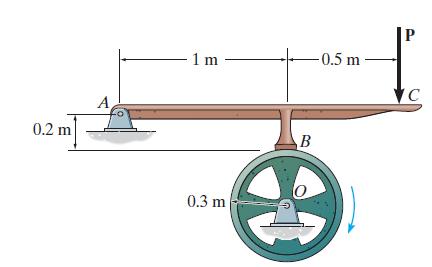
At the instant shown, rod CD rotates with an angular velocity of ω = 6 rad/s. If it is subjected to a couplemoment M = 450 N · m, determine the force developed inrod AB, the horizontal and vertical component of reactionon pin D, and the angular acceleration of rod CD at thisinstant. The bar has a
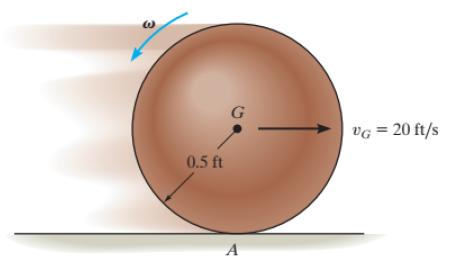
Determine the backspin ω which should be given to the 20-lb ball so that when its center is given an initial horizontal velocity vG = 20 ft/s it stops spinning and translating at the same instant. The coefficient of kinetic friction is μA = 0.3. 0.5 ft G A VG = 20 ft/s
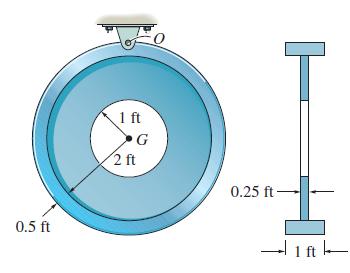
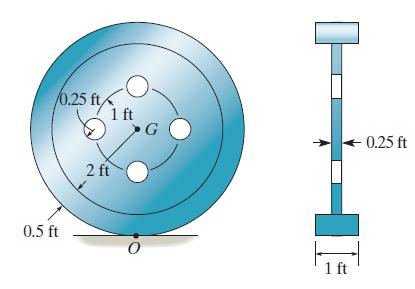
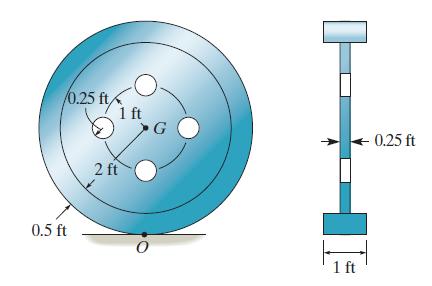
Determine the moment of inertia of the assembly about an axis which is perpendicular to the page and passes through point O. The material has a specific weight of γ = 90 lb>ft3. 0.5 ft 1 ft G 2 ft 0.25 ft- 1 ft
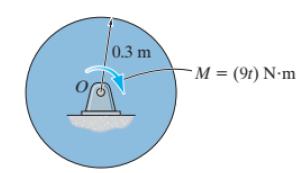
The 50-kg disk is subjected to the couple moment of M = (91) N·m, where t is in seconds. Determine theangular velocity of the disk when t = 4 s starting from rest. 0.3 m - M = (9t) N-m
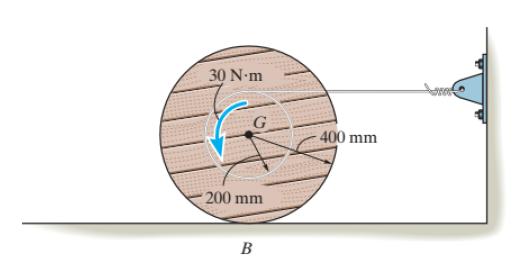
The spool and wire wrapped around its core have a mass of 20 kg and a centroidal radius of gyration KG = 250 mm. If the coefficient of kinetic friction at the ground is μB = 0.1, determine the angular acceleration of the spool when the 30-N-m couple moment is applied. 30 N-m G 200 mm B 400 mm
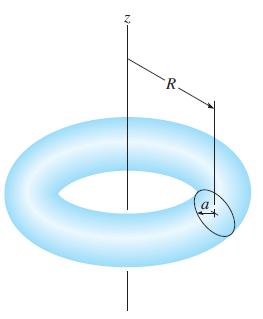
Determine the moment of inertia Iz of the torus.The mass of the torus is m and the density is constant. N R.
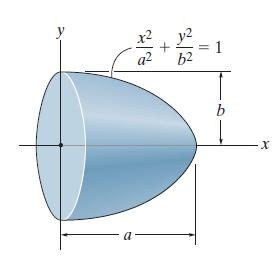
Determine the moment of inertia of the semi ellipsoid with respect to the x axis and express the result in terms of the mass m of the semi ellipsoid. The material has a constant density ρ. + 1 b X
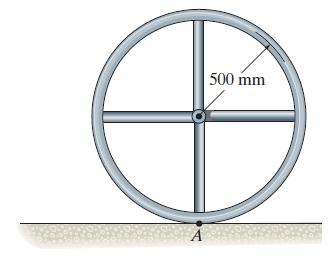
The wheel consists of a thin ring having a mass of 10 kg and four spokes made from slender rods and each having a mass of 2 kg. Determine the wheel’s moment of inertia about an axis perpendicular to the page and passing through point A. A 500 mm
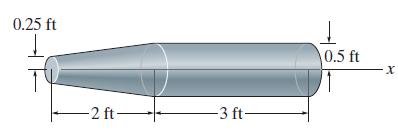
Determine the moment of inertia of the solid steel assembly about the x axis. Steel has a specific weight of γst = 490 lb/ft3. 0.25 ft -2 ft- -3 ft- 0.5 ft X
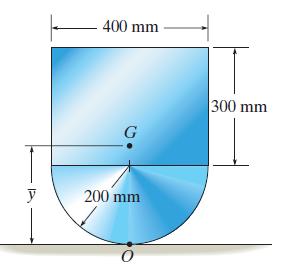
Determine the location ȳ of the center of mass G of the assembly, and then calculate the moment of inertia about an axis perpendicular to the page and passing through G. The block has a mass of 3 kg and the semicylinder has a mass of 5 kg. y 400 mm G 200 mm 300 mm
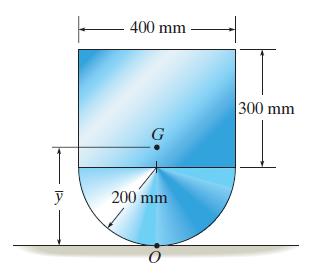
Determine the moment of inertia of the assembly about an axis perpendicular to the page and passing through point O. The block has a mass of 3 kg, and the semicylinder has a mass of 5 kg. y 400 mm G 200 mm 300 mm
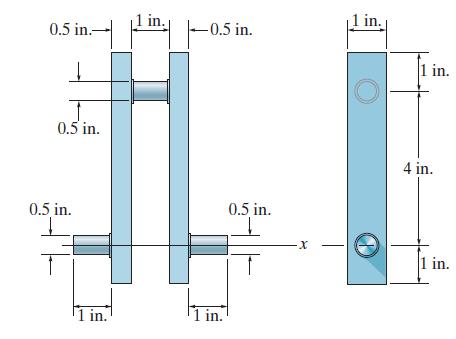
Determine the moment of inertia of the center crank about the x axis. The material is steel having a specific weight of γst = 490 lb/ft3. 0.5 in.- ↓ 1 0.5 in. 0.5 in. 1 in. -0.5 in. 1 in. 0.5 in. ·X in. 1 in. 4 in. 1 in.
Determine the moment of inertia of the wheel about an axis which is perpendicular to the page and passes through the center of mass G. The material has a specific weight γ = 90 lb/ft3. /0.25 ft/ 0.5 ft 1 ft 2 ft 0 G HIS 1 ft 0.25 ft
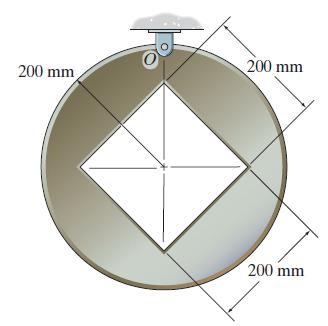
Determine the mass moment of inertia of the thin plate about an axis perpendicular to the page and passing through point O. The material has a mass per unit area of 20 kg/m2. 200 mm 200 mm 200 mm
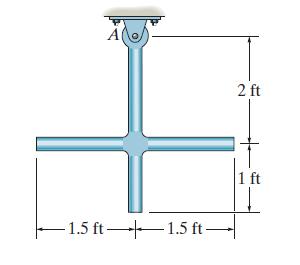
The slender rods have a weight of 3 lb/ft Determine the moment of inertia of the assembly about an axis perpendicular to the page and passing through point A. A -1.5 ft 1.5 ft 2 ft 1 ft
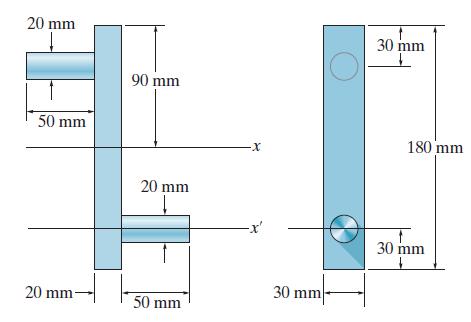
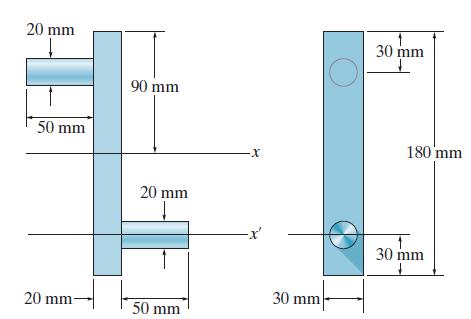
Determine the moment of inertia of the overhung crank about the x axis. The material is steel having a destiny of ρ = 7.85 Mg/m3. 20 mm 50 mm 20 mm- 90 mm 20 mm ↓ 50 mm -X 30 mm/ 30 mm 180 mm T 30 mm
Determine the moment of inertia of the overhung crank about the x′ axis. The material is steel having a destiny of ρ = 7.85 Mg/m3. 20 mm 50 mm 20 mm- 90 mm 20 mm 50 mm -X 30 mm 30 mm 180 mm 30 mm
Determine the moment of inertia of the wheel about an axis which is perpendicular to the page and passes through point O. The material has a specific weight γ = 90 lb/ft3. 0.5 ft 0.25 ft/1 ft 2 ft ➤G O HIS 1 ft -0.25 ft
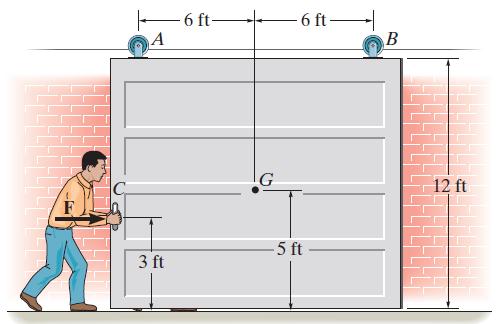
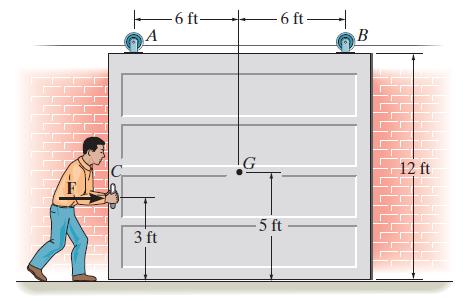
The door has a weight of 200 lb and a center of gravity at G. Determine how far the door moves in 2 s, starting from rest, if a man pushes on it at C with a horizontal force F = 30 lb. Also, find the vertical reactions at the rollers A and B. -6 ft- A 3 ft G -6 ft- -5 ft B 12 ft
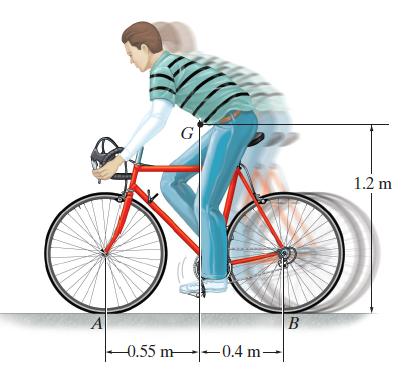
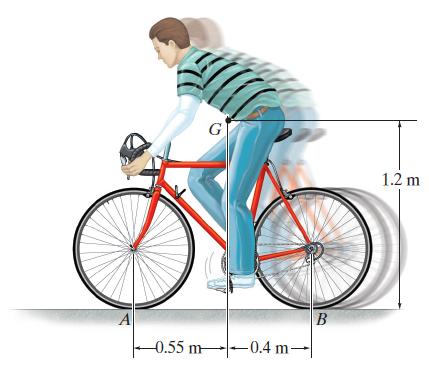
The bicycle and rider have a mass of 80 kg with center of mass located at G. If the coefficient of kinetic friction at the rear tire is μB = 0.8, determine the normal reactions at the tires A and B, and the deceleration of the rider, when the rear wheel locks for braking. What is the normal
The door has a weight of 200 lb and a center of gravity at G. Determine the constant force F that must be applied to the door to push it open 12 ft to the right in 5 s, starting from rest. Also, find the vertical reactions at the rollers A and B. A 3 ft 6 ft G -6 ft- 5 ft B 12 ft
The bicycle and rider have a mass of 80 kg with center of mass located at G. Determine the minimum coefficient of kinetic friction between the road and the wheels so that the rear wheel B starts to lift off the ground when the rider applies the brakes to the front wheel. Neglect the mass of the
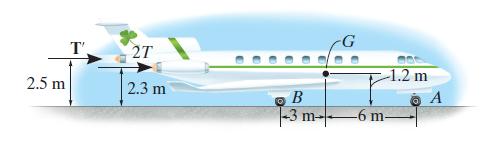
The jet aircraft has a total mass of 22 Mg and a center of mass at G. Initially at take-off the engines provide a thrust 2T = 4 kN and T′ = 1.5 kN Determine the acceleration of the plane and the normal reactions on the nose wheel and each of the two wing wheels located at B. Neglect the mass of
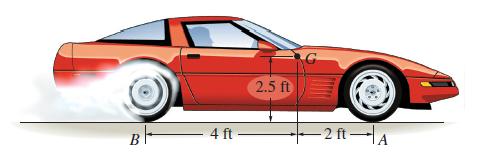
The sports car has a weight of 4500 lb and center of gravity at G. If it starts from rest it causes the rear wheels to slip as it accelerates. Determine how long it takes for it to reach a speed of 10 ft/s. Also, what are the normal reactions at each of the four wheels on the road? The coefficients
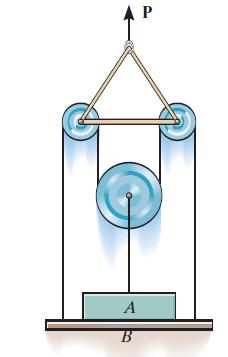
Block A weighs 50 lb and the platform weighs 10 lb. If P = 100 lb, determine the normal force exerted by block A on B. Neglect the weight of the pulleys and bars of the triangular frame. A P O A B
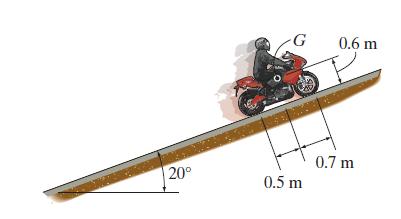
The motorcycle and rider have a total mass of 900 kg and mass center at G. If it is traveling up the slope with a constant acceleration of 3 m/s2, determine the normal reactions on the front and rear wheels. Also, what is the required friction force developed on the rear wheel? The front wheel is
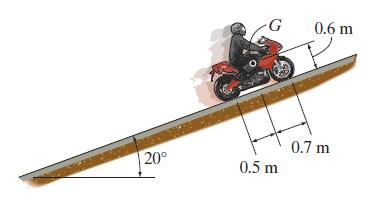
The motorcycle and rider have a total mass of 900 kg and mass center at G. Determine the minimum coefficient of static friction between the rear wheel and the slope in order for the rider to perform a “wheely,” that is, to begin to lift the front wheel off the road. Also, what is the
At the start of takeoff, the propeller on the 2-Mg plane exerts a horizontal thrust of 600 N on the plane. Determine the plane’s acceleration and the vertical reactions at the nose wheel A and each of the two wing wheels B. Neglect the lifting force of the wings since the plane is originally at
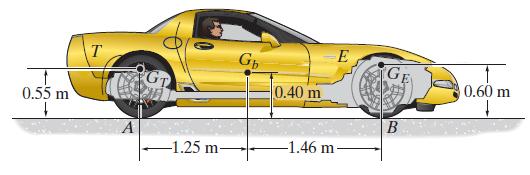
The sports car has been designed so that the 260-kg engine E 165-kg transmission T have been placed over the front and rear wheels, respectively. Their mass centers are located at GE and GT. The mass center of the remaining 512-kg body and frame is located at Gb. If power is suppied to the rear
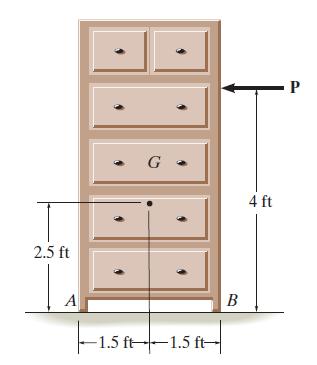
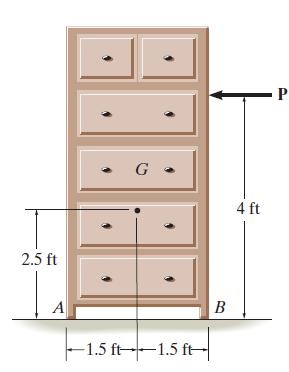
The dresser has a weight of 80 lb and is pushed along the floor. If the coefficient of static friction at A and B is μs = 0.3 and the coefficient of kinetic friction is μk = 0.2, determine the smallest horizontal force P needed to cause motion. If this force is increased slightly, determine the
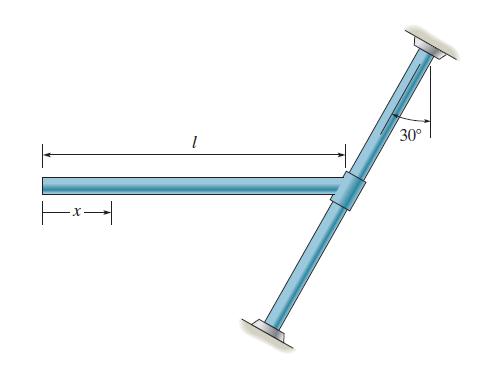
The bar has a weight per length w and is supported by the smooth collar. If it is released from rest, determine the internal normal force, shear force, and bending moment in the bar as a function of x. ·X 1 30°
The dresser has a weight of 80 lb and is pushed along the floor. If the coefficient of static friction at A and B is μs = 0.3 and the coefficient of kinetic friction is μk = 0.2, determine the maximum horizontal force P that can be applied without causing the dresser to tip over. 2.5 ft A G -1.5
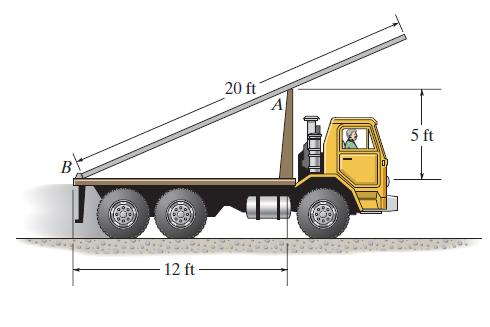
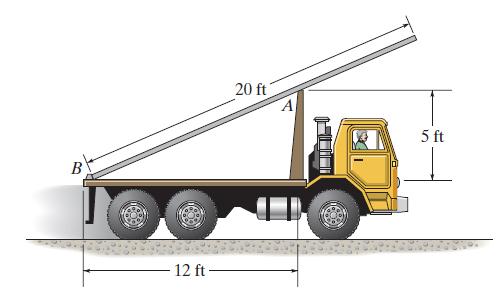
The smooth 180-lb pipe has a length of 20 ft and a negligible diameter. It is carried on a truck as shown. If the truck accelerates at a = 5 ft/s2, determine the normal reaction at A and the horizontal and vertical components of force which the truck exerts on the pipe at B. B 1000) - 12 ft 20
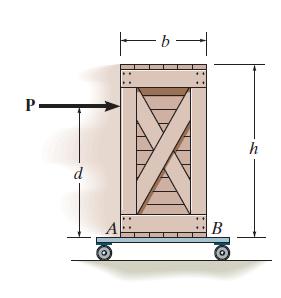
The crate of mass m is supported on a cart of negligible mass. Determine the maximum force P that can be applied a distance d from the cart bottom without causing the crate to tip on the cart. P d -6- B h
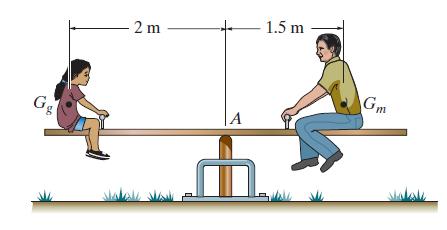
A 75-kg man and 40-kg girl sit on the seesaw, which has negligible mass. At the instant the man lifts his feet from the ground, determine their acceleration if each sits upright, i.e., they do not rotate. The centers of mass of the man and girl are at Gm and Gg, respectively. Gg -2m -1.5 m
The smooth 180-lb pipe has a length of 20 ft and a negligible diameter. It is carried on a truck as shown. Determine the maximum acceleration which the truck can have without causing the normal reaction at A to be zero. Also determine the horizontal and vertical components of force which the truck
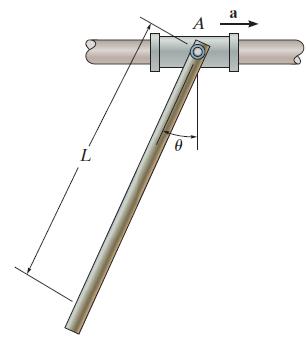
The uniform bar of mass m is pin connected to the collar, which slides along the smooth horizontal rod. If the collar is given a constant acceleration of a, determine the bar’s inclination angle θ. Neglect the collar’s mass. L 0 A
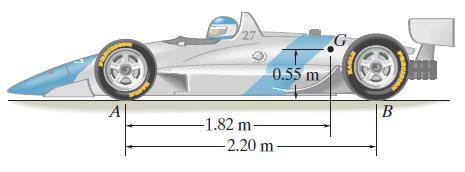
Determine the greatest possible acceleration of the 975-kg race car so that its front tires do not leave the ground or the tires slip on the track. The coefficients of static and kinetic friction are μs = 0.8 and μk = 0.6, respectively. Neglect the mass of the tires.The car has rear-wheel drive
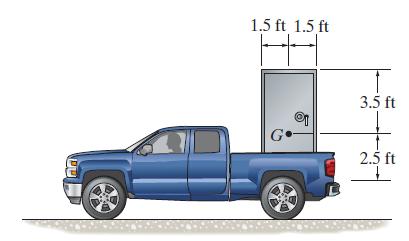
The truck carries the 1200-lb safe, which has a center of mass at G. Determine the largest acceleration of the truck so that the safe will not slip or tip on the truck bed. The coefficient of static friction between the safe and the truck is μs = 0.5. 1.5 ft 1.5 ft H 3.5 ft 2.5 ft +
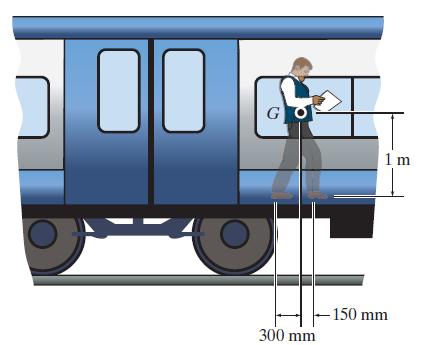
A man stands in the aisle of a moving train. If the coefficient of static friction between his shoes and the floor is μs = 0.5, and he has a mass of 85 kg, with center of mass at G, determine the smallest train acceleration to the right to cause the man to either slide or tip. Assume the man holds
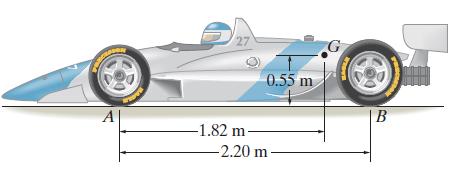
Determine the greatest possible acceleration of the 975-kg race car so that its front wheels do not leave the ground and none of the tires slip on the track. The coefficients of static and kinetic friction are μs = 0.8 and μk = 0.6, respectively. Neglect the mass of the tires. The car has
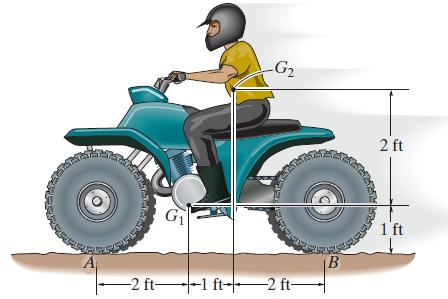
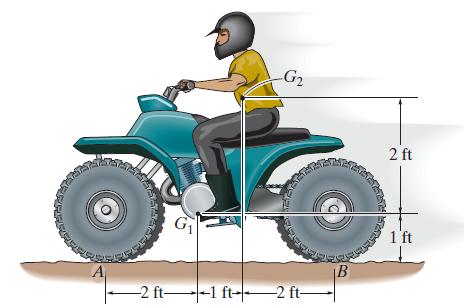
The four-wheeler has a weight of 335 lb and a center of gravity at G1, whereas the rider has a weight of 150 lb and a center of gravity at G2. If the coefficient of static friction between the rear wheels and the ground is μs = 0.3, determine the greatest acceleration the vehicle can have without
The four-wheeler has a weight of 335 lb and a center of gravity at G1, whereas the rider has a weight of 150 lb and a center of gravity at G2. If the engine can develop enough torque to cause the rear wheels to slip, determine the largest coefficient of static friction between the rear wheels and
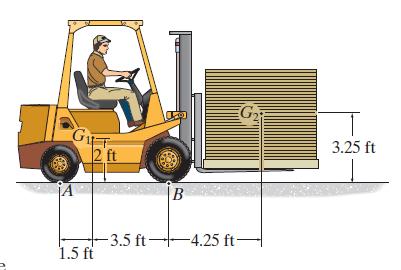
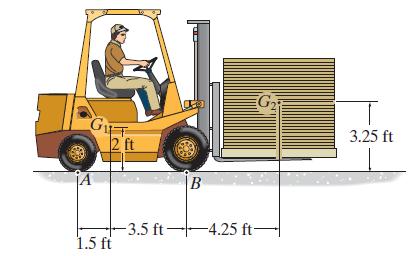
The forklift travels forward with a constant speed of 9ft/s. Determine the shortest stopping distance without causing any of the wheels to leave the ground. The forklift has a weight of 2000 lb with center of gravity at G₁, and the load weighs 900 lb with center of gravity at G₂. Neglect the
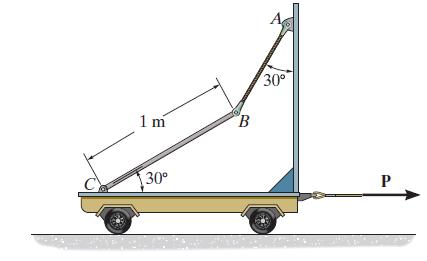
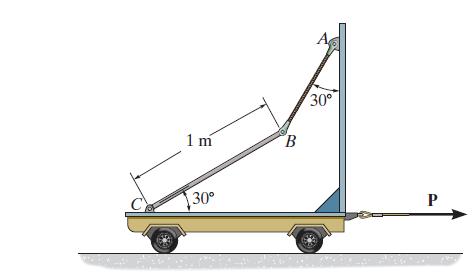
If the cart’s mass is 30 kg and it is subjected to a horizontal A force of P = 90 N, determine the tension in cord AB and the horizontal and vertical components of reaction on end C of the uniform 15-kg rod BC. 1 m 30⁰ B 30° P
If the cart’s mass is 30 kg, determine the horizontal force P that should be applied to the cart so that the cord AB just becomes slack.The uniform rod BC has a mass of 15 kg. 1 m 30⁰ в 30° С P
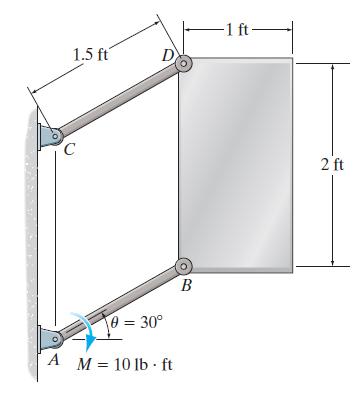
A uniform plate has a weight of 50 lb. Link AB is subjected to a couple moment of M = 10 lb · ft and has a clockwiseangular velocity of 2 rad/s at the instant θ = 30°. Determinethe force developed in link CD and the tangentialcomponent of the acceleration of the plate's mass center atthis
If the forklift's rear wheels supply a combined traction force of FA = 300 lb, determine its acceleration and the normal reactions on the pairs of rear wheels and front wheels. The forklift has a weight of 2000 lb, with center of gravity at G₁, and the load weighs 900 lb, with center of gravity
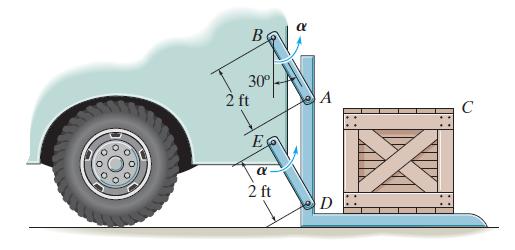
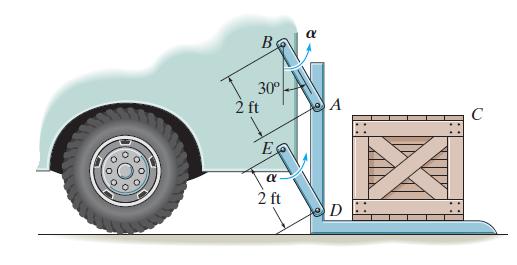
The crate C has a weight of 150 lb and rests on the truck elevator for which the coefficient of static friction is μs = 0.4. Determine the largest initial angular acceleration a, starting from rest, which the parallel links AB and DE can have without causing the crate to slip. No tipping occurs.
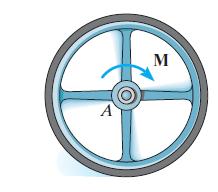
The 10-kg wheel has a radius of gyration KA = 200 mm. If the wheel is subjected to a moment M = (5t) N · m, where t is in seconds, determine its angular velocity when t = 3 s starting from rest. Also, calculate the reactions which the fixed pin A exerts on the wheel during the motion. A M
The crate C has a weight of 150 lb and rests on the truck elevator. Determine the initial friction and normal force of the elevator on the crate if the parallel links are given an angular acceleration α = 2 rad/s2 starting from rest. B 30° 2 ft α 2 ft α A D C
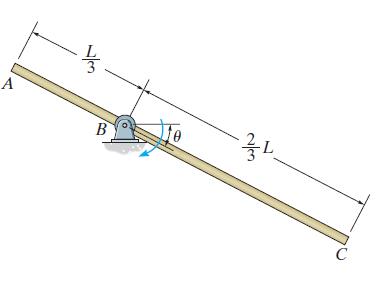
The uniform slender rod has a mass m. If it is released from rest when θ = 0°, determine the magnitude of the reactive force exerted on it by pin B when θ = 90°. A -5. B Te 룩
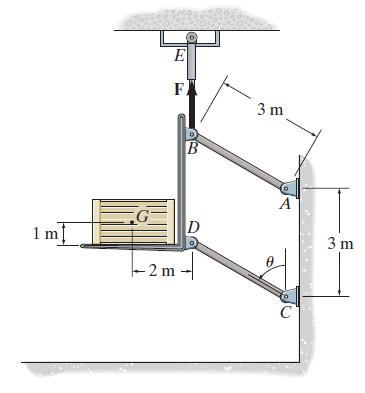
If the hydraulic cylinder BE exerts a vertical force of F = 1.5 kN on the platform, determine the force developed in links AB and CD at the instant θ = 90°. The platform is at rest when θ = 45°. Neglect the mass of thelinks and the platform. The 200-kg crate does not slip onthe platform. 1
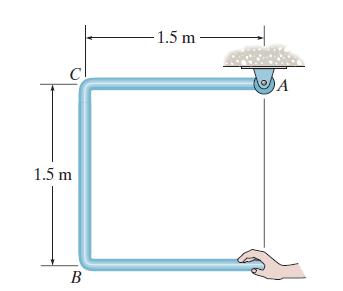
The bent rod has a mass of 2 kg/m. If it is released from rest in the position shown, determine its initial angular acceleration and the horizontal and vertical components of reaction at A. 1.5 m B -1.5 m- A
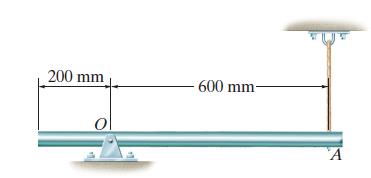
The uniform slender rod has a mass of 5 kg. If the cord at A is cut, determine the reaction at the pin O, (a) When the rod is still in the horizontal position, and (b) When the rod swings to the vertical position. 200 mm 600 mm-
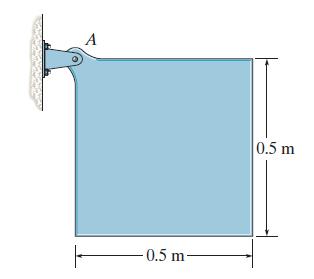
The uniform 24-kg plate is released from rest at the position shown. Determine its initial angular acceleration and the horizontal and vertical reactions at the pin A. A -0.5 m- 0.5 m
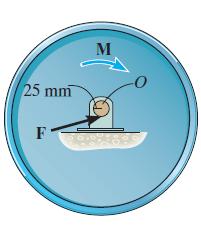
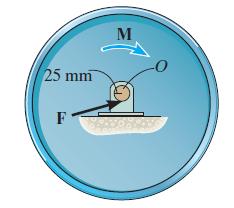
A motor supplies a constant torque M = 2 N · m to a 50-mm- diameter shaft O connected to the center of the 30-kg flywheel. The resultant bearing friction F, which the bearing exerts on the shaft, acts tangent to the shaft and has a magnitude of 50 N. Determine how long the torque must be applied
If the motor of Prob. 17-62 is disengaged from the shaft once the flywheel is rotating at 15 rad/s, so that M = 0, determine how long it will take before the resultant bearing friction F = 50 N stops the flywheel from rotating.Prob. 17-62A motor supplies a constant torque M = 2 N · m to a 50-mm-
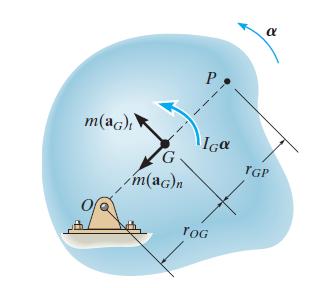
The kinetic diagram representing the general rotational motion of a rigid body about a fixed axis passing through O is shown in the figure. Show that IGα may be eliminated by moving the vectors m(aG)t and m(aG)t to point P, located a distance rGP = k2G/roG from the center of mass G of the body.
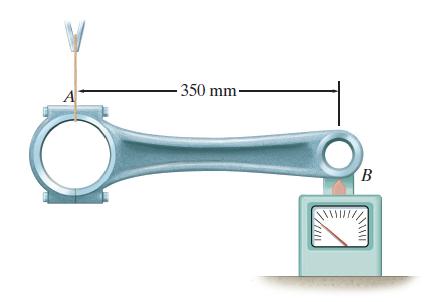
In order to experimentally determine the moment of inertia IG of a 4-kg connecting rod, the rod is suspended horizontally at A by a cord and at B by a bearing and piezoelectric sensor, an instrument used for measuring force. Under these equilibrium conditions, the force at B is measured as
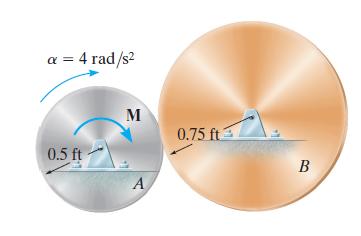
Disk A has a weight of 5 lb and disk B has a weight of 10 lb. If no slipping occurs between them, determine the couple moment M which must be applied to disk A to give it an angular acceleration of 4 rad/s2. α = 4 rad/s² 0.5 ft M A 0.75 ft B
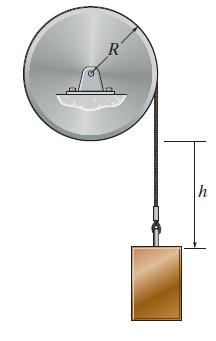
The disk has a mass M and a radius R. If the block of mass m is attached to the cord, determine the angular velocity of the disk when the block is released from rest and falls a distance h. R h
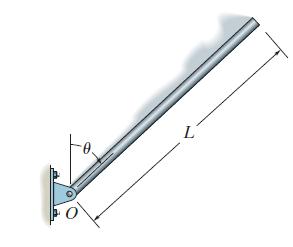
The rod has a length L and mass m. If it is released from rest when θ ≈ 0°, determine its angular velocity as a function of θ. Also, express the horizontal and vertical components of reaction at the pin O as a function of θ. L
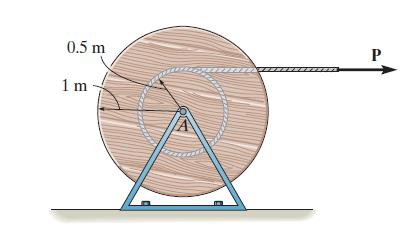
The reel of cable has a mass of 400 kg and a radius of gyration of kA = 0.75 m. Determine its angular velocity when t = 2 s, starting from rest, if the force P = (20t2 + 80) N is applied, where t is in seconds. Neglect the mass of the unwound cable, and assume it is always at a radius of 0.5 m. 0.5
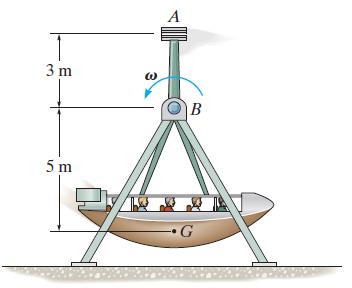
The passengers, the gondola, and its swing frame have a total mass of 50 Mg, a mass center at G, and a radius of gyration kB = 3.5 m. Additionally, the 3-Mg steel block at A can be considered as a point of concentrated mass. Determine the horizontal and vertical components of reaction at pin B if
The 30-kg disk is originally spinning at ω = 125 rad/s. If it is placed on the ground, for which the coefficient of kinetic friction is μC = 0.5, determine the time required for the motion to stop. What are the horizontal and vertical components of force which the member AB exerts on the pin at A
The passengers, the gondola, and its swing frame have a total mass of 50 Mg, a mass center at G, and a radius of gyration kB = 3.5 m. Additionally, the 3-Mg steel block at A can be considered as a point of concentrated mass. Determine the angle θ to which the gondola will swing before it stops
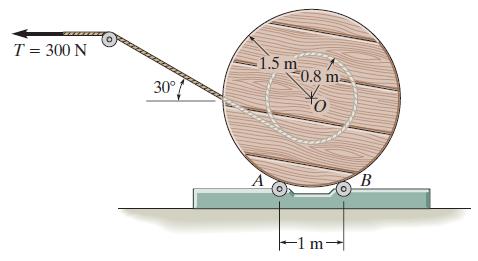
Cable is unwound from a spool supported on small rollers at A and B by exerting a force T = 300 N on the cable. Determine the time needed to unravel 5 m of cable from the spool if the spool and cable have a total mass of 600 kg and a radius of gyration of kO = 1.2 m. For the calculation, neglect
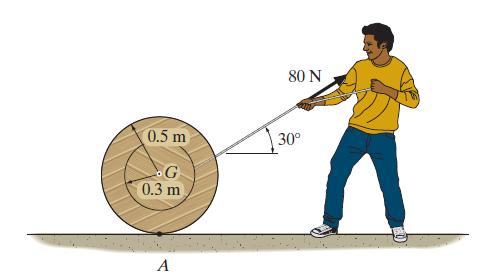
The man pulls up on the cord with a force of 80 N. Determine the angular acceleration of the spool if there is no slipping at A. The spool has a mass of 60 kg and a radius of gyration about its mass center G of kG = 0.35 m. 0.5 m G 0.3 m A 80 N 30°
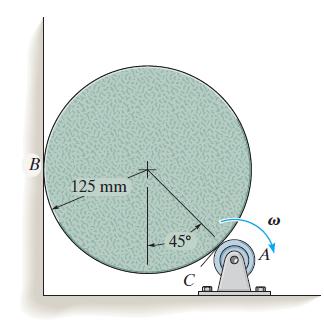
The 5-kg cylinder is initially at rest when it is placed in contact with the wall B and the rotor at A. If the rotor always maintains a constant clockwise angular velocity ω= 6 rad/s, determine the initial angular acceleration of the cylinder. The coefficient of kinetic friction at the contacting
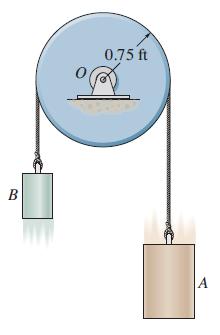
Two cylinders A and B, having a weight of 10 lb and 5 lb, respectively, are attached to the ends of a cord which passes over a 3-lb pulley (disk). If the cylinders are released from rest, determine their speed in t = 0.5 s. The cord does not slip on the pulley. Neglect the mass of the cord. Analyze
The 50-kg flywheel has a radius of gyration about its center of mass of ko = 250 mm. It rotates with a constant angular velocity of 1200 rev/min before the brake is applied. If the coefficient of kinetic friction between the brake pad B and the wheel's rim is μk = 0.5, and a force of P = 300 N is
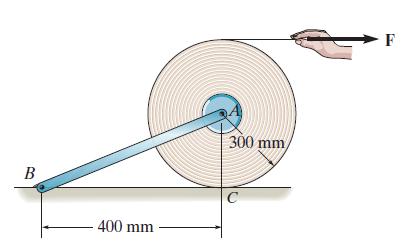
The 20-kg roll of paper has a radius of gyration kA = 120 mm about an axis passing through point A. It is pin supported at both ends by two brackets AB. The roll rests on the floor, for which the coefficient of kinetic friction is μk = 0.2. If a horizontal force F = 60 N is applied to the end of
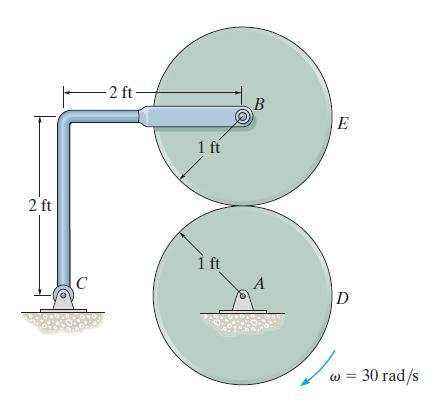
Disk D turns with a constant clockwise angular velocity of 30 rad/s. Disk E has a weight of 60 lb and is initially at rest when it is brought into contact with D. Determine the time required for disk E to attain the same angular velocity as disk D. The coefficient of kinetic friction between the
The 50-kg flywheel has a radius of gyration about its center of mass of ko = 250 mm. It rotates with a constant angular velocity of 1200 rev/min before the brake is applied. If the coefficient of kinetic friction between the brake pad B and the wheel's rim is μk = 0.5, determine the constant force
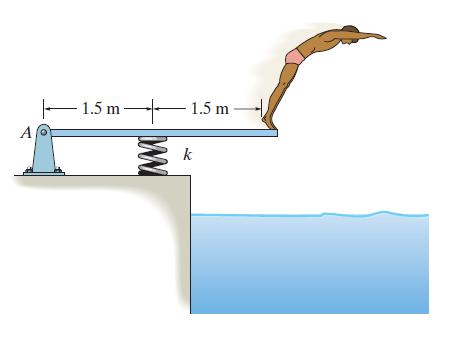
Determine the angular acceleration of the 25-kg diving board, and the horizontal and vertical components of reaction at the pin A, the instant the man dives off. Assume that the board is uniform and rigid, and that at the instant he dives off, the spring is compressed a maximum amount of 200 mm, ω
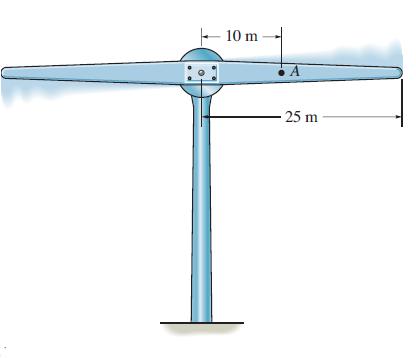
The turbine consists of a rotor which is powered from a torque applied at its center. At the instant the rotor is horizontal it has an angular velocity of 15 rad/s and a clockwise angular acceleration of 8 rad/s2. Determine the internal normal force, shear force, and moment at a section through A.
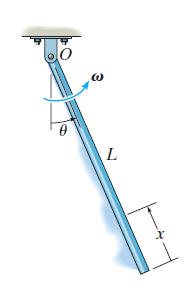
The bar has a weight per length of w. If it is rotating in the vertical plane at a constant rate ω about point O, determine the internal normal force, shear force, and moment as a function of x and θ. L x
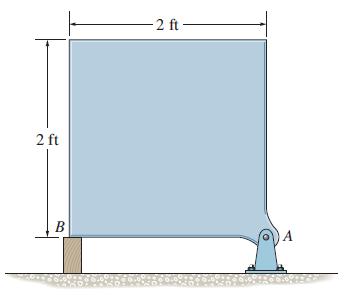
If the support at B is suddenly removed, determine the initial reactions at the pin A. The plate has a weight of 30 lb. 2 ft B -2 ft
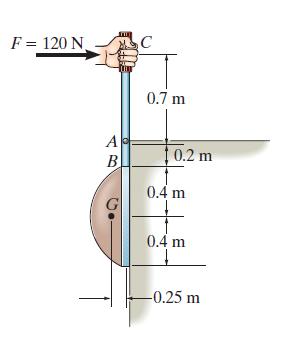
The furnace cover has a mass of 20 kg and a radius of gyration kG = 0.25 m about its mass center G. If an operator applies a force F = 120 N to the handle in order to open the cover, determine the cover’s initial angular acceleration and the horizontal and vertical components of reaction which
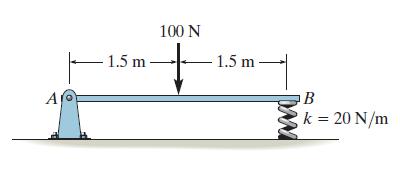
The 4-kg slender rod is initially supported horizontally by a spring at B and pin at A. Determine the angular acceleration of the rod and the acceleration of the rod’s mass center at the instant the 100-N force is applied. A -1.5 m- 100 N -1.5 m- B k = 20 N/m
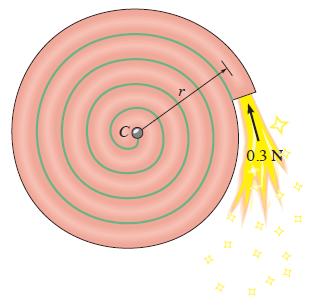
The “Catherine wheel” is a firework that consists of a coiled tube of powder which is pinned at its center. If the powder burns at a constant rate of 20 g/s such that the exhaust gases always exert a force having a constant magnitude of 0.3 N, directed tangent to the wheel, determine the
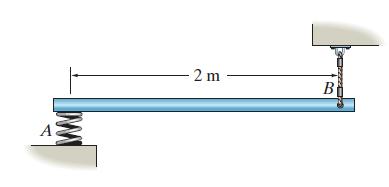
The 4-kg slender rod is supported horizontally by a spring at A and a cord at B. Determine the angular acceleration of the rod and the acceleration of the rod’s mass center at the instant the cord at B is cut. A 2 m- B
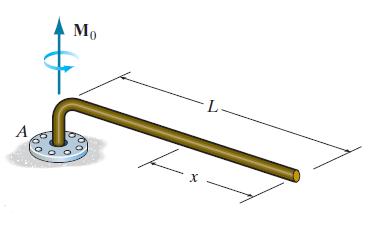
The uniform rod of length L has a mass of m. If the couple moment M0 is applied to its end, determine the internal normal force and shear force, and the bending moment in the rod as a function of x just after M0 is applied. The bearing at A allows free rotation. A Mo L X L-
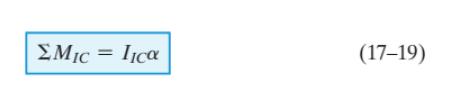
If the disk in Fig. 17-19 rolls without slipping, show that when moments are summed about the instantaneous center of zero velocity, IC, it is possible to use the moment equation ∑MIC = lIcα, where IIC represents the moment of inertia of the disk calculated about the instantaneous axis of zero
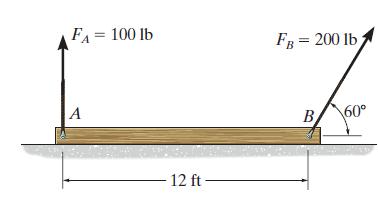
The uniform 150-lb beam is initially at rest when the forces are applied to the cables. Determine the magnitude of the acceleration of the mass center and the angular acceleration of the beam at this instant. FA = 100 lb A -12 ft- FB= 200 lb, B/ 60⁰
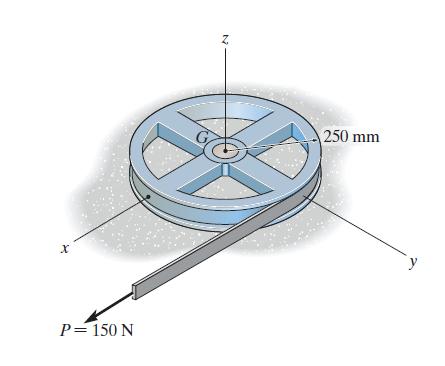
The 75-kg wheel has a radius of gyration about the z axis of kz = 150 mm. If the belt of negligible mass is subjected to a force of P = 150 N, determine the acceleration of the mass center and the angular acceleration of the wheel. The surface is smooth and the wheel is free to slide. X P = 150
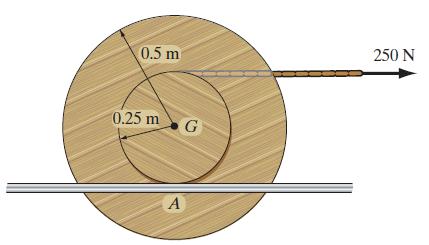
The spool has a mass of 100 kg and radius of gyration about its mass center of kG = 0.3 m. Determine its angular acceleration when the force of 250 N is applied to the cable. The spool rolls without slipping. 0.5 m 0.25 m A G 250 N
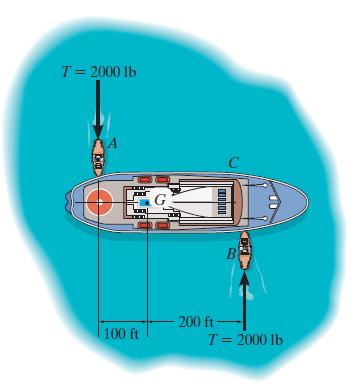
The ship has a weight of 4(166) lb and center of gravity at G. Two tugboats of negligible weight are used to turn it. If each tugboat pushes on it with a force of T = 2000 lb, determine the initial acceleration of its center of gravity G and its angular acceleration. Its radius of gyration about
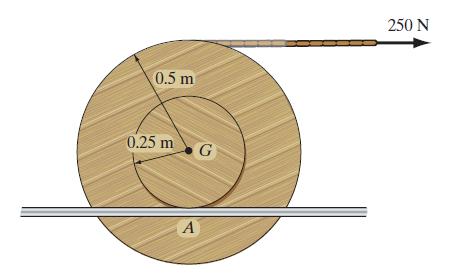
The spool has a mass of 100 kg and radius of gyration about its mass center of kG = 0.3 m. Determine the smallest coefficient of static friction that will prevent slipping on the rail at A. What is the angular acceleration of the spool? 0.5 m 0.25 m A G 250 N
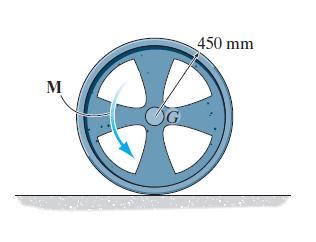
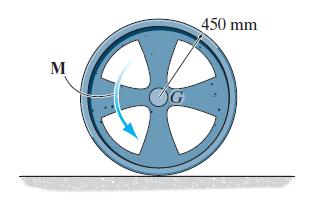
The 75-kg wheel has a radius of gyration about its mass center of kG = 375 mm. If it is subjected to a torque of M = 100 N · m, determine its angular acceleration. The coefficients of static and kinetic friction between the wheel and the ground are μs = 0.2 and μk = 0.15, respectively. M 450 mm
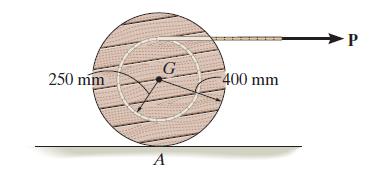
The spool has a mass of 100 kg and a radius of gyration kG = 0.3 m. If the coefficients of static and kinetic friction at A are μs = 0.2 and μk = 0.15, respectively, and P = 600 N, determine the angular acceleration of the spool. 250 mm G A -400 mm P
The 75-kg wheel has a radius of gyration about its mass center of kG = 375 mm. If it is subjected to a torque of M = 150 N · m, determine its angular acceleration. The coefficients of static and kinetic friction between the wheel and the ground are μs = 0.2 and μk = 0.15, respectively. M G 450 mm
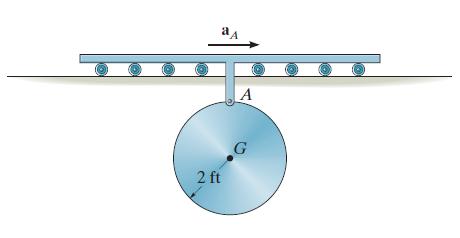
The 15-lb circular plate is suspended from a pin at A. If the pin is connected to a track which is given an acceleration aA = 3 ft/s2, determine the initial horizontal and vertical components of reaction at A and the acceleration of the plate’s mass center G.The plate is originally at rest. 2
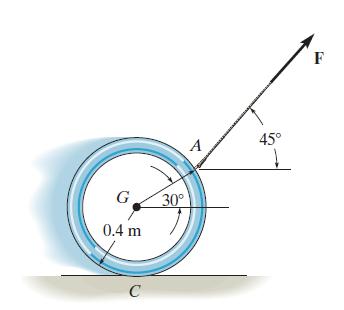
If the coefficient of static friction at C is μs = 0.3, determine the largest force F that can be applied to the 5-kg ring without causing it to slip. Neglect the thickness of the ring. G 0.4 m C 30° A 45° F
A force of F = 10 N is applied to the 10-kg ring as shown. If slipping does not occur, determine the ring’s initial angular acceleration, and the acceleration of its mass center, G. Neglect the thickness of the ring. G 0.4 m C 30° A 45° 1 F
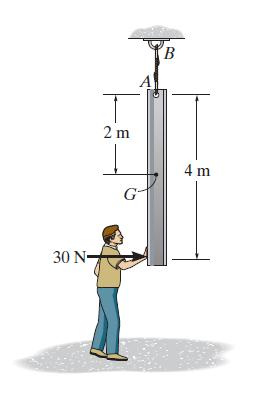
The slender, 200-kg beam is suspended by a cable at its end as shown. If a man pushes on its other end with a horizontal force of 30 N, determine the initial acceleration of its mass center G, the beam’s angular acceleration, the tension in the cable AB, and the initial acceleration of the end A.
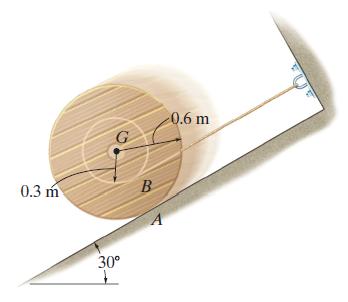
The spool has a mass of 75 kg and a radius of gyration kG = 0.380 m. It rests on the inclined surface for which the coefficient of kinetic friction is μk = 0.15. If the spool is released from rest and slips at A, determine the initial tension in the cord and the angular acceleration of the spool.
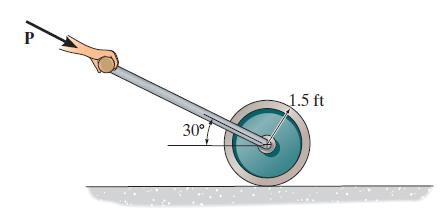
If P = 30 lb, determine the angular acceleration of the 50-lb roller. Assume the roller to be a uniform cylinder and that no slipping occurs. P 30° 1.5 ft
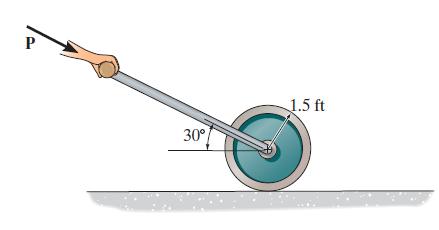
If the coefficient of static friction between the 50-lb roller and the ground is μs = 0.25, determine the maximum force P that can be applied to the handle, so that the roller rolls on the ground without slipping. Also, find the angular acceleration of the roller. Assume the roller to be a uniform
Showing 800 - 900
of 2426
First
2
3
4
5
6
7
8
9
10
11
12
13
14
15
16
Last
Step by Step Answers

 Get 50% OFF
Claim Now
Get 50% OFF
Claim Now