New Semester
Started
Get
50% OFF
Study Help!
--h --m --s
Claim Now
Question Answers
Textbooks
Find textbooks, questions and answers
Oops, something went wrong!
Change your search query and then try again
S
Books
FREE
Study Help
Expert Questions
Accounting
General Management
Mathematics
Finance
Organizational Behaviour
Law
Physics
Operating System
Management Leadership
Sociology
Programming
Marketing
Database
Computer Network
Economics
Textbooks Solutions
Accounting
Managerial Accounting
Management Leadership
Cost Accounting
Statistics
Business Law
Corporate Finance
Finance
Economics
Auditing
Tutors
Online Tutors
Find a Tutor
Hire a Tutor
Become a Tutor
AI Tutor
AI Study Planner
NEW
Sell Books
Search
Search
Sign In
Register
study help
physics
college physics 2nd
College Physics A Strategic Approach 4th Edition Randall D. Knight, Brian Jones - Solutions
Snakes and other reptiles that live on land warm up in the sun. Their bodies can reach temperatures well above the ambient air temperature. But fish don’t do this. Most fish are at nearly the same temperature as the water in which they swim. How do you explain the difference?
Male emperor penguins spend the long Antarctic night on the ice. They keep from freezing with exquisite thermal insulation. Their insulation is so effective that the surface temperature of their feathers can actually be lower than that of the surrounding air. Explain how this is possible.
Suppose you start your day in Denver, on a cool 10°C spring day. The local atmospheric pressure is 85 kPa. You fill your car’s tires until the gauge shows 210 kPa (about 30 psi). You then drive up to Fairplay, Colorado, where the atmospheric pressure is lower—70 kPa—and the temperature drops
You can buy an expensive frying pan that is made of copper but has a handle made of stainless steel. Why are different metals used for the part of the pan that touches the stove and for the part that touches your hand?
On a chilly 10°C day, you quickly take a deep breath—all your lungs can hold, 4.0 L. The air warms to your body temperature of 37°C. If the air starts at a pressure of 1.0 atm, and you hold the volume of your lungs constant (a good approximation) and the number of molecules in your lungs stays
If a person’s lungs are compromised, they can use supplemental oxygen to increase the concentration of oxygen in their lungs. Explain how this helps increase oxygen uptake.
A football is inflated in the locker room before the game. The air warms as it is pumped, so it enters the ball at a temperature of 27°C. The ball is inflated to a gauge pressure of 13 psi. The ball is used for play at 10°C. Once the ball cools, what is the pressure in the ball? Assume that
Many fish maintain buoyancy with a gas-filled swim bladder. The pressure inside the swim bladder is the same as the outside water pressure, so when a fish descends to a greater depth, the gas compresses. Adding gas to restore the original volume requires energy. A fish at a depth where the absolute
Suppose you inflate your car tires to 35 psi on a 20°C day. Later, the temperature drops to 0°C. What is the pressure in your tires now?
When you apply the brakes on your car, the kinetic energy of your vehicle is transformed into thermal energy in your brake disks. During a mountain descent, a 28.00-cm-diameter iron brake disk heats up from 30°C to 180°C. What is the diameter of the disk after it heats up?
In the chapter, you saw that bridges often have expansion joints to account for the changes in size due to temperature changes. Suppose a bridge is supported by steel girders; the central span has a girder that is 30 m long. If the girder warms from 0°C to 30°C, by how much does its length
When people exercise, they report feeling exhaustion when their body temperature rises to 39.7°C. A 68 kg man is running at 15 km/h on a hot, muggy day—so hot and muggy that he can’t lose any heat to the environment. His body temperature starts at 37.0°C. How long can he run before he feels
Dogs keep themselves cool by panting, rapidly breathing air in and out. Panting results in evaporation from moist tissues of the airway and lungs, which cools the animal. Measurements show that, on a 35°C day with a relative humidity of 50%, a 12 kg dog loses 1.0 g of water per minute if it is
The Bodø NATO base in northern Norway uses a heat pump to extract heat from ocean water. 7.0°C ocean water is continuously drawn into the system, heat is extracted, and the water is returned to the ocean at 3.0°C. When the system is working at full capacity, 2000 kW of heat is delivered to the
If you pour whisky over ice, the ice will cool the drink, but it will also dilute it. A solution is to use whisky stones. Suppose Ernest pours 55 g of whisky at 22°C room temperature, and then adds three whisky stones to cool it. Each stone is a 32 g soapstone cube that is stored in the freezer at
It’s possible to boil water by adding hot rocks to it, a technique that has been used in many societies over time. If you heat a rock in the fire, you can easily get it to a temperature of 500°C. If you use granite or other similar stones, the specific heat is about 800 J/kg # K. If 5.0 kg of
You draw in a deep breath on a chilly day, inhaling 3.0 L of 0°C air. If the pressure in your lungs is a constant 1.0 atm, how much heat must your body supply to warm the air to your 37°C internal body temperature?
A 30 kg male emperor penguin under a clear sky in the Antarctic winter loses very little heat to the environment by convection; its feathers provide very good insulation. It does lose some heat through its feet to the ice, and some heat due to evaporation as it breathes; the combined power is about
A nerve impulse is propagated across a synapse when the neurotransmitter acetylcholine is released from the pre-synaptic membrane and diffuses across the 20-nm-wide synaptic cleft to the post-synaptic membrane.a. How long does it take a nerve signal to cross a synapse? You can assume that the
Your heart does work to pump blood through your body. Each minute, 5.0 L of blood travels through your circulatory system. The pressure drops from 16 kPa as it exits the heart to approximately zero as it returns to the heart. We can calculate the work required to move a fluid volume V through a
When you put on the brakes on your bicycle, friction heats the steel rims of your wheels. Could this heating be a problem? Suppose a 65 kg cyclist with a 15 kg bike is descending Trail Ridge Road in Rocky Mountain National Park, going down a 7.0% grade and thus losing 7.0 m in height for every 100
If you put a heavy load in a wheelbarrow, the force you apply to the handles is much less than the weight of the load and the wheelbarrow. To lift with the least force, you put the load toward the front of the wheelbarrow, near to the front wheel. Explain how this reduces the force to support the
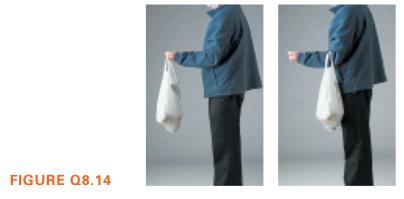
When you carry shopping bags, rather than grasp the handles with your hand as in Figure Q8.14a, you might choose to put them over your arm and slide the handle toward your elbow as in Figure Q8.14b. Explain why this leads to less muscle effort to carry the bags and less force in your elbow joint.
You can apply a much larger bite force with your molars, in the back of your mouth, than with your incisors, at the front of your mouth. Explain why this is so.
An isometric exercise is one in which the joint angle does not change during the application of muscle force. For instance, you can join your hands together, pushing down with one hand and pushing up with the other. In each arm, the muscles that provide the force are connected to the bones of the
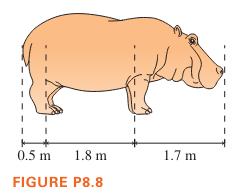
A hippo’s body is 4.0 m long with front and rear feet located as in Figure P8.8. The hippo carries 60% of its weight on its front feet. How far from its tail is the hippo’s center of gravity? 0.5 m 1.8 m 1.7 m FIGURE P8.8
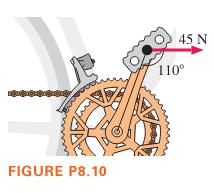
A bicycle mechanic is checking a road bike’s chain. He applies a 45 N force to a pedal at the angle shown in Figure P8.10 while keeping the wheel from rotating. The pedal is 17 cm from the center of the crank; the gear has a diameter of 16 cm. What is the tension in the chain? wwwww FIGURE P8.10
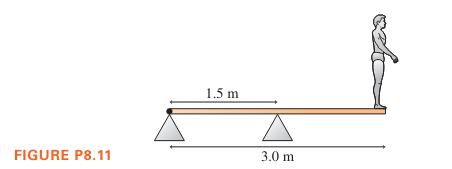
A 60 kg diver stands at the end of a 30 kg springboard, as shown in Figure P8.11. The board is attached to a hinge at the left end but simply rests on the right support. What is the magnitude of the vertical force exerted by the hinge on the board? FIGURE P8.11 1.5 m 3.0 m Yew
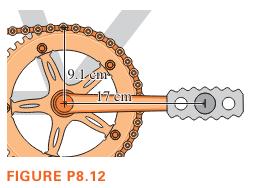
A bike chain can support a tension of no more than 9800 N. The pedal connects to a crank 17 cm from the axle, and the gear pulling the chain has a 9.1 cm radius. When riding at a constant speed, with the crank and pedal horizontal, as in Figure P8.12, what is the maximum force that can be applied
The four wheels of a car are connected to the car’s body by spring assemblies that let the wheels move up and down over bumps and dips in the road. When a 68 kg (about 150 lb) person sits on the left front fender of a small car, this corner of the car dips by about 1.2 cm (about ½ in). If we
A passenger railroad car has a total of 8 wheels. Springs on each wheel compress—slightly—when the car is loaded. Ratings for the car give the stiffness per wheel (the spring constant, treating the entire spring assembly as a single spring) as 2.8 × 10⁷ N/m. When 30 passengers, each with
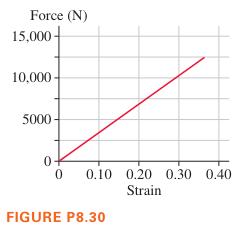
Dynamic climbing ropes are designed to be quite pliant, allowing a falling climber to slow down over a long distance. The graph in Figure P8.30 shows forceversus-strain data for an 11-mm-diameter climbing rope. What is the Young’s modulus for this rope? Force (N) 15,000- 10,000- 5000 0+ 0 0.10
Static climbing ropes are designed to be relatively stiff so that they stretch less than dynamic ropes. To meet a certain specification, an 11-mm-diameter rope must experience a maximum elongation of 5.0% when supporting a 150 kg load. What is the minimum Young’s modulus?
A mineshaft has an ore elevator hung from a single braided cable of diameter 2.5 cm. Young’s modulus of the cable is 10 × 1010 N/m2 . When the cable is fully extended, the end of the cable is 800 m below the support. How much does the fully extended cable stretch when 1000 kg of ore is loaded?
To penetrate armor, a projectile’s point concentrates force in a small area, creating a stress large enough that the armor fails. A species of jellyfish launches a pointed needle that can penetrate the hard shell of a crustacean. The rapid deceleration on impact creates a 32 μN force on the tip,
You’ve just put a new wood floor in your house. An object will dent the flooring if the stress—the force divided by the area—exerted by the object is great enough. Who is more likely to dent your floor: a 50 kg woman in high-heeled shoes (assume a circular heel pad 0.50 cm in diameter) with
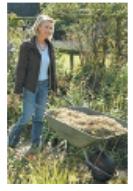
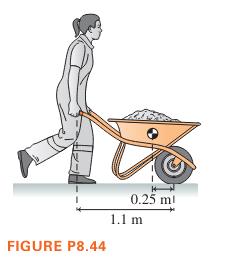
A woman is pushing a load in a wheelbarrow, as in Figure P8.44. The combined mass of the wheelbarrow and the load is 110 kg, with a center of gravity 0.25 m behind the axle. The woman supports the wheelbarrow at the handles, 1.1 m behind the axle.a. What is the force required to support the
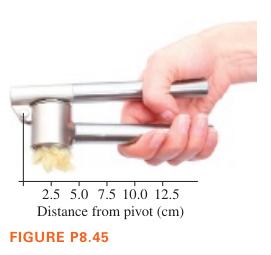
Figure P8.45 shows the operation of a garlic press. The lower part of the press is held steady, and the upper handle is pushed down, thereby crushing a garlic clove through a screen. Approximate distances are shown in the figure. If the user exerts a 12 N force on the upper handle, estimate the
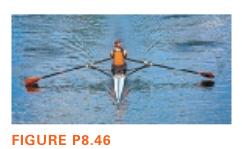
Consider a rower in a scull as in Figure P8.46. The oars aren’t accelerating, and they are rotating at a constant speed, so the net force and net torque on the oars are zero. An oar is 2.8 m long, and the rower pulls with a 250 N force on the handle, which is 0.92 m from the pivot.a. Assume that
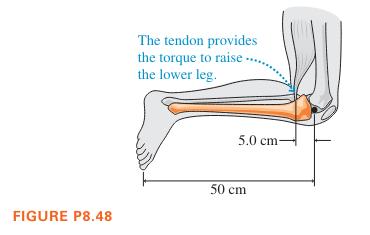
If you stand on one foot while holding your other leg up behind you, your muscles apply a force to hold your leg in this raised position. We can model this situation as in Figure P8.48. The leg pivots at the knee joint, and the force that holds the leg up is provided by a tendon attached to the
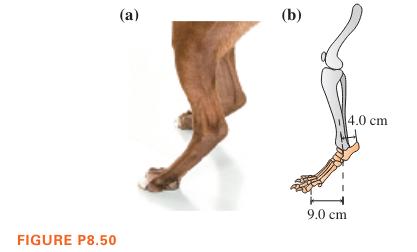
Dogs—like many animals—stand and walk on their toes. A photo of the rear foot of a dog is shown in Figure P8.50a; Figure P8.50b shows the bones of the leg and foot along with relevant distances. The colored element corresponds to your foot, and the connection with the leg corresponds to your
An 85 kg man stands in a very strong wind moving at 14 m/s at torso height. As you know, he will need to lean in to the wind, and we can model the situation to see why. Assume that the man has a mass of 85 kg, with a center of gravity 1.0 m above the ground. The action of the wind on his torso,
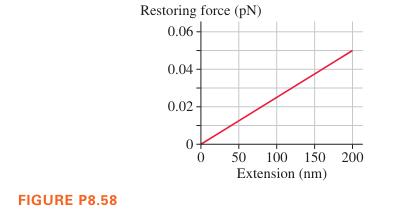
DNA molecules are typically folded tightly. Stretching a strand of DNA means straightening it, and the molecules resist this straightening. Investigators can attach beads to the ends of a strand of DNA and, using “optical tweezers,” measure the force required to produce a certain extension.
You are bowling with a 10-pound ball that you throw at 10 mph, and you’ve decided that you need to hit the pins with a ball that has more momentum. What are two possible changes you could make?
When you catch a water balloon, it’s best to start with your hand in motion, moving with the balloon, and then gradually slow it to rest. Why is this approach desirable?
When you leap down from a high perch, you have a gentler landing with less force if you bend your knees as you land. Use the principles of impulse and momentum to explain why this approach reduces the force on you.
Students in a technology class are racing cars propelled by carbon dioxide cartridges. A burst of gas is released when the seal of the cartridge is broken, and this propels the car down the track. The cartridges are designed to provide a certain impulse. Use the concepts of impulse and momentum to
In the past, asteroids striking the earth have produced disastrous results. If we discovered an asteroid on a collision course with the earth, we could, in principle, deflect it and avoid an impact by focusing a laser on the surface. Intense surface heating from the laser could cause surface
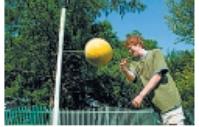
In the playground game of tetherball, a ball tied to a rope circles a pole, wrapping the rope around the pole is it goes. Opponents compete to wrap the ball around the pole in one direction or the other; the game ends when the rope is entirely wrapped around the pole and the ball touches the pole.
If you jump from a diving board and find that your body is rotating forward, you can spin your arms to stop the rotation and make your body land feet first. Explain in which direction you would rotate your arms and how this would help.
A dancer leaping into the air and trying for the maximum possible vertical height will move her arms upward as she is pushing off with her legs, putting her arms in rapid upward motion before she leaves the ground. Explain how this approach can give greater height.
Two physics students are doing a side competition during a game of bowling, seeing who can toss a ball with the larger momentum. The first bowler throws a 4.5 kg ball at 7.2 m/s. A second bowler throws a 6.4 kg ball. What speed must she beat to win the competition?
A large raindrop—the type that lands with a definite splat— has a mass of 0.014 g and hits your roof at a speed of 8.1 m/s.a. What is the magnitude of the impulse delivered to your roof?b. If the raindrop comes to rest in 0.37 ms, what is the magnitude of the average force of the impact?
A billiard ball of mass 0.28 kg hits a second, identical ball at a speed of 7.2 m/s and comes to rest as the second ball flies off. The collision takes 250 μs. What is the average force on the first ball? The second ball?
A trap-jaw ant snaps its mandibles shut at very high speed, a good trait for catching small prey. But an ant can also slam its mandibles into the ground; the resulting force can launch the ant into the air for a quick escape. A 12 mg ant hits the ground with an average force of 47 mN for a time of
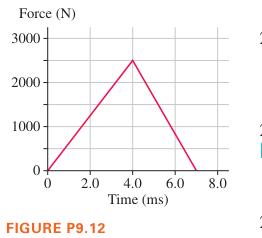
Investigators studying the effect of hitting a soccer ball with the head are using a force plate to look at the forces in ball collisions; the force when the ball hits a player’s head will be similar. A 0.43 kg ball is launched at a force plate at 16 m/s. Smoothed data for the force versus time
Ferns spread spores instead of seeds, and some ferns eject the spores at surprisingly high speeds. One species accelerates 1.4 μg spores to a 4.5 m/s ejection speed in a time of 1.0 ms. What impulse is provided to the spores? What is the average force on a spore?
Climbing ropes stretch when they catch a falling climber, thus increasing the time it takes the climber to come to rest and reducing the force on the climber. In one standardized test of ropes, an 80 kg mass falls 4.8 m before being caught by a 2.5-m-long rope. If the net force on the mass must be
Squid rely on jet propulsion when a rapid escape is necessary. A 1.5 kg squid at rest pulls 0.10 kg of water into its mantle, then ejects this water at a remarkable 45 m/s. Right after this ejection, how fast is the squid moving?
Some species of jellyfish use jet propulsion to get around, a much gentler form of jet propulsion than squid use. A small jellyfish takes water into its bell; the total mass of jellyfish and water is 3.2 g. The jellyfish then rapidly ejects 1.3 g of water, achieving a speed of 0.070 m/s. What is
If you free the cork in a highly pressurized champagne bottle, the resulting launch of the cork will, in principle, cause the bottle to recoil. A filled champagne bottle has a mass of 1.8 kg. The cork has a mass of 7.5 g and is launched at 20 m/s. If the bottle could move freely, with what speed
In a football game, a 90 kg receiver leaps straight up in the air to catch the 0.42 kg ball the quarterback threw to him at a vigorous 21 m/s, catching the ball at the highest point in his jump. Right after catching the ball, how fast is the receiver moving? Is he likely to notice this recoil?
Casey is driving a 1600 kg car toward the east. She goes through an intersection at a speed of 16 m/s (approximately 35 mph), the speed limit on both roads of the intersection. Kerry is driving a car of mass 1200 kg into the intersection, going north, and doesn’t see or doesn’t heed a red
A 110 kg linebacker running at 2.0 m/s and an 82 kg quarterback running at 3.0 m/s have a head-on collision in midair. The linebacker grabs and holds onto the quarterback. Who ends up moving forward after they hit?
A canoe is designed to have very little drag when it moves along its length. Riley, mass 52 kg, sits in a 21 kg canoe in the middle of a lake. She dives into the water off the front of the canoe, along the axis of the canoe. She dives forward at 1.6 m/s relative to the boat. Just after her
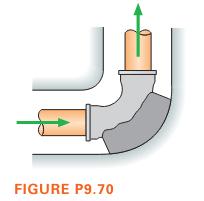
A water pipe in a building delivers 1000 liters (with mass 1000 kg) of water per second. The water is moving through the pipe at 1.4 m/s. The pipe has a 90° bend, and the pipe will require a supporting structure, called a thrust block, at the bend, as in Figure P9.70. We can use the ideas of
You swing a weight attached to a string in a vertical circle. At the top of the circle the string just barely goes slack for an instant. At this point the centripetal acceleration of the weight isA. Greater thang. B. Less thang. C. Equal tog. D. Can’t answer without knowing the weight’s
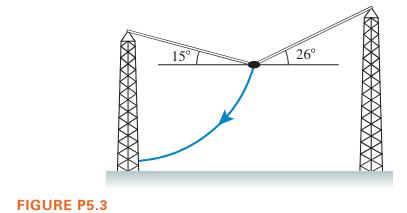
In the Skycoaster amusement park ride, riders are suspended from a tower by a long cable. A second cable then lifts them until they reach the starting position indicated in Figure P5.3. The lifting cable is then released, and the riders swing down the circular arc shown. If the four riders have a
Bethany, who weighs 560 N, lies in a hammock suspended by ropes tied to two trees. One rope makes an angle of 45° with the ground; the other makes an angle of 30°. Find the tension in each of the ropes.
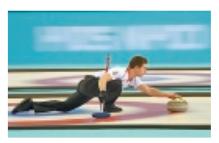
In the winter sport of curling, two teams alternate sliding 20 kg stones on an icy surface in an attempt to end up with the stone closest to the center of a target painted on the ice. During one turn, a player releases a stone that travels 27.9 m before coming to rest. The friction force acting on
The acceleration of the spacecraft in which the Apollo astronauts took off from the moon was 3.4 m/s2 . On the moon, g = 1.6 m/s2 .What was the apparent weight of a 75 kg astronaut during takeoff?
A dump truck, whose bed is made of steel, holds an old steel watering trough. The bed of the truck is slowly raised until the trough begins to slide. What is the acceleration of the trough as it slides down the truck bed?
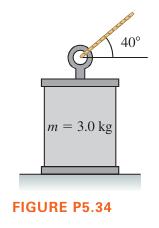
A vendor at the local art fair ties her tent to the concrete-filled coffee can shown in Figure P5.34. A stiff breeze comes up and the string becomes taut. What is the maximum value that the string tension can have before the can slips? The coefficient of static friction between the can and the
Oceanographers use submerged sonar systems, towed by a cable from a ship, to map the ocean floor. In addition to their downward weight, there are buoyant forces and forces from the flowing water that allow them to travel in a horizontal path. One such submersible has a cross-section area of 1.3 m2
At its widest point, the diameter of a bottlenose dolphin is 0.50 m. Bottlenose dolphins are particularly sleek, having a drag coefficient of only about 0.090.a. What is the drag force acting on such a dolphin swimming at 7.5 m/s?b. Using the dolphin’s diameter as its characteristic length,
The most dangerous particles in polluted air are those with diameters less than 2.5 mm because they can penetrate deeply into the lungs. A 15-cm-tall closed container holds a sample of polluted air containing many spherical particles with a diameter of 2.5 μm and a mass of 1.4 × 10⁻¹⁴ kg. How
What is the magnitude of the acceleration of a skydiver who is currently falling at one-half his eventual terminal speed?
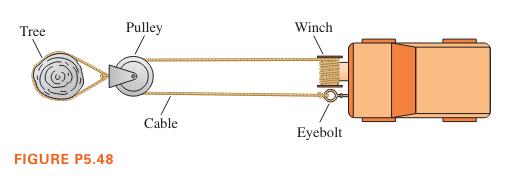
A Jeep is stuck in the mud. The driver has a winch that can pull on its cable with a force of 40,000 N. The driver loops the cable through a pulley attached to a tree, then attaches the end of the cable to his Jeep, as shown in Figure P5.48. What is the maximum force that can be exerted on the Jeep
You probably think of wet surfaces as being slippery. Surprisingly, the opposite is true for human skin, as you can demonstrate by sliding a dry versus a slightly damp fingertip along a smooth surface such as a desktop. Researchers have found that the static coefficient of friction between dry skin
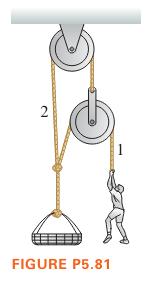
In rock climbing, various rope and pulley systems have been devised to help haul up heavy loads, including injured climbers. A rescuer is hauling up an injured climber who weighs 660 N using the rope and pulley system shown in Figure P5.81. (The ropes in this figure are drawn at various angles for
The earth, with a radius of 6.4 × 10⁶ m, rotates on its axis once a day. What is the speed of a person standing on the equator, due to the earth’s rotation?
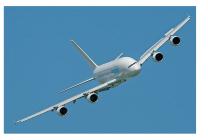
The force on an airplane’s wing from the air flowing past it is mostly perpendicular to the wing’s flat surface; this is the force that holds the plane aloft in level flight. Given this fact, why do planes “bank” when making a turn?
Tarzan hangs from a vine without it breaking. But when he swings on the same vine starting from a high branch, the vine snaps at the bottom of his swing. Explain why this happens.
The California sea lion is capable of making extremely fast, tight turns while swimming underwater. In one study, scientists observed a sea lion making a circular turn with a radius of 0.35 m while swimming at 4.2 m/s.a. What is the sea lion’s centripetal acceleration, in units of g?b. What
On a roller coaster loop-the-loop the riders are upside-down at the top of the loop, while on a Ferris wheel the riders are upright at the top. Suppose a Ferris wheel and the loop of a roller coaster have the same diameter. If riders on each have the same magnitude of apparent weight at the top,
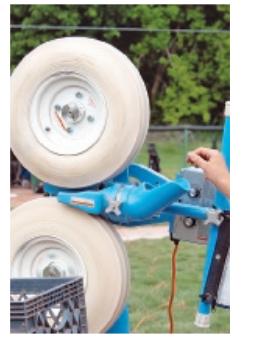
Baseball pitching machines are used to fire baseballs toward a batter for hitting practice. In one kind of machine, the ball is fed between two wheels that are rapidly rotating in opposite directions; as the ball is pulled in between the wheels, it rapidly accelerates up to the speed of the
Astronauts in the International Space Station must work out every day to counteract the effects of weightlessness. Researchers have investigated if riding a stationary bicycle while experiencing artificial gravity from a rotating platform gives any additional cardiovascular benefit. What frequency
In addition to their remarkable top speeds of almost 60 mph, cheetahs have impressive cornering abilities. In one study, the maximum centripetal acceleration of a cheetah was measured to be 18 m/s2 . What minimum value of the coefficient of static friction between the ground and the cheetah’s
An object’s apparent weight is slightly less when it is at the equator than when it is at the North Pole. Explain why this is so.
A wind turbine has 12,000 kg blades that are 38 m long. The blades spin at 22 rpm. If we model a blade as a point mass at the midpoint of the blade, what is the inward force necessary to provide each blade’s centripetal acceleration?
The spin cycle of a clothes washer extracts the water in clothing by greatly increasing the water’s apparent weight so that it is efficiently squeezed through the clothes and out the holes in the drum. In a top loader’s spin cycle, the 45-cm-diameter drum spins at 1200 rpm around a vertical
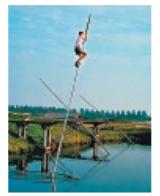
In the very Dutch sport of Fierljeppen, athletes run up to a long pole and then use it to vault across a canal. At the very top of his arc, a 55 kg vaulter is moving at 2.5 m/s and is 5.1 m from the bottom end of the pole. What vertical force does the pole exert on the vaulter?
You’re driving your new sports car at 75 mph over the top of a hill that has a radius of curvature of 525 m. What fraction of your normal weight is your apparent weight as you crest the hill?
In a car’s suspension system, each wheel is connected to a vertical spring; these springs absorb shocks when the car travels on bumpy roads. In one car, each spring has a spring constant of 5.0 × 10⁴ N/m. If this 1400 kg car is driven at 25 m/s through the bottom of a circular dip in the road
Just before it landed on the moon, the Apollo 12 lunar lander had a mass of 7200 kg. What rocket thrust was necessary to have the lander touch down with zero acceleration?
The gravitational constant G was first measured accurately by Henry Cavendish in 1798. He used an exquisitely sensitive balance to measure the force between two lead spheres whose centers were 0.23 m apart. One of the spheres had a mass of 158 kg, while the mass of the other sphere was 0.73 kg.
In 2014, a space probe approached the rocky core of the comet Churyumov–Gerasimenko, which is only a few km in diameter. The probe then entered orbit around the comet at a distance of 30 km. The comet was found to have a mass of 1.0 × 10¹³ kg. What was the orbital period of the probe around the
Mars has two moons, Phobos and Deimos. Phobos orbits Mars at a distance of 9380 km from Mars’s center, while Deimos orbits at 23,500 km from the center. What is the ratio of the orbital period of Deimos to that of Phobos?
Mars’s moon Phobos orbits the planet at a distance of 9380 km from its center, and it takes 7 hours and 39 minutes to complete one orbit. What is the ratio of Mars’s mass to the mass of the earth?
The dwarf planet Praamzius is estimated to have a diameter of about 300 km and orbits the sun at a distance of 6.4 × 10¹² m. What is its orbital period in years?
Showing 300 - 400
of 3651
1
2
3
4
5
6
7
8
9
10
11
12
13
14
15
Last
Step by Step Answers

 Get 50% OFF
Claim Now
Get 50% OFF
Claim Now