







Question: I do not know what formulas you want me to put. Matlab Code % This code uses as input the frequency of operation as well
I do not know what formulas you want me to put.
Matlab Code
% This code uses as input the frequency of operation as well as the % relative permittivity, relative permeability, and conductivity of a % material to calculate the loss tangent, attenuation constant, phase % constant, intrinsic impedance, phase velocity, skin depth, and % wavelength.
clear;
% Input values f = input('Frequency: '); er = input('Relative Permittivity: '); mur = input('Relative Permeability: '); sigma = input('Conductivity: '); fprintf(' '); % empty line between input and output values
% Constants eo = 8.854e-12; % permittivity of free space muo = 4*pi*1e-7; % permeability of free space mu = muo*mur; % permeability of the material eps = ; % permittivity of the material *** ADD EQUATION HERE *** w = 2*pi*f; % angular frequency loss_tangent = ; % loss tangent *** ADD EQUATION HERE ***
% Print loss measure to screen fprintf('OUTPUT: '); fprintf('Loss Tangent (epsilon"/epsilon'') = %f ',loss_tangent);
% Calculate output values if loss_tangent 100 disp('Good Conductor'); alpha = sqrt(pi*f*mu*sigma); beta = alpha; eta = ; % *** ADD EQUATION HERE *** up = sqrt((4*pi*f)/(mu*sigma)); elseif sigma == 0 disp('Lossless Medium'); alpha = 0; beta = w*sqrt(mu*eps); eta = sqrt(mu/eps); up = 1/sqrt(mu*eps); else disp('General Medium (Quasi-Conductor)'); alpha = ; % *** ADD EQUATION HERE *** beta = w*sqrt((mu*eps/2)*(sqrt(1+(loss_tangent)^2)+1)); eta = sqrt(mu/eps)*(1-1i*loss_tangent)^(-1/2); up = w/beta; end
lambda = ; % calculat the wavlength *** ADD EQUATION HERE *** skin_depth = ; % calculate the skin depth *** ADD EQUATION HERE ***
% Print output to the screen fprintf('alpha = %f ',alpha); %f is fixed-point notation fprintf('beta = %f ',beta); fprintf('intrinsic impedance (eta) = %f + %fi ',eta, eta/1i); % eta may be complex fprintf('phase velocity (up) = %e ',up); %e is exponential notation fprintf('lambda = %e ',lambda); fprintf('skin depth = %f ',skin_depth);
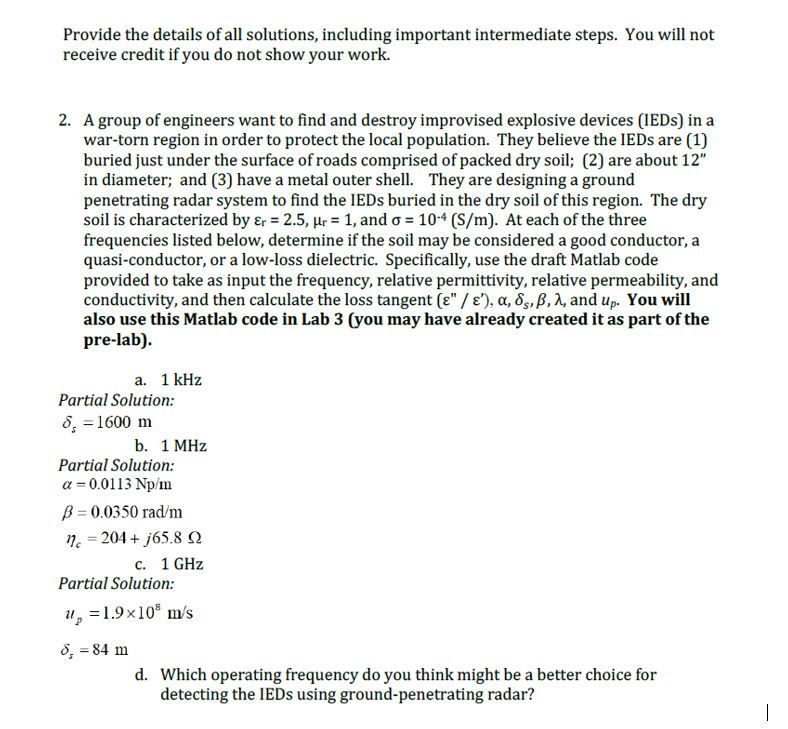
Provide the details of all solutions, including important intermediate steps. You will not receive credit if you do not show your work. 2. A group of engineers want to find and destroy improvised explosive devices (IEDs) in a war-torn region in order to protect the local population. They believe the IEDs are (1) buried just under the surface of roads comprised of packed dry soil; (2) are about 12" in diameter; and (3) have a metal outer shell. They are designing a ground penetrating radar system to find the IEDs buried in the dry soil of this region. The dry soil is characterized by : 2.5, 1, and = 10.4 (S/m). At each of the three frequencies listed below, determine if the soil may be considered a good conductor, a quasi-conductor, or a low-loss dielectric. Specifically, use the draft Matlab code provided to take as input the frequency, relative permittivity, relative permeability, and conductivity, and then calculate the loss tangent (e" / ), , , , , and up. You will also use this Matlab code in Lab 3 (you may have already created it as part of the pre-lab). a. 1 kHz Partial Solution 1600 m b. 1 MHz Partial Solution = 0.01 13 Npm -0.0350 rad/m -204+765.8 c. 1 GHz Partial Solution: 1.9x10⁸ m/s = 84 m d. Which operating frequency do you think might be a better choice for detecting the IEDs using ground-penetrating radar? Provide the details of all solutions, including important intermediate steps. You will not receive credit if you do not show your work. 2. A group of engineers want to find and destroy improvised explosive devices (IEDs) in a war-torn region in order to protect the local population. They believe the IEDs are (1) buried just under the surface of roads comprised of packed dry soil; (2) are about 12" in diameter; and (3) have a metal outer shell. They are designing a ground penetrating radar system to find the IEDs buried in the dry soil of this region. The dry soil is characterized by : 2.5, 1, and = 10.4 (S/m). At each of the three frequencies listed below, determine if the soil may be considered a good conductor, a quasi-conductor, or a low-loss dielectric. Specifically, use the draft Matlab code provided to take as input the frequency, relative permittivity, relative permeability, and conductivity, and then calculate the loss tangent (e" / ), , , , , and up. You will also use this Matlab code in Lab 3 (you may have already created it as part of the pre-lab). a. 1 kHz Partial Solution 1600 m b. 1 MHz Partial Solution = 0.01 13 Npm -0.0350 rad/m -204+765.8 c. 1 GHz Partial Solution: 1.9x10⁸ m/s = 84 m d. Which operating frequency do you think might be a better choice for detecting the IEDs using ground-penetrating radar
Step by Step Solution
There are 3 Steps involved in it

Get step-by-step solutions from verified subject matter experts
 Study Help