







Question: Part I: Thevenin's Theorem Objectives: 1 . Analyze complex networks. 2 . Reduce the number of components to establish the same characteristics at the output
Part I: Thevenin's Theorem
Objectives:
Analyze complex networks.
Reduce the number of components to establish the same characteristics at the output terminals R
Investigate the effect of changing a particular component on the behavior of a network without having to analyze the entire network after each change.
Using the same reduced circuit and manipulate with the underlineR to investigate at what resistivity the maximum power is achieved.
Using NI Multisim simulator to enhance your skills of optimized outcome.
Instrument and components
Resistors: mathrmROmegamathrmROmegamathrmR is the same as mathrmRmathrmLmathbfOmega
NI MultiSIM
Procedures
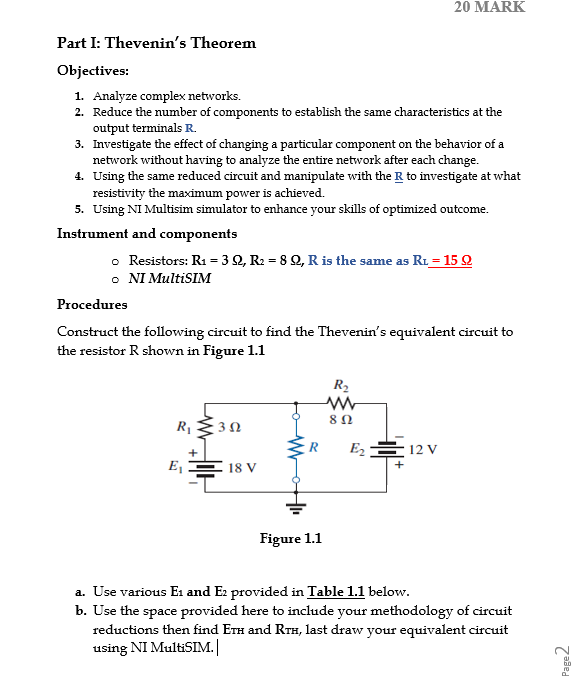
Construct the following circuit to find the Thevenin's equivalent circuit to the resistor R shown in Figure
a Use various mathrmE and mathrmE provided in Table below.
b Use the space provided here to include your methodology of circuit reductions then find mathrmEmathrmTH and mathrmRmathrmTH last draw your equivalent circuit using NI MultiSIM.
Remember: IL is always found at RL which in this case is called R
Question :
a Screenshot your own circuit created on MultiSIM make sure your name and ID is embedded into the circuit drawings. MARK
DATA TABLE
Marks
begintabularcccccc
hline NO & E & E & & I. & mathrmRmathrmTH
hline & & & & & multirow
hline & & & & &
hline & & & & &
hline
endtabular
b Show your calculation to solve Thevenin's Theorem shown in Figure
Marks
Step by Step Solution
There are 3 Steps involved in it
1 Expert Approved Answer
Step: 1 Unlock

Question Has Been Solved by an Expert!
Get step-by-step solutions from verified subject matter experts
Step: 2 Unlock
Step: 3 Unlock
 Study Help