Question: Read the Article provided on wellness in the workplace by Madsen , S.R. and Respond to the following questions based on the article 1.
Read the Article provided on "wellness in the workplace " by Madsen , S.R. and Respond to the following questions based on the article
1. How do employees adapt to their work environment?
2. How do employees see change affecting them?
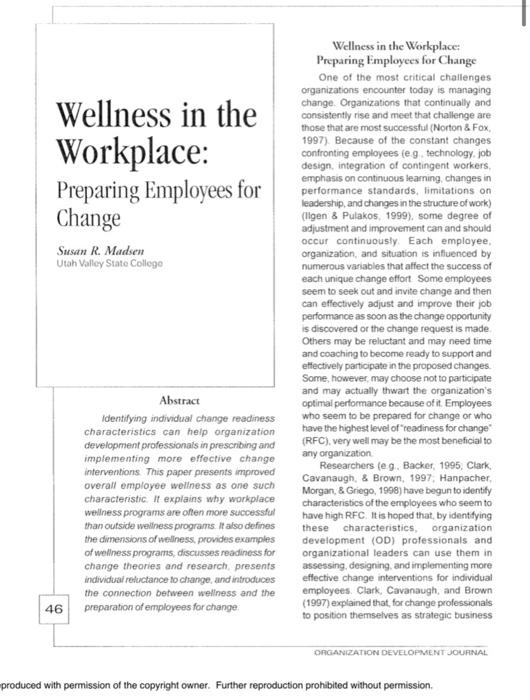
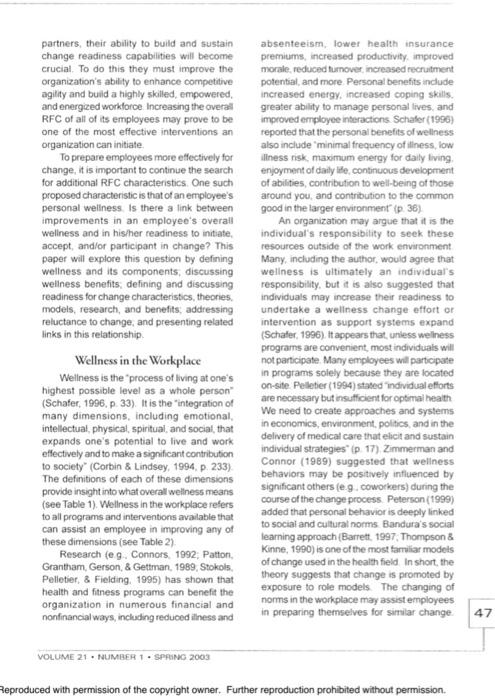
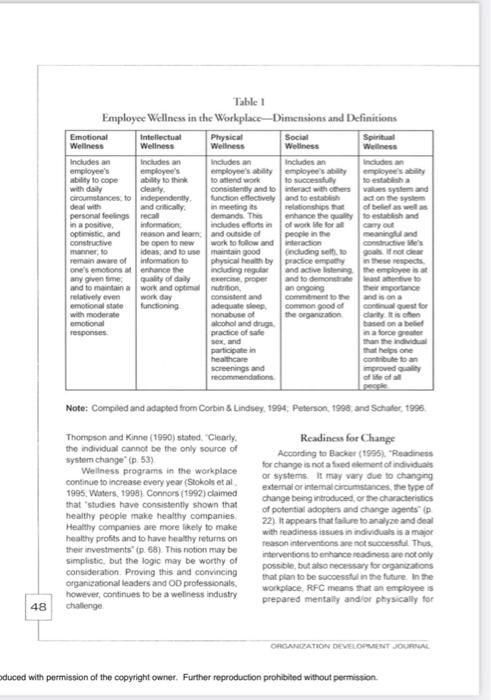
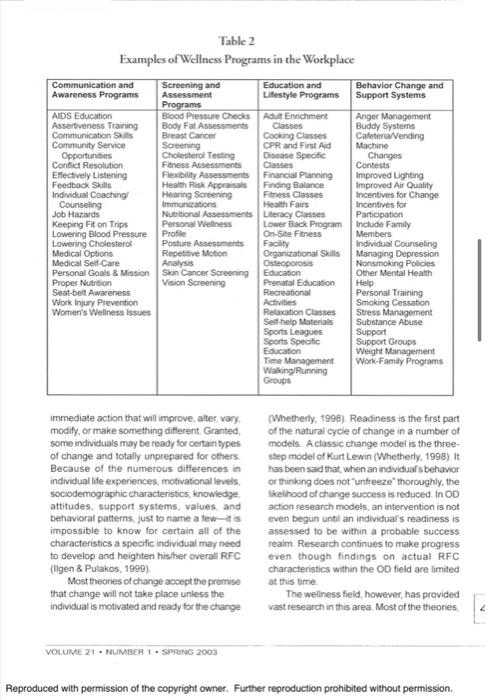
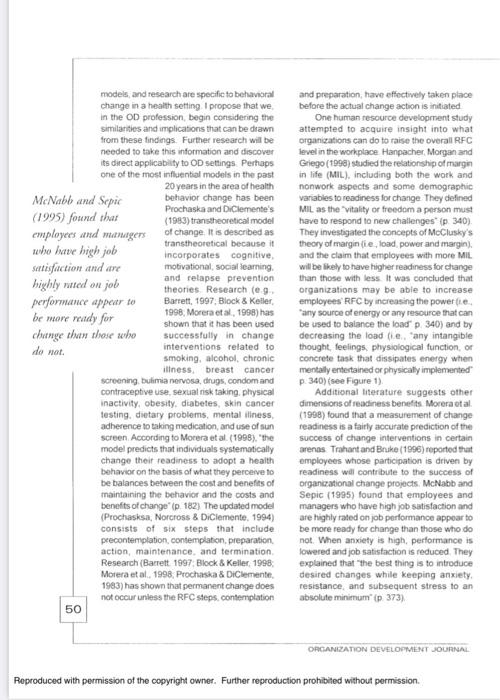
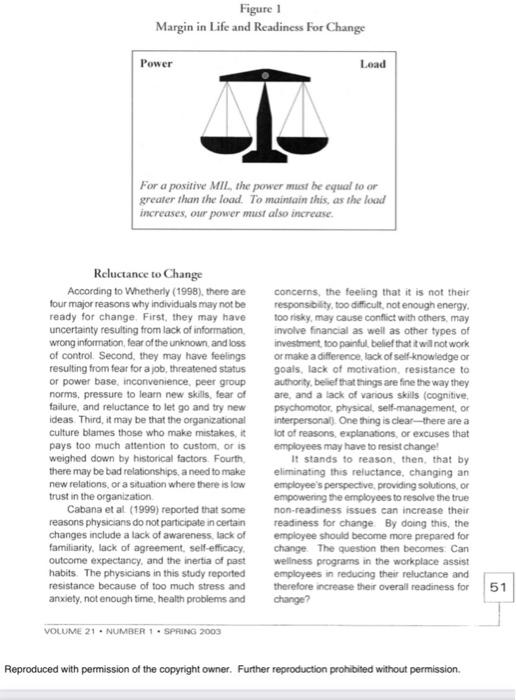
Wellness in the Workplace: Preparing Employees for Change Susan R. Madsen Utoh Valley State College Wellness in the Workplace: Preparing Employees for Change One of the most critical challenges organizations encounter today is managing change. Organizations that continually and consistently rise and meet that challenge are those that are most successful (Norton & Fox 1997). Because of the constant changes confronting employees (eg technology job design, integration of contingent workers, emphasis on continuous learning, changes in performance standards, limitations on leadership, and changes in the structure of work) (ligen 8 Pulakos 1999), some degree of adjustment and improvement can and should occur continuously Each employee, organization and situation is influenced by numerous variables that affect the success of each unique change effort Some employees seem to seek out and invite change and then can effectively adjust and improve their job performance as soon as the change opportunity is discovered or the change request is made Others may be reluctant and may need time and coaching to become ready to support and effectively participate in the proposed changes Some, however may choose not to participate and may actually thwart the organization's optimal performance because of it Employees who seem to be prepared for change or who have the highest level of readiness for change (RFC), very well may be the most beneficial to any organization Researchers (eg. Backer, 1995, Clark Cavanaugh & Brown, 1997. Hanpacher Morgan & Griego, 1998) have begun to identify characteristics of the employees who seem to have high RFC. It is hoped that, by identifying these characteristics, organization development (OD) professionals and organizational leaders can use them in assessing, designing and implementing more effective change interventions for individual employees. Clark, Cavanaugh, and Brown (1997) explained that for change professionals to position themselves as strategic business Abstract identifying individual change readiness characteristics can help organization development professionals in prescribing and implementing more effective change interventions. This paper presents improved overall employee wellness as one such characteristic. It explains why workplace wellness programs are often more successful than outside wellness programs. It also defines the dimensions of wellness, provides examples of wellness programs, discusses readiness for change theories and research presents individual reluctance to change and introduces the connection between wellness and the preparation of employees for change: 46 ORGANIZATION DEVELOPMENT JOURNAL produced with permission of the copyright owner. Further reproduction prohibited without permission partners, their ability to build and sustain change readiness capabilities will become crucial. To do this they must improve the organization's ability to enhance competitive agility and build a highly skilled, empowered. and energized workforce Increasing the overall RFC of all of its employees may prove to be one of the most effective interventions an organization can initiate To prepare employees more effectively for change, it is important to continue the search for additional RFC characteristics. One such proposed characteristic is that of an employee's personal wellness Is there a link between improvements in an employee's overall wellness and in his/her readiness to initiate, accept, and/or participant in change? This paper will explore this question by defining wellness and its components, discussing wellness benefits, defining and discussing readiness for change characteristics, theories models, research, and benefits, addressing reluctance to change and presenting related links in this relationship Wellness in the Workplace Wellness is the process of living at one's highest possible level as a whole person (Schafer, 1996. p 33). It is the integration of many dimensions, including emotional intellectual, physical, spiritual and social, that expands one's potential to live and work effectively and to make a significant contribution to society' (Corbin & Lindsey, 1994, p. 233) The definitions of each of these dimensions provide insight into what overall wellness means (see Table 1). Wellness in the workplace refers to all programs and interventions available that can assist an employee in improving any of these dimensions (see Table 2) Research (eg. Connors, 1992Patton Grantham, Gerson, & Gettman, 1989, Stokols Pelletier, & Fielding, 1995) has shown that health and fitness programs can benefit the organization in numerous financial and nonfinancial ways, including reducediliness and absenteeism, lower health insurance premiums, increased productivity improved morale, reduced turnover increased recruitment potential, and more Personal benefits include increased energy, increased coping skills greater ability to manage personal lives, and improved employee interactions Schafer (1996) reported that the personal benefits of wellness also include minimal frequency of liness, low llness risk maximum energy for daily living enjoyment of daily life, continuous development of abilities, contribution to well-being of those around you, and contribution to the common good in the larger environment (p 36) An organization may argue that it is the individual's responsibility to seek these resources outside of the work environment Many, including the author, would agree that wellness is ultimately an individual's responsibility, but it is also suggested that individuals may increase their readiness to undertake a wellness change effort or intervention as support systems expand (Schafer, 1996). It appears that unless wellness programs are convenient, most individuals will not participate. Many employees will participate in programs solely because they are located on-site Pelletier (1994) stated individual efforts are necessary but insufficient for optimal health We need to create approaches and systems in economics, environment, politics and in the delivery of medical care that elicit and sustain individual strategies" (p 17) Zimmerman and Connor (1989) suggested that wellness behaviors may be positively influenced by significant others (eg. coworkers) during the course of the change process. Peterson (1999) added that personal behavior is deeply linked to social and cultural norms Bandura's social learning approach (Barrett. 1997. Thompson & Kinne, 1990) is one of the most familiar models of change used in the health field. In short, the theory suggests that change is promoted by exposure to role models. The changing of norms in the workplace may assist employees in preparing themselves for similar change 47 VOLUME 21 NUMBER 1.SPRING 2003 Reproduced with permission of the copyright owner. Further reproduction prohibited without permission. Table 1 Employee Wellness in the WorkplaceDimensions and Definitions Emotional Intellectual Physical Social Spiritual Wellness Wellness Wellness Wellness Wellness Includes an Includes an Includes an Includes an Includes employee's employee's employee's ability employee's ability employees ability to cope ability to think to attend work to successfully to establisha with daily clearly consistently and to interact with others les system and circumstances, to independently, function effectively and to establish ad on the system deal with and critically in meeting its relationships that of belief as well as personal feelings recall demands. This enhance the quality to establish and in a positive information includes efforts in of work life fora carry out optimistic and reason and learn and outside of people in the meaningful and constructive be open to new work to follow and interaction constructives manner to ideas, and to use maintain good Induding to remain aware of information to physical health by practice empty these respects one's emotions at enhance the including regular and active listening the employees at any given time quality of daily proper and to demonstrative to and to maintain a work and optimalnutrition an ongoing the importance relatively even work day consistent and commitment to the and is on emotional state functioning adequate common good of continual quest for | with moderate nonabuse of the ration darly Itischen emotional alcohol and drugs based on a bebe responses practice of a ma force groot sex, and than the individu participate in that helps one healthcare consuetan Screenings and Improved recommendations off Note: Compiled and adapted from Cortin & Lindsey, 1994. Peterson, 1998, and Schader 1996 Thompson and Kinne (1990) stated. Clearly, Readiness for Change the individual cannot be the only source of system change' (p. 53) According to Backer (1995). "Readiness for change is not a fedelement of individuals Wellness programs in the workplace continue to increase every year (Stokols et al or systems may vary due to changing external or internal circumstances, the type of 1995, Waters, 1998) Connors (1992) claimed change being introduced, or the characteristics that studies have consistently shown that healthy people make healthy companies of potential adopters and change agents 22) It appears that are to analyze and deal Healthy companies are more likely to make healthy profits and to have healthy returns on with readiness issues in individuals is a major reason interventions are not succes. Thus their investments" (p. 58). This notion may be interventions to enhance readiness are not only simplistic, but the logic may be worthy of possible, but also necessary for organizations consideration Proving this and convincing organizational leaders and OD professionals, that plan to be successful in the future in the however, continues to be a wellness industry workplace RFC means that an employees challenge prepared mentally and/or physically for 48 ORGANIZATION DEVELOPMENT JOURNAL duced with permission of the copyright owner. Further reproduction prohibited without permission Table 2 Examples of Wellness Programs in the Workplace Communication and Screening and Education and Behavior Change and Awareness Programs Assessment Lifestyle Programs Support Systems Programs AIDS Education Blood Pressure Checks Adult Enrichment Anger Management Assertiveness Training Body Fat Assessments Classes Buddy Systems Communication Skills Breast Cancer Cooking Classes Cafeteria Vending Community Service Screening CPR and First Aid Machine Opportunities Cholesterol Testing Disease Specific Changes Conflict Resolution Fitness Assessments Classes Contests Effectively Listening Flexibility Assessments Financial Planning Improved Lighting Feedback Skills Health Risk Appraisal Finding Balance Improved Air Quality Individual Coaching Hearing Screening Foness Classes Incentives for Change Counseling Immunizations Health Fairs Incentives for Job Hazards Nutritional Assessments Literacy Classes Participation Keeping FR on Trips Personal Wellness Lower Back Program Include Family Lowering Blood Pressure Profile On-Site Fitness Members Lowering Cholesterol Posture Assessments Facility Individual Counseling Medical Options Repetitive Motion Organizational Skills Managing Depression Medical Self-Care Analysis Osteoporosis Nonsmoking Policies Personal Goals & Mission Skin Cancer Screening Education Other Mental Health Proper Nutrition Vision Screening Prenatal Education Help Seat-belt Awareness Recreational Personal Training Work Injury Prevention Activities Smoking Cessation Women's Wellness issues Relaxation Classes Stress Management Self-help Materials Substance Abuse Sports Leagues Support Sports Specific Support Groups Education Weight Management Time Management Work-Family Programs Walking Running Groups immediate action that will improve, alter, vary. modify, or make something different Granted, some individuals may be ready for certain types of change and totally unprepared for others Because of the numerous differences in individual life experiences, motivational levels sociodemographic characteristics, knowledge attitudes, support systems, values and behavioral patterns, just to name a fewis impossible to know for certain all of the characteristics a specific individual may need to develop and heighten his/her overall RFC (llgen & Pulakos, 1999) Most theories of change accept the premise that change will not take place unless the individual is motivated and ready for the change (Whetherly, 1998). Readiness is the first part of the natural cycle of change in a number of models. A classic change model is the three- step model of Kurt Lewin (Whetherly, 1998) It has been said that when an individuals behavior or thinking does not unfreeze thoroughly, the likelihood of change success is reduced. In OD action research models, an intervention is not even begun until an individual's readiness is assessed to be within a probable success realm Research continues to make progress even though findings on actual RFC characteristics within the OD field are limited at this time The wellness field, however, has provided vast research in this area. Most of the theories VOLUME 21. NUMBER 1.SPRING 2003 Reproduced with permission of the copyright owner. Further reproduction prohibited without permission. models and research are specific to behavioral and preparation, have effectively taken place change in a health setting propose that we before the actual change action is initiated in the OD profession, begin considering the One human resource development study similarities and implications that can be drawn attempted to acquire insight into what from these findings. Further research will be organizations can do to raise the overall RFC needed to take this information and discover level in the workplace Hanpacher Morgan and its direct applicabilty to OD settings. Perhaps Griego (1998) studied the relationship of margin one of the most influential models in the past in life (MIL), including both the work and 20 years in the area of health nonwork aspects and some demographic McNabb and Sepic behavior change has been Variables to readiness for change They defined Prochaska and DiClemente's MIL as the "vitality or freedom a person must (1995) found that (1983) transtheoretical model have to respond to new challenges (p 340) employees and managers of change. It is described as They investigated the concepts of McClusky's transtheoretical because it whole high job theory of marginie, load power and margin) incorporates cognitive, and the claim that employees with more MIL satisfaction and are motivational social learning will be likely to have higher readiness for change and relapse prevention than those with less. It was concluded that highly utted on job theories Research (9 organizations may be able to increase performance appear to Barrett, 1997, Block & Keller employees' RFC by increasing the power (e. 1998, Morera et al, 1998) has be more ready for any source of energy or any resource that can shown that has been used be used to balance the load' p. 340) and by change then those who successfully in change decreasing the load te any intangible interventions related to thought, feelings, physiological function, or smoking, alcohol, chronic concrete task that dissipates energy when illness, breast cancer mentally entertained or physically implemented screening, bulimia nervosa, drugs, condom and p. 340) (see Figure 1). contraceptive use, sexual risk taking physical Additional literature suggests other inactivity, obesity, diabetes, skin cancer dimensions of readiness benefits Morera of al testing, dietary problems, mental illness (1998) found that a measurement of change adherence to taking medication, and use of sun readiness is a fairly accurate prediction of the screen According to Morera et al. (1998). "the Success of change interventions in certain model predicts that individuals systematically arenas. Trahant and Bruke (1996) reported that change their readiness to adopt a health employees whose participation is driven by behavior on the basis of what they perceive to readiness will contribute to the success of be balances between the cost and benefits of organizational change projects. McNabband maintaining the behavior and the costs and Sepic (1995) found that employees and benefits of change" (p. 182) The updated model managers who have high job satisfaction and (Prochasksa, Norcross & DiClemente, 1994) are highly rated on job performance appear to consists of six steps that include be more ready for change than those who do preconterriplation, contemplation, preparation not. When anxiety is high performance is action, maintenance, and termination lowered and job satisfaction is reduced. They Research (Barrett 1997. Block & Keller, 1998explained that the best thing is to introduce Morera et al., 1998, Prochaska & DiClemente desired changes while keeping anxiety 1983) has shown that permanent change does resistance, and subsequent stress to an not occur unless the RFC steps. contemplation absolute minimum" (373) 50 do not ORGANIZATION DEVELOPMENT JOURNAL Reproduced with permission of the copyright owner. Further reproduction prohibited without permission. The Link prepared for change. Customized time man 1 propose that there is a link between pre- agement and organizational skills coaching or paring employees for change and providing training can reduce anxiety and stress, in wellness programs in the workplace. As dis crease the availability increase motivation and cussed previously, the research shows that the openness to change provide confidence, as greater the margin in life of power, the higher sist the individual in adjusting priorities and the individual's RFC may become It was also setting goals, and may eliminate certain con- mentioned that with each change opportunity Ticts that may have been present the more reluctance is eliminated or reduced Some reluctance can be reduced or the higher the individual's RFC may become eliminated when employees start and continue By comparing Table 2 with the list of change regular physical activity. This can also provide reluctancies listed previously, these links a source of energy or resource (le "power") should begin to emerge Because of the depth that can be used to balance the load and breadth of the possible Workplace fitness-related classes, programs, wellness programs and the and screenings have shown notable health and An employee who is large number of reasons motivational results for employees (Connors, physically fit will have employees may not be 1992: Schafer, 1996, Waters, 1998) The personal benefits include a reduction in the risk more enery be able ready for change. I will ad of prematura death dying from heart disease to think derer, will dress only a few in this po per Before doing this, how and developing diabetes, high blood pressure and colon cancer (eg. Stokols et al. 1995 display improved ever. 1 posit that important elements to workplace Waters, 1998). It also helps reduce blood confidence in some wellness success are de pressure, reduces feelings of depression and arets, and will be pendent on the thorough ariety helps control weight and helps build ness of organization and is and maintain healthy bones muscles and joints present at work more in some Research has also shown that dividual needs assess days of the year then ments, the quality and a physical activity promotes psychological well if he/she were anfit. plicability of wellness pro Deing (Barrett, 1997. Waters, 1998) An grams offered and the depth employee who is physically it will have more to which the programs are energy be able to think clearer will display shown to be cost-beneficial mproved confidence in some areas, and wil and strategically aligned with the organication's be present at work more days of the year than mission and goals helshe were unfit (Schafer, 1996. Waters, Customized communication, assertive 1998) More research is needed, however, to ness, listening, conflict resolution, and feed solidify the direct relationship of regular physical back skill training can play a major role in in activity to increased RFC in the workplace creasing personal power and reducing relu One last example of a wellness program tance that may be related to work relationships that may assist in preparing employees for stress, self-expression, authority, anciety, fear change is that of stress management and lack of contidence Smoking cessation Interventions There are numerous negative programs can reduce health conces, increase effects of stress that are both related and overall health, increase energy levels, reduce related to health Some health related short- absenteeism and may actually increase the term effects can cause many problems in the time and effort used to perform work tasks dur workplace on a day-to-day basis. These ing the work day. All of these benefits may problems may include lack of concentration increase an employee's power to become more preoccupation with nonwork issues, headachen 52 ORGANIZATION DEVELOPMENT JOURNAL Reproduced with permission of the copyright owner. Further reproduction prohibited without permission. back pain, panic attacks, dizzy spells edginess, depression, irritability, impatience and short-temperedness (Schafer, 1996). In addition, some health-related long-term effects include chronic fatigue, irritability, anxiety, and possibly heart disease, depression, ulcers. irritable bowel syndrome, diabetes, the common cold cancers, multiple sclerosis, osteoporosis, and brain atrophy (Center for Women's Healthcare, 1998) With a decrease in these negative stress-related effects, employees show improvements in many areas. one of which may be RFC As with physical exercise, research is needed in this area to verify this relationship empirically Conclusion OD professionals are in the business of initiating change interventions that will result in performance improvements for the organization Only when individuals within an organization are ready for change can interventions be effective in the long-term Preparing employees for change can be very difficult and complex. If possible, understanding an individual's level of readiness and designing interventions that target that level may prove to be most beneficial This paper has shown links or intuitive connections between individual employee wellness and readiness for change. Even though there is research available that supports each of the links presented, one of the weaknesses of this paper is that there is currently no research that supports the direct connection I have presented. Studies conducted in this area would be beneficial for performance improvement professionals Research in the broader area of individual readiness characteristics is also needed Additionally, I would propose that research be conducted in the OD field using behavioral modification health-related models such as the transtheoretical model OD and human resource development professionals should consider prescribing workplace wellness programs as a component of an effective individual or organization-wide change effort Improving the physical emotional, spiritual, social and intellectual wellness of individuals in an organization can make a positive impact in their job performance and ultimatelythe performance of the overall organization References Backer, T.E (1995). Assessing and enhancing readiness for change implications for technology transfer In T E Backer, SL David & G Soucy (Eds.). Reviewing the behavioral science knowledge base on technology transfer (pp. 21-41) Rockville, MD: National Institute on Drug Abuse Barrett, B. S (1997). An application of the transtheoretical model to physical activity Unpublished Doctoral Dissertation, University of Minnesota, St Paul Block LG & Keller, PA (1998). Beyond protection motivation An integrative theory of health appeals. Journal of Applied Social Psychology, 28(17), 1584-1608 Cabana, MD Rand, C W Powe.NR.WU. A W Wilson, Modena H. Abboud, PA C. & Rubin, H R (1999) Why don't physicians follow clinical practice guidelines? A framework for improvement The Journal of the American Medical Association 282(15). 1458-1465 Center for Women's Healthcare (1998). How stress affects your physical health Cornell University Medical College. Women's Health Advisor, 2(10), 1-4 Clark. C.E. Cavanaugh, NC & Brown, CV (1997) Building change-readiness capabilities in the US organization: Insights from the Bell Atlantic experience MIS Quarterly, 21(4), 425-456 Connors, N. (1992, March) Welness promotes healthier employees. Business and Health pp 66-71 53









 Study Help