







Question: (a) A system is represented by the ordinary differential equation dz(t)/dt = w(t) w(t 1) where w(t) is the input and z(t) the output. i.
(a) A system is represented by the ordinary differential equation dz(t)/dt = w(t) ˆ’ w(t ˆ’ 1) where w(t) is the input and z(t) the output.
i. How is this system related to an averager having an input/output equation
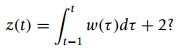
ii. Is the system represented by the given ordinary differential equation LTI?
(b) If we consider the current i(t) the input of a capacitor, with a zero initial voltage across it, the voltage across the capacitor€”or the output€”is given by
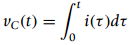
i. Is this capacitor time-invariant? If not, what conditions would you impose to make it time-invariant?
ii. If we let i(t) = u(t) what is the corresponding voltage vC (t)? If we delay the current source so that the input is i(t ˆ’ 1), find the corresponding voltage across the capacitor and indicate if this result shows the capacitor is time invariant.
(c) An amplitude modulation system has an input/output equation
y(t) = x(t) sin(2Ï€t) ˆ’ˆž
i. Let x(t) = u(t), plot the corresponding output y(t) = sin(2Ï€t) u(t)
ii. If the input is delayed, i.e., the input is x1(t) = x(t ˆ’ 0.5) = u(t ˆ’ 0.5), plot the corresponding output y1(t) = x1(t) sin(2Ï€t), and use this result to determine whether the given AM system is time-invariant.
z(t) = | w(t)dt + 2? t-1 t-1 vc(t) = : i(t)dt %3D
Step by Step Solution
3.49 Rating (162 Votes )
There are 3 Steps involved in it
a Derivative which excludes the initial condition of ... View full answer

Get step-by-step solutions from verified subject matter experts
 Study Help