New Semester
Started
Get
50% OFF
Study Help!
--h --m --s
Claim Now
Question Answers
Textbooks
Find textbooks, questions and answers
Oops, something went wrong!
Change your search query and then try again
S
Books
FREE
Study Help
Expert Questions
Accounting
General Management
Mathematics
Finance
Organizational Behaviour
Law
Physics
Operating System
Management Leadership
Sociology
Programming
Marketing
Database
Computer Network
Economics
Textbooks Solutions
Accounting
Managerial Accounting
Management Leadership
Cost Accounting
Statistics
Business Law
Corporate Finance
Finance
Economics
Auditing
Tutors
Online Tutors
Find a Tutor
Hire a Tutor
Become a Tutor
AI Tutor
AI Study Planner
NEW
Sell Books
Search
Search
Sign In
Register
study help
engineering
thermodynamics fundamentals
Thermodynamics Fundamentals And Engineering Applications 1st Edition William C. Reynolds, Piero Colonna - Solutions
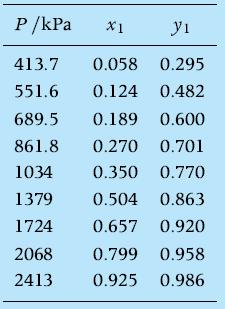
Given the set of VLE experimental data for the non-ideal mixture propane/n-pentane at 344.26 K from B. Sage and W. Lacey, “Phase equilibria in hydrocarbon systems, propanen- pentane system,” Industrial and Engineering Chemistry, 32, (7), 992–996, 1940,correlate them with the Margules
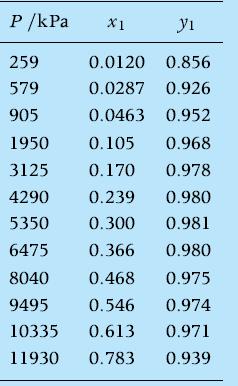
Given the set of experimental VLE data for a CO2 /toluene mixture at T = 80°C of W. Morris and M. Donohue, “Vapor–liquid equilibria in mixtures containing carbon dioxide, toluene, and i-methylnaphthalene,” J. Chem. Eng. Data, 30, (3), 259–263, 1985,estimate the Henry’s constant. Use
Use STANMIX to find the azeotropic composition for the mixture 2-propanol/water at P = 60 kPa. Explain why distillation of 2-propanol is not possible.
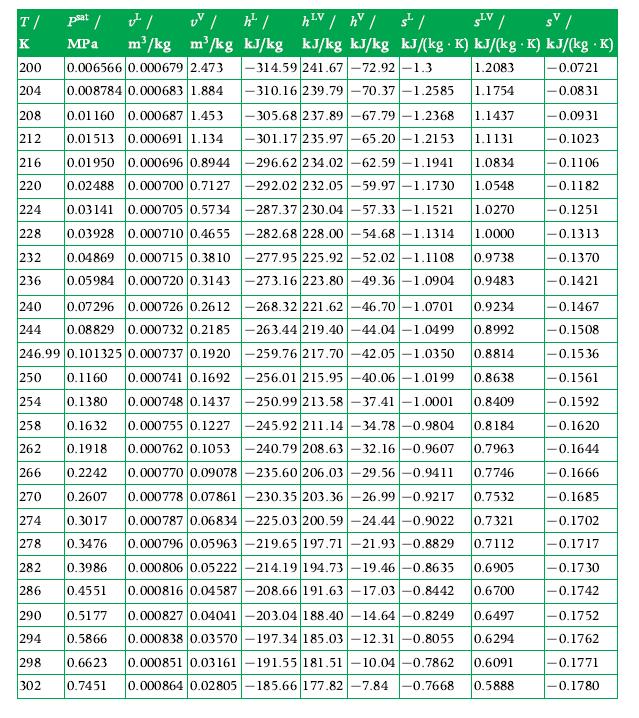
One kilogram of R134a is heated in a constant volume container from the critical point to 450 K. How much energy is transferred as heat to the fluid? Use the diagrams or data in Appendix A.4.Data From A.4 T/ K 200 204 h¹V / hv / s¹/ LV 282 286 psat / ¹/ UV /h¹/ SLV / SV/ MPa m³/kg m³/kg kJ/kg
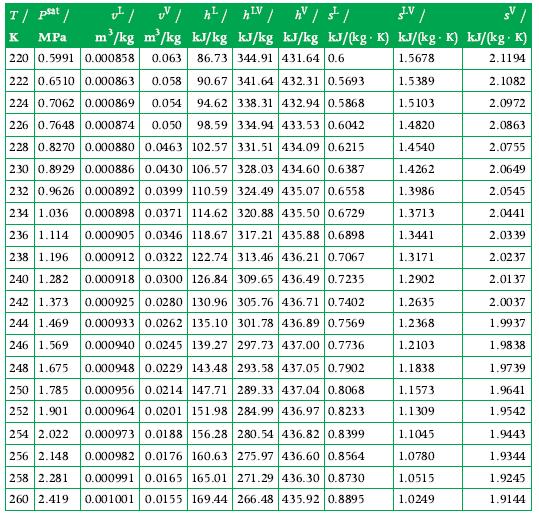
One kilogram of carbon dioxide is expanded adiabatically in a piston–cylinder system from 10 bar and 500 K to the saturated-vapor state at 5 bar. How much work is done by carbon dioxide and on what? Use the data in Appendix A.9. T/ psat / K MPa 220 0.5991 222 0.6510 0.000863 0.058 90.67 341.64
Calculate the mass flow rate of the steam that enters an adiabatic duct with a velocity of 10 m/s, at a pressure of 1.5 bar and a temperature of 400°C. The duct has a diameter of 0.16 m at the inlet and the steam outlet temperature is 650 K. Plot the exit velocity as well as the exit diameter
Your company asks you, the process engineer, to estimate the rate at which energy is transferred as heat through a steam turbine casing. This turbine operates with an inlet pressure of 16 bar and an inlet temperature of 377°C, while the steam exits the turbine as saturated vapor at 30°C. Its
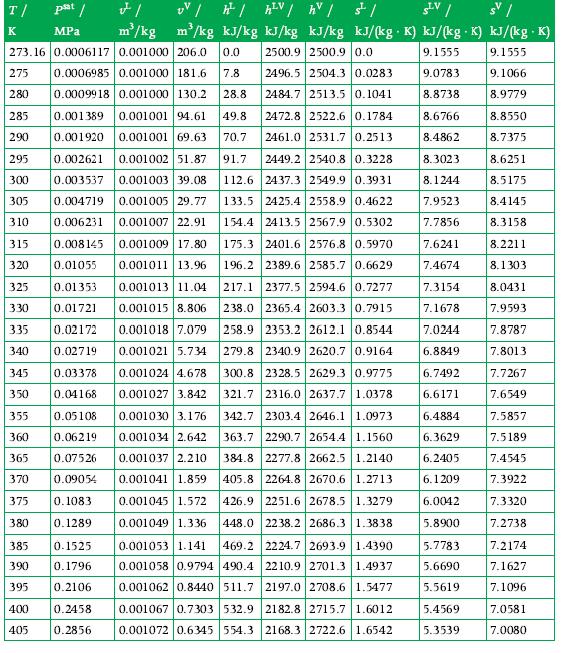
An adiabatic piston–cylinder system contains a 1000 W immersion heater and 4 kg of water. The water is initially at 1 atm and 96% quality. The heater is operated for 7 minutes. Calculate the final volume of the system using Appendix A.3 for data.Data From A.3 T/ psat / K MPa UV /h²/h²V / hv /
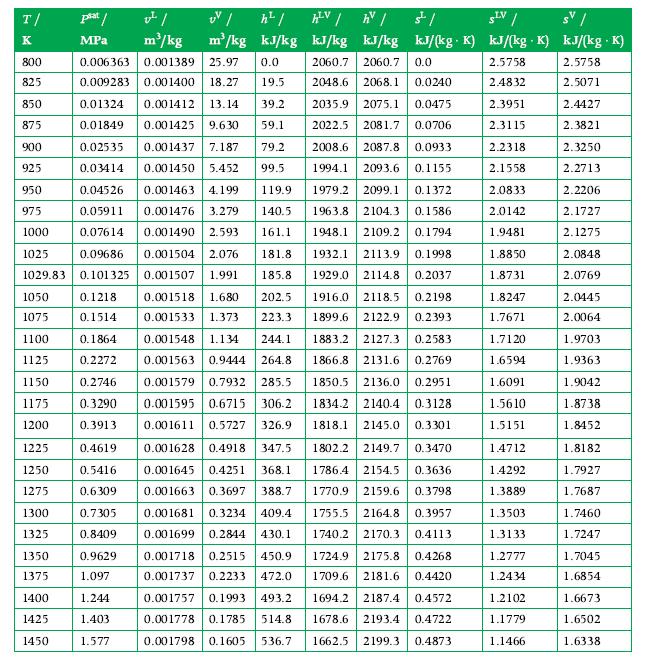
Potassium, an alkali metal, enters a condenser in the vapor phase with a mass flow rate of 0.02 kg/s and at a temperature and pressure of 1370 K and 0.4 MPa. It exits as a saturated liquid at 0.2 MPa. Calculate the rate of energy transfer as heat from the condenser in kW using Appendix A.11 for
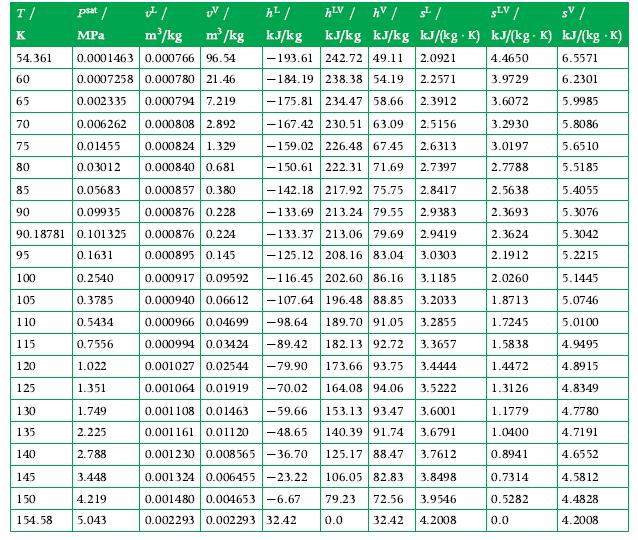
Oxygen flows through an adiabatic steady flow compressor as saturated vapor at a rate of 1000 kg/hr. The saturated vapor enters at 2.5 bar and exits at 17.5 bar and 175 K. Calculate the shaft work per unit mass of oxygen and the required power to drive the compressor. Use Appendix A.8 for data.Data
In a coal-fired power station, steam (H2O) enters the nozzle in a turbine at T1 = 800 K, P1 = 2 MPa at negligible velocity, and emerges at high velocity as a liquid–vapor mixture having quality x2 = 0.97 at P2 = 0.07 MPa. Assuming steady-state and negligible heat transfer, calculate the
Steam (H2O) enters the steam turbine in a nuclear power station at T1 = 800 K, P1 = 2 MPa at negligible velocity, and emerges at T2 = 370 K, P2 = 0.07 MPa. Assuming steady-state and neglecting heat transfer, and neglecting the potential and kinetic energy of the fluid at the inlet and
20 kg/s of water/steam enters the condenser in a central power station at T1 = 342 K with a quality of x1 = 0.98, and emerges as a saturated liquid at the same pressure (P2 = P1). Assuming steady-state, and neglecting the potential and kinetic energy of the fluid at the inlet and outlet of the
In a two-fluid heat exchanger of a methane cooling system, 4 kg/s of methane at T1 = 350 K, P1 = 0.5 MPa enters the tubes, emerging at T2 = 225 K with negligible loss in pressure (P1 = P2). Refrigerant R134a flows on the outside of the tubes, entering as a liquid–vapor mixture
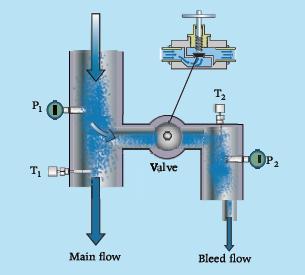
The throttling calorimeter is a device for determining the thermodynamic state of a fluid in vapor–liquid equilibrium. The procedure to estimate the vapor fraction of the fluid consists in bleeding off a small amount of the two-phase fluid, throttle it through a valve, and take the temperature
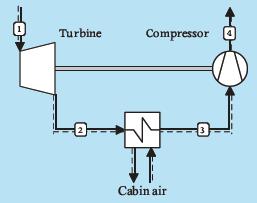
The cooling system for a small private jet airplane consists of the hardware shown here.High-pressure air from the aircraft engine compressor is fed to a small turbine at state 1 (temperature T1). The turbine extracts energy from the air, lowering the air temperature to state 2. This cold air is
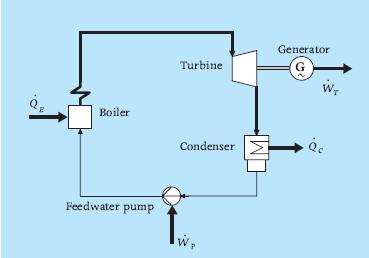
A small solar engine is used for water pumping in a desert area. Water is the working fluid.Water enters the pump as saturated liquid at 50°C and is pumped up to 2 bar by a small centrifugal pump. The boiler evaporates the water at 2 bar, and saturated vapor at this pressure enters a small
At a tee junction in the piping of a chemical plant, 5 kg/s of methane enters on one side at P1 = 1 MPa, T1 = 400 K, and 1 kg/s of methane enters on the other as a saturated liquid at P2 = 1 MPa. The two streams are mixed and exit from the junction at P3 = 1 MPa. Assuming steady-state,
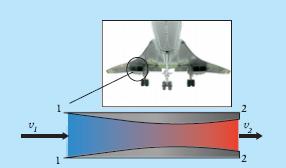
The inlet of the jet engine of a supersonic aircraft is a carefully shaped flow passage that takes in flow at very high speed ν1(relative to the engine) (section 1) and discharges the air at much lower velocity ν2 << ν1 and higher pressure (section 2) to the inlet of the compressor.
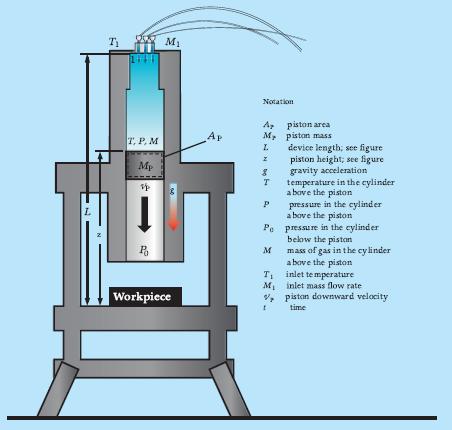
An impact press consists of a piston that is accelerated rapidly by pumping high pressure gas into the cylinder. The high-speed piston slams into the material to be flattened. Derive the equations needed to perform the design and analysis of this system according to the following suggested
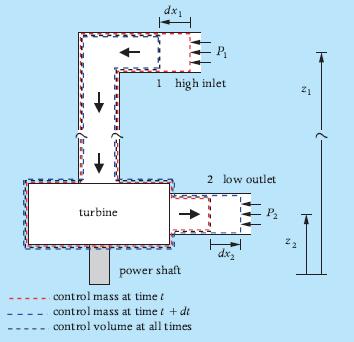
A hydraulic turbine is fed with water from a reservoir whose free surface is at z1 = 22 m a.s.l. (above sea level). Water enters the turbine inlet pipe, flows through the turbine and its diffuser, and is discharged downstream of the dam at z2 = 14 m a.s.l.Calculate the average power that the
Showing 300 - 400
of 321
1
2
3
4
Step by Step Answers

 Get 50% OFF
Claim Now
Get 50% OFF
Claim Now