New Semester
Started
Get
50% OFF
Study Help!
--h --m --s
Claim Now
Question Answers
Textbooks
Find textbooks, questions and answers
Oops, something went wrong!
Change your search query and then try again
S
Books
FREE
Study Help
Expert Questions
Accounting
General Management
Mathematics
Finance
Organizational Behaviour
Law
Physics
Operating System
Management Leadership
Sociology
Programming
Marketing
Database
Computer Network
Economics
Textbooks Solutions
Accounting
Managerial Accounting
Management Leadership
Cost Accounting
Statistics
Business Law
Corporate Finance
Finance
Economics
Auditing
Tutors
Online Tutors
Find a Tutor
Hire a Tutor
Become a Tutor
AI Tutor
AI Study Planner
NEW
Sell Books
Search
Search
Sign In
Register
study help
sciences
college physics reasoning
College Physics A Strategic Approach 3rd Edition Randall D. Knight, Brian Jones, Stuart Field - Solutions
A particle moving at speed \(0.40 c\) has kinetic energy \(K_{0}\). The speed of the particle is increased to \(0.80 c\). The kinetic energy is now A. Less than \(4 K_{0}\)B. Exactly \(4 K_{0}\)C. Greater than \(4 K_{0}\)
A base on Planet \(X\) fires a missile toward an oncoming space fighter. The missile's speed according to the base is \(0.85 c\). The space fighter measures the missile's speed as \(0.96 c\). How fast is the space fighter traveling relative to Planet \(\mathrm{X}\) ?
A \(1.0 \mathrm{~g}\) particle has momentum \(400,000 \mathrm{~kg} \cdot \mathrm{m} / \mathrm{s}\). What is the particle's speed?
A firecracker explodes at \(x=0 \mathrm{~m}, t=0 \mu \mathrm{s}\). A second explodes at \(x=300 \mathrm{~m}, t=2.0 \mu \mathrm{s}\). What is the proper time between these events?
You're standing on an asteroid when you see your best friend rocketing by in her new spaceship. As she goes by, you notice that the front and rear of her ship coincide exactly with the 400-m-diameter of another nearby asteroid that is stationary with respect to you. However, you happen to know that
A subatomic particle moves through the laboratory at \(0.90 c\). Laboratory experimenters measure its lifetime, from creation to annihilation, to be \(2.3 \mathrm{ps}\left(1 \mathrm{ps}=1\right.\) picosecond \(\left.=10^{-12} \mathrm{~s}\right)\). According to the particle, how long did it live?
You and Maria each own identical spaceships. As you fly past Maria, you measure her ship to be \(90 \mathrm{~m}\) long and your own ship to be \(100 \mathrm{~m}\) long.a. How long does Maria measure your ship to be?b. How fast is Maria moving relative to you?
A very fast-moving train car passes you, moving to the right at \(0.50 c\). You measure its length to be \(12 \mathrm{~m}\). Your friend David flies past you to the right at a speed relative to you of \(0.80 c\). How long does David measure the train car to be?
Two events in reference frame \(\mathrm{S}\) occur \(10 \mu \mathrm{s}\) apart at the same point in space. Frame \(\mathrm{S}^{\prime}\) travels at speed \(v=0.90 c\) relative to frame \(\mathrm{S}\).a. What is the time interval between the events in reference frame \(S^{\prime}\) ?b. What is the
A spaceship heads directly toward an asteroid at a relative speed of \(0.75 \mathrm{c}\). When it is \(3.0 \times 10^{8} \mathrm{~m}\) from the asteroid, as measured in the asteroid's frame, the rocket fires a laser pulse at the asteroid. According to the rocket captain, what is the time interval
Because of the earth's rotation, a person living on top of a mountain moves at a faster speed than someone at sea level. The mountain dweller's clocks thus run slowly compared to those at sea level. If the average life span of a hermit is 80 years, on average how much longer would a hermit dwelling
Two spaceships approach each other at speeds of \(0.80 c\) and \(0.90 c\) relative to the sun. When they are \(5.0 \times 10^{9} \mathrm{~m}\) apart, as measured in the sun's reference frame, they each set their clocks to zero. By how much do their clocks differ at the instant they pass each other?
A railroad car that is \(20 \mathrm{~m}\) long when at rest passes Rachael, who is standing on the ground. She records that it takes \(120 \mathrm{~ns}\) to go by. How fast is the car moving, as a fraction of \(c\) ?
A spaceship flies past an experimenter who measures its length to be one-half the length he had measured when the spaceship was at rest. An astronaut aboard the spaceship notes that his clock ticks at 1 -second intervals. What is the time between ticks as measured by the experimenter?
Marissa's spaceship approaches Joseph's at a speed of \(0.99 c\). As Marissa passes Joseph, they synchronize their clocks to both read \(t=0 \mathrm{~s}\). When Marissa's clock reads \(100 \mathrm{~s}\), she sends a light signal back to Joseph. According to his clock, when does he receive this
At a speed of \(0.90 c\), a spaceship travels to a star that is 9.0 ly distant.a. According to a scientist on earth, how long does the trip take?b. According to a scientist on the spaceship, how long does the trip take?c. According to the scientist on the spaceship, what is the distance traveled
A military jet traveling at \(1500 \mathrm{~m} / \mathrm{s}\) has engine trouble and the pilot must bail out. Her ejection seat shoots her forward at \(300 \mathrm{~m} / \mathrm{s}\) relative to the jet. According to the Lorentz velocity transformation, by how much is her velocity relative to the
A railcar has a velocity of \(0.5 \mathrm{c}\) relative to the ground. To another train traveling on the same track, the railcar's velocity is \(-0.2 c\). What is the velocity of the train relative to the ground?
James, Daniella, and Tara all possess identical clocks. As Daniella passes James in her rocket, James observes that her clock runs at \(80 \%\) the rate of his clock. As Tara passes in her rocket, in the same direction as Daniella, James observes that her clock runs at \(70 \%\) the rate of his
A space beacon on Planet Karma emits a pulse of light every second. Spaceman Trevor flies directly toward the beacon at a speed of \(0.95 c\). According to Trevor, what is the time between one pulse reaching his ship and the next?
The highest-energy cosmic ray ever detected had an energy of about \(3.0 \times 10^{20} \mathrm{eV}\). Assume that this cosmic ray was a proton.a. What was the proton's speed as a fraction of \(c\) ?b. If this proton started at the same time and place as a photon traveling at the speed of light,
What is the speed of an electron after being accelerated from INT rest through a \(20 \times 10^{6} \mathrm{~V}\) potential difference?
What is the speed of a proton after being accelerated from \(\mathbb{N} T\) rest through a \(50 \times 10^{6} \mathrm{~V}\) potential difference?
What is the momentum of a particle with speed \(0.95 c\) and total energy \(2.0 \times 10^{-10} \mathrm{~J}\) ?
A standard nuclear power plant generates \(3.0 \mathrm{GW}\) of thermal power from the fission of \({ }^{235} \mathrm{U}\). Experiments show that, on average, \(0.19 \mathrm{u}\) of mass is lost in each fission of a \({ }^{235} \mathrm{U}\) nucleus. How many kilograms of \({ }^{235} \mathrm{U}\)
The nuclear reaction that powers the sun is the fusion of four protons into a helium nucleus. The process involves several steps, but the net reaction is simply \(4 \mathrm{p} \rightarrow{ }^{4} \mathrm{He}+\) energy. The mass of a helium nucleus is known to be \(6.64 \times 10^{-27}
The chemical energy of gasoline is \(46 \mathrm{MJ} / \mathrm{kg}\). If gasoline's mass could be completely converted into energy, what mass of gasoline would be needed to equal the chemical energy content of \(1.0 \mathrm{~kg}\) of gasoline?
When antimatter (which we'll learn more about in Chapter 30) interacts with an equal mass of ordinary matter, both matter and antimatter are converted completely into energy in the form of photons. In an antimatter-fueled spaceship, a staple of science fiction, the newly created photons are shot
What is the half-life of a pion in the reference frame of the patient undergoing pion therapy?A. \(1.8 \times 10^{-10} \mathrm{~s}\)B. \(1.8 \times 10^{-8} \mathrm{~s}\)C. \(1.8 \times 10^{-7} \mathrm{~s}\)D. \(1.8 \times 10^{-6} \mathrm{~s}\)
According to the pion, what is the distance it travels from the accelerator to the medical bay?A. \(0.30 \mathrm{~m}\)B. \(3.0 \mathrm{~m}\)C. \(30 \mathrm{~m}\)D. \(3000 \mathrm{~m}\)
The proton collision that creates the pion also creates a gamma-ray photon traveling in the same direction as the pion. The photon will get to the medical bay first because it is moving faster. What is the speed of the photon in the pion's reference frame?A. \(0.00005 \mathrm{c}\)B. \(0.5 c\)C.
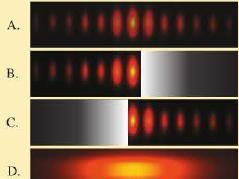
A laser illuminates two slits, leading to the interference pattern shown below. After the right-hand slit is covered up, what will the pattern look like?
If the pion slows down to \(0.99990 c\), about what percentage of its kinetic energy is lost?A. \(0.03 \%\)B. \(0.3 \%\)C. \(3 \%\)D. \(30 \%\)
X rays with a wavelength of \(0.12 \mathrm{~nm}\) undergo first-order diffraction from a crystal at a \(68^{\circ}\) angle of incidence. What is the angle of second-order diffraction?
The first-order \(x\)-ray diffraction of monochromatic \(x\) rays from a crystal occurs at angle \(\theta_{1}\). The crystal is then compressed, causing a slight reduction in its yolume. Does \(\theta_{1}\) increase, decrease, or stay the same? Explain.
The first-order di ffraction of x rays from two crystals with simple cubic structure is measured. The first-order di ffrac tion from crystal A occurs at an angle of20°. The first-order diffraction of the same x rays from crystal B occurs at 30°. Which crystal has the larger atomic spacing?
X rays with a wavelength of \(0.20 \mathrm{~nm}\) undergo first-order diffraction from a crystal at a \(54^{\circ}\) angle of incidence. At what angle does first-order diffraction occur for \(\mathrm{x}\) rays with a wavelength of \(0.15 \mathrm{~nm}\) ?
Explain the reasoning by which we claim that the stopping potential \(V_{\text {stop }}\) measures the maximum kinetic energy of the electrons in a photoelectric-effect experiment.
The work functions of metals A, B, and Care 3.0 eV, 4.0 eV, and 5.0 eV, respectively. UV light shines on all three metals, causing electrons to be emitted. Rank in order, from largest to smallest, the stopping voltages for A, B, and C.
How does Einstein's explanation account for each of these characteristics of the photoelectric effect?a. The photoelectric current is zero for frequencies below some threshold.b. The photoelectric current increases with increasing light intensity.c. The photoelectric current is independent of
X rays diffract from a crystal in which the spacing between atomic planes is \(0.175 \mathrm{~nm}\). The second-order diffraction occurs at \(45.0^{\circ}\). What is the angle of the first-order diffraction?
The intensity of a beam of light is increased but the light's frequency is unchanged. Which one (or perhaps more than one) of the following is true?A. The photons travel faster.B. Each photon has more energy.C. There are more photons per second.
The spacing between atomic planes in a crystal is \(0.110 \mathrm{~nm}\). If \(12.0 \mathrm{keV} \mathrm{x}\) rays are diffracted by this crystal, what are the angles of(a) first-order and(b) second-order diffraction?
A current is detected in a photoelectric-effect experiment when the cathode is illuminated with green light. Will a current necessarily be detected if the cathode is illuminated with blue light? With red light?
A beam of electrons, a beam of protons, and a beam of oxygen atoms each pass at the same speed through a 1-μ,m-wide slit. Which will produce the widest central maximum on a detector behind the slit?A. The beam of electrons. B. The beam of protons.C. The beam of oxygen atoms. D. All three patterns
X rays with a wavelength of \(0.085 \mathrm{~nm}\) diffract from a crystal in which the spacing between atomic planes is \(0.18 \mathrm{~nm}\). How many diffraction orders are observed?
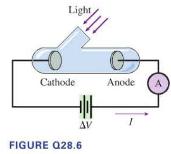
In the photoelectric effect experiment, as illustrated by Figure Q28.6, a current is measured while light is shining on the cathode. But this does not appear to be a complete circuit, so how can there be a current? Explain. Light Cathode Anode A FIGURE Q28.6 AV
A particle in a box, with the standing matter wave shown, has an energy of 8.0 eV. What is the lowest energy that this particle can have?A . 1.0 eV B. 2.0 eV C. 4.0 eV D. 8.0eV
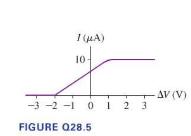
Figure Q28.5 shows the typical photoelectric behavior of a metal as the anode-cathode potential difference \(\Delta V\) is varied.a. Why do the curves become horizontal for \(\Delta V \geqq 1 \mathrm{~V}\) ? Shouldn't the current increase as the potential difference increases? Explain.b. Why
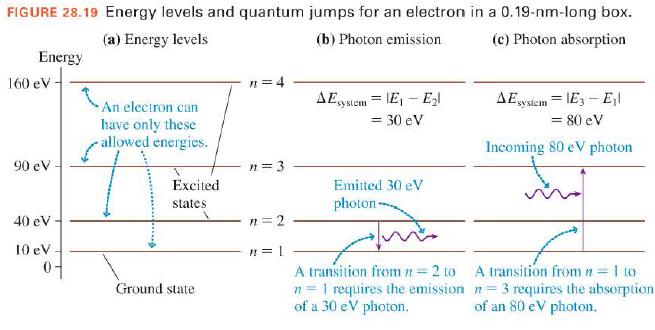
For the system shown in Figure 28.19, which are possible energies of emitted photons? There may be more than one correct answer.A. 40eV B. 50eV C. 60 eV D. 70eV E. 80eV FIGURE 28.19 Energy levels and quantum jumps for an electron in a 0.19-nm-long box. (a) Energy levels (b) Photon emission (c)
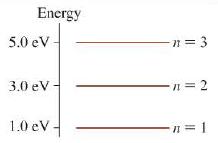
A photon with a wavelength of 4 10 nm has energy Ephoton = 3.0 eV. Do you expect to see a spectral line with λ = 410 nm in the emission spectrum of the system represented by this energy level diagram? Energy 5.0 eV n = 3 3.0 eV - 1.0 eV. -n=2
A metal surface is illuminated by light with a wavelength of \(350 \mathrm{~nm}\). The maximum kinetic energy of the emitted electrons is found to be \(1.50 \mathrm{eV}\). What is the maximum electron kinetic energy if the same metal is illuminated by light with a wavelength of \(250 \mathrm{~nm}\)
Electrons are emitted when a metal is illuminated by light with a wavelength less than \(388 \mathrm{~nm}\) but for no greater wavelength. What is the metal's work function?
Metal surfaces on spacecraft in bright sunlight develop a net electric charge. Do they develop a negative or a positive charge? Explain.
A gold cathode is illuminated with light of wavelength \(250 \mathrm{~nm}\). It is found that the current is zero when \(\Delta V=1.0 \mathrm{~V}\). Would the current change ifa. The light intensity is doubled?b. The anode-cathode potential difference is increased to \(\Delta V=5.5 \mathrm{~V} ?\)
The speeds of an electron and a proton have been measured to the same uncertainty. Which one has a larger uncertainty in position?A. The proton, because it's more massive. B. The electron, because it's less massive.C. The uncertainty in position is the same, because the uncertainty in velocity is
Light with a wavelength of \(375 \mathrm{~nm}\) illuminates a metal cathode. The maximum kinetic energy of the emitted electrons is \(0.76 \mathrm{eV}\). What is the longest wavelength of light that will cause electrons to be emitted from this cathode?
Three laser beams have wavelengths \(\lambda_{1}=400 \mathrm{~nm}, \lambda_{2}=600 \mathrm{~nm}\), and \(\lambda_{3}=800 \mathrm{~nm}\). The power of each laser beam is \(1 \mathrm{~W}\).a. Rank in order, from largest to smallest, the photon energies \(E_{1}, E_{2}\), and \(E_{3}\) in these three
When we say that a photon is a "quantum of light," what does that mean? What is quantized?
A solar cell is illuminated with \(2.0 \mathrm{~W}\) of light. Is the maximum possible current greater with \(2.0 \mathrm{~W}\) of red light or \(2.0 \mathrm{~W}\) of blue light?
Zinc has a work function of \(4.3 \mathrm{eV}\).a. What is the longest wavelength of light that will release an electron from a zinc surface?b. A \(4.7 \mathrm{eV}\) photon strikes the surface and an electron is emitted. What is the maximum possible speed of the electron?
An investigator is measuring the current in a photoelectric effect experiment. The cathode is illuminated by light of a single wavelength. What happens to the current if the wavelength of the light is reduced by a factor of two while keeping the intensity constant?
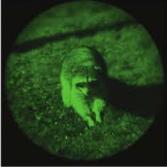
Image intensifiers used in nightvision devices create a bright image from dim light by letting the light first fall on a photocathode. Electrons emitted by the photoelectric effect are accelerated and then strike a phosphorescent screen, causing it to glow more brightly than the original scene.
To have the best resolution, should an electron microscope use very fast electrons or very slow electrons? Explain.
A neutron is shot straight up with an initial speed of \(100 \mathrm{~m} / \mathrm{s}\). As it rises, does its de Broglie wavelength increase, decrease, or not change? Explain.
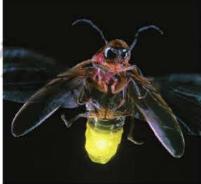
A firefly glows by the direct conversion of chemical energy to light. The light emitted by a firefly has peak intensity at a wavelength of \(550 \mathrm{~nm}\).a. What is the minimum chemical energy, in \(\mathrm{eV}\), required to generate each photon?b. One molecule of ATP provides \(0.30
Electrons are accelerated from rest through an \(8000 \mathrm{~V}\) potential difference. By what factor would their de Broglie wavelength increase if they were instead accelerated through a \(2000 \mathrm{~V}\) potential?
Can an electron with a de Broglie wavelength of \(2 \mu \mathrm{m}\) pass through a slit that is \(1 \mu \mathrm{m}\) wide? Explain.
Figure Q28.20 shows the standing de Broglie wave of a particle in a box.a. What is the quantum number?b. Can you determine from this picture whether the "classical" particle is moving to the right or to the left? If so, which is it? If not, why not? FIGURE Q28.20
The laser in a DVD player emits light at a wavelength of \(640 \mathrm{~nm}\). The laser in a Blu-Ray player emits light at \(405 \mathrm{~nm}\). What are the photon energies of each laser, in \(\mathrm{eV}\) ?
Figure Q28.23 shows a standing de Broglie wave.a. Does this standing wave represent a particle that travels back and forth between the boundaries with a constant speed or a changing speed? Explain.b. If the speed is changing, at which end is the particle moving faster and at which end is it moving
A particle in a box of length \(L_{\mathrm{a}}\) has \(E_{1}=2 \mathrm{eV}\). The same particle in a box of length \(L_{\mathrm{b}}\) has \(E_{2}=50 \mathrm{eV}\). What is the ratio \(L_{\mathrm{a}} / L_{\mathrm{b}}\) ?
It The wavelengths of light emitted by a firefly span the visible spectrum but have maximum intensity near \(550 \mathrm{~nm}\). A typical flash lasts for \(100 \mathrm{~ms}\) and has a power of \(1.2 \mathrm{~mW}\). If we assume that all of the light is emitted at the peak-intensity wavelength of
At \(510 \mathrm{~nm}\), the wavelength of maximum sensitivity of the human eye, the dark-adapted eye can sense a 100-ms-long flash of light of total energy \(4.0 \times 10^{-17} \mathrm{~J}\). (Weaker flashes of light may be detected, but not reliably.) If \(60 \%\) of the incident light is lost
Science fiction movies often use devices that transport people and objects rapidly from one position to another. To "beam" people in this fashion means taking them apart atom by atom, carefully measuring each position, and then sending the atoms in a beam to the desired final location where they
A light sensor is based on a photodiode that requires a minimum photon energy of \(1.7 \mathrm{eV}\) to create mobile electrons. What is the longest wavelength of electromagnetic radiation that the sensor can detect?A. \(500 \mathrm{~nm}\)B. \(730 \mathrm{~nm}\)C. \(1200 \mathrm{~nm}\)D. \(2000
A circuit employs a silicon solar cell to detect flashes of light lasting \(0.25 \mathrm{~s}\). The smallest current the circuit can detect reliably is \(0.42 \mu \mathrm{A}\). Assuming that all photons reaching the solar cell give their energy to a charge carrier, what is the minimum power of a
In a photoelectric effect experiment, the frequency of the light is increased while the intensity is held constant. As a result,A. There are more electrons.B. The electrons are faster.C. Both A and B.D. Neither A nor B.
In a photoelectric effect experiment, the intensity of the light is increased while the frequency, which is above the threshold frequency, is held constant. As a result, A. There are more electrons.B. The electrons are faster.C. Both A and B.D. Neither A nor B.
a. What is the de Broglie wavelength of a \(200 \mathrm{~g}\) baseball with a speed of \(30 \mathrm{~m} / \mathrm{s}\) ?b. What is the speed of a \(200 \mathrm{~g}\) baseball with a de Broglie wavelength of \(0.20 \mathrm{~nm}\) ?
In the photoelectric effect, electrons are never emitted from a metal if the frequency of the incoming light is below a certain threshold value. This is becauseA. Photons of lower-frequency light don't have enough energy to eject an electron.B. The electric field of low-frequency light does not
Visible light has a wavelength of about \(500 \mathrm{~nm}\). A typical radio wave has a wavelength of about \(1.0 \mathrm{~m}\). How many photons of the radio wave are needed to equal the energy of one photon of visible light?A. 2,000 B. 20,000 C. 200,000 D. \(2,000,000\)
Many medical PET scans use the isotope \({ }^{18} \mathrm{~F}\), which has a half-life of \(1.8 \mathrm{~h}\). A sample prepared at 10:00 A.M. has an activity of \(20 \mathrm{mCi}\). What is the activity at 1:00 P.M., when the patient is injected?
The technetium isotope \({ }^{99} \mathrm{Tc}\) is useful in medical imaging, but its short \(6.0 \mathrm{~h}\) halflife means that shipping it from a source won't work; it must be created where it will be used. Hospitals extract the \({ }^{99} \mathrm{Tc}\) daughter product from the decay of the
A \(50 \mathrm{~kg}\) nuclear plant worker is exposed to \(20 \mathrm{~mJ}\) of neutron radiation with an RBE of 10 . What is the dose in \(\mathrm{mSv}\) ?
\(150 \mathrm{rad}\) of gamma radiation are directed into a \(150 \mathrm{~g}\) tumor. How much energy does the tumor absorb?
During the 1950s, nuclear bombs were tested on islands in the South Pacific. In one test, personnel on a nearby island received \(10 \mathrm{mGy}\) per hour of beta and gamma radiation. At this rate, how long would it take to receive a potentially lethal dose equivalent of \(4.5 \mathrm{~Sv}\) ?
\({ }^{131} \mathrm{I}\) undergoes beta-minus decay with a subsequent gamma emission from the daughter nucleus. Iodine in the body is almost entirely taken up by the thyroid gland, so a gamma scan using this isotope will show a bright area corresponding to the thyroid gland with the surrounding
Two radio stations have the same power output from their antennas. One broadcasts AM at a frequency of \(1000 \mathrm{kHz}\) and one broadcasts FM at a frequency of \(100 \mathrm{MHz}\). Which statement is true?A. The FM station emits more photons per second.B. The AM station emits more photons per
A paramecium is covered with motile hairs called cilia that propel it at a speed of \(1 \mathrm{~mm} / \mathrm{s}\). If the paramecium has a volume of \(2 \times 10^{-13} \mathrm{~m}^{3}\) and a density equal to that of water, what is its de Broglie wavelength when in motion? What fraction of the
Light consisting of \(2.7 \mathrm{eV}\) photons is incident on a piece of potassium, which has a work function of \(2.3 \mathrm{eV}\). What is the maximum kinetic energy of the ejected electrons?A. \(2.3 \mathrm{eV}\)B. \(2.7 \mathrm{eV}\)C. \(5.0 \mathrm{eV}\)D. \(0.4 \mathrm{eV}\)
How many photons does a \(5.0 \mathrm{~mW}\) helium-neon laser \((\lambda=633 \mathrm{~nm})\) emit in 1 second?A. \(1.2 \times 10^{19}\)B. \(4.0 \times 10^{18}\)C. \(8.0 \times 10^{16}\)D. \(1.6 \times 10^{16}\)
You shoot a beam of electrons through a double slit to make an interference pattern. After noting the properties of the pattern, you then double the speed of the electrons. What effect would this have?A. The fringes would get closer together.B. The fringes would get farther apart.C. The positions
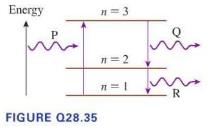
Photon P in Figure Q28.35 moves an electron from energy level \(n=1\) to energy level \(n=3\). The electron jumps down to \(n=2\), emitting photon \(\mathrm{Q}\), and then jumps down to \(n=1\), emitting photon \(\mathrm{R}\). The spacing between energy levels is drawn to scale. What is the correct
A quantum system has three energy levels, so three wavelengths appear in its emission spectrum. The shortest observed wavelength is \(248 \mathrm{~nm}\); light with a \(414 \mathrm{~nm}\) wavelength is also observed. What is the third wavelength?
The speed of an electron is known to be between \(3.0 \times 10^{6} \mathrm{~m} / \mathrm{s}\) and \(3.2 \times 10^{6} \mathrm{~m} / \mathrm{s}\). Estimate the smallest possible uncertainty in its position.
A proton is confined within an atomic nucleus of diameter \(4 \mathrm{fm}\left(1 \mathrm{fm}=10^{-15} \mathrm{~m}\right)\). Estimate the smallest range of speeds you might find for a proton in the nucleus.
In a photoelectric-effect experiment, the maximum kinetic energy of electrons is \(2.8 \mathrm{eV}\). When the wavelength of the light is increased by \(50 \%\), the maximum energy decreases to \(1.1 \mathrm{eV}\). What are(a) the work function of the cathode and(b) the initial wavelength?
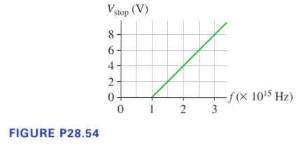
Light of constant intensity but varying wavelength was used to illuminate the cathode in a photoelectric-effect experiment. The graph of Figure P28.54 shows how the stopping potential depended on the frequency of the light. What is the work function, in \(\mathrm{eV}\), of the cathode? Vstop (V) 8-
Suppose you need to image the structure of a virus with a BIO diameter of \(50 \mathrm{~nm}\). For a sharp image, the wavelength of the probing wave must be \(5.0 \mathrm{~nm}\) or less. We have seen that, for imaging such small objects, this short wavelength is obtained by using an electron beam
Showing 900 - 1000
of 4913
First
3
4
5
6
7
8
9
10
11
12
13
14
15
16
17
Last
Step by Step Answers

 Get 50% OFF
Claim Now
Get 50% OFF
Claim Now