New Semester
Started
Get
50% OFF
Study Help!
--h --m --s
Claim Now
Question Answers
Textbooks
Find textbooks, questions and answers
Oops, something went wrong!
Change your search query and then try again
S
Books
FREE
Study Help
Expert Questions
Accounting
General Management
Mathematics
Finance
Organizational Behaviour
Law
Physics
Operating System
Management Leadership
Sociology
Programming
Marketing
Database
Computer Network
Economics
Textbooks Solutions
Accounting
Managerial Accounting
Management Leadership
Cost Accounting
Statistics
Business Law
Corporate Finance
Finance
Economics
Auditing
Tutors
Online Tutors
Find a Tutor
Hire a Tutor
Become a Tutor
AI Tutor
AI Study Planner
NEW
Sell Books
Search
Search
Sign In
Register
study help
sciences
college physics reasoning
College Physics A Strategic Approach 3rd Edition Randall D. Knight, Brian Jones, Stuart Field - Solutions
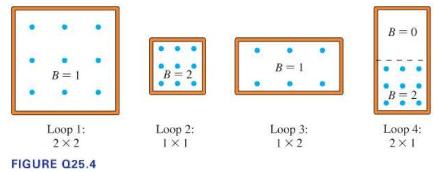
Figure Q25.4 shows four different loops in a magnetic field. The numbers indicate the lengths of the sides and the strength of the field. Rank in order the magnetic fluxes \(\Phi_{1}\) through \(\Phi_{4}\), from the largest to the smallest. Some may be equal. Explain. B=1 2 B=1 B=0 B=2 Loop 1: 2x2
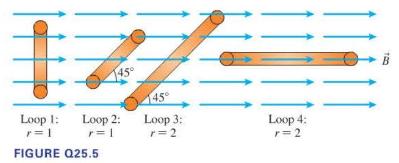
Figure Q25.5 shows four different circular loops that are perpendicular to the page. The radius of loops 3 and 4 is twice that of loops 1 and 2. The magnetic field is the same for each. Rank in order the magnetic fluxes \(\Phi_{1}\) through \(\Phi_{4}\), from the largest to the smallest. Some may
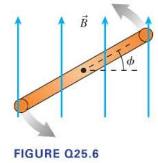
A circular loop rotates at constant speed about an axle through the center of the loop. Figure Q25.6 shows an edge view and defines the angle \(\phi\), which increases from \(0^{\circ}\) to \(360^{\circ}\) as the loop rotates.a. At what angle or angles is the magnetic flux a maximum?b. At what
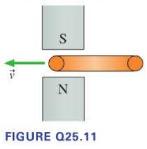
The conducting loop in Figure Q25.11 is moving into the region between the magnetic poles shown.a. Is the induced current (viewed from above) clockwise or counterclockwise?b. Is there an attractive magnetic force that tends to pull the loop in, like a magnet pulls on a paper clip? Or do you need to
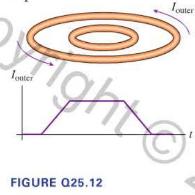
Figure Q25.12 shows two concentric, conducting loops. We will define a counterclockwise current (viewed from above) to be positive, a clockwise current to be negative. The graph shows the current in the outer loop as a function of time. Sketch a graph that shows the induced current in the inner
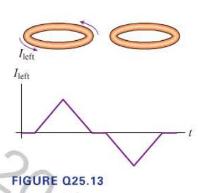
Figure Q25.13 shows conducting loops next to each other. We will define a counterclockwise current (viewed from above) to be positive, a clockwise current to be negative. The graph shows the current in the left loop as a function of time. Sketch a graph that shows the induced current in the right
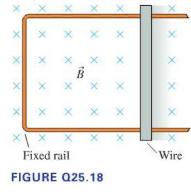
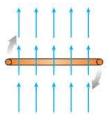
A metal wire is resting on a \(U\)-shaped conducting rail, as shown in Figure Q25.18. The rail is fixed in position, but the wire is free to move.a. If the magnetic field is increasing in strength, which way does the wire move?b. If the magnetic field is decreasing in strength, which way does the
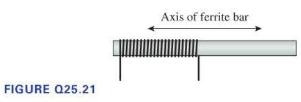
An AM radio detects the oscillating magnetic field of the radio wave with an antenna consisting of a coil of wire wrapped around a ferrite bar, as shown in Figure Q25.21. Ferrite is a magnetic material that "amplifies" the magnetic field of the wave. The radio antenna broadcasts waves with the
Three laser beams have wavelengths \(\lambda_{1}=400 \mathrm{~nm}, \lambda_{2}=\) \(600 \mathrm{~nm}\), and \(\lambda_{3}=800 \mathrm{~nm}\). The power of each laser beam is \(1 \mathrm{~W}\).a. Rank in order, from largest to smallest, the photon energies \(E_{1}, E_{2}\), and \(E_{3}\) in these
A circular loop of wire has an area of \(0.30 \mathrm{~m}^{2}\). It is tilted by \(45^{\circ}\) with respect to a uniform \(0.40 \mathrm{~T}\) magnetic field. What is the magnetic flux through the loop?A. \(0.085 \mathrm{~T} \cdot \mathrm{m}^{2}\)B. \(0.12 \mathrm{~T} \cdot \mathrm{m}^{2}\)C.
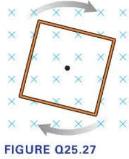
In Figure Q25.27, a square loop is rotating in the plane of the page around an axis through its center. A uniform magnetic field is directed into the page. What is the direction of the induced current in the loop?A. Clockwise.B. Counterclockwise.C. There is no induced current. x X XX XX X x FIGURE
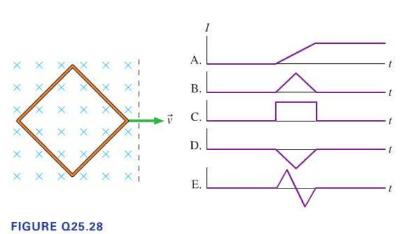
A diamond-shaped loop of wire is pulled at a constant velocity through a region where the magnetic field is directed into the paper in the left half and is zero in the right half, as shown in Figure Q25.28. As the loop moves from left to right, which graph best represents the induced current in the
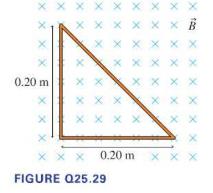
Figure Q25.29 shows a triangular loop of wire in a uniform magnetic field. If the field strength changes from 0.30 to \(0.10 \mathrm{~T}\) in \(50 \mathrm{~ms}\), what is the induced emf in the loop?A. \(0.08 \mathrm{~V}\)B. \(0.12 \mathrm{~V}\)C. \(0.16 \mathrm{~V}\)D. \(0.24 \mathrm{~V}\)E.
A device called a flip coil can be used to measure the earth's magnetic field. The coil has 100 turns and an area of \(0.010 \mathrm{~m}^{2}\). It is oriented with its plane perpendicular to the earth's magnetic field, then flipped \(180^{\circ}\) so the field goes through the coil in the opposite
The electromagnetic waves that carry FM radio range in frequency from \(87.9 \mathrm{MHz}\) to \(107.9 \mathrm{MHz}\). What is the range of wavelengths of these radio waves?A. \(500-750 \mathrm{~nm}\)B. \(0.87-91.08 \mathrm{~m}\)C. \(2.78-3.41 \mathrm{~m}\)D. \(278-341 \mathrm{~m}\)E. \(234-410
The beam from a laser is focused with a lens, reducing the area of the beam by a factor of 2 . By what factor does the amplitude of the electric field increase?A. The amplitude does not change.B. The amplitude increases by a fâctor of \(\sqrt{2}\).C. The amplitude increases by a factor of 2 .D.
Communication with submerged submarines via radio waves is difficult because seawater is conductive and absorbs electromagnetic waves. Penetration into the ocean is greater at longer wavelengths, so the United States has radio installations that transmit at \(76 \mathrm{~Hz}\) for submarine
How many photons are emitted during \(5.0 \mathrm{~s}\) of operation of a red laser pointer? The device outputs \(2.8 \mathrm{~mW}\) at a \(635 \mathrm{~nm}\) wavelength.A. \(4.5 \times 10^{10}\)B. \(4.5 \times 10^{11}\)C. \(4.5 \times 10^{15}\)D. \(4.5 \times 10^{16}\)
A 10-cm-long wire is pulled along a U-shaped conducting rail in a perpendicular magnetic field. The total resistance of the wire and rail is \(0.20 \Omega\). Pulling the wire with a force of \(1.0 \mathrm{~N}\) causes \(4.0 \mathrm{~W}\) of power to be dissipated in the circuit.a. What is the speed
In the rainy season, the Amazon flows fast and runs deep. In one location, the river is \(23 \mathrm{~m}\) deep and moves at a speed of \(4.0 \mathrm{~m} / \mathrm{s}\) toward the east. The earth's \(50 \mu \mathrm{T}\) magnetic field is parallel to the ground and directed northward. If the bottom
A delivery truck with \(2.8-\mathrm{m}\)-high aluminum sides is driving west at \(75 \mathrm{~km} / \mathrm{h}\) in a region where the earth's magnetic field is \(\vec{B}=\left(5.0 \times 10^{-5} \mathrm{~T}\right.\), north \()\)a. What is the potential difference between the top and the bottom of
Michael Faraday unsuccessfully attempted to measure the potential difference across the River Thames due to the flow of water (which is a good conductor due to dissolved salts) in the earth's field. At Waterloo Bridge, where Faraday made his attempt, the river is \(200 \mathrm{~m}\) wide and flows
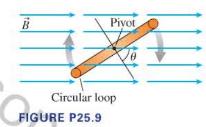
Figure P25.9 is an edge-on view of a 10-cm-diameter circular loop rotating in a uniform \(0.050 \mathrm{~T}\) magnetic field. What is the magnetic flux through the loop when \(\theta\) is \(0^{\circ}, 30^{\circ}, 60^{\circ}\), and \(90^{\circ}\) ? B Pivot Circular loop FIGURE P25.9
At a typical location in the United States, the earth's magnetic field has a magnitude of \(5.0 \times 10^{-5} \mathrm{~T}\) and is at a \(65^{\circ}\) angle from the horizontal. What is the flux through the \(22 \mathrm{~cm} \times\) \(28 \mathrm{~cm}\) front cover of your textbook if it is flat
A 1000-turn coil of wire \(2.0 \mathrm{~cm}\) in diameter is in a magnetic field that drops from \(0.10 \mathrm{~T}\) to \(0 \mathrm{~T}\) in \(10 \mathrm{~ms}\). The axis of the coil is parallel to the field. What is the emf of the coil?
Figure P25.16 shows a 100-turn coil of wire of radius \(12 \mathrm{~cm}\) in a \(0.15 \mathrm{~T}\) magnetic field. The coil is rotated \(90^{\circ}\) in \(0.30 \mathrm{~s}\), ending up parallel to the field. What is the average emf induced in the coil as it rotates?Figure P25.16 1111
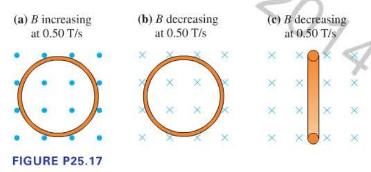
Figure P25.17 shows a 10-cm-diameter loop in three different magnetic fields. The loop's resistance is \(0.10 \Omega\). For each case, determine the induced emf, the induced current, and the direction of the current. at (a) B increasing 0.50 T/s (b) B decreasing at 0.50 T/s FIGURE P25.17 (c) B
The plane of a loop of wire is perpendicular to a magnetic field. Rank, from greatest to least, the magnitudes of the loop's induced emf for the following situations:A. The magnetic field strength increases from 0 to \(1 \mathrm{~T}\) in \(6 \mathrm{~s}\).B. The magnetic field strength increases
Patients undergoing an MRI occasionally report seeing flashes of light. Some practitioners assume that this results from electric stimulation of the eye by the emf induced by the rapidly changing fields of an MRI solenoid. We can do a quick calculation to see if this is a reasonable assumption. The
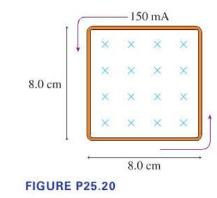
The loop in Figure P25.20 has an induced current as shown. The loop has a resistance of \(0.10 \Omega\). Is the magnetic field strength increasing or decreasing? What is the rate of change of the field, \(\Delta B / \Delta t\) ? 8.0 cm -150 mA x x x x x x X XXXX XX FIGURE P25.20 8.0 cm
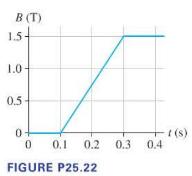
A 5.0-cm-diameter loop of wire has resistance \(1.2 \Omega\). A nearby solenoid generates a uniform magnetic field along the axis of the loop that varies with time as shown in Figure P25.22. Graph the magnitude of the current in the loop over the same time interval. B (T) 1.5- 1.0- 0.5 0- +(s). 0
A 20-cm-circumference loop of wire has a resistance of \(0.12 \Omega\). The loop is placed between the poles of an electromagnet, and a field of \(0.55 \mathrm{~T}\) is switched on in a time of \(15 \mathrm{~ms}\). What is the induced current in the loop?
The magnetic field at the earth's surface can vary in response to solar activity. During one intense solar storm, the vertical component of the magnetic field changed by \(2.8 \mu \mathrm{T}\) per minute, causing voltage spikes in large loops of the power grid that knocked out power in parts of
A typical helium-neon laser found in supermarket checkout scanners emits \(633-\mathrm{nm}\)-wavelength light in a 1.0 -mm-diameter beam with a power of \(1.0 \mathrm{~mW}\). What are the amplitudes of the oscillating electric and magnetic fields in the laser beam?
The magnetic field of an electromagnetic wave in a vacuum is \(B_{2}=(3.0 \mu \mathrm{T}) \sin \left(\left(1.0 \times 10^{7}\right) x-2 \pi f t\right)\), where \(x\) is in \(\mathrm{m}\) and \(t\) is in s. What are the wave's (a) wavelength, (b) frequency, and (c) electric field amplitude?
A \(200 \mathrm{MW}\) laser pulse is focused with a lens to a diameter of\(2.0 \mu \mathrm{m}\). What is the laser beam's electric field amplitude at the focal point?
The intensity of a polarized electromagnetic wave is \(10 \mathrm{~W} / \mathrm{m}^{2}\). What will be the intensity after passing through a polarizing filter whose axis makes the following angles with the plane of polarization? (a) \(\theta=0^{\circ}\), (b) \(\theta=30^{\circ}\), (c)
A low-power college radio station broadcasts \(10 \mathrm{~W}\) of electromagnetic waves. At what distance from the antenna is the electric field amplitude \(2.0 \times 10^{-3} \mathrm{~V} / \mathrm{m}\), the lower limit at which good reception is possible?
One recent study has shown that \(\mathrm{x}\) rays with a wavelength of \(0.0050 \mathrm{~nm}\) can produce mutations in human cells.a. Calculate the energy in \(\mathrm{eV}\) of a photon of radiation with this wavelength.b. Assuming that the bond energy holding together a water molecule is
Rod cells in the retina of the eye detect light using a photopigment called rhodopsin. \(1.8 \mathrm{eV}\) is the lowest photon energy that can trigger a response in rhodopsin. What is the maximum wavelength of electromagnetic radiation that can cause a transition? In what part of the spectrum is
Extremely high-energy photons of \(2.0 \times 10^{13} \mathrm{eV}\) are occasionally observed from distant astronomical sources. What are the corresponding wavelength and frequency?
If A 193-nm-wavelength UV laser for eye surgery emits a \(0.500 \mathrm{~mJ}\) pulse. How many photons does the light pulse contain?
The human eye can barely detect a star whose intensity at the earth's surface is \(1.6 \times 10^{-11} \mathrm{~W} / \mathrm{m}^{2}\). If the dark-adapted eye has a pupil diameter of \(7.0 \mathrm{~mm}\), how many photons per second enter the eye from the star? Assume the starlight has a wavelength
A particular species of copepod, a small marine crustacean, emits a flash of light consisting of \(1.4 \times 10^{10}\) photons at a wavelength of \(490 \mathrm{~nm}\). The flash lasts for \(2.4 \mathrm{~s}\). What is the power of the flash?
Our sun's \(5800 \mathrm{~K}\) surface temperature gives a peak wavelength in the middle of the visible spectrum. What is the minimum surface temperature for a star whose emission peaks at some wavelength less than \(400 \mathrm{~nm}\) - that is, in the ultraviolet?
The star Sirius is much hotter than the sun, with a peak wavelength of \(290 \mathrm{~nm}\) compared to the sun's \(500 \mathrm{~nm}\). It is also larger, with a diameter 1.7 times that of the sun. By what factor does the energy emitted by Sirius exceed that of the sun?
The photon energies used in different types of medical x-ray imaging vary widely, depending upon the application. Single dental \(x\) rays use photons with energies of about \(25 \mathrm{keV}\). The photon energy used for \(\mathrm{x}\)-ray microtomography, a process that allows repeated imaging in
A python can detect thermal radiation with intensity greater than \(0.60 \mathrm{~W} / \mathrm{m}^{2}\). A typical human body has a surface area of \(1.8 \mathrm{~m}^{2}\), a surface temperature of \(30^{\circ} \mathrm{C}\), and an emissivity \(e=0.97\) at infrared wavelengths. What is the maximum
If astronomers look toward any point in outer space, they see radiation that matches the emission spectrum of an object at 2.7 K, a remnant of the Big Bang. What is the peak wavelength of this radiation? What part of the electromagnetic spectrum is it in?
A 25-turn, 10.0-cm-diameter coil is oriented in a vertical plane with its axis aligned east-west. A magnetic field pointing to the northeast decreases from \(0.80 \mathrm{~T}\) to \(0.20 \mathrm{~T}\) in \(2.0 \mathrm{~s}\). What is the emf induced in the coil?
People immersed in strong unchanging magnetic fields occasionally report sensing a metallic taste. Some investigators suspect that motion in the constant field could produce a changing flux and a resulting emf that could stimulate nerves in the tongue. We can make a simple model to see if this is
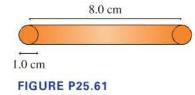
Currents induced by rapid field changes in an MRI solenoid can, in some cases, heat tissues in the body, but under normal circumstances the heating is small. We can do a quick estimate to show this. Consider the "loop" of muscle tissue shown in Figure P25.61. This might be muscle circling the bone
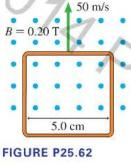
It The loop in Figure P25.62 is being \(750 \mathrm{~m} / \mathrm{s}\) pushed into the \(0.20 \mathrm{~T}\) magnetic field \(B^{\circ}=0^{\circ} 20^{\circ}{ }^{\circ}{ }^{\circ}\). at \(50 \mathrm{~m} / \mathrm{s}\). The resistance of the loop is \(0.10 \Omega\). What are the direction and
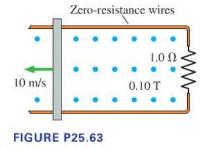
A 20-cm-long, zero-resistance wire is pulled outward, on zero-resistance rails, at a steady speed of \(10 \mathrm{~m} / \mathrm{s}\) in a \(0.10 \mathrm{~T} \mathrm{mag}\) netic field. (See Figure P25.63.) On the opposite side, a \(1.0 \Omega\) carbon resistor completes the circuit by connecting
A TMS (transcranial magnetic stimulation) device creates very rapidly changing magnetic fields. The field near a typical pulsed-field machine rises from \(0 \mathrm{~T}\) to \(2.5 \mathrm{~T}\) in \(200 \mu\) s. Suppose a technician holds his hand near the device so that the axis of his
When the Voyager 2 spacecraft passed Neptune in 1989, it was \(4.5 \times 10^{9} \mathrm{~km}\) from the earth. Its radio transmitter, with which it sent back data and images, broadcast with a mere \(21 \mathrm{~W}\) of power. Assuming that the transmitter broadcast equally in all directions,a.
In reading the instruction manual that came with your garagedoor opener, you see that the transmitter unit in your car produces a \(250 \mathrm{~mW}\) signal and that the receiver unit is supposed to respond to a radio wave of the correct frequency if the electric field amplitude exceeds \(0.10
Unpolarized light passes through a vertical polarizing filter, emerging with an intensity \(I_{0}\). The light then passes through a horizontal filter, which blocks all of the light; the intensity transmitted through the pair of filters is zero. Suppose a third polarizer with axis \(45^{\circ}\)
A light-emitting diode (LED) connected to a \(3.0 \mathrm{~V}\) power supplyemits \(440 \mathrm{~nm}\) blue light. The current in the LED is \(10 \mathrm{~mA}\), and the LED is \(60 \%\) efficient at converting electric power input into light power output. How many photons per second does the LED
A \(1000 \mathrm{kHz}\) AM radio station broadcasts with a power of \(20 \mathrm{~kW}\). How many photons does the transmitting antenna emit each second?
The human body has a surface area of approximately \(1.8 \mathrm{~m}^{2}\), a surface temperature of approximately \(30^{\circ} \mathrm{C}\), and a typical emissivity at infrared wavelengths of \(e=0.97\). If we make the approximation that all photons are emitted at the wavelength of peak
What is the wavelength of \(27 \mathrm{MHz}\) radio waves?A. \(11 \mathrm{~m}\)B. \(9.0 \mathrm{~m}\)C. \(0.011 \mathrm{~m}\)D. \(0.009 \mathrm{~m}\)Radio waves and microwaves are used in therapy to provide "deep heating" of tissue because the waves penetrate beneath the surface of the body and
If the frequency of the radio waves is increased, the depth of penetrationA. IncreasesB. Does not change.C. Decreases.Radio waves and microwaves are used in therapy to provide "deep heating" of tissue because the waves penetrate beneath the surface of the body and deposit energy. We define the
For \(27 \mathrm{MHz}\) radio waves, the wave intensity has been reduced by a factor of 3 at a depth of approximately \(15 \mathrm{~cm}\). At this point in the tissue, the electric field amplitude has decreased by a factor ofA. 9B. \(3 \sqrt{3} \cap\)C. 3D. \(\sqrt{3}\)Radio waves and microwaves
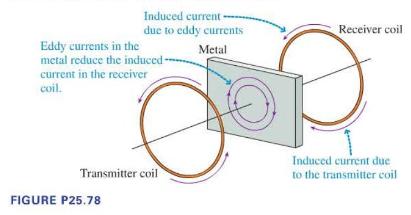
The metal detector will not detect insulators becauseA. Insulators block magnetic fields.B. No eddy current can be produced in an insulator.C. No emf can be produced in an insulator.D. An insulator will increase the field at the receiver.Metal detectors use induced currents to sense the presence of
A metal detector can detect the presence of metal screws used to repair a broken bone inside the body. This tells us that A. The screws are made of magnetic materials.B. The tissues of the body are conducting.C. The magnetic fields of the device can penetrate the tissues of the body.D. The screws
Which of the following changes would not produce a larger eddy current in the metal?A. Increasing the frequency of the oscillating current in the transmitter coilB. Increasing the magnitude of the oscillating current in the transmitter coilC. Increasing the resistivity of the metalD. Decreasing the
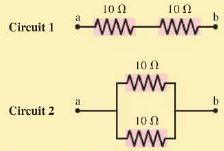
Circuit 1 and circuit 2 at right each has a Circuit 1 combination of resistors connected between points a and b. Which circuit has the greater equivalent resistance between points a and b?A. Circuit 1B. Circuit 2C. Both circuits have the same resistance. Circuit 1 10 102 b wwww Circuit 2 102 ww
An AC current with a peak value of 1.0 A passes through bulb A. A DC current of 1.0 A passes through an identical bulb B. Which bulb is brighter?A. Bulb AB. Bulb BC. Both bulbs are equally bright.
Each of the transformers shown here has its primary connected to a 120 V AC power supply and its secondary connected to a 1000 flload resistor. Rank the transformers, from highest to lowest, by the rms voltage they create across the resistor. 500 turns 100 turns 400 turns 200 turns 300 turns 50
Rank the following four devices by the energy they use for the time period given, from highest to lowest:A. Electric blanket (60 W) used for 8 hB. Flat-screen television (120 W) for 3 hC. Whole-house fan (250 W) for 8 hD. Air conditioner (1000 W) for 3 h
Suppose a current enters the body at one point and exits at another. Using the model of resistance of the body presented in Figure 26.13 rank the following current paths in terms of resistance, from highest to lowest. Assume that the skin resistance is zero.A. Right hand to left handB. Right hand
A capacitor is attached to an AC voltage source. Which change will result in a doubling of the current?A. Halving the voltage and doubling the frequencyB. Doubling the frequencyC. Halving the frequencyD. Doubling the voltage and halving the frequency
An inductor is attached to an AC voltage source. Which change will result in a halving of the current?A. Halving the voltage and doubling the frequencyB. Doubling the frequencyC. Halving the frequencyD. Doubling the voltage and halving the frequency
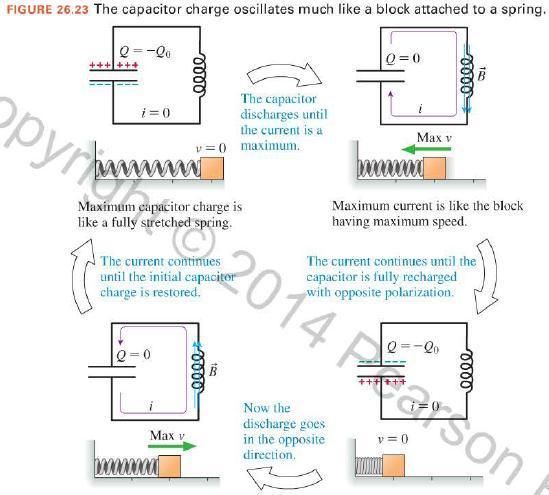
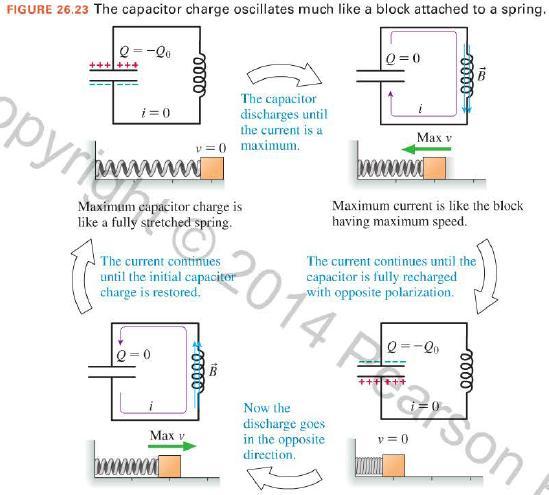
Consider the oscillation circuit shown in Figure 26.23. During the portion of the cycle when the capacitor's top plate is positive and the amount of charge is increasing, the current through the inductor isA. Clockwise and increasing.B. Clockwise and decreasing.C. Zero.D. Counterclockwise and
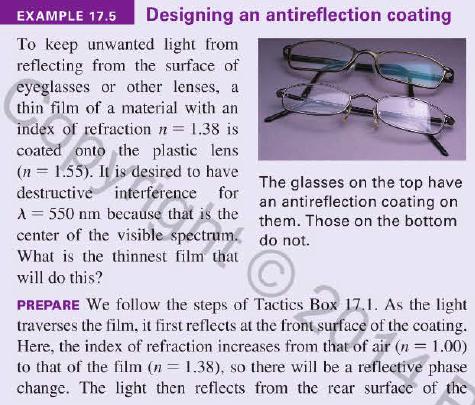
Example 17.5 showed that a thin film whose thickness is one quarter of the wavelength of light in the film serves as an antireflection coating when coated on glass. In Example 17.5, \(n_{\text {film }}n_{\text {glass }}\) were used instead, would the film still serve as an antireflection coating?
Give a specific example of a process that has the energy changes and transfers described. (For example, if the question states " \(\Delta E_{\mathrm{th}}>0, W=0\)," you are to describe a process that has an increase in thermal energy and no transfer of energy by work. You could write "Heating a pan
Give a specific example of a process that has the energy changes and transfers described. (For example, if the question states " \(\Delta E_{\mathrm{th}}>0, W=0\)," you are to describe a process that has an increase in thermal energy and no transfer of energy by work. You could write "Heating a pan
Give a specific example of a process that has the energy changes and transfers described. (For example, if the question states " \(\Delta E_{\mathrm{th}}>0, W=0\)," you are to describe a process that has an increase in thermal energy and no transfer of energy by work. You could write "Heating a pan
Give a specific example of a process that has the energy changes and transfers described. (For example, if the question states " \(\Delta E_{\mathrm{th}}>0, W=0\)," you are to describe a process that has an increase in thermal energy and no transfer of energy by work. You could write "Heating a pan
Give a specific example of a process that has the energy changes and transfers described. (For example, if the question states " \(\Delta E_{\mathrm{th}}>0, W=0\)," you are to describe a process that has an increase in thermal energy and no transfer of energy by work. You could write "Heating a pan
Give a specific example of a process that has the energy changes and transfers described. (For example, if the question states " \(\Delta E_{\mathrm{th}}>0, W=0\)," you are to describe a process that has an increase in thermal energy and no transfer of energy by work. You could write "Heating a pan
A proton with an initial speed of \(800,000 \mathrm{~m} / \mathrm{s}\) is brought to rest by an electric field.a. Did the proton move into a region of higher potential or lower potential?b. What was the potential difference that stopped the proton?c. What was the initial kinetic energy of the
\(\mathrm{A}+25 \mathrm{nC}\) charge is at the origin. How much farther from the charge is the \(2000 \mathrm{~V}\) equipotential surface than the \(3000 \mathrm{~V}\) surface?
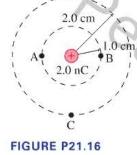
a. What is the electric potential at points A, B, and C in Figure P21.16?b. What is the potential energy of an electron at each of these points?c. What are the potential differences \(\Delta V_{\mathrm{AB}}\) and \(\Delta V_{\mathrm{BC}}\) ? 2.0 cm 1.0 cm B 2.0 nC FIGURE P21.16
A 1.0-cm-diameter sphere is charged to a potential of \(3400 \mathrm{~V}\). How much charge is on the sphere?
a. What is the potential difference between the terminals of an ordinary AA or AAA battery? (If you're not sure, find one and look at the label.)b. An AA battery is connected to a parallel-plate capacitor having \(4.0-\mathrm{cm}\)-diameter plates spaced \(2 \mathrm{~mm}\) apart. How much charge
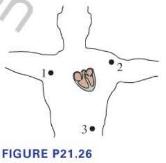
Three electrodes, \(1-3\), are attached to a patient as shown in Figure P21.26. During ventricular depolarization (see Figure 21.29), across which pair of electrodes is the magnitude of the potential difference likely to be the smallest? Explain. 3. FIGURE P21.26
A parallel-plate capacitor is connected to a battery and stores \(4.4 \mathrm{nC}\) of charge. Then, while the battery remains connected, a sheet of Teflon is inserted between the plates.a. Does the capacitor's charge increase or decrease?b. By how much does the charge change?
A parallel-plate capacitor is charged by a \(12.0 \mathrm{~V}\) battery, then the battery is removed.a. What is the potential difference between the plates after the battery is disconnected?b. What is the potential difference between the plates after a sheet of Teflon is inserted between them?
Two uncharged metal spheres, spaced \(15.0 \mathrm{~cm}\) apart, have a capacitance of \(24.0 \mathrm{pF}\). How much work would it take to move \(12.0 \mathrm{nC}\) of charge from one sphere to the other?
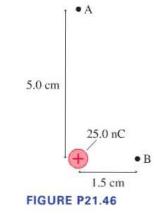
What is the change in electric potential energy of a \(3.0 \mathrm{nC}\) point charge when it is moved from point A to point B in Figure P21.46? 5.0 cm A 25.0 nC 1.5 cm FIGURE P21.46 B
A \(-50 \mathrm{nC}\) charged particle is in a uniform electric field \(\mathbb{N}\). \(\vec{E}=(10 \mathrm{~V} / \mathrm{m}\), east \()\). An external force moves the particle \(1.0 \mathrm{~m}\) north, then \(5.0 \mathrm{~m}\) east, then \(2.0 \mathrm{~m}\) south, and finally \(3.0 \mathrm{~m}\)
At a distance \(r\) from a point charge, the electric potential is\(3000 \mathrm{~V}\) and the magnitude of the electric field is \(2.0 \times 10^{5} \mathrm{~V} / \mathrm{m}\).a. What is the distance \(r\) ?b. What are the electric potential and the magnitude of the electric field at distance \(r
II The \(4000 \mathrm{~V}\) equipotential surface is \(10.0 \mathrm{~cm}\) farther from a positively charged particle than the \(5000 \mathrm{~V}\) equipotential surface. What is the charge on the particle?
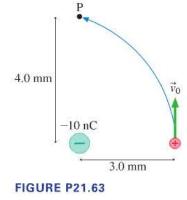
A proton follows the path shown in Figure P21.63. Its initial speed is \(v_{0}=1.9 \times 10^{6} \mathrm{~m} / \mathrm{s}\). What is the proton's speed as it passes through point \(\mathrm{P}\) ? 4.0 mm P -10 nC FIGURE P21.63 3.0 mm vo
Suppose that a molecular ion with charge \(-10 e\) is embedded within the 5.0-nm-thick cell membrane of a cell with membrane potential \(-70 \mathrm{mV}\). What is the electric force on the molecule?
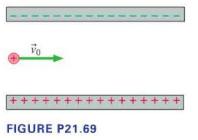
A parallel-plate capacitor is charged to \(5000 \mathrm{~V}\). A proton is fired into the center of the capacitor at a speed of \(3.0 \times 10^{5} \mathrm{~m} / \mathrm{s}\), as shown in Figure P21.69. The proton is deflected while inside the capacitor, and the plates are long enough that the
A proton is released from rest at the positive plate of a parallel-plate capacitor. It crosses the capacitor and reaches the negative plate with a speed of \(50,000 \mathrm{~m} / \mathrm{s}\). What will be the proton's final speed if the experiment is repeated with double the amount of charge on
In proton-beam therapy, a high-energy beam of protons is fired at a tumor. The protons come to rest in the tumor, depositing their kinetic energy and breaking apart the tumor's DNA, thus killing its cells. For one patient, it is desired that \(0.10 \mathrm{~J}\) of proton energy be deposited in a
Showing 1400 - 1500
of 4913
First
8
9
10
11
12
13
14
15
16
17
18
19
20
21
22
Last
Step by Step Answers

 Get 50% OFF
Claim Now
Get 50% OFF
Claim Now