New Semester
Started
Get
50% OFF
Study Help!
--h --m --s
Claim Now
Question Answers
Textbooks
Find textbooks, questions and answers
Oops, something went wrong!
Change your search query and then try again
S
Books
FREE
Study Help
Expert Questions
Accounting
General Management
Mathematics
Finance
Organizational Behaviour
Law
Physics
Operating System
Management Leadership
Sociology
Programming
Marketing
Database
Computer Network
Economics
Textbooks Solutions
Accounting
Managerial Accounting
Management Leadership
Cost Accounting
Statistics
Business Law
Corporate Finance
Finance
Economics
Auditing
Tutors
Online Tutors
Find a Tutor
Hire a Tutor
Become a Tutor
AI Tutor
AI Study Planner
NEW
Sell Books
Search
Search
Sign In
Register
study help
sciences
college physics reasoning
College Physics A Strategic Approach 3rd Edition Randall D. Knight, Brian Jones, Stuart Field - Solutions
Gamma rays are photons with very high energy.a. What is the wavelength of a gamma-ray photon with energy \(625 \mathrm{keV}\) ?b. How many visible-light photons with a wavelength of \(500 \mathrm{~nm}\) would you need to match the energy of this one gamma-ray photon?
A red laser with a wavelength of \(650 \mathrm{~nm}\) and a blue laser with a wavelength of \(450 \mathrm{~nm}\) emit laser beams with the same light power. What is the ratio of the red laser's photon emission rate (photons per second) to the blue laser's photon emission rate?
In a laser range-finding experiment, a pulse of laser light is fired toward an array of reflecting mirrors left on the moon by Apollo astronauts. By measuring the time it takes for the pulse to travel to the moon, reflect off the mirrors, and return to earth, scientists can measure the distance to
What is the kinetic energy in \(\mathrm{eV}\) of an electron whose de Broglie wavelength is \(10 \%\) of the wavelength of a photon of the same energy?
Electrons pass through a 200 -nm-diameter circular aperture,\(\mathbb{N T}\) forming a diffraction pattern on a detector \(1.2 \mathrm{~m}\) behind the aperture. What is the kinetic energy of the electrons if the width of the central maximum is \(0.37 \mathrm{~mm}\) ?
It is stated in the text that special relativity must be used to calculate the de Broglie wavelength of electrons in an electron microscope. Let us discover how much of an effect relativity has. Consider an electron accelerated through a potential difference of \(1.00 \times 10^{5} \mathrm{~V}\).a.
As an electron in a one-dimensional box of length \(0.600 \mathrm{~nm}\) jumps between two energy levels, a photon of energy \(8.36 \mathrm{eV}\) is emitted. What are the quantum numbers of the two levels?
Magnetic resonance is used in imaging; it is also a useful tool for analyzing chemical samples. Magnets for magnetic resonance experiments are often characterized by the proton resonance frequency they create. What is the field strength of an \(800 \mathrm{MHz}\) magnet?
The electron has a magnetic moment, so you can do magnetic resonance measurements on substances with unpaired electron spins. The electron has a magnetic moment \(\mu=9.3 \times 10^{-24} \mathrm{~J} / \mathrm{T}\). A sample is placed in a solenoid of length \(15 \mathrm{~cm}\) with 1200 turns of
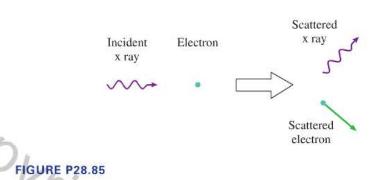
When the \(x\)-ray photon scatters from the electron,A. Its speed increases.B. Its speed decreases.C. Its speed stays the same.Further support for the photon model of electromagnetic waves comes from Compton scattering, in which \(\mathrm{x}\) rays scatter from electrons, changing direction and
When the \(x\)-ray photon scatters from the electron, A. Its wavelength increases. B. Its wavelength decreases.C. Its wavelength stays the same.Further support for the photon model of electromagnetic waves comes from Compton scattering, in which \(\mathrm{x}\) rays scatter from electrons,
When the electron is struck by the \(x\)-ray photon,A. Its de Broglie wavelength increases.B. Its de Broglie wavelength decreases.C. Its de Broglie wavelength stays the same.Further support for the photon model of electromagnetic waves comes from Compton scattering, in which \(\mathrm{x}\) rays
X-ray diffraction can also change the direction of a beam of \(x\) rays. Which statement offers the best comparison between Compton scattering and \(\mathrm{x}\)-ray diffraction?A. X-ray diffraction changes the wavelength of \(x\) rays; Compton scattering does not.B. Compton scattering changes the
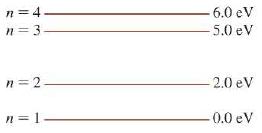
After the n = 1 to n = 3 absorption shown in the energy-level diagram to the left, which is a possible energy of an emitted photon?A. 1 eV B. 4eV C. 5 eV D. 9 eV
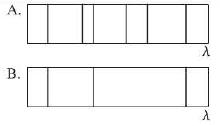
The black lines show the emission or absorption lines observed in two spectra of the same element. Which one is an emission spectrum and which is an absorption spectrum? . .
Carbon is the sixth element in the periodic table. How many protons and how many neutrons are there in a nucleus of the isotope 14C?
Can nuclei of the same element have different values of \(Z\) ? Of \(N\) ? Of \(A\) ? Can nuclei of different elements have the same values of \(Z\) ? Of \(N\) ? Of \(A\) ?
How many electrons, protons, and neutrons are contained in the following atoms or ions:(a) \({ }^{6} \mathrm{Li}\),(b) \({ }^{13} \mathrm{C}^{+}\), and(c) \({ }^{18} \mathrm{O}^{++}\)?
A photon with a wave-length of 410 nm has energy Ephoton = 3.0 eV. Do you expect to see a spectral line with λ = 410 nm in the emission spectrum of the atom represented by this energy-level diagram? If so, what transition or transitions will emit it?Do you expect to see a spectral line with λ=
An atom has four energy levels. How many spectral lines are seen in its emission spectrum? In its absorption spectrum? How many absorption lines?
How many electrons, protons, and neutrons are contained in the following atoms or ions:(a) \({ }^{9} \mathrm{Be}^{+}\),(b) \({ }^{12} \mathrm{C}\), and(c) \({ }^{15} \mathrm{~N}^{+++}\)?
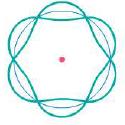
What is the quantum number of this hydrogen atom?
Write the symbol for an atom or ion with:a. four electrons, four protons, and five neutrons.b. six electrons, seven protons, and eight neutrons.
What are the quantum numbers n and l for a hydrogen atom with E (13.60/9) eV and L = V2h?
The \(n=3\) state of hydrogen has \(E_{3}=-1.51 \mathrm{eV}\).a. Why is the energy negative?b. What is the physical significance of the specific number \(1.51 \mathrm{eV}\) ?
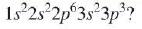
Which element has the ground-state electron configurationA. P B. A1 C. B D. Ge 1s2s22p63s3p?
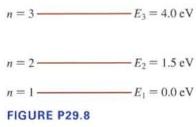
Figure P29.8 is an energylevel diagram for a simple atom. What wavelengths appear in the atom's(a) emission spectrum and(b) absorption spectrum?An electron with \(2.0 \mathrm{eV}\) of \(n=3 \longrightarrow E_{3}=4.0 \mathrm{eV}\)\(n=2 \longrightarrow E_{2}=1.5 \mathrm{eV}\)\(n=1 \longrightarrow
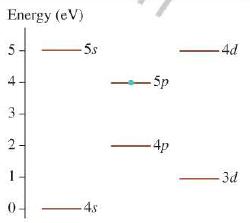
In this hypothetical atom, what is the photon energy £photon of the longest wavelength photons emitted by atoms in the 5p state?A. 1.0 eV B. 2.0eV C. 3.0 eV D. 4.0eV Energy (eV) S 5- 4 3- 2- 5s -5p -4p -4s 4d 3d
What are the \(n\) and \(l\) values of the following states of a hydrogen atom:(a) \(4 d\),(b) \(5 f\),(c) \(6 s\) ?
How would you label the hydrogen-atom states with the following \((n, l, m)\) quantum numbers:(a) \((4,3,0)\),(b) \((3,2,1)\),(c) \((3,2,-1)\) ?
A hydrogen atom is in a state with principal quantum number \(n=5\). What possible values of the orbital quantum number \(l\) could this atom have?
The allowed energies of a simple atom are \(0.0 \mathrm{eV}, 4.0 \mathrm{eV}\), and \(6.0 \mathrm{eV}\). An electron traveling at a speed of \(1.6 \times 10^{6} \mathrm{~m} / \mathrm{s}\) collisionally excites the atom. What are the minimum and maximum speeds the electron could have after the
In a multielectron atom, does a \(5 s\) electron have higher or lower energy than a \(4 f\) electron? Explain.
Do the following electron configurations represent a possible state of an element? If so, (i) identify the element and (ii) determine if this is the ground state or an excited state. If not, why not?a. \(1 s^{2} 2 s^{2} 2 p^{6} 3 s^{2}\)b. \(1 s^{2} 2 s^{2} 2 p^{7} 3 s\)c. \(1 s^{2} 2 s^{2} 2 p^{4}
Why is the section of the periodic table labeled as "transition elements" exactly 10 elements wide in all rows?
Infrared light with a wavelength of \(1870 \mathrm{~nm}\) is emitted from hydrogen. What are the quantum numbers of the two states involved in the transition that emits this light?
a. Which states of a hydrogen atom can be excited by a collision with an electron with kinetic energy \(K=12.5 \mathrm{eV}\) ? Explain.b. After the collision the atom is not in its ground state. What happens to the electron? (i) It bounces off with \(K>12.5 \mathrm{eV}\), (ii) It bounces off with
A hydrogen atom is excited from its ground state to the \(n=\) 4 state. The atom subsequently emits three photons, one of which has a wavelength of \(656 \mathrm{~nm}\). What are the wavelengths of the other two photons?
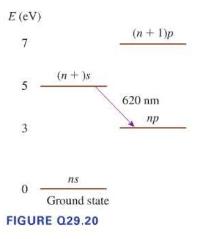
Figure Q29.20 shows the energy \(\quad E(\mathrm{eV})\) levels of a hypothetical atom. \(\quad(n+1) p\)a. What minimum kinetic energy (in \(\mathrm{eV}\) ) must an electron have to collisionally excite this atom and cause the emission of a \(620 \mathrm{~nm}\) photon? Explain.b. Can an electron
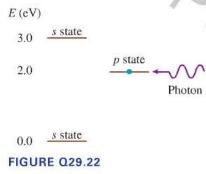
A 2.0 eV photon is incident on an atom in the \(p\) stat shown in the energy-level diagram in Figure Q29.22. Does the atom undergo an absorption transition, a stimulated emission transition, or neither? Explain. E (eV) 3.0 2.0 s state p state N 0.0 & state FIGURE Q29.22 Photon
The energy of a hydrogen atom is \(12.09 \mathrm{eV}\) above its ground-state energy. As a multiple of \(\hbar\), what is the largest angular momentum that this atom could have?
An electron collides with an atom in its ground state. The atom then emits a photon of energy \(E_{\text {photon }}\). In this process the change \(\Delta E_{\text {elec }}\) in the electron's energy is A. Greater than \(E_{\text {photon }}\).B. Greater than or equal to \(E_{\text {photon }}\).C.
How many states are in the \(l=4\) subshell?A. 8 B. 9 C. 16 D. 18 E. 22
The angular momentum of a hydrogen atom is \(4.70 \times 10^{-34} \mathrm{~J} \cdot \mathrm{s}\). What is the minimum energy, in \(\mathrm{eV}\), that this atom could have?
What is the ground-state electron configuration of calcium \((Z=20)\) ?A. \(1 s^{2} 2 s^{2} 2 p^{6} 3 s^{2} 3 p^{8}\)B. \(1 s^{2} 2 s^{2} 2 p^{6} 3 s^{2} 3 p^{6} 4 s^{1} 4 p^{1}\)C. \(1 s^{2} 2 s^{2} 2 p^{6} 3 s^{2} 3 p^{6} 4 s^{2}\)D. \(1 s^{2} 2 s^{2} 2 p^{6} 3 s^{2} 3 p^{6} 4 p^{2}\)
The energy of a hydrogen atom is \(-3.40 \mathrm{eV}\). What is the electron's kinetic energy?A. \(1.70 \mathrm{eV}\)B. \(2.62 \mathrm{eV}\)C. \(3.40 \mathrm{eV}\)\(\begin{array}{ll}\text { D. } 5.73 \mathrm{eV} & \text { E. } 6.80 \mathrm{eV}\end{array}\)
Identify the element for each of these electron configurations. Then determine whether this configuration is the ground state or an excited state.a. \(1 s^{2} 2 s^{2} 2 p^{5}\)b. \(1 s^{2} 2 s^{2} 2 p^{6} 3 s^{2} 3 p^{6} 3 d^{10} 4 s^{2} 4 p\)
a. With what element is the \(3 s\) subshell first completely filled?b. With what element is the \(5 d\) subshell first half filled?
Identify the element for each of these electron configurations. Then determine whether this configuration is the ground state or an excited state.a. \(1 s^{2} 2 s^{2} 2 p^{6} 3 s^{2} 3 p^{6} 4 s^{2} 3 d^{9}\)b. \(1 s^{2} 2 s^{2} 2 p^{6} 3 s^{2} 3 p^{6} 4 s^{2} 3 d^{10} 4 p^{6} 5 s^{2} 4 d^{10} 5
A "soft x-ray" photon with an energy of \(41.8 \mathrm{eV}\) is absorbed by a hydrogen atom in its ground state, knocking the atom's electron out. What is the speed of the electron as it leaves the atom?A. \(1.84 \times 10^{5} \mathrm{~m} / \mathrm{s}\)B. \(3.08 \times 10^{5} \mathrm{~m} /
Explain what is wrong with these electron configurations:a. \(1 s^{2} 2 s^{2} 2 p^{8} 3 s^{2} 3 p^{4}\)b. \(1 s^{2} 2 s^{3} 2 p^{4}\)
Hydrogen gas absorbs light of wavelength \(103 \mathrm{~nm}\). Afterward, what wavelengths are seen in the emission spectrum?
a. Is a \(4 p \rightarrow 4 s\) transition allowed in sodium? If so, what is its wavelength? If not, why not?b. Is a \(3 d \rightarrow 4 s\) transition allowed in sodium? If so, what is its wavelength? If not, why not?
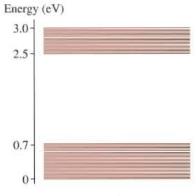
Figure P29.38 shows a molecular energy-level diagram. What are the longest and shortest wavelengths in(a) the molecule's absorption spectrum and(b) the molecule's fluorescence spectrum?Figure P29.38 Energy (eV) 3.0 2.5- 0.7- 01
In LASIK surgery, a laser is used to reshape the cornea of the eye to improve vision. The laser produces extremely short\(\mathbb{N T}\) pulses of light, each containing \(1.0 \mathrm{~mJ}\) of energy.a. In each pulse there are \(9.7 \times 10^{14}\) photons. What is the wavelength of the laser?b.
Two of the wavelengths emitted by a hydrogen atom are \(102.6 \mathrm{~nm}\) and \(1876 \mathrm{~nm}\).a. What are the Balmer formula \(n\) and \(m\) values for each of these wavelengths?b. For each of these wavelengths, is the light infrared, visible, or ultraviolet?
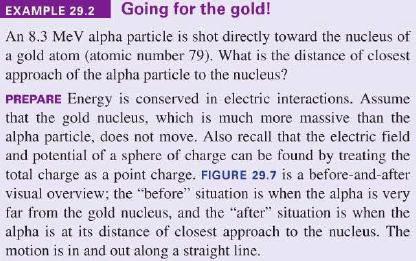
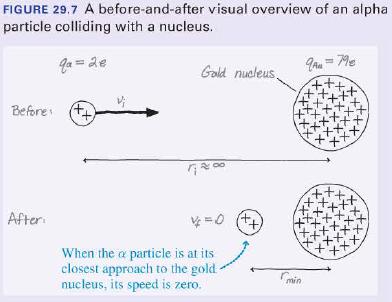
In Example 29.2 it was assumed that the initially stationary gold nucleus would remain motionless during a head-on collision with an \(8.3 \mathrm{MeV}\) alpha particle. What is the actual recoil speed of the gold nucleus after that elastic collision? Assume that the mass of a gold nucleus is
Consider the gold isotope \({ }^{197} \mathrm{Au}\).a. How many electrons, protons, and neutrons are in a neutral \({ }^{197} \mathrm{Au}\) atom?b. The gold nucleus has a diameter of \(14.0 \mathrm{fm}\). What is the density of matter in a gold nucleus?c. The density of lead is \(11,400
The diameter of an atom is \(1.2 \times 10^{-10} \mathrm{~m}\) and the diameter of its nucleus is \(1.0 \times 10^{-14} \mathrm{~m}\). What percent of the atom's volume is occupied by mass and what percent is empty space?
If the nucleus is a few \(\mathrm{fm}\) in diameter, the distance between the centers of two protons must be \(\approx 2 \mathrm{fm}\).a. Calculate the repulsive electric force between two protons that are \(2.0 \mathrm{fm}\) apart.b. Calculate the attractive gravitational force between two protons
A hydrogen atom in the ground state absorbs a \(12.75 \mathrm{eV}\) photon. Immediately after the absorption, the atom undergoes a quantum jump to the next-lowest energy level. What is the wavelength of the photon emitted in this quantum jump?
Potassium atom 1 , with a mass of \(6.47 \times 10^{-26} \mathrm{~kg}\), has a speed of \(1.30 \times 10^{4} \mathrm{~m} / \mathrm{s}\). It collides with potassium atom 2 that is at rest, exciting atom 2 to a state from which it emits a \(3.06 \mathrm{eV}\) photon as it returns to the ground state.
a. Calculate the orbital radius and the speed of an electron in both the \(n=99\) and the \(n=100\) states of hydrogen.b. Determine the orbital frequency of the electron in each of these states.c. Calculate the frequency of a photon emitted in a \(100 \rightarrow 99\) transition.d. Compare the
A particular emission line in the hydrogen spectrum has a wavelength of \(656.5 \mathrm{~nm}\). What are all possible transitions (e.g., \(6 d \rightarrow 2 s\) ) that could give rise to this emission?
Germicidal lamps are used to sterilize tools in biological and medical facilities. One type of germicidal lamp is a low-pressure mercury discharge tube, similar to a fluorescent lightbulb, that has been optimized to emit ultraviolet light with a wavelength of \(254 \mathrm{~nm}\). A 15-mm-diameter,
Fluorescence microscopy, is an important tool in modern cell biology. A variation on this technique depends on a phenomenon known as two-photon excitation. If two photons are absorbed simultaneously (i.e., within about \(10^{-16} \mathrm{~s}\) ), their energies can add. A molecule that is normally
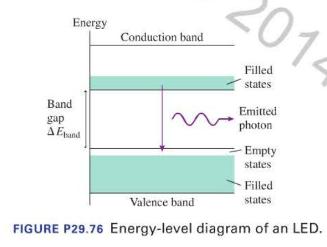
An LED emits green light. Increasing the size of the band gap could change the color of the emitted light to A. Red C. Yellow B. Orange D. Blue Light-emitting diodes, known by the acronym LED, produce the familiar green and red indicator lights used in a wide variety of consumer electronics. LEDs
Suppose the LED band gap is \(2.5 \mathrm{eV}\), which corresponds to a wavelength of \(500 \mathrm{~nm}\). Consider the possible electron transitions in Figure P29.76. \(500 \mathrm{~nm}\) is theA. Maximum wavelength of the LED.B. Average wavelength of the LED.C. Minimum wavelength of the
The same kind of semiconducting material used to make an LED can also be used to convert absorbed light into electrical energy, essentially operating as an LED in reverse. In this case, the absorption of a photon causes an electron transition from a filled state in the valence band to an unfilled
The efficiency of a light source is the percentage of its energy input that gets radiated as visible light. If some of the blue light in an LED is used to cause a fluorescent material to glow,A. The overall efficiency of the LED is increased.B. The overall efficiency of the LED does not change.C.
How many protons and how many neutrons are in(a) \({ }^{3} \mathrm{H}\),(b) \({ }^{40} \mathrm{Ar}\),(c) \({ }^{40} \mathrm{Ca}\), and(d) \({ }^{239} \mathrm{Pu}\) ?
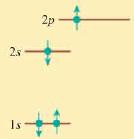
This energy-level diagram represents an atom with four electrons. What element is this? And is this the ground state of the atom or an excited state?A. Lithium, ground state B. Lithium, excited state C. Beryllium ground state D. Beryllium excited state E. Boron, ground state F. Boron, excited state
Given that \(m_{\mathrm{H}}=1.007825 \mathrm{u}\), is the mass of a hydrogen atom \({ }^{1} \mathrm{H}\) greater than, less than, or equal to \(1 / 12\) the mass of \(\mathrm{a}^{12} \mathrm{C}\) atom? Explain.
How many protons and how many neutrons are in(a) \({ }^{3} \mathrm{He}\),(b) \({ }^{20} \mathrm{Ne}\),(c) \({ }^{60} \mathrm{Co}\), and(d) \({ }^{226} \mathrm{Ra}\) ?
Three electrons orbit a neutral 6Li atom. How many electrons orbit a neutral 7Li atom?
a. Is there a stable \({ }_{3}^{30} \mathrm{Li}\) nucleus? Explain how you made your determination.b. Is there a stable \({ }_{92}^{184} \mathrm{U}\) nucleus? Explain how you made your determination.
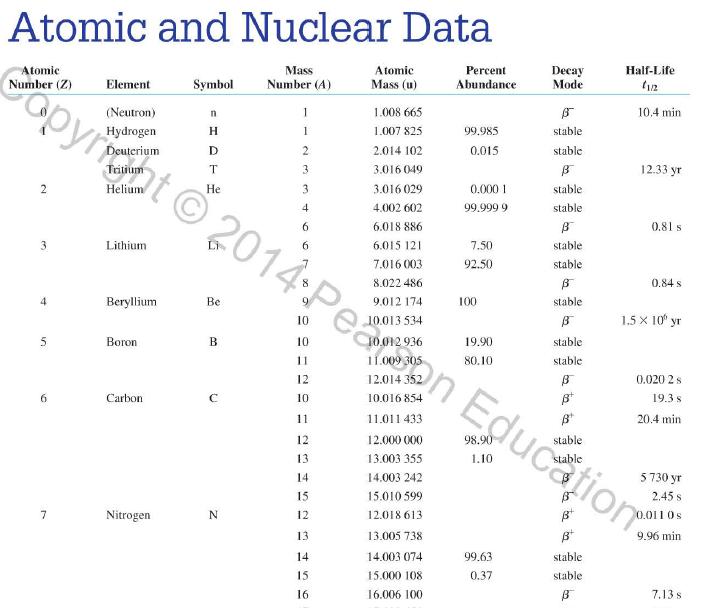
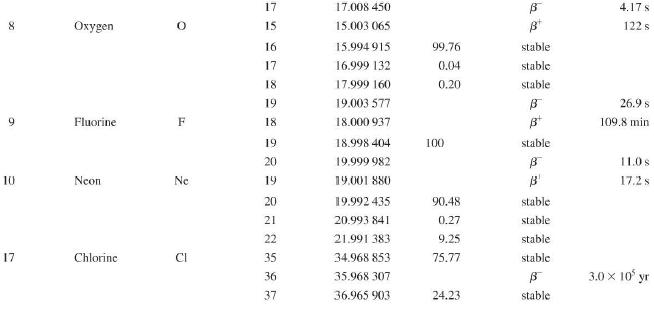
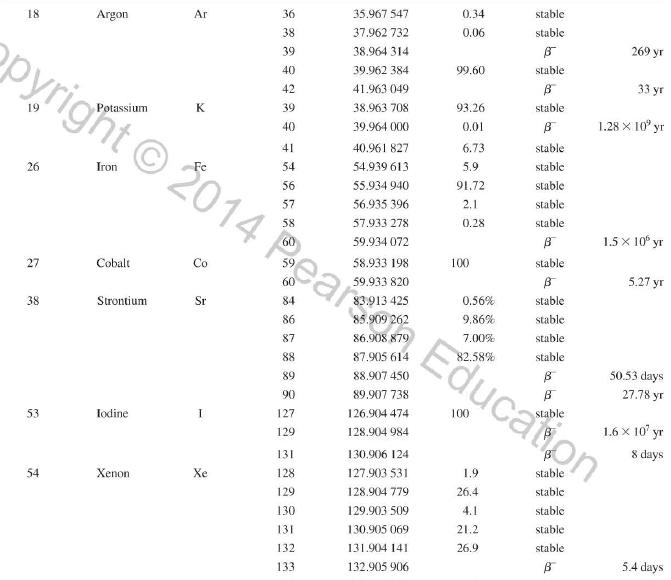
Use the data in Appendix D to calculate the chemical atomic mass of lithium, to two decimal places.Appendix D Atomic and Nuclear Data Mass Element Symbol Number (A) (Neutron) n H 1 D 2 T 3 3 4 6 3 Lithium Beryllium Be Copyright 2014 Pearson Education. Atomic Mass (u) Percent Abundance Decay
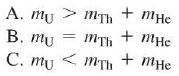
238U is long-lived but ultimately unstable; it will eventually spontaneously break into two fragments, a 4He nucleus and a 234Th nucleus, in a process called alpha decay, which we'll learn about in the next section. A great deal of energy is released in the process. What must be true about the
Use the data in Appendix D to calculate the chemical atomic mass of neon, to two decimal places.Appendix D Atomic and Nuclear Data Mass Element Symbol Number (A) (Neutron) n H 1 D 2 T 3 3 4 6 3 Lithium Beryllium Be Copyright 2014 Pearson Education. Atomic Mass (u) Percent Abundance Decay Half-Life
Rounding slightly, the nucleus \({ }^{3} \mathrm{He}\) has a binding energy of \(2.5 \mathrm{MeV} /\) nucleon and the nucleus \({ }^{6} \mathrm{Li}\) has a binding energy of \(5 \mathrm{MeV} /\) nucleon.a. What is the binding energy of \({ }^{3} \mathrm{He}\) ?b. What is the binding energy of \({
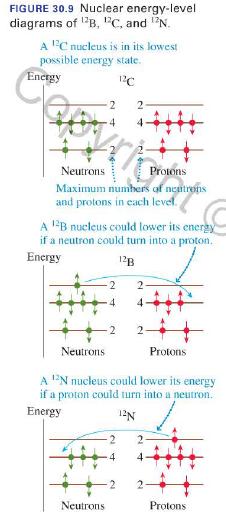
Based on the model of nuclear energy levels and transitions you have seen, would you expect 13C to be stable?
What are the energy equivalents (in \(\mathrm{MeV}\) ) of the mass of(a) an electron,(b) a proton,(c) a hydrogen atom, and(d) a helium atom?
The cobalt isotope 60Co (Z = 27) decays to the nickel isotope 60Ni (Z = 28). The decay process is A. Alpha decay.B. Beta-minus decay.C. Beta-plus decay.D. Gamma decay.
The chemical atomic mass of hydrogen, with the two stable isotopes \({ }^{1} \mathrm{H}\) and \({ }^{2} \mathrm{H}\) (deuterium), is \(1.00798 \mathrm{u}\). Use this value to determine the natural abundance of these two isotopes.
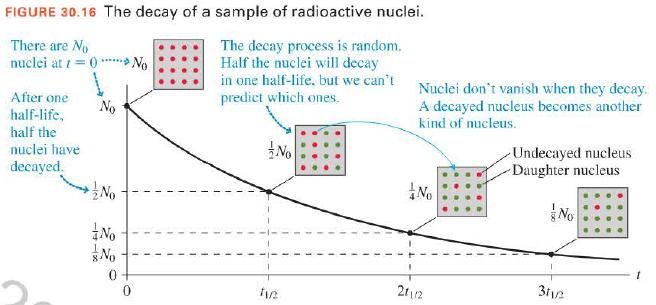
Nucleus A decays to nucleus B, with a half-life of 10 minutes.A pure sample of nucleus A contains 24,000 particles. Using what you've learned in Figure 30.16, after 30 minutes the sample will contain A. 3000 particles of nucleus B.B. 4000 particles of nucleus B.C. 12,000 particles of nucleus B.D.
A sample of 1000 radioactive atoms has a 10 minute half-life.How old is the sample when 750 atoms have decayed?A. 10 minutes B. 15 minutes C. 20 minutes D. 30 minutes
Calculate (in \(\mathrm{MeV}\) ) the total binding energy and the binding energy per nucleon(a) for \({ }^{40} \mathrm{Ar}\) and(b) for \({ }^{40} \mathrm{~K}\).
A patient ingests a radioactive isotope to treat a tumor. The isotope provides a dose of 0. 10 Gy. Which type of radiation will give the highest dose equivalent in Sv?A. Alpha particles B. Beta particles C. Gamma rays
A radioactive sample's half-life is \(1.0 \mathrm{~min}\), so each nucleus in the sample has a \(50 \%\) chance of undergoing a decay sometime between \(t=0\) and \(t=1 \mathrm{~min}\). One particular nucleus has not decayed at \(t=15 \mathrm{~min}\). What is the probability this nucleus will decay
Calculate (in \(\mathrm{MeV}\) ) the binding energy per nucleon for \({ }^{12} \mathrm{C}\) and \({ }^{13} \mathrm{C}\). Which is more tightly bound?
The material that formed the earth was created in a supernova explosion approximately 6 billion years ago. The two most common isotopes of uranium, \({ }^{238} \mathrm{U}\) and \({ }^{235} \mathrm{U}\), were created in roughly equal amounts. Today, the earth contains more than 100 times as much \({
Calculate (in \(\mathrm{MeV}\) ) the binding energy per nucleon for(a) \({ }^{14} \mathrm{~N}\),(b) \({ }^{56} \mathrm{Fe}\), and(c) \({ }^{207} \mathrm{~Pb}\).
An investigator receives a sample of a short-lived isotope that was created using a cyclotron. Explain why it is not possible to tell the age of an individual nucleus, but it is possible to determine the age of the sample.
When a nucleus of \({ }^{235} \mathrm{U}\) undergoes fission, it breaks into two smaller, more tightly bound fragments. Calculate the binding energy per nucleon for \({ }^{235} \mathrm{U}\) and for the fission product \({ }^{137} \mathrm{Cs}\).
When a nucleus of \({ }^{240} \mathrm{Pu}\) undergoes fission, it breaks into two smaller, more tightly bound fragments. Calculate the binding energy per nucleon for \({ }^{240} \mathrm{Pu}\) and for the fission product \({ }^{133} \mathrm{Xe}\).
Radiocarbon dating assumes that the abundance of \({ }^{14} \mathrm{C}\) in the environment has been constant. Suppose \({ }^{14} \mathrm{C}\) was less abundant 10,000 years ago than it is today. Would this cause a lab using radiocarbon dating to overestimate or underestimate the age of a
a. Compute the binding energy of the reactants and of the products in the nuclear fusion reactionb. What is the change in binding energy per nucleon in this reaction? 2H+LiHe++He
Draw an energy-level diagram, similar to Figure 30.9, for the protons and neutrons in \({ }^{11} \mathrm{Be}\). Do you expect this nucleus to be stable? FIGURE 30.9 Nuclear energy-level diagrams of 1B, 1C, and N. AC nucleus is in its lowest possible energy state. Energy 12C 2 2 4 Neutrons Protons
Identify the unknown \(\mathrm{X}\) in the following decays:a. \({ }_{86}^{222} \mathrm{Rn} \rightarrow{ }_{84}^{218} \mathrm{Po}+\mathrm{X}\)b. \({ }_{88}^{228} \mathrm{Ra} \rightarrow{ }_{89}^{228} \mathrm{Ac}+\mathrm{X}\)c. \({ }_{54}^{140} \mathrm{Xe} \rightarrow{ }_{55}^{140}
Are the following decays possible? If not, why not?a. \({ }_{90}^{232} \mathrm{Th} \rightarrow{ }_{92}^{236} \mathrm{U}+\alpha\)b. \({ }_{94}^{238} \mathrm{Pu} \rightarrow{ }_{92}^{236} \mathrm{U}+\alpha\)c. \({ }_{15}^{33} \mathrm{P} \rightarrow{ }_{16}^{32} \mathrm{~S}+\mathrm{e}^{-}\)
Showing 1000 - 1100
of 4913
First
4
5
6
7
8
9
10
11
12
13
14
15
16
17
18
Last
Step by Step Answers

 Get 50% OFF
Claim Now
Get 50% OFF
Claim Now